

Retail in 2077: Architecture as Interface for a Dematerialized Economy
Junqiao Li imagines a modular grid of VR portals and advertising surfaces where commerce dissolves into spatial experience.


What happens to the store when there is nothing left to sell? In a speculative future where virtual reality has absorbed the logic of commerce, the shelf, the display case, and the checkout counter all become relics. Architecture no longer houses products; it stages thresholds into digital worlds. Future Retail in 2077 takes this premise seriously, proposing a built environment stripped of merchandise and rebuilt as a continuous sensory interface, a spatial matrix where advertising surfaces, printed textures, and modular grids replace every convention of the retail interior.
The project is the work of Junqiao Li, who uses the year 2077 as a design provocation rather than a prediction. Published on uni.xyz, the proposal traces a timeline from the early bazaar to the e-commerce warehouse, then leaps forward to imagine what comes after the last mile has been delivered. The answer: experience itself becomes the commodity, and architecture becomes the medium through which it is accessed.
A Figure on the Highway: Commerce as Sensory Overload
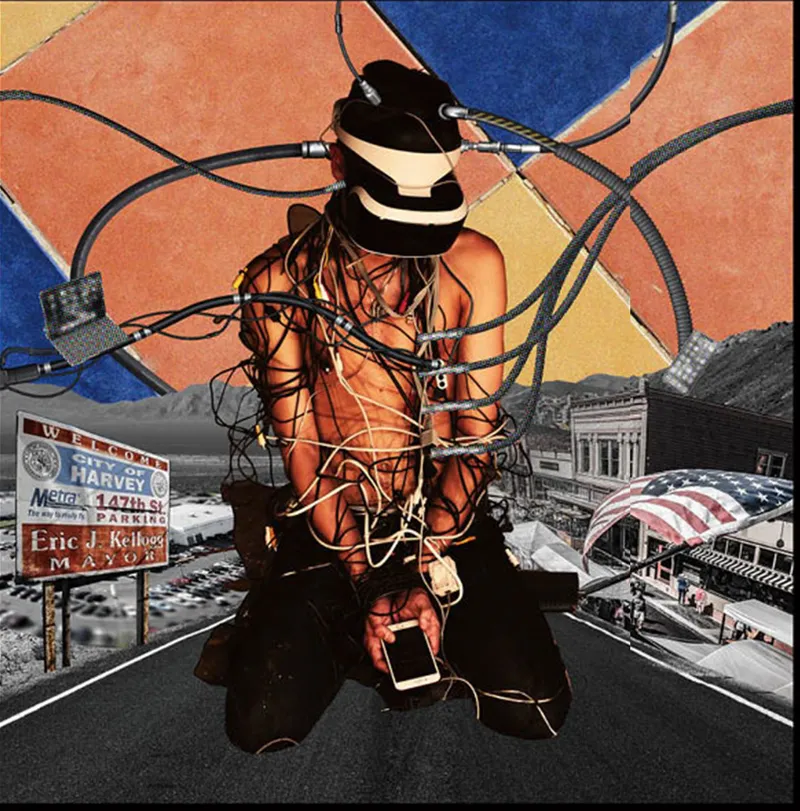
The opening collage sets the tone with visceral immediacy. A figure wrapped in cables and a VR headset stands on a highway flanked by roadside signage, the kind of visual clutter that already defines commercial corridors today. But here, the human body is literally tethered to the advertising landscape. The image collapses the distance between consumer and environment, suggesting that in 2077 there is no separation between the person navigating a retail zone and the sensory apparatus that surrounds them. Architecture is not a container you walk into; it is a condition you plug into.
Li's collage technique is deliberate. By compositing the figure against a recognizable infrastructure of signs and asphalt, the project anchors its speculative leap in a world we already inhabit. The highway is not some alien megastructure. It is the American strip mall pushed to its logical extreme, where the act of looking becomes the act of consuming.
Pixelated Streetscapes and Vertical Boom Systems
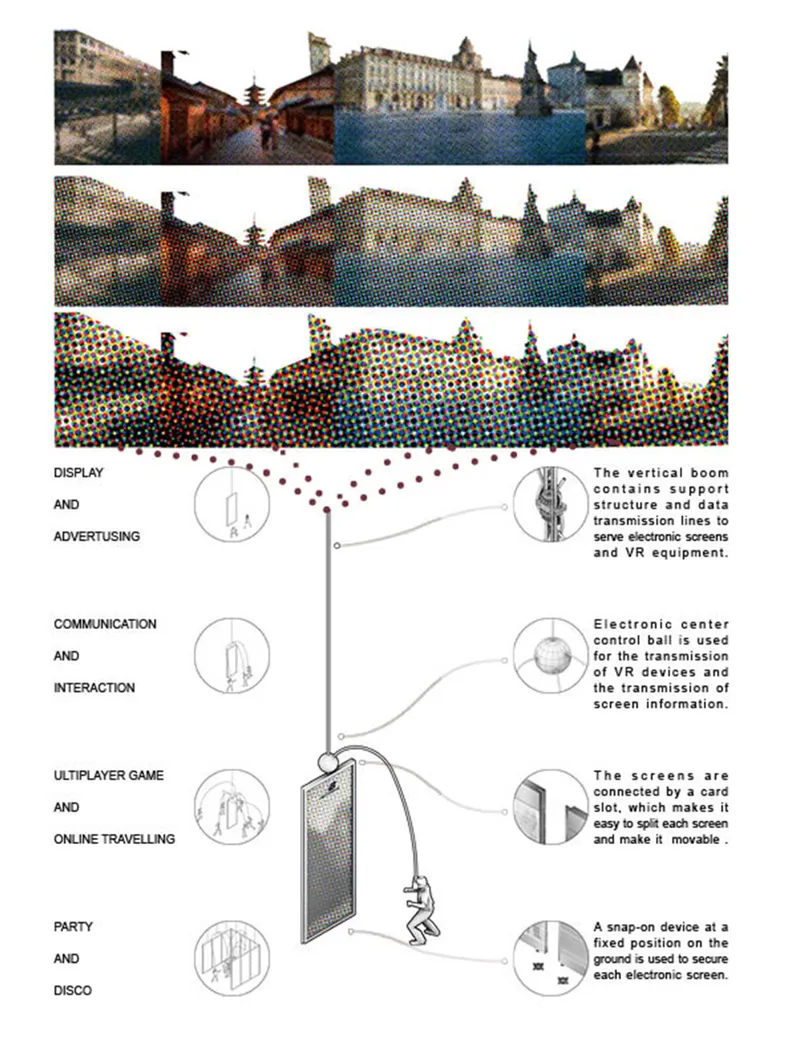
The second drawing shifts from collage to annotated diagram, illustrating a pixelated urban streetscape with callouts for vertical boom structures and electronic transmission systems. The street reads as a canyon of coded surfaces, where every facade is an active screen rather than a passive wall. Li annotates the drawing with the precision of a technical proposal, identifying the systems that would transform a conventional street section into an environment capable of broadcasting curated VR experiences to passersby.
What makes this diagram compelling is its refusal to aestheticize. The pixelation is not decorative; it represents the literal resolution of a world where digital content overlays physical form. Vertical booms function as infrastructure for holographic and electronic transmission, turning the public right-of-way into a distribution network for immersive content. The street becomes programmable, each segment capable of hosting a distinct digital universe triggered by proximity and movement.
Responsive Terrain: Holographic Projection Over Undulating Floors
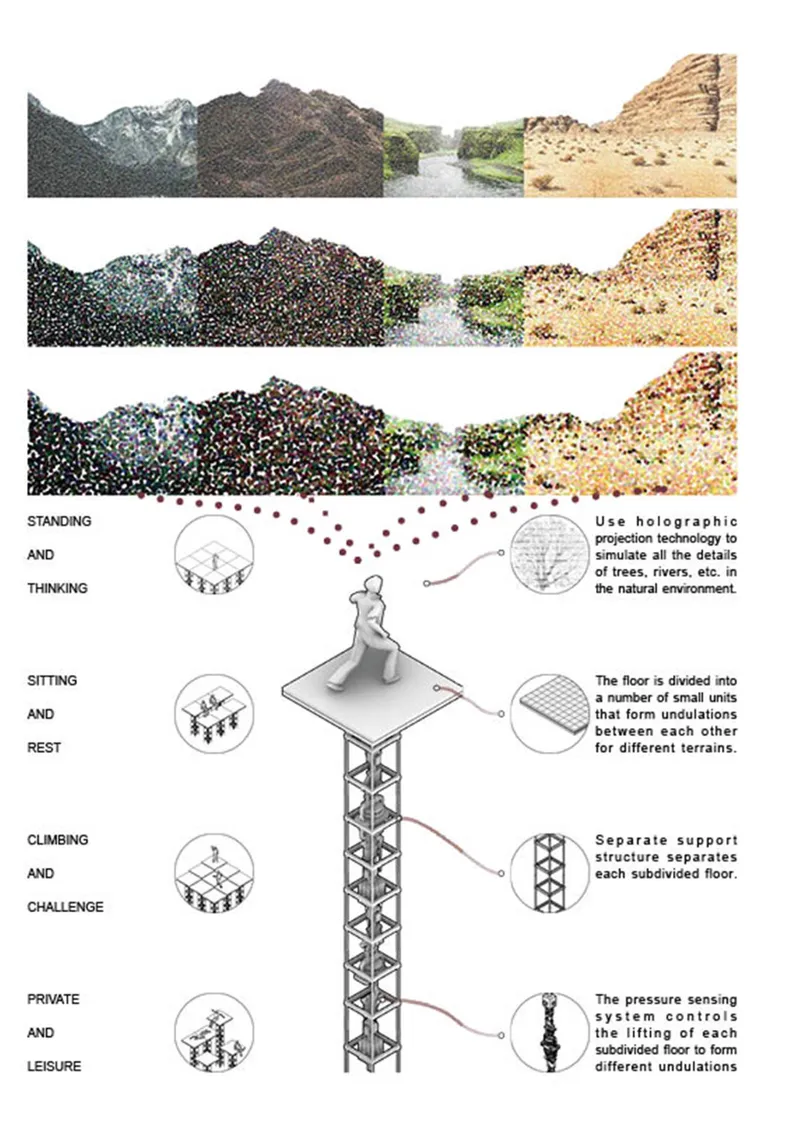
The third drawing introduces a radically different spatial register. Natural landscape sequences give way to annotations for holographic projection systems and responsive undulating floor structures. The ground plane itself becomes active, rising and falling to choreograph the visitor's bodily experience. Rather than a flat retail floor punctuated by fixtures, the surface warps into a topographic field that guides movement, controls sightlines, and modulates the emotional register of each zone.
Li frames this as the upper-level experience of the retail environment, a surreal terrain of atmospheric gradients and pixelated textures. Holographic projections replace product displays entirely. The tactile quality of the floor and the visual depth of the projections work in concert, turning the visitor's walk through the space into a participatory ritual. There is no browsing in the traditional sense. There is only drifting through curated sensory prompts that lead toward VR portals, each one an entrance into an alternate commercial world.
The Infinite Grid: A Programmable Spatial Matrix
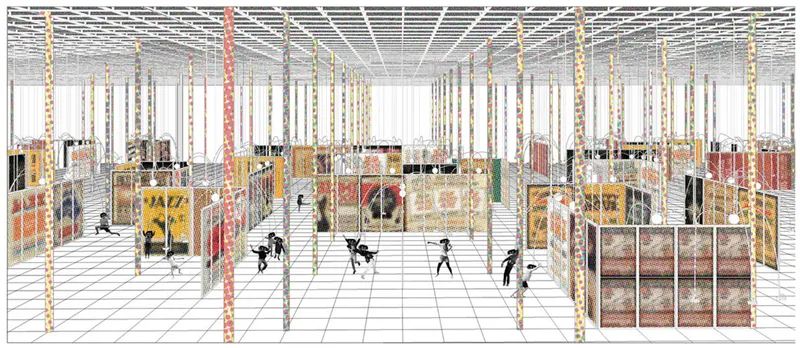
The axonometric drawing crystallizes the project's architectural logic. A vast gridded interior of uniformly distributed vertical columns contains scattered figures moving among modular exhibition boxes. There are no walls, no storefronts, no branded thresholds. The grid is neutral, endless, and fundamentally open. Circulation is not prescribed; visitors drift and choose their own paths through a field of potential experiences. Each modular box can host a different VR environment, making the architecture itself reprogrammable without physical alteration.
The drawing's strength lies in its restraint. By reducing the architectural language to columns and boxes on a repeating module, Li argues that the richness of future retail lies not in formal complexity but in the digital content layered onto a minimal framework. The printed advertising textures that wrap surfaces become the true skin of architecture, replacing shelving, signage, and display logic with a single graphic surface that functions as both decoration and interface. The building does not express; it receives.
Why This Project Matters
Speculative projects are easy to dismiss as fantasy, but Future Retail in 2077 earns its provocation by grounding each leap in observable trends. The decline of physical retail, the rise of experiential marketing, the maturation of VR hardware: these are trajectories already in motion. Li's contribution is to ask what architecture does when these trajectories converge. The answer is not a building type but a spatial condition, one where the grid replaces the storefront and sensory choreography replaces the product display.
More importantly, the project reframes the architect's role. In a dematerialized economy, design is not about enclosing space for objects but about calibrating perception for experiences. The timeline from bazaar to VR portal is not merely historical illustration; it is a challenge to the discipline. If retail architecture has always adapted to the dominant mode of exchange, then the next adaptation demands that architects think less like builders and more like interface designers. Li's drawings suggest that this shift has already begun.
View the Full Project
About the Designers
Designer: Junqiao Li
Enter a Design Competition on uni.xyz
uni.xyz runs architecture and design competitions year-round that reward proposals with spatial conviction and real site intelligence.
Project credits: Retail in 2077 by Junqiao Li.




Popular Articles
Popular articles from the community


Riyadh For All: Intergenerational Urban Design for Active Aging in Rabat
Riyadh For All reimagines urban design in Rabat with intergenerational co-living, adaptive courtyards, and Moroccan cultural exchange today.

The Musturak Paradise: Senior Living Architecture for a Connected Future in Temara, Morocco
The Musturak Paradise reimagines senior living architecture in Temara via private homes, social spaces, culture, community, and shared care.

The Earth Pod: 3D Printed Homes for Resilient Refugee Communities
The Earth Pod reimagines refugee housing through 3D printed homes made from clay, combining resilience, self-sufficiency, and rapid shelter.

Conexión: Biophilic Design Reimagines High-Rise Living in Hong Kong
Conexión reimagines high-rise living in Hong Kong through biophilic design, green facades, shared spaces, daylight, water and nature within.


Similar Reads
You might also enjoy these articles
The Musturak Paradise: Senior Living Architecture for a Connected Future in Temara, Morocco
The Musturak Paradise reimagines senior living architecture in Temara via private homes, social spaces, culture, community, and shared care.

The Leaf Center: Cultural Center Architecture for Social Integration in Amsterdam
Cultural center architecture becomes a bridge at The Leaf Center, connecting international students with Amsterdam through art and exchange.
Conexión: Biophilic Design Reimagines High-Rise Living in Hong Kong
Conexión reimagines high-rise living in Hong Kong through biophilic design, green facades, shared spaces, daylight, water and nature within.

Wander to Wonder: Modular Playground Design for Children in Kutupalong Refugee Camp
Wander to Wonder uses modular playground design to create flexible, imaginative play spaces for children in Kutupalong refugee camp.
Explore Future of Retail Competitions
Discover active competitions in this discipline



Challenge to reimagine the Iron Throne


Photograph architecture without architects


Illustrate the lost glory of Angkor Wat - Render Challenge


Design challenge to reuse E-waste
Comments (0)
Please login or sign up to add comments
No comments yet. Be the first to comment!