
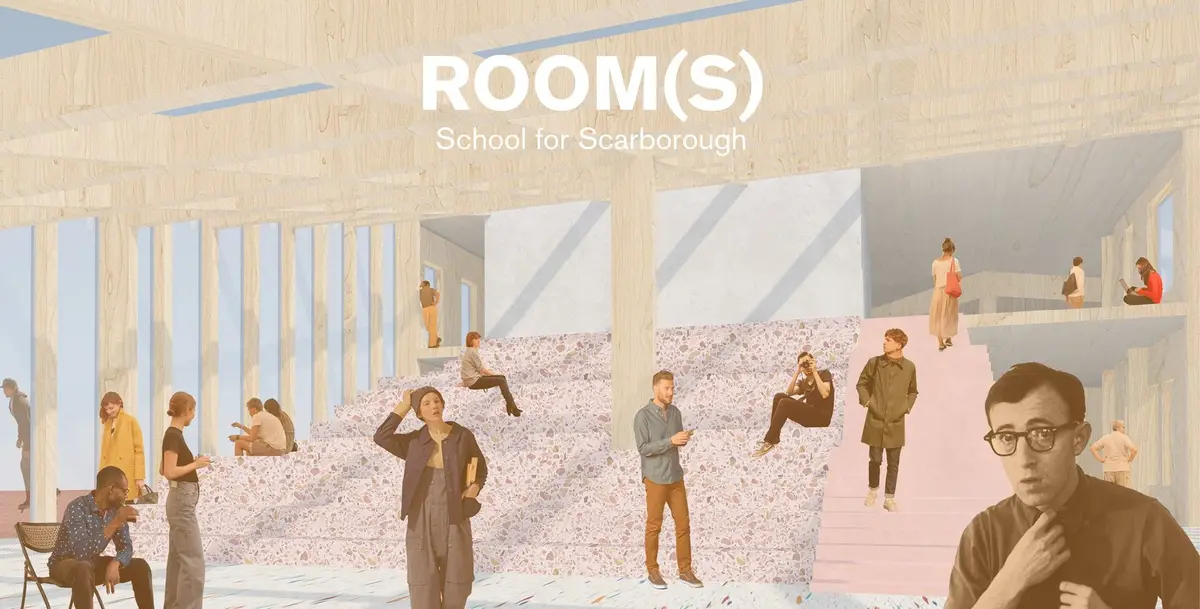
ROOM(S): A Scarborough School That Treats the Classroom as an Adjustable System
A shortlisted School of Thought 2020 entry that dissolves fixed classrooms into an open core of stepped platforms, modular grids and movable walls.


Most schools are still built as a corridor with boxes on either side, and the box is assumed to be the room where learning happens. ROOM(S) questions that assumption from the start. It asks whether a learning environment should stay fixed or evolve with the people who use it, and it answers with a spatial system rather than a set of classrooms. In this school, walls move, programmes share a grid, and the staircase works as a place to teach.
Designed by Ruven Benedict Berg and shortlisted in School of Thought 2020, the proposal is a school for Scarborough. Its site is a dense urban plot surrounded by retail developments and transport infrastructure, so the building cannot depend on a leafy campus for its identity. Berg treats this as an opportunity. The school opens outward and presents itself as a communal anchor for a neighbourhood whose public life is otherwise organised around shopping and transit.
A Grounded Base and a Lighter Volume Above the Red Plaza


The exterior renderings set out the project's dual architectural language. A corrugated white volume, two storeys high at the corner, sits beside a tall glazed wall, and the ribbed cladding makes a quiet reference to the site's industrial past. Framed windows are cut into this skin and give it scale without making it fragile. Next to it, the glazing expresses the lighter, more open part of the building, the side that invites people in. Berg presents the pairing as continuity between memory and transformation, and the renderings support that reading. Neither half tries to dominate the other.
The red brick paving does as much civic work as the facades. Students talk and walk across it, and two men play basketball at the corner, which suggests the ground plane belongs to the neighbourhood as well as to the pupils. That fits the brief Berg sets for himself. Sports facilities, cafeterias and community spaces are part of the programme so the building stays in use after school hours. The plaza is where that shared ownership becomes visible, and it is an unusually generous gesture on a site squeezed by commercial and transport uses.
Plywood Rooms That Users Rearrange Themselves
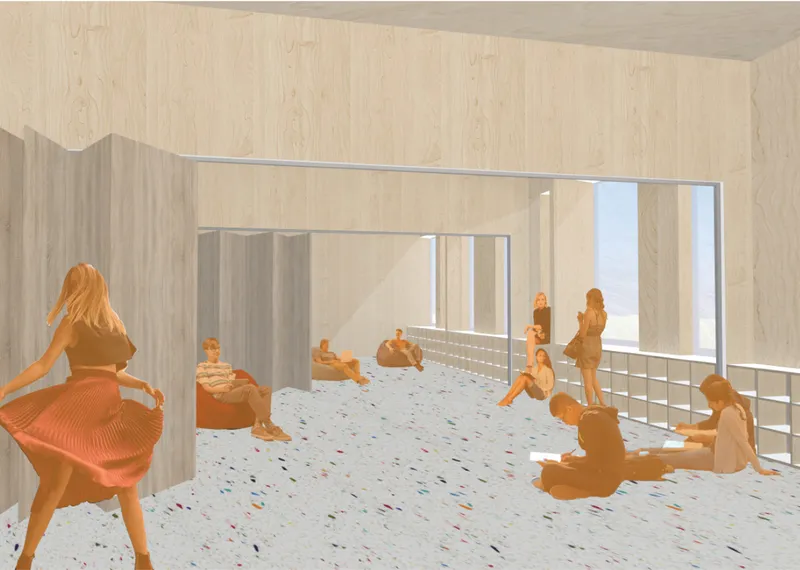
The interior rendering shows what flexibility feels like at the scale of a student. A plywood-lined room holds bean bags, a low shelf wall and speckled flooring, and a girl in a red skirt occupies it at her own pace. There are no rows of desks and no teaching wall. The low shelf divides the room without closing it off, which captures the project's central argument well: walls here are adjustable elements that open or close as spatial needs change, not permanent boundaries.
This is where Berg's idea of user agency becomes concrete. If students and teachers can reshape their surroundings to suit different modes of engagement, the building itself becomes a pedagogical tool. The warm timber surfaces matter too. They make a space designed to change feel stable and domestic, and that makes it easier for a child to take ownership of it.
An X-Shaped Plan Built Around a Cascading Open Core

The exploded axonometric shows the logic beneath the renderings. Colour-coded programme layers are stacked above ground floor, first floor, basement and structure plans of an X-shaped building. Science labs, arts workshops, research spaces and communal areas are distributed across a modular grid instead of being sealed into separate compartments. Because of this, spaces can expand, contract or merge. A structured lesson and an informal gathering can sit side by side, and the building can absorb new pedagogies without major reconstruction.
At the centre of this organisation is the open core, a sequence of cascading platforms and stepped seating that serves at once as circulation, social hub and informal learning environment. Berg's sharpest move is to give the staircase a role in teaching. It becomes a stage for observation, spontaneous interaction and peer-to-peer learning. The X-shaped plan seems designed to feed this core, with wings reaching into the site and every route returning to the shared middle. The school reads less as a set of zones and more as what Berg calls a learning landscape, a continuous field where boundaries dissolve.
Why This Project Matters
Flexible learning has become a common phrase in school design, and it often amounts to little more than a folding partition. ROOM(S) takes the idea further and builds it into every scale of the project. It appears in the modular grid that organises programme, in the stepped core that turns movement into a place to stay, in the movable walls inside each room, and in a ground plane that serves the neighbourhood as readily as the school. Each layer supports the same argument: learning happens everywhere, not only inside enclosed rooms.
Equally important is where the school sits. Placing an open, civic-minded building among retail and transport infrastructure in Scarborough is a statement about what a school owes its surroundings. Berg's proposal suggests that the most resilient educational buildings are the ones that refuse to fix their own use. They keep enough slack in plan and section that students, teachers and neighbours can continue to rewrite them over time.
View the Full Project
About the Designers
Designer: Ruven Benedict Berg
Enter a Design Competition on uni.xyz
uni.xyz runs architecture and design competitions year-round that reward proposals with spatial conviction and real site intelligence.
Project credits: ROOM(S) – School for Scarborough, by Ruven Benedict Berg School of Thought 2020 (uni.xyz).


Popular Articles
Popular articles from the community


The Amber Palace Opera: A Geological Fiction Surfaces on Tallinn's Baltic Waterfront
Pierre Brillard reimagines a Baltic legend as a public landscape, opera house, and waterfront promenade rooted in Tallinn's coastal identity.


Cube Design Draws an Ecological Corridor Between Two Shenzhen Hills with the Nankai Building
Beside Shenzhen's container docks, the Nankai Building pairs stacked balconies with a climbing green screen to connect two hillsides across its height.

graciastudio Turns a Viewless Tijuana Lot Inward Around a Courtyard of Concrete, Timber and Trees
In Tijuana, Jorge Gracia's GA2 House stacks a timber-clad private floor over exposed concrete and replaces a missing view with a planted interior patio.

Singing Woman: An Opera House That Performs Before the Curtain Rises
Ovidiu Cristian Pavel's conceptual opera house translates Estonia's choral identity into a sculpted waterfront landmark facing the Baltic Sea.

Similar Reads
You might also enjoy these articles
Healing Façade: A Modular Chapel System That Restores Ethiopia's Sacred Forests
Winner of the Eco-Chapel competition, this circular timber façade collects water from air to rebuild soil and reforest degraded Ethiopian landscapes.
Kaffeebühnen: Where Coffee Shop Architecture Becomes a Civic Stage in Vienna
A linear sequence of timber boxes, transparent shells, and open yards turns the Viennese café tradition into a public performance space.
Eco Chapel: A Modular Forest Pavilion That Grows Like the Landscape It Protects
Hexagonal timber modules weave through existing trees, turning a chapel into a living system for prayer, education, and reforestation.


Urban Forest: A Vertical Ecosystem for 5,000 Workers in Singapore's Changi Business Park
Radially stacked pods and layered green decks turn a 7-acre plot into 47 acres of ecological workspace projected for 2040.

Explore Learning Spaces Competitions
Discover active competitions in this discipline

Challenge to design public laboratory

Challenge to reimagine the Iron Throne

Photograph architecture without architects

Illustrate the lost glory of Angkor Wat - Render Challenge
Comments (0)
Please login or sign up to add comments
No comments yet. Be the first to comment!