

STREAM School: Circulation and Terraced Landscape as the Curriculum for an Adaptive Toronto Campus
A Scarborough school organised around a central learning purpose zone, where green roofs, plazas and reconfigurable blocks turn movement into study.


Most schools treat the corridor as the space between lessons. STREAM School treats it as the lesson. The project argues that if education is shifting from fixed syllabi toward self-directed, interdisciplinary learning, the building has to stop behaving like a static container of classrooms and start acting as a participant: a sequence of pathways, terraces and shared rooms where students discover what they want to study simply by moving through it.
Designed by DO TO and Hai Mai-Ngoc, the proposal received an Honorable Mention in School Of Thought 2020. The site sits in Scarborough District, Toronto, a multicultural part of the city with strong public transport links. The designers frame their response around the progression from STEM to STEAM to STREAM, adding reading and the arts to science, technology, engineering and mathematics, and then translate that pedagogical layering into a campus of two organically shaped volumes joined by a central public plaza.
A Heavy Stone Mass Opened by a Banded Glass Drum
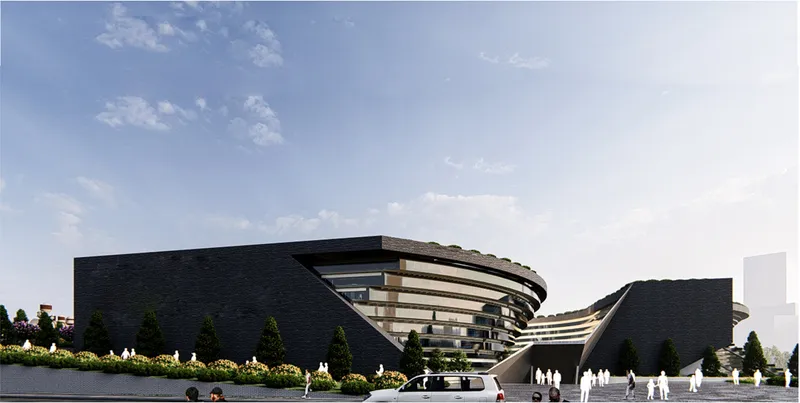
From the street, the school reads as a grounded, dark stone mass interrupted by a curved drum of banded glass. The contrast does useful work: the solid stone signals permanence and civic weight, while the glazed curve exposes activity inside and hints at the continuous circulation that organises the plan. The line of cypress trees and the pedestrians along the frontage suggest a building that expects to be walked past and walked into, not approached only at the start and end of the school day.
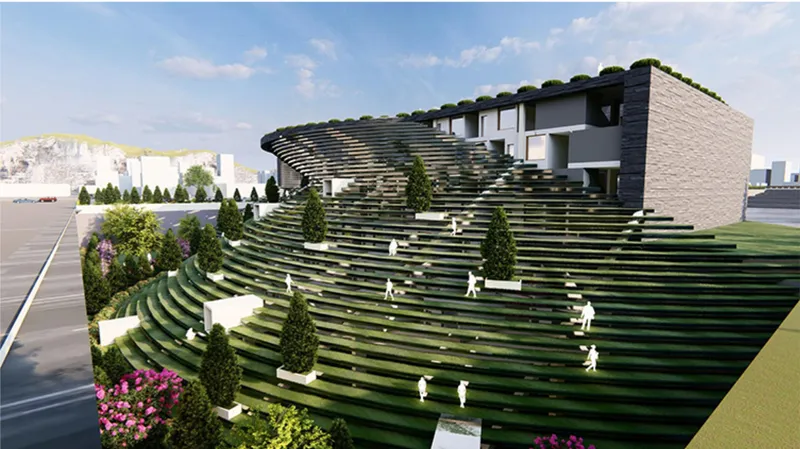
The second view shows how the architecture lets the ground rise to meet it. Grass steps curve up toward a stone-clad block with a planted roof edge, so the threshold between public plaza and school becomes a seating landscape rather than a gate. This matters for the project's central claim. The plaza is described as the social heart of the campus, linking indoor and outdoor activity, and the terraced steps make that link physical, giving students and neighbours a place to sit, gather and watch before they ever pass through a door.
Roofs and Sloped Facades That Extend the Classroom
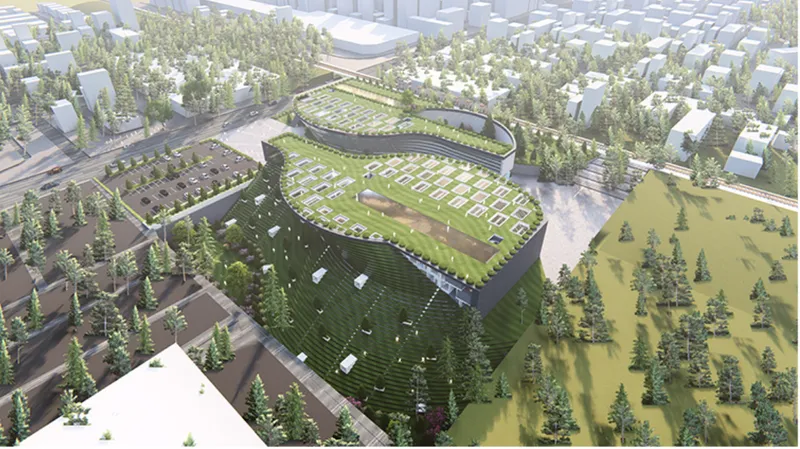
The aerial view clarifies the boldest move in the scheme: the roof is not a lid but a landscape. A grass-covered slope punctuated by skylights pulls daylight down into the learning spaces while offering a walkable surface above them. The designers position these terraced green roofs as outdoor classrooms, recreational zones and ecological systems at once, which is an ambitious overlap of uses. Where it succeeds is in refusing to separate environmental performance from pedagogy; the same surface that moderates the building's climate also becomes somewhere to teach about it.
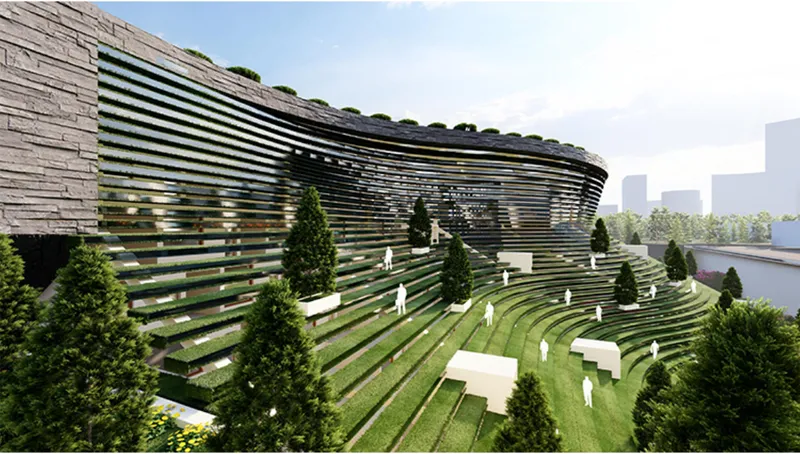
The curved facade of horizontal slats above stepped lawn terraces carries the idea down the building's edge. The slats soften the transition between the layered terraces and the enclosed interior, and the sweeping geometry keeps the eye moving, reinforcing the circulation-driven concept in elevation as well as in plan. The designers also note seasonal adaptability as a goal, an important qualification for a Toronto site, where the success of any outdoor classroom depends on how well it works beyond the warmer months.
The Learning Purpose Zone as an Interior Commons
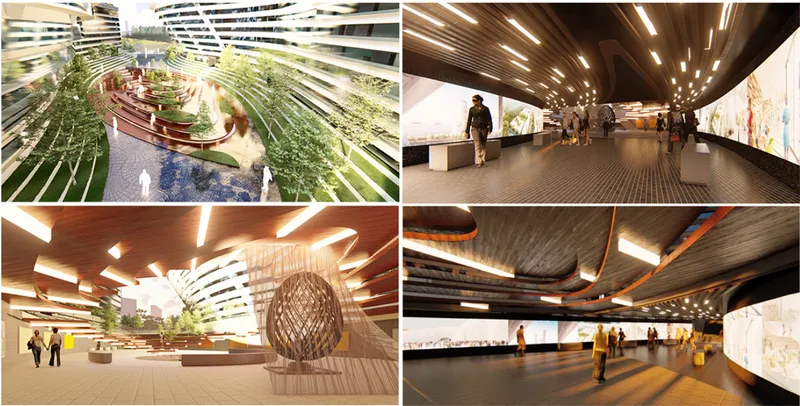
Inside, the project replaces the familiar double-loaded corridor with a central learning purpose zone: a hub combining study areas, exhibition spaces, community zones and gardens. The collage shows a planted atrium courtyard and galleries under timber ceilings with linear lights, with a woven spherical sculpture hanging as a focal point. These are spaces where student work can be displayed, where a planned group session and a chance encounter can happen within sight of each other, and where the boundary between formal and informal learning stays deliberately blurry.
Behind this commons sits the modular block system. Class blocks, auxiliary spaces and new units are designed to be reconfigured over time, and interior partitions allow rooms to shift between individual study, group collaboration and large-scale workshops. It is a pragmatic answer to an uncertain future: rather than predicting the next educational model, the building leaves room to absorb it. The strength of the atrium is that it gives these changing blocks a stable shared centre to orbit.
An Amphitheatre at the Top of the Learning Hierarchy
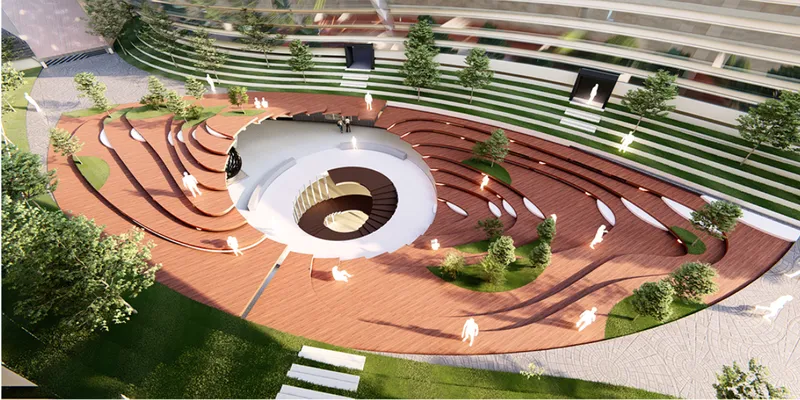
The top-down view of the terracotta-toned amphitheatre is where the project's spatial hierarchy lands most clearly. Curved steps wrap a circular opening with a spiral stair, ringed by grass terraces, so the largest communal space in the scheme is also a vertical connector. The designers organise functions from small personal learning environments up to large community-oriented spaces, and this amphitheatre sits at the generous end of that scale: a place for assemblies, performances and public events that can draw in the surrounding neighbourhood.
The spiral stair is a small but telling detail. It turns the most public room into a point of passage between levels, meaning students cross the communal heart of the school as part of their daily routes. That is the circulation-as-learning idea at its most concentrated: movement, gathering and spectatorship folded into one figure, with the warm terracotta surface setting it apart from the dark stone and green roofs around it.
Why This Project Matters
STREAM School is persuasive because it links a pedagogical argument to specific architectural moves. The call for students to choose their interests early and shape their own learning journeys becomes a building of continuous paths, an interior commons, reconfigurable blocks and roofs that double as classrooms. Many school proposals talk about flexibility in the abstract; this one gives it a plan, a section and a landscape strategy.
The open questions are the right ones for a competition entry to raise: how the outdoor terraces perform through a Scarborough winter, and how a modular system keeps its spatial clarity after years of reconfiguration. Still, the proposal makes a clear case that the spaces between rooms deserve as much design attention as the rooms themselves, and that a school can serve its wider community as a civic landscape rather than a sealed institution. For an Honorable Mention, that is a substantial contribution to the conversation about where learning actually happens.
View the Full Project
About the Designers
Designers: DO TO, Hai Mai-Ngoc
Enter a Design Competition on uni.xyz
uni.xyz runs architecture and design competitions year-round that reward proposals with spatial conviction and real site intelligence.
Project credits: STREAM School by DO TO, Hai Mai-Ngoc School Of Thought 2020 (uni.xyz).


Popular Articles
Popular articles from the community


David Ortega Stacks a Two-Story Mexico City Penthouse Around a Steel Stair and a Pergola-Shaded Roof Terrace
In Colonia Roma, a 300 m² penthouse uses oak joinery, a planted steel stair and a slatted roof pergola to make a new-build apartment feel like a house.

GROUP A Strips a 1969 Rotterdam Harbor Headquarters to Its Frame and Wraps It in Timber Louvers
In Rotterdam's M4H harbor district, Ferro Offices reuses a 1969 frame, adds one timber storey and reaches BREEAM-NL Outstanding.

longwave studio Reorganizes a 112 m² Tainan Apartment Around the Daily Routines of a Family and Two Cats
In Tainan, Taiwan, birch plywood, rust-red furniture and a freestanding plaster wall link arrival, storage, work and family life in one apartment.

U.GA Architects Wraps an Oval Rooftop Pool in Curved Board-Formed Concrete on Busan's Jeollidan-gil
In Busan's Jeonpo-dong, a 454 m² mixed-use block stacks a neighborhood facility, guest rooms and an oval rooftop pool inside spiraling concrete walls.

Similar Reads
You might also enjoy these articles
Healing Façade: A Modular Chapel System That Restores Ethiopia's Sacred Forests
Winner of the Eco-Chapel competition, this circular timber façade collects water from air to rebuild soil and reforest degraded Ethiopian landscapes.
Kaffeebühnen: Where Coffee Shop Architecture Becomes a Civic Stage in Vienna
A linear sequence of timber boxes, transparent shells, and open yards turns the Viennese café tradition into a public performance space.
Eco Chapel: A Modular Forest Pavilion That Grows Like the Landscape It Protects
Hexagonal timber modules weave through existing trees, turning a chapel into a living system for prayer, education, and reforestation.


Urban Forest: A Vertical Ecosystem for 5,000 Workers in Singapore's Changi Business Park
Radially stacked pods and layered green decks turn a 7-acre plot into 47 acres of ecological workspace projected for 2040.

Explore Mes School Of Architecture Competitions
Discover active competitions in this discipline

Challenge to design public laboratory

Challenge to reimagine the Iron Throne

Photograph architecture without architects

Illustrate the lost glory of Angkor Wat - Render Challenge
Comments (0)
Please login or sign up to add comments
No comments yet. Be the first to comment!