
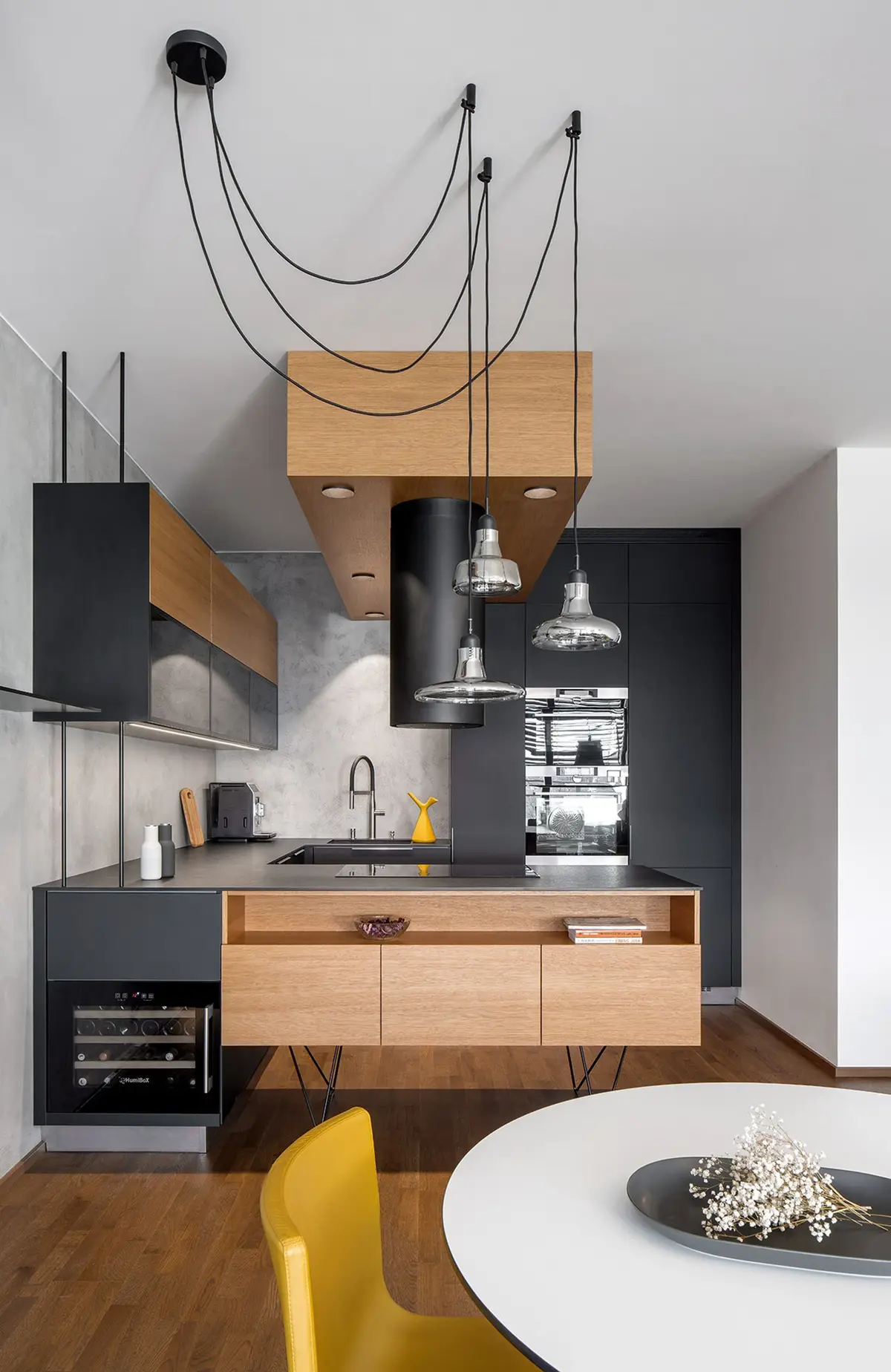
Black Kitchen: A Prague Apartment Where Steel, Oak and a Hidden Screen Do the Talking
A Jury Commendation at Interiors '20, Jana Stachova's Holešovice flat lets a black kitchen anchor the plan and swaps the TV for a drop-down screen.


Most apartments accumulate. This one subtracts. Black Kitchen starts from the premise that a home in a dense city should lower the volume, and it does so by narrowing the palette to anthracite, black and oak, then letting a dark kitchen hold the whole plan together. What is left after the editing is mostly architecture: surfaces, joints, light and a handful of objects allowed to matter.
Designed by Jana Stachova and awarded a Jury Commendation at Interiors '20, the project fits out a flat in a new residential building in Holešovice, Prague, for a young, active couple. The brief asked for a calm retreat from the city around it. Stachova answers with a disciplined material language, fully custom furniture and a living room that hides its technology until it is needed.
A Palette of Grey and Black, Interrupted by One Yellow Note
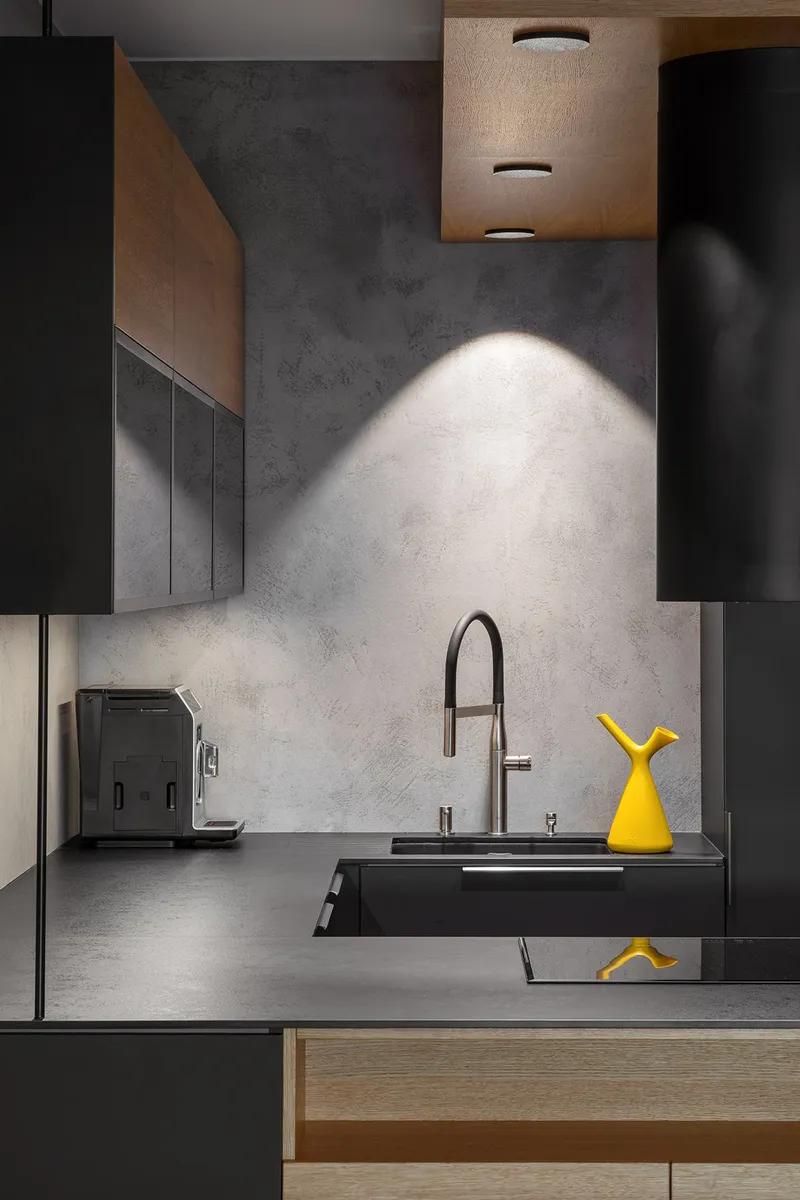
The kitchen corner sums up the material argument in a single frame. A black gooseneck faucet stands against a plastered, concrete-look wall, picked out by downlights, while a mustard yellow watering-can vase supplies the only bright colour. That accent is doing real work: in a scheme built on anthracite, black and muted neutrals, one controlled hit of yellow keeps restraint from tipping into monotony, and it recurs elsewhere in the flat so it reads as a decision rather than a stray object.
Steel runs through the apartment as a constant, appearing in structural moments and furniture details alike, and natural oak is set against it to warm the composition. Neither material is disguised. The cold, precise steel and the tactile oak keep their identities, which is why the interior feels layered instead of flat.
An Island That Hovers Beneath a Timber Ceiling Box
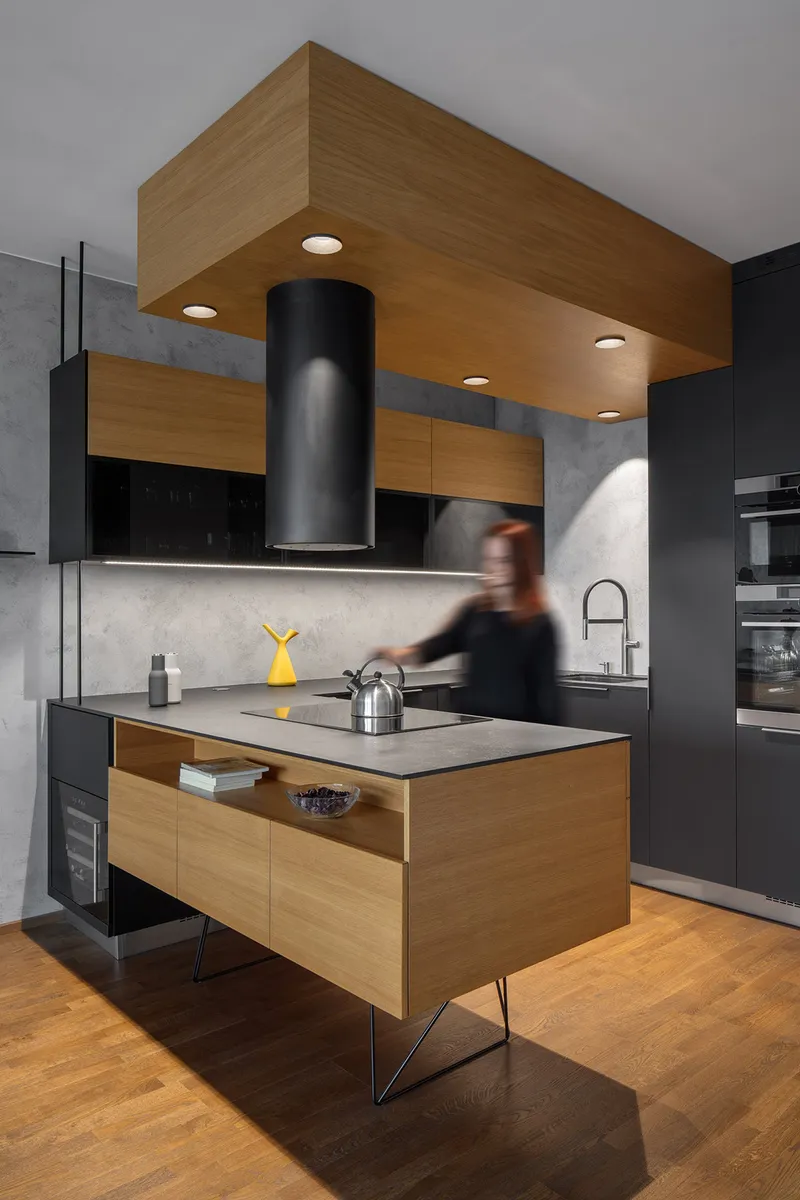
The black kitchen is the organising element of the plan, and the island is where its hierarchy becomes legible. A lighter oak base contrasts with the dark cabinetry, and slender steel legs lift it off the floor so the mass appears to float. Overhead, a suspended timber box defines the cooking zone without walls, a quiet way of marking territory in an open room.
Appliances are concealed and storage is integrated, so the dark run of units stays visually uninterrupted. That seamlessness depends on close coordination between designer and carpenter; Stachova's text credits the joinery as essential, and it shows. In a minimalist kitchen there is nowhere for a careless junction to hide.
The Bedroom as a Single Piece of Furniture
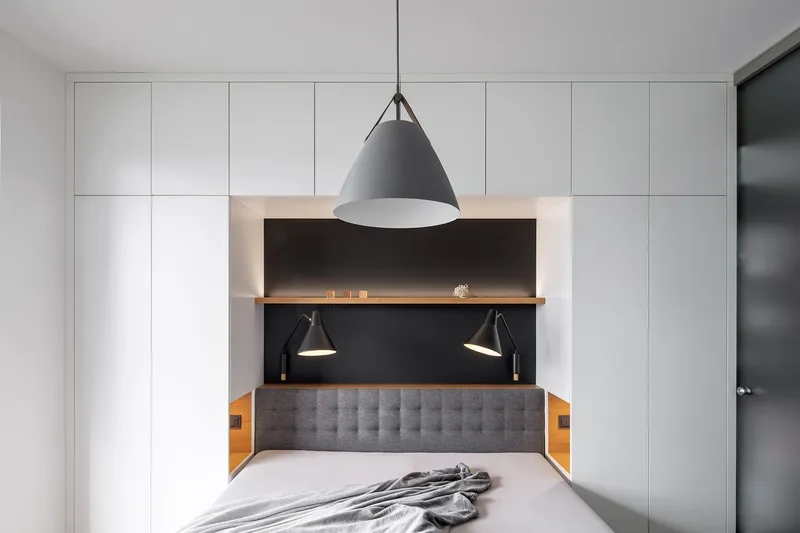
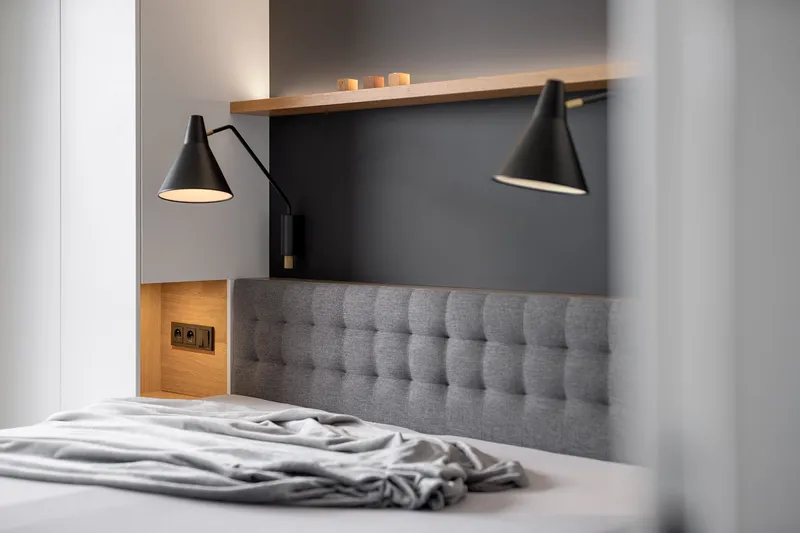
In the bedroom, the bed, library and bedside tables are composed as one system, forming a compact niche framed by white wardrobes. A grey pendant drops over the tufted headboard, set against a dark wall that pulls the space inward. The closer view shows how the detail scales down: black wall lamps, an oak shelf carrying small candles, a blanket left rumpled in the foreground.
This is the project's custom-furniture strategy at its most persuasive. Because every element is drawn for its exact position, the niche reads as part of the room's structure rather than as items placed inside it, and a modest footprint ends up holding sleeping, reading and storage without crowding.
A Living Room That Becomes a Cinema
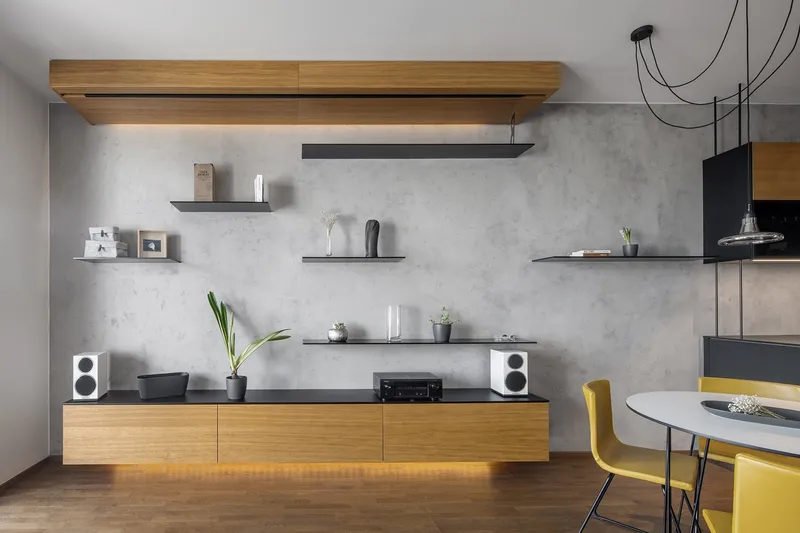
There is no television here, and that absence shapes the living wall. A floating oak sideboard with warm light glowing beneath it anchors the composition, flanked by black metal shelves, speakers and a plant, with yellow chairs carrying the accent colour into the room. The shelves follow the blade-like logic seen across the flat: thin steel insertions that store without adding bulk.
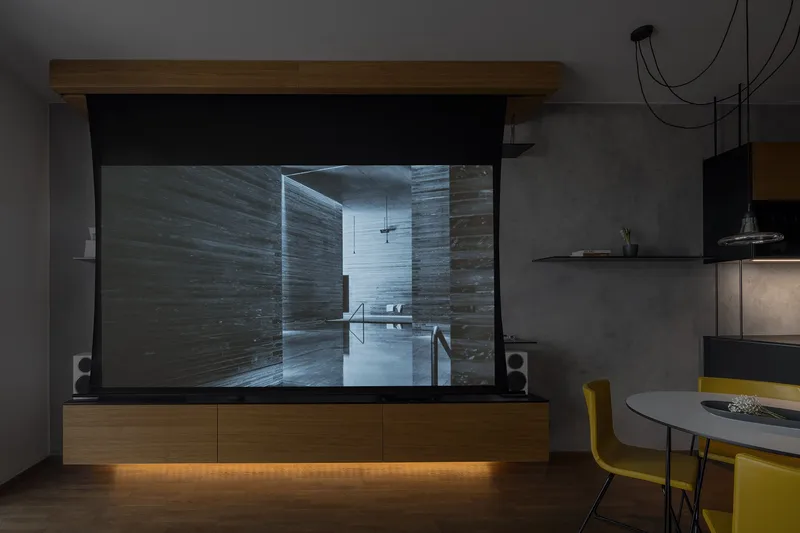
After dark, a projection screen lowers from the timber ceiling box over the sideboard, and the room dims into a home cinema. Combined with planned lighting and smart wiring, the move lets the space shift between everyday use and immersive viewing. Burying the technology rather than displaying it is a small decision with large consequences; the wall stays composed when the screen is away, and the evening ritual gains a sense of occasion.
Pegs, Drawers and Baskets: Putting the Hallway to Work
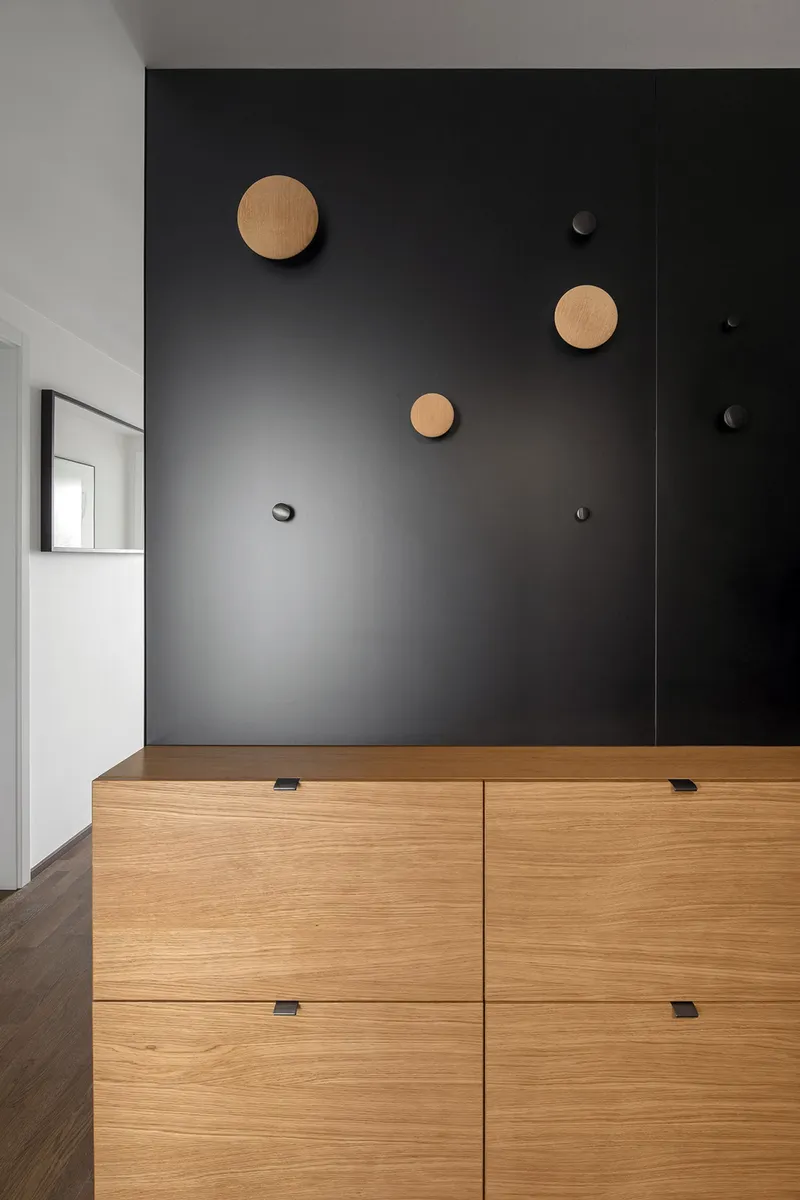
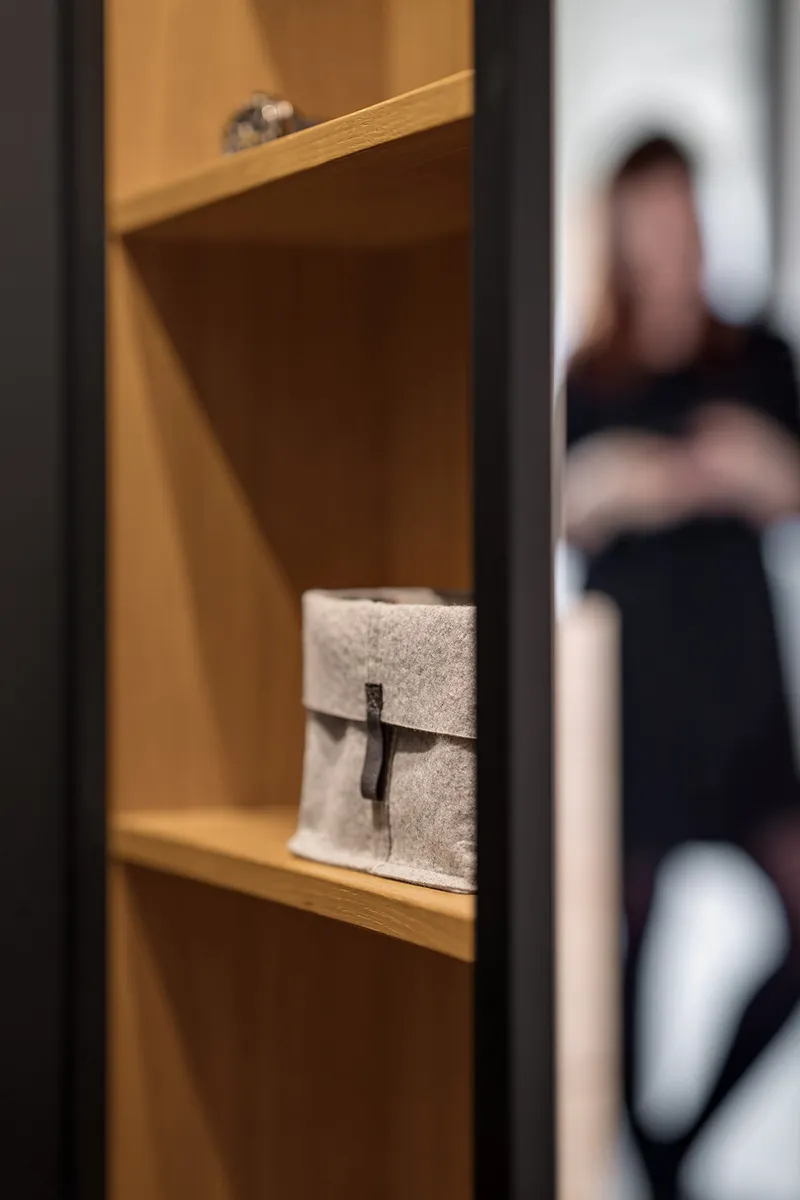
Transitional spaces are often where minimalism breaks down under coats, keys and bags. Stachova addresses this directly with integrated seating and storage in the hallway. A black wall panel studded with round oak and black pegs sits above an oak drawer unit, and side light falling across it turns a utilitarian corner into a graphic composition.
The close-up of an oak shelf holding a grey felt basket with a leather tab reveals the softer register of the scheme. Felt, leather and wood bring texture to a palette that could otherwise feel austere, and they make the storage something you want to touch.
Why This Project Matters
Black Kitchen demonstrates that restraint is a design method rather than a style. By limiting colour, letting steel and oak keep their character and drawing every piece of furniture for its place, Stachova produces a flat whose calm comes from coherence instead of emptiness. The single yellow accent and the hidden screen show a designer who knows exactly where to break her own rules.
For young designers working on compact urban homes, the lesson lies in integration. Storage becomes wall, the bed becomes a niche, the television disappears into a ceiling box, and the hallway earns its square metres. The Jury Commendation at Interiors '20 recognises a project in which careful detailing and close work with the maker carry the concept from drawing to built reality.
View the Full Project
About the Designers
Designer: Jana Stachova
Enter a Design Competition on uni.xyz
uni.xyz runs architecture and design competitions year-round that reward proposals with spatial conviction and real site intelligence.
Project credits: Black Kitchen by Jana Stachova Interiors '20 (uni.xyz).


Popular Articles
Popular articles from the community


Tsunami Convergenics: Turning Catastrophic Ocean Forces into Underwater Housing Infrastructure
A speculative underwater settlement off the coast of Onagawa, Japan, treats tsunamis and typhoons as energy sources rather than threats.
Temporary Home for Dogs: A Reversed Zoo Rethinks Animal Shelter Architecture
In Bucharest, a sinuous corridor and freed landscape flip the logic of containment, designing a shelter that works to make itself unnecessary.

Extended Shell: Retrofitting Kolkata's Balconies as Living Urban Thresholds
A modular retrofit system recovers the social and environmental intelligence of Kolkata's historic verandas for contemporary Park Street residents.

Cloaked Colonization: A Mobile Underwater Habitat That Moves Like a Fish
Micah Abaya's shortlisted EHC Pacific entry reimagines ocean settlement as a dispersed network of self-sustaining architectural organisms.

Similar Reads
You might also enjoy these articles

Healing Façade: A Modular Chapel System That Restores Ethiopia's Sacred Forests
Winner of the Eco-Chapel competition, this circular timber façade collects water from air to rebuild soil and reforest degraded Ethiopian landscapes.
Kaffeebühnen: Where Coffee Shop Architecture Becomes a Civic Stage in Vienna
A linear sequence of timber boxes, transparent shells, and open yards turns the Viennese café tradition into a public performance space.
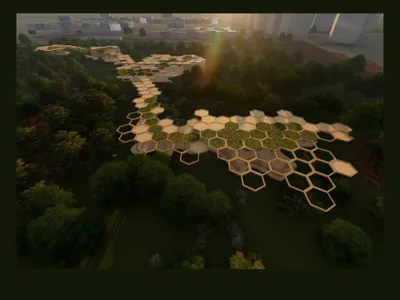
Eco Chapel: A Modular Forest Pavilion That Grows Like the Landscape It Protects
Hexagonal timber modules weave through existing trees, turning a chapel into a living system for prayer, education, and reforestation.


Urban Forest: A Vertical Ecosystem for 5,000 Workers in Singapore's Changi Business Park
Radially stacked pods and layered green decks turn a 7-acre plot into 47 acres of ecological workspace projected for 2040.

Explore Minimalism Competitions
Discover active competitions in this discipline

Challenge to design luxury tourism on rails

Challenge to reimagine the Iron Throne

Photograph architecture without architects

VR headsets Storefront design competition
Comments (0)
Please login or sign up to add comments
No comments yet. Be the first to comment!