

Project Infinity: Floating Architecture That Shields Archaeology While Building 2040
A People's Choice winning concept layers cantilevered canopies, AI-driven urban planning, and hybrid public spaces above ancient heritage sites.


What if the most radical thing a building could do in 2040 is hover, leaving the ground it sits above completely untouched? Project Infinity takes that provocation seriously. The concept proposes an Urban Canopy: floating, cantilevered structures suspended above archaeological terrain, preserving heritage layers while generating entirely new public life on elevated planes. It is speculative, yes, but grounded in a disciplined logic about minimum footprints, AI-assisted simulation, and the coexistence of deep history with forward-looking urban density.
Designed by Migom Doley, Roahan Viswanathan, Yatharth Gupta, and Abhinav Sujit, the project won the People's Choice Award in the Breaking Work competition on uni.xyz. Centered on a speculative city called Tyr, the Mosaic City, the entry imagines a 2040 in which human creativity and artificial intelligence collaborate to shape adaptive urban frameworks. The site strategy is specific: encircle ancient sites with hybrid urban programs, keep modern footprints off the archaeological ground plane, and let elevated canopies define new public gathering circuits above.
Dispersed Volumes Lifted Off the Ground Plane
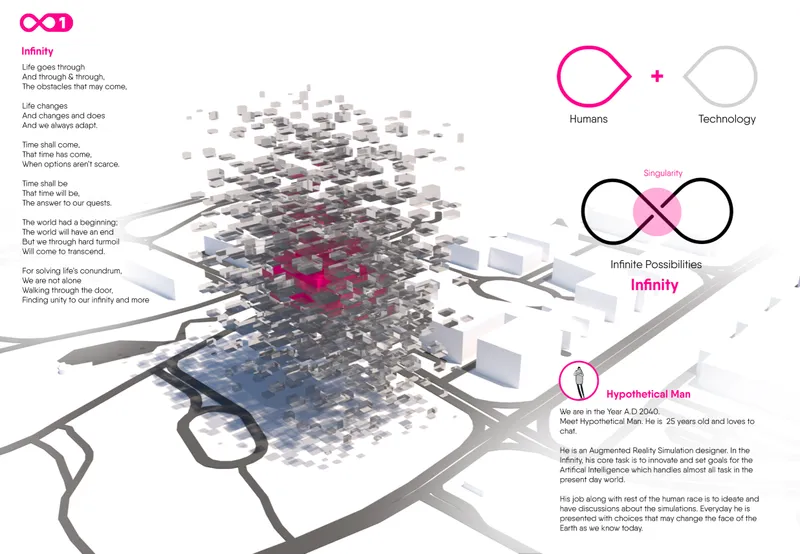
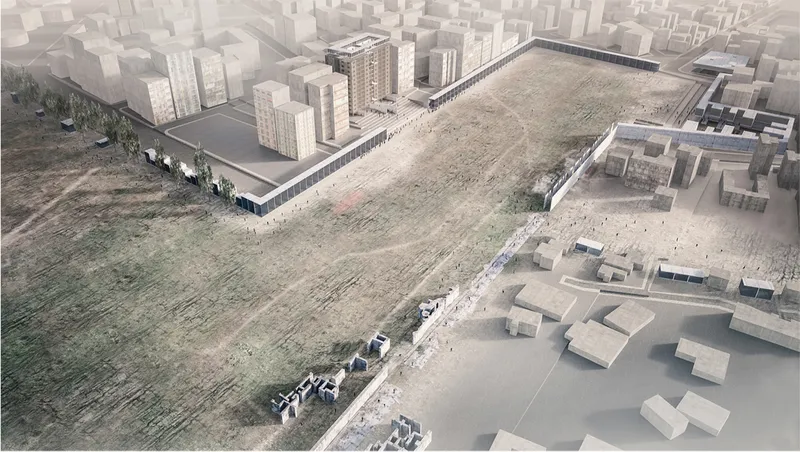
The axonometric diagram pulls the scheme apart to reveal its core spatial logic: modular volumes do not sit on the site, they float above it. Each unit is dispersed across the conceptual plan, maintaining deliberate gaps of negative space between them. The aerial rendering shows what that strategy produces at ground level: a terraced public plaza carved into the landscape between existing buildings, where the terrain itself becomes the floor of a gathering space rather than a construction site. The result is an inversion of conventional development. Instead of the building consuming the ground, the ground remains public and archaeological while built program hovers overhead.
Tyr's Horseshoe: Connecting Neighborhood to Open Heritage Ground
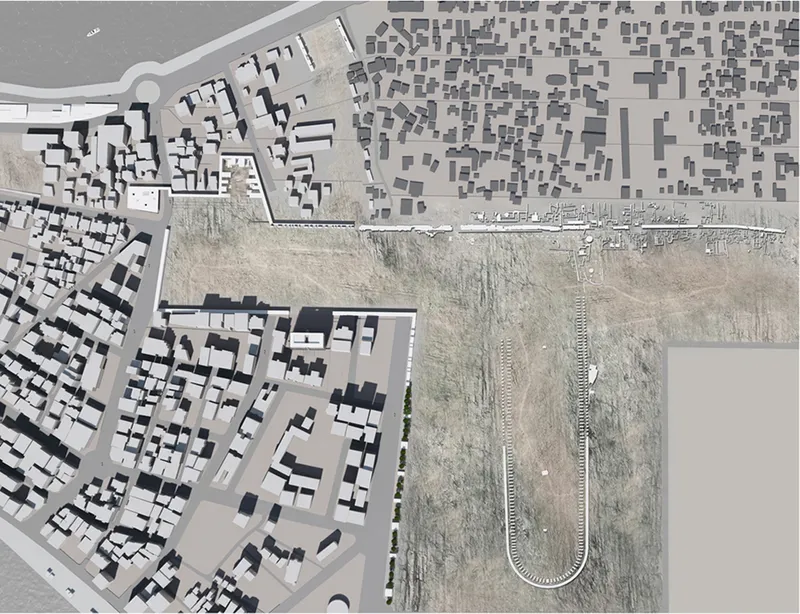
The site plan reveals the larger urban figure of Tyr. A horseshoe-shaped intervention wraps around the perimeter of an existing neighborhood, bridging it to open ground beyond. This is the framework the designers call the Mosaic City: a protective armature that encircles archaeological heritage while enabling contemporary growth to extend outward. The horseshoe geometry is deliberate. It creates a continuous pedestrian circuit, connecting museum paths, hybrid public spaces, and cultural hubs without interrupting the interior archaeological zone. Minimum structural contact with the ground ensures that what lies beneath remains legible and accessible for future excavation.
Cantilevered Timber Screens Above an Excavated Courtyard
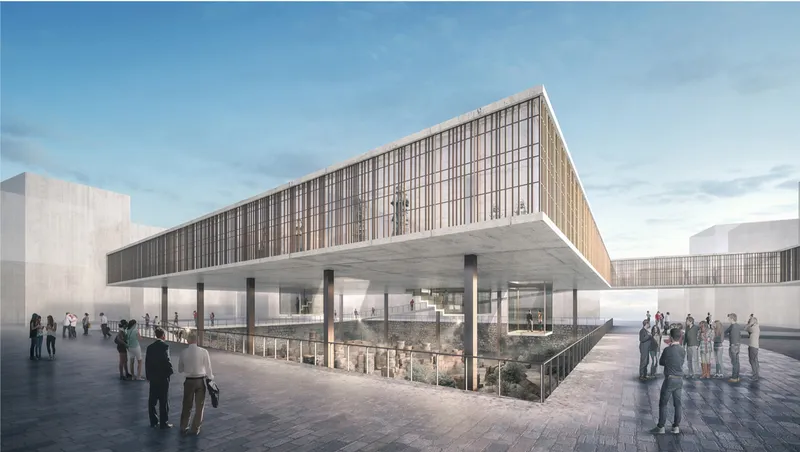
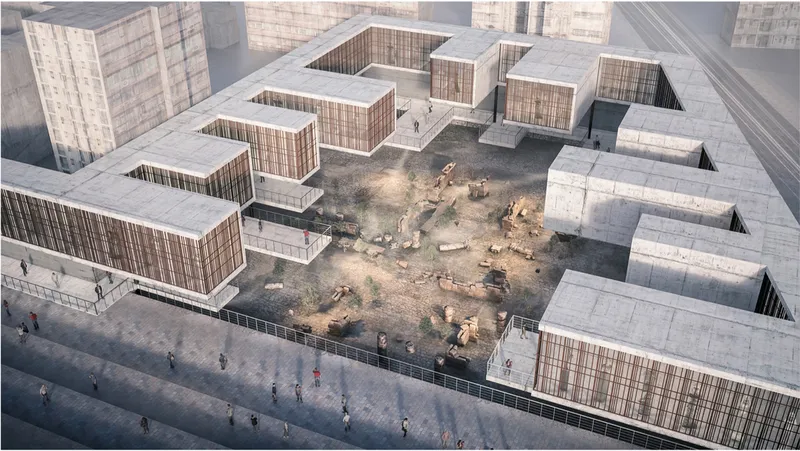
At closer range, the architectural language sharpens. A cantilevered volume clad in vertical timber screens extends over an excavated courtyard, defining a shaded gathering space below without touching the archaeological surface. The timber screens filter light and provide visual porosity, allowing occupants above to look down into history while people at ground level perceive the canopy as a sheltering presence rather than an imposing mass. The aerial daylight view shows clustered pavilions arranged around an exposed archaeological site, each wrapped in the same timber screen system. The pavilions are oriented to frame sight lines toward the ruins, turning the act of preservation into a spatial experience rather than a bureaucratic boundary.
This duality is what the designers call the "Real DNA of the City": a reinterpreted urban identity where community memory, contemporary use, and future aspiration overlap in the same physical space. The archaeological paths below become connected circuits guiding visitors through heritage, while the elevated volumes above house flexible programs ranging from cultural hubs to innovation platforms.
Layered Systems: Photovoltaics, Retractable Skins, and Adaptive Tectonics

The exploded axonometric diagram is where the speculative ambition meets technical aspiration. Layered building systems are pulled apart to show photovoltaic panels at the roof plane, retractable components that can open or close in response to environmental conditions, and structural frames designed for minimal ground contact. This is the adaptive architecture the team describes: design that evolves alongside societal and technological progress rather than remaining static after construction. The integration of AI-driven simulation into the design process, where augmented reality testing enables architects to evaluate multiple scenarios before implementation, is what the designers propose as the mechanism for achieving these responsive systems at scale.
The concept of the Hypothetical Man, a symbolic figure representing humanity in 2040, drives this narrative. Rather than positioning AI as a replacement for creative intuition, the team frames it as a co-creator: setting goals, managing resources, and handling everyday complexity so that designers can focus on the cultural, spatial, and experiential qualities of the built environment. It is an optimistic stance, perhaps deliberately utopian, but the exploded diagram grounds it in buildable components.
Why This Project Matters
Project Infinity operates in the territory where speculation and pragmatism overlap. The idea of lifting entire programs off the ground to preserve what lies beneath is not new, but the team's integration of AI collaboration, adaptive building skins, and cultural preservation into a single urban narrative gives the concept a coherence that pure futurism often lacks. The Mosaic City framework, with its horseshoe plan and connected archaeological circuits, demonstrates spatial thinking rather than mere image-making.
What distinguishes the project is its refusal to treat the past and the future as opposing forces. The Urban Canopy does not erase history to make room for technology; it creates a literal and conceptual space where both can coexist. For a competition about reimagining how we work and live, that layered coexistence is a more durable proposition than the frictionless smart-city fantasies that dominate so much speculative design. The People's Choice recognition suggests the audience agreed: the most compelling vision of 2040 might be one that begins by respecting what already exists on the ground.
View the Full Project
About the Designers
Designers: Migom Doley, Roahan Viswanathan, Yatharth Gupta, Abhinav Sujit
Enter a Design Competition on uni.xyz
uni.xyz runs architecture and design competitions year-round that reward proposals with spatial conviction and real site intelligence.
Project credits: Project Infinity by Migom Doley, Roahan Viswanathan, Yatharth Gupta, Abhinav Sujit Breaking Work (uni.xyz).


Popular Articles
Popular articles from the community


Tsunami Convergenics: Turning Catastrophic Ocean Forces into Underwater Housing Infrastructure
A speculative underwater settlement off the coast of Onagawa, Japan, treats tsunamis and typhoons as energy sources rather than threats.

The Amber Palace Opera: A Geological Fiction Surfaces on Tallinn's Baltic Waterfront
Pierre Brillard reimagines a Baltic legend as a public landscape, opera house, and waterfront promenade rooted in Tallinn's coastal identity.

Opera on the Sea: Driftwood Logic Shapes a Timber Opera House on Estonia's Coast
Trevor Orgill's opera house translates the entangled drift of floating timber into a civic building where wood, water, and music converge.

Cloaked Colonization: A Mobile Underwater Habitat That Moves Like a Fish
Micah Abaya's shortlisted EHC Pacific entry reimagines ocean settlement as a dispersed network of self-sustaining architectural organisms.

Similar Reads
You might also enjoy these articles
The Amber Palace Opera: A Geological Fiction Surfaces on Tallinn's Baltic Waterfront
Pierre Brillard reimagines a Baltic legend as a public landscape, opera house, and waterfront promenade rooted in Tallinn's coastal identity.
Dynamic Modules Shelter: A Telescopic Ring for Mountain Pilgrimage
A circular modular framework of steel, bamboo, and fabric grows vertically with demand, wrapping communal ground in adaptable shelter.

Singing Woman: Contemporary Architecture Inspired by Estonia’s Voice and the Sea
Singing Woman turns Estonia’s song culture into flowing opera house architecture, blending public life, landscape, sea, and national memory.
HYPERBLOCK: Flexible Urban Design for Barcelona’s Future City
HYPERBLOCK reimagines Barcelona as flexible urban design, layering density, daylight, public space and adaptable housing above Cerdà’s grid.

Comments (0)
Please login or sign up to add comments
No comments yet. Be the first to comment!