
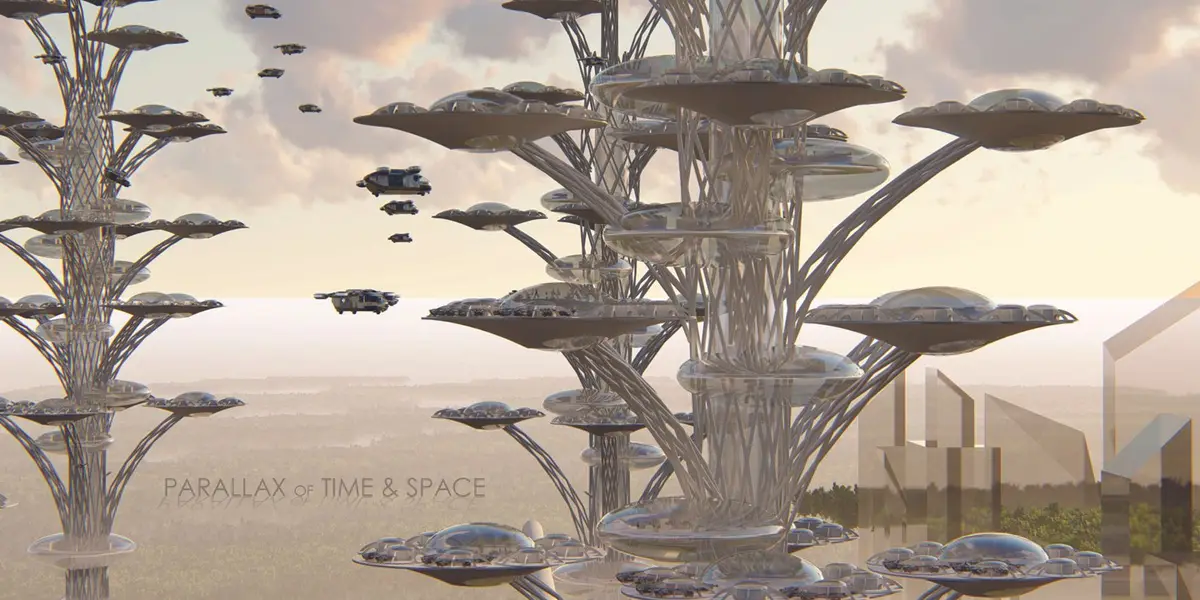
Parallax of Time & Space: Skyscrapers as Living Vertical Ecosystems
A biomorphic tower system in Bangkok lifts urban programs into the sky, freeing the ground for forests, flood resilience, and renewable energy.


What if a skyscraper behaved less like a building and more like a tree? Not metaphorically, but operationally: branching outward at altitude, sheltering a living canopy of workspaces and public decks, while surrendering the ground plane entirely to forests, water systems, and biodiversity. Parallax of Time & Space takes that premise literally. The proposal imagines a cluster of vertical towers shaped like enormous trees, their circular platforms cantilevering from central cores at various heights, connected by elevated roadways and served by VTOL pods that dock and depart like insects visiting a bloom.
Designed by Ahmad Wasi, the project is set in Bangkok, Thailand, a city defined by extreme density, chronic flooding, and rapid urban transformation. Rather than treating those conditions as constraints, the proposal reads them as design drivers. Frequent flooding demands the elevation of critical programs. High density requires creative spatial extension. And emerging hybrid lifestyles, where the boundaries between work, recreation, and mobility dissolve by the hour, call for architecture that refuses to hold still.
A Forest of Towers Above a Reclaimed Ground Plane
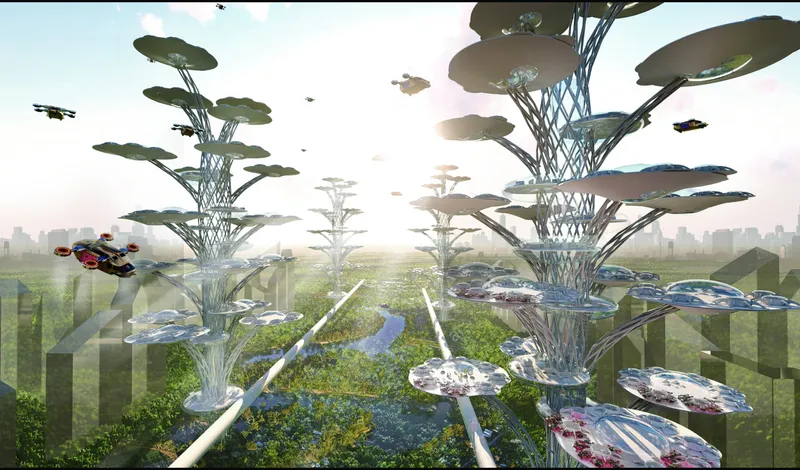
From the aerial perspective, the towers read as a grove of colossal vertical trees rising over continuous green parkland. Circular sky-decks branch outward at staggered heights, their platforms linked by elevated roadways that curve between the structures. The ground below is not paved, parked on, or built over. It is given back entirely to forest cover, water channels, and renewable energy landscapes. The reduced ground footprint is not incidental; it is the project's central ecological argument. By lifting architectural mass into the sky, surface runoff is minimized, soil subsidence is mitigated, and heat accumulation associated with massive vertical masses is distributed across lighter, separated program layers.
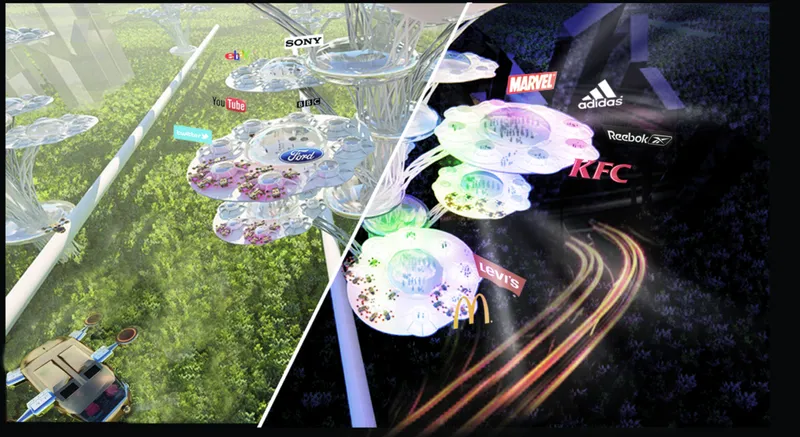
The split rendering captures how the system performs across the day-night cycle. During the day, the towers appear as a calm extension of the landscape, their platforms catching sunlight like elevated canopies. At night, the structures become illuminated nodes threaded by light trails of moving VTOL pods, revealing the kinetic energy of a city that operates continuously. The biomorphic form is not merely symbolic. It carries functional significance: each branching terrace serves as a landing platform, a co-working zone, a public sky-park, or a meeting terrace, depending on demand and time of day.
Nocturnal Urbanism: Light Trails and Transient Spatial Clusters
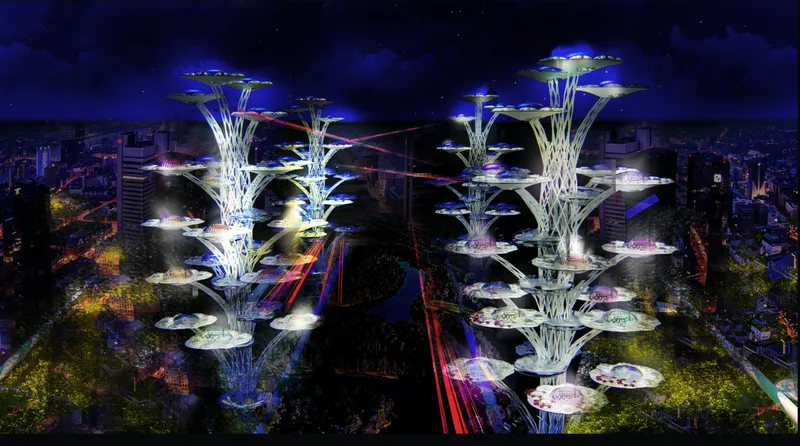
The nighttime close-up reveals how the tower cluster operates as a living network rather than a collection of isolated buildings. Colored light trails arc between the stacked circular platforms, tracing the flight paths of VTOL pods moving between altitude zones. Each pod functions as a personalized workstation, a collaborative capsule, a mobile meeting room, or a plug-and-play office, complete with a pilot space, panoramic windows, and a compact workstation layout that enables uninterrupted work during transit. The pods dock onto the tree-like structural branches, forming temporary work clusters that assemble and dissolve based on user demand. Architecture here is not a container you inhabit. It is a system you move through.
Ground Level: Where Infrastructure Meets the Canopy
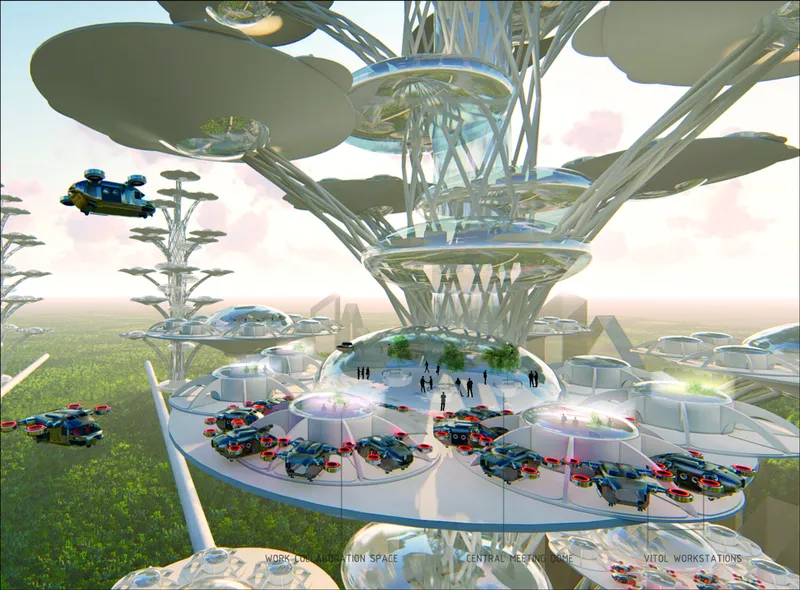
At ground level, the tower's branching structural core rises from a circular plaza where vehicles are parked and flying craft hover overhead, preparing to dock. The scale shift is dramatic: the human figures and automobiles below emphasize how much of the program has been lifted away from the earth. The central trunk narrows as it ascends, its branches fanning outward to support the sky-decks above. The ground-level experience is open, sheltered by structure but not enclosed by walls. For a city like Bangkok, where flooding routinely paralyzes urban systems, this elevation strategy is not speculative luxury. It is a direct spatial response to climate risk, reclaiming the surface for water absorption and natural drainage.
Vertical Stacking: Programmatic Zones Distributed by Altitude
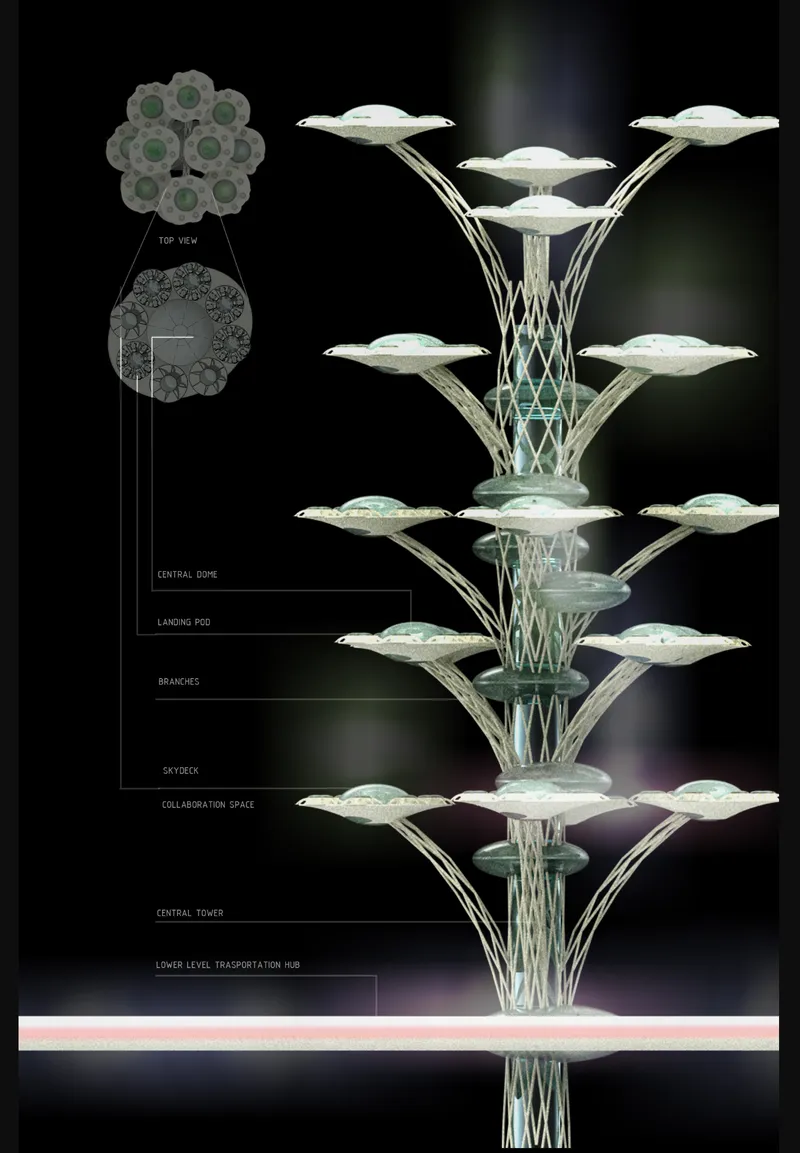
The sectional diagram lays bare the organizational logic. Circular platforms are stacked along the central core at varying intervals, each labeled with its programmatic function. The section confirms that the project rejects fixed spatial programming. A space may operate as a workplace in the morning, a collaborative lounge at noon, and a social or research hub in the evening. The user, not the building, becomes the fixed variable. Architecture dynamically adapts to support evolving activities, and the vertical distribution of program layers ensures that no single altitude zone is overburdened. The diagram also reveals how the branching terraces create interstitial voids, allowing natural ventilation and daylight to reach platforms that would otherwise be shaded by the mass above.
Why This Project Matters
Parallax of Time & Space is speculative, and it knows it. The VTOL pod ecosystem, the fully liberated ground plane, the day-to-night programmatic fluidity: none of these are buildable tomorrow. But that is precisely the point. The proposal operates as a provocation aimed at the assumptions embedded in conventional skyscraper logic, particularly the assumption that vertical density must mean a heavy footprint, rigid zoning, and static interior programs. By reframing the tower as a branching organism rather than an extruded floor plate, Ahmad Wasi forces a conversation about what density could look like in flood-prone, climate-stressed Southeast Asian megacities.
The project's real contribution is not its formal ambition but its systemic thinking. Lifting programs above the ground is not merely a visual gesture; it creates a cascading set of environmental benefits, from reduced surface runoff to preserved biodiversity corridors to distributed thermal loads. The VTOL pods are not just sci-fi mobility gadgets; they are the mechanism that makes flexible programming possible without constant interior renovation. Every design decision serves at least two purposes. That layered reasoning, where ecology, mobility, and spatial flexibility reinforce each other rather than compete, is what separates a compelling vision from a rendering exercise.
View the Full Project
About the Designers
Designer: Ahmad Wasi
Enter a Design Competition on uni.xyz
uni.xyz runs architecture and design competitions year-round that reward proposals with spatial conviction and real site intelligence.
Project credits: Parallax of Time & Space by Ahmad Wasi.


Popular Articles
Popular articles from the community


Singing Woman: Contemporary Architecture Inspired by Estonia’s Voice and the Sea
Singing Woman turns Estonia’s song culture into flowing opera house architecture, blending public life, landscape, sea, and national memory.

Tsunami Convergenics: Turning Catastrophic Ocean Forces into Underwater Housing Infrastructure
A speculative underwater settlement off the coast of Onagawa, Japan, treats tsunamis and typhoons as energy sources rather than threats.

The Amber Palace Opera: A Geological Fiction Surfaces on Tallinn's Baltic Waterfront
Pierre Brillard reimagines a Baltic legend as a public landscape, opera house, and waterfront promenade rooted in Tallinn's coastal identity.

Faces of the Soviet Avant-Garde: Turning Moscow's Street Names into an Open-Air Museum
A network of sculptural installations across a Moscow residential district transforms forgotten architect names into spatial encounters with cultural memor

Similar Reads
You might also enjoy these articles
The Amber Palace Opera: A Geological Fiction Surfaces on Tallinn's Baltic Waterfront
Pierre Brillard reimagines a Baltic legend as a public landscape, opera house, and waterfront promenade rooted in Tallinn's coastal identity.
Dynamic Modules Shelter: A Telescopic Ring for Mountain Pilgrimage
A circular modular framework of steel, bamboo, and fabric grows vertically with demand, wrapping communal ground in adaptable shelter.
Singing Woman: Contemporary Architecture Inspired by Estonia’s Voice and the Sea
Singing Woman turns Estonia’s song culture into flowing opera house architecture, blending public life, landscape, sea, and national memory.
HYPERBLOCK: Flexible Urban Design for Barcelona’s Future City
HYPERBLOCK reimagines Barcelona as flexible urban design, layering density, daylight, public space and adaptable housing above Cerdà’s grid.


Comments (0)
Please login or sign up to add comments
No comments yet. Be the first to comment!