
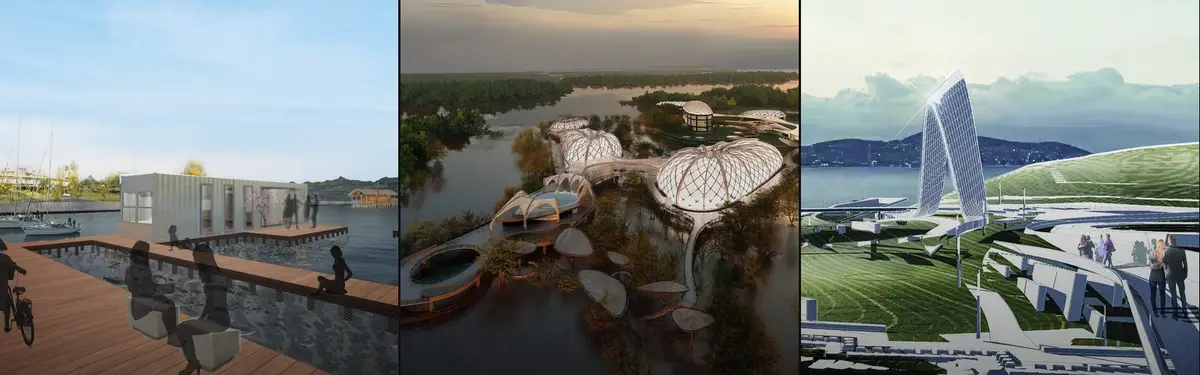


Ocean Architecture
Architectural design and urban planning concepts for human habitation and infrastructure in ocean environments.
Ocean architecture is the design of buildings and settlements for living and working on or under the sea: floating homes and neighbourhoods, offshore platforms, underwater habitats, and the structures that help coastal cities adapt to rising water. It treats the ocean as a site in its own right, with its own loads, materials, ecology and law, rather than as a view from the shore.
What is ocean architecture?
Ocean architecture covers anything people occupy that sits in, on or beneath salt water. In practice it falls into four families. Floating architecture uses buoyant hulls or pontoons, from a single houseboat to a moored neighbourhood. Offshore architecture builds on fixed or tethered platforms, including old oil and gas rigs. Underwater habitats place sealed, pressurised rooms on the seabed or in the water column. Coastal adaptation covers the edge, where buildings must survive storm surges and sea level rise.
It differs from coastal architecture, which builds on land beside the sea and borrows its views and climate. An ocean building has no ground to stand on, or only a seabed far below. That changes almost everything: the structure has to float or be anchored, every material has to resist salt, and services such as power, fresh water and waste cannot simply connect to a city grid. It also differs from naval architecture, the design of ships. A ship is built to travel; most ocean architecture is built to stay, and to be lived in by people who are not sailors.
The field has grown alongside climate concerns. As coastal land becomes scarce and more exposed to flooding, architects and planners have returned to an idea that has been drawn and redrawn for nearly seventy years: if the water is coming, build on it.
A short history of ocean architecture
People have lived on water for centuries in stilt villages and houseboats. Ocean architecture as a design discipline took shape in the 1950s and 1960s. The Japanese architect Kiyonori Kikutake is best known for his Marine City project of 1958, a vision of a city on the sea that formed part of the Metabolist movement launched at the World Design Conference in Tokyo in 1960.
Kikutake later built a working version of the idea. The centrepiece of Expo '75 in Okinawa was Aquapolis, a floating city he designed as a prototype for marine communities. It was built at a shipyard in Hiroshima and towed to the Expo site, stayed on as an attraction after the fair, closed in 1993, and was towed to Shanghai for scrap in 2000.
Below the surface, Jacques Cousteau's team ran a series of experiments in seabed living. In Conshelf Two (1963), six oceanauts lived for 30 days about 10 metres down in the Red Sea, at Sha'ab Rumi off Sudan, in a starfish-shaped house supplied with air, power and food from ships above. The tradition continues at Aquarius Reef Base, which Florida International University describes as the world's only underwater research laboratory, deployed 60 feet beneath the surface of the Florida Keys National Marine Sanctuary.

On calmer water, the Netherlands turned floating homes into everyday housing. According to Wikipedia's overview of floating buildings, floating homes form a planning category of their own there: Amsterdam has hundreds of houseboats on its canals, and newer floating neighbourhoods such as those at IJburg are promoted as a response to a low-lying, water-rich landscape.

The largest recent proposal is OCEANIX Busan. In April 2022 UN-Habitat, Busan Metropolitan City and OCEANIX unveiled the design of what they called the world's first prototype sustainable floating city, with BIG and SAMOO as lead architects: linked platforms totalling 6.3 hectares for a community of 12,000 people.
"We are on track to delivering OCEANIX Busan and demonstrating that floating infrastructure can create new land for coastal cities looking for sustainable ways to expand onto the ocean, while adapting to sea level rise".
Philipp Hofmann, Chief Executive Officer of OCEANIX, at UN Headquarters (2022)
Key principles of ocean architecture
Six questions shape almost every serious ocean project, whether it is a built pavilion or a competition concept.
Buoyancy and anchoring
A floating building must displace enough water to carry its own weight plus people, furniture and stored water, and it must stay stable when that load shifts. Concrete pontoons, steel hulls and foam-filled floats are the usual bases. Anchoring then holds the structure in place: piles, chains to the seabed, or tethers that let it rise and fall with the tide while staying put. Fixed offshore structures solve the same problem with legs driven into the seabed.
Corrosion and materials
Salt water and salt air attack steel, fixings and reinforcement far faster than inland weather. Designers respond with protective coatings, generous concrete cover over rebar, corrosion-resistant metals, and details that let water drain rather than sit. Everything that can fail should be reachable for inspection and replacement, because a building at sea cannot be scaffolded easily.
Energy and water self-sufficiency
Most ocean sites have no grid connection, so buildings have to make their own power and fresh water. Sun, wind and waves are the obvious sources, and desalination or rain capture provide water. Aqua-Carapace, by SIDDHI AGARWAL, Harshita Yadav and Somya Agarwal for the Mobitecture competition, imagines a small floating eco-house powered by sun, ocean and algae that can travel above and beneath the surface.
Marine ecology
Any structure in the sea becomes habitat, shade and obstruction at once. Good projects aim to add to the ecosystem rather than smother it. wireless CORALPODS by Rachel Cheah, a winning entry in the EHC - Pacific competition, proposes habitat pods with no cables to the sea floor or mainland, built on a circular exchange with the marine ecosystem so that both humans and marine species can inhabit them.

Modularity
Ocean settlements are usually planned to grow in units: a module that can be built in a yard, towed out and joined to others. Underwater, space is costly, so modules also have to work hard. A uni.xyz journal review of one underwater habitat put it this way:
"Underwater, every cubic metre is hard won. Each one must be pressurised, lit, ventilated and defended against the sea, so a room that sits empty for twenty hours a day is an expensive luxury."
UNI Editorial, Aquadapt: An Underwater Habitat That Rewrites Its Rooms by the Hour
The project it describes, AQUADAPT by Paweł Swacha, Jakub Koźlik, Daniel Stawicki and Magdalena Niewiadomska, won a People's Choice Award at the EHC - Pacific competition. Its curved modules shift through the day from a compact apartment in the morning to a lounge and then an open social floor in the evening.

Safety and access
People at sea need a way in, a way out and a way home in bad weather. That means sheltered landings, bridges or boats to shore, refuges if a module floods, and for underwater habitats, airlocks and a planned route to the surface. Fire, evacuation and medical access are harder offshore than in any city block, so they belong in the first sketch rather than the last.
Ocean architecture on uni.xyz
Members of uni.xyz have proposed floating cities, reef habitats, reused rigs and ocean museums, many of them through competitions that asked how people might live with the sea.
Futuristic Floating Residents, by soheib rahmani, kiana oveisi, elham akhgar and Kimia Esmaeili, is the most liked project in this topic and won a People's Choice Award at the Container City competition. The team starts from sea level rise in coastal cities, argues that traditional land reclamation is not a practical long-term answer and harms the ecosystem, and proposes adapting with floating structures instead.

AFLOATOPOLIS, by Onur Asar, UZAY DENİZ YILMAZ, Ayça ZÜMRÜT and Şeyhmus Çelik for the Afloat competition, proposes a new urban cross-section between water and land for cities threatened by climate change, keeping public values at the centre of the design.
Several entries reuse the industrial leftovers of the offshore economy. ArchiPelago, The sea satellite, by Jákob Czinger, Diana Konovalova, Anna Orbanic and SARA ORBANIĆ, a winning entry in the Proximity Island 2019 competition, revitalises an abandoned oil station as a multi-purpose structure in offshore conditions. In the same competition, ANACHRONOS by Kshir Bedhesi and Sumbul Pardesi, an Editor's Choice, reads the oil rig as something between shores, visible from land but beyond it.

Ocean museums form another strand. THE TALE OF MARINE LIFE by Faisal Ahamed, a People's Choice Award winner in both the Sustainable & Regenerative Design Awards and UnIATA '24, proposes a live marine aquarium at Sonadia in Bangladesh that promotes biodiversity, education, research and conservation through displays, an auditorium, a library and a café.

The journals add depth to the underwater work. BIOREEF, by Vincent Tiburcio, Si Nguyen and Julio Quiroz and a Runner-up in EHC - Pacific, is reviewed as a vertical research and housing station placed in Pacific currents to catch floating plastic, recycle it and grow coral on its submerged base. The designers mapped ocean currents to decide where a network of such stations should go, treating the current itself as infrastructure. Other reviews in the same series cover habitats on the Great Barrier Reef, off Penang and off Onagawa in Japan, which shows how far the competition pushed members to think about specific waters rather than a generic sea.
Challenges and future directions
Cost is the first obstacle. Everything at sea is harder to build, insure and maintain, and few clients will pay a premium for floating floor area when land is available. Storms are the second. A design that works on a sheltered canal may fail in open water, where waves, wind and surge load every joint, and where moorings must hold through the worst storm in decades, not the average day.
Ecological impact is real too. Floating platforms shade the water below, anchors disturb the seabed, and construction and waste can harm the very reefs some projects claim to restore. Claims of regeneration need monitoring after construction, not only renderings before it.

Governance may be the hardest question. Who plans, taxes and polices a city that floats? Seasteading, the idea of permanent dwellings in international waters independent of existing governments, shows the risk. No structure on the high seas has been recognised as a sovereign state, and critics fear seasteads could become refuges for the wealthy to avoid taxes. A planned floating project in French Polynesia collapsed when the government cut ties in 2018. Projects such as OCEANIX Busan take the opposite route, working inside a host city's waters and planning system. As UN-Habitat's executive director put it at the Busan launch:
"We cannot solve today's problems with yesterday's tools. We need to innovate solutions to global challenges. But in this drive for innovation, let's be inclusive and equitable and ensure we leave no one and no place behind."
Maimunah Mohd Sharif, Executive Director of UN-Habitat (2022)
Ocean architecture for students and designers
Ocean projects reward students who take one real problem seriously instead of drawing a utopia. Pick a real site with known tides, depth and storms, and design the anchoring, servicing and escape before the facade. Strong thesis angles include reusing a decommissioned offshore platform, a floating school or clinic for a flood-prone delta, an underwater research station built around reef repair, or a floating extension to a crowded port city.
Draw the waterline in every section. Show how people arrive, where power and fresh water come from, and what happens in a storm. Related topics on uni.xyz include floating architecture, underwater habitats and sustainable living. Browse current architecture competitions for ocean and waterfront briefs.
Frequently asked questions
What is ocean architecture?
It is the design of buildings and settlements on or under the sea, including floating homes, offshore platforms, underwater habitats and coastal adaptation. It deals with buoyancy, corrosion, self-sufficient services and marine ecology, which land buildings rarely face.
What was the first floating city?
One of the earliest built prototypes was Aquapolis, designed by Kiyonori Kikutake as the centrepiece of Expo '75 in Okinawa. It was built in a shipyard in Hiroshima and towed to the site. OCEANIX Busan, unveiled in 2022, is described by UN-Habitat as the first prototype sustainable floating city.
Can people live underwater?
Yes, for limited periods. Cousteau's Conshelf Two kept six people on the Red Sea floor for 30 days in 1963, and the Aquarius Reef Base off Florida still hosts researchers. Permanent underwater towns remain concepts.
Are floating houses safe?
On sheltered water with proper moorings, floating homes are a normal form of housing in the Netherlands and elsewhere. Open-ocean sites face much greater wave and storm loads, which is why most built floating homes sit in canals, lakes and harbours.
What is seasteading?
Seasteading is the idea of building permanent homes in international waters, outside the control of existing governments. No such structure has been recognised as a sovereign state, and the idea faces criticism over taxes, cost and environmental impact.
References and further reading
- UN-Habitat and partners unveil OCEANIX Busan, the world's first prototype floating city, UN-Habitat
- Medina Aquarius Program, Florida International University
- Kiyonori Kikutake, Wikipedia
- Expo '75, Wikipedia
- Continental Shelf Station Two, Wikipedia
- Floating building, Wikipedia
- Seasteading, Wikipedia


Popular projects
View all 60 projects


Latest journals
View all 82 journals

Voice of the Sea: A Glowing Underwater Beacon Drawn to the Rhythm of Whale Migration
Drina Cortez imagines a luminous seabed tower and a floating shell for Bermuda's waters, a vision carried by atmosphere more than by plan.

Aquadapt: An Underwater Habitat That Rewrites Its Rooms by the Hour
Curved modules ring the seabed while one shell shifts from breakfast room to cinema, farm and football pitch as residents' needs change.
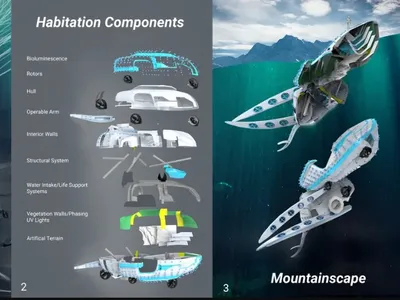
Tidal Survival: A Biomimetic Habitat That Glows, Moves, and Breathes Beneath the Ocean
Nicholas Miller's shortlisted EHC Pacific entry reimagines underwater habitation as a mobile, bioluminescent organism rather than a rigid capsule.
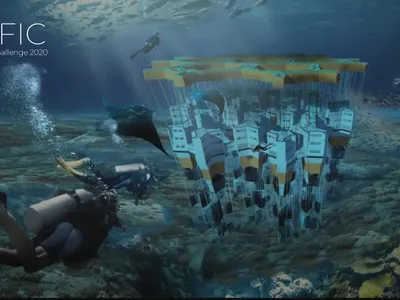
Pacific: A Modular Underwater Colony That Grows One Hexagonal Cell at a Time
A shortlisted proposal for a self-sufficient settlement on the Pacific Continental Shelf, scaling from six residents to over six hundred.


