


Religious Building
Architectural design of spaces for worship, spiritual practice, and faith-based community gathering.
A religious building is a structure designed and built for worship, ritual, prayer or spiritual practice by a community of faith, such as a church, mosque, synagogue, temple, gurdwara or shrine. Its form is shaped less by function in the everyday sense than by belief: where people face, how they arrive, what they see and hear, and what the building is meant to house or make present.
What is a religious building?
The term covers any place of worship, together with the buildings that sustain a religious life around it: monasteries, pilgrim lodgings, seminaries, prayer halls and community kitchens. You will also see the terms "religious structure" and "religious institutional building", the latter usually meaning a place of worship together with the halls, schools and offices attached to it. In each case the building gives a shared belief a physical address.
Religious buildings sit inside the wider field of religious architecture, which also studies style, ornament and liturgy across centuries. The narrower term points at a typology with a brief: a client, a ritual programme and a site. It also overlaps with the idea of sacred space, which can exist without any building at all, in a grove, a mountain or a riverbank. A religious building is the point where that sense of the sacred is given walls, a roof and a door.
What separates the type from a concert hall or a library is that key decisions, such as the direction of prayer or the place of a sacred text, are often fixed by the faith before the architect arrives. Good design works with those givens.
Types of religious buildings
Each tradition names its buildings in its own terms. The main types are:
Churches, cathedrals and chapels
A church is the Christian place of worship. A cathedral is the church that holds the seat of a diocesan bishop in the Catholic, Orthodox and Anglican churches, and a chapel is a smaller or private place of worship.
Mosques
A mosque is the Muslim place of prayer. Its essential element is the qibla wall facing the Kaaba in Mecca, marked inside by a niche called the mihrab. Courtyards and minarets are common but vary by region.
Synagogues
A synagogue (also called a shul) is a Jewish house of assembly, prayer and study. The Torah ark is almost always placed so that worshippers facing it face Jerusalem, and a raised platform, the bimah, is used for reading the Torah. There is no set blueprint, so synagogues have historically adopted the local architecture of their time.
Hindu temples (mandir)
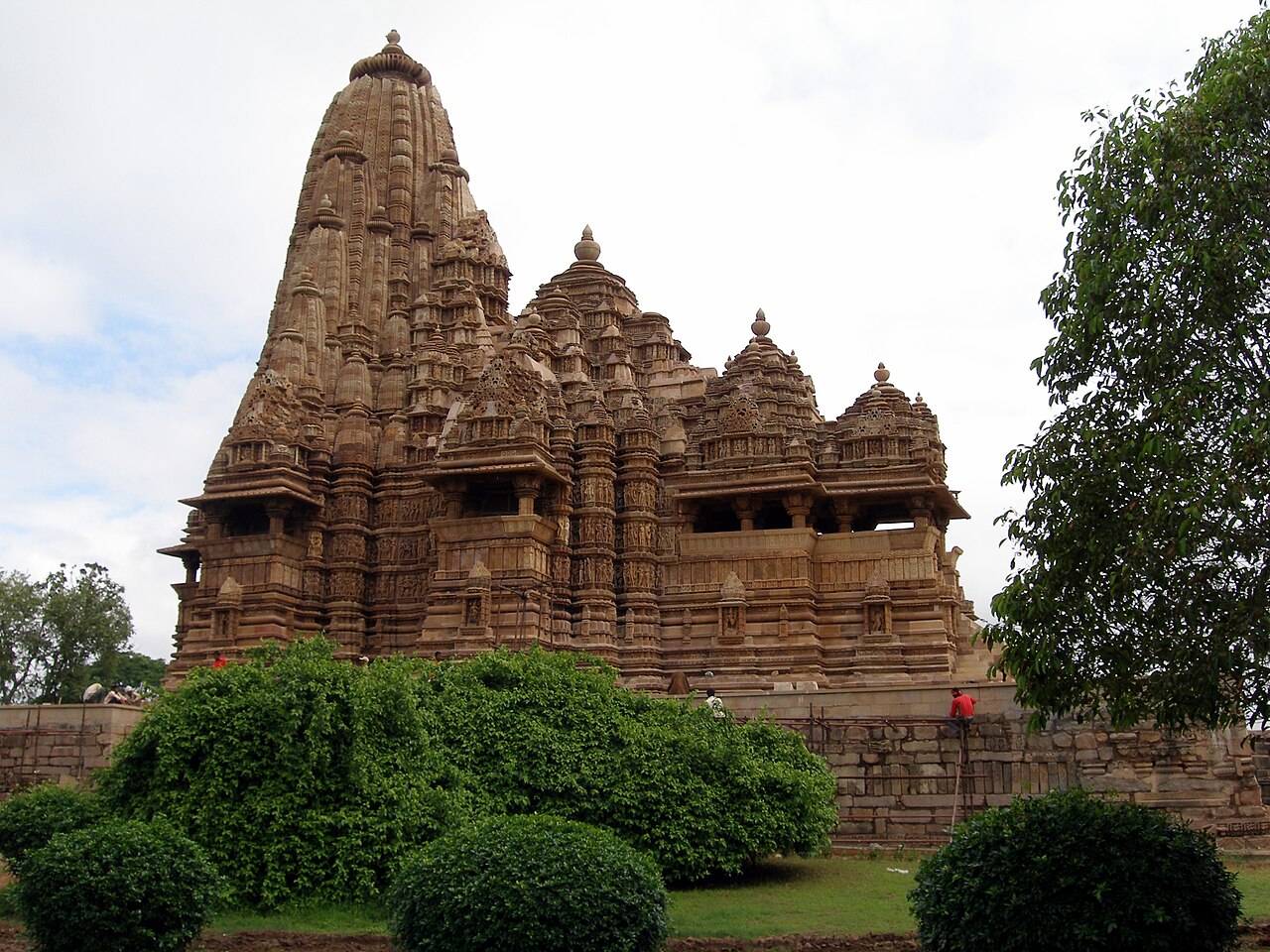
A Hindu temple, or mandir, is understood as a symbolic house, seat and body of the deity. At its core is the garbhagriha, a small, unornamented sanctum holding the murti, under a tower called a shikhara in north India and a vimana in the south. Pillared halls called mandapas lead towards it.
Buddhist temples, stupas and pagodas
A stupa is a domed, hemispherical structure containing relics, walked around clockwise in a ritual known as pradakshina. In East Asia the stupa developed into the pagoda, a multistorey tower within a temple complex.
Gurdwaras
A gurdwara, "the gateway through which the guru could be reached", houses the Guru Granth Sahib on a raised throne in the main hall. Every gurdwara has a langar, a free community kitchen, and a tall Nishan Sahib flag marks it from a distance. Many newer gurdwaras follow the pattern of the Harmandir Sahib in Amritsar, with entrances on all four sides.

Jain temples, Shinto shrines, monasteries and multi-faith rooms
A Jain temple is called a derasar in Gujarat and Rajasthan and a basadi in Karnataka; the Dilwara temples are known for their pure white marble. A Shinto shrine (jinja) is announced by a torii gate, which marks the transition from the mundane to the sacred. Monasteries house religious orders, and a multifaith space is a quiet room set aside in a hospital, university or airport for people of any belief, or none.
A short history of religious buildings
Monumental building and ritual have been linked for a very long time. At Göbekli Tepe in southeastern Turkey, circular enclosures with T-shaped stone pillars were raised from around 9500 BCE. Its excavator read it as a ritual centre, but later findings point to a settlement, and no definitive purpose has been established for the megalithic structures.
In Rome, the Pantheon was completed under Hadrian, probably around AD 126, and in 609 it was consecrated as a church. Its oculus has never been covered, and its dome is still the world's largest of unreinforced concrete. In Constantinople, Justinian's Hagia Sophia (532 to 537), designed by Anthemius of Tralles and Isidore of Miletus, became a mosque in 1453, a museum in 1935 and a mosque again in 2020. Its court historian saw the dome as weightless.
"Yet it seems not to rest upon solid masonry, but to cover the space with its golden dome suspended from Heaven."
Procopius, The Buildings, I.1.46 (6th century, trans. H. B. Dewing)
In Java, Borobudur, a Mahayana Buddhist monument of the Sailendra period, stacks nine platforms carrying 2,672 relief panels and originally 504 Buddha statues. Pilgrims climb it by walking clockwise through its galleries, so the building is experienced as a journey rather than a room.

The Great Mosque of Córdoba, begun in 785 under Abd al-Rahman I, spread its prayer hall across rows of two-tiered arches on columns; after 1236 it became a cathedral. In northern France, the rebuilt choir of the Abbey of Saint-Denis (about 1140 to 1144) is considered the first Gothic building, using rib vaults and pointed arches to open the walls to stained glass. In the modern era, Tadao Ando's Church of the Light (1989) in Ibaraki, Osaka, reduced the sanctuary to concrete walls and a cross cut into the wall behind the altar.
Religious building design: key principles
Traditions differ, but the same seven questions recur across faiths and across our members' work.
Orientation and axis
Many faiths fix a direction. Mosques align their qibla wall towards Mecca; synagogues place the ark towards Jerusalem; most churches built since the eighth century are oriented with the altar at the east end, often in an apse, though the earliest churches in Rome faced the other way. Hindu temples traditionally face sunrise, with the devotee's entrance on the east. Córdoba shows that the rule meets the site: the mosque points more to the south than towards Mecca.

Threshold and procession
Religious buildings are entered in stages: a gate, a court, a porch, a hall, a sanctum. The torii, the temple mandapa and the cathedral west front all slow the visitor down. INTROVERSE by Aimi Berton, Mira Spasova, Gabriela Bacchi and Milena Raeva uses a spiral to turn that sequence into a single journey towards a central space.

Light and the sacred
Light is the most widely shared material of sacred architecture, from the Pantheon's oculus to Gothic glass. Ando put it plainly.
"In all my works, light is an important controlling factor."
Tadao Ando, Pritzker Architecture Prize laureate profile (1995)
Our journal on Alberto Campo Baeza's tabernacle for Madrid's Basílica de la Milagrosa shows how small the move can be: a 1.2 metre glass cube set into the brick apse catches daylight around a suspended gold tabernacle, after the Creed's "Light from Light".

Acoustics and voice
Worship is spoken, chanted and sung. Hard domes and long naves give reverberation that suits chant and organ music, while sermons and readings need clarity. The designer decides which voice matters most, and whether a bell or call to prayer belongs to the street.
Symbolism and geometry
Plans often encode belief. Hindu temples are laid out on the vastu-purusha-mandala, a square grid of 64 or 81 cells; stupas and domes use the circle as an image of completeness. Contemporary projects use fewer symbols, so geometry carries more of the meaning.
Community and everyday use
Many religious buildings are also social buildings. The gurdwara's langar feeds anyone who arrives, and parish halls, madrasas and temple kitchens keep buildings busy between services.
Conservation of living heritage
Historic religious buildings are rarely museums. ICCROM's forum on living religious heritage framed the task as reconciling the conservation of places of heritage value with their function as part of a living religion. Repairs, lighting and access must respect continuing worship as well as historic fabric, linking this work to cultural heritage practice.
Religious buildings on uni.xyz
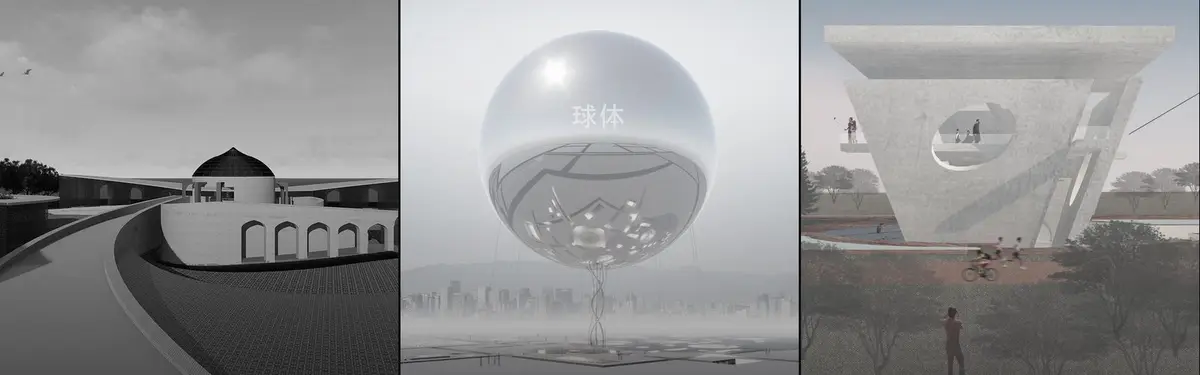
Members on uni.xyz have approached the type mostly through open briefs, where a sacred programme is set without a single faith attached. That makes the work a good record of how designers now think about shared spiritual space, and three of the projects below come from a single brief, the Faith competition.
INTROVERSE, the most-liked project on this topic and an Editor's Choice in the Faith competition, sits in a park in the heart of Beijing. Its team uses nature to ground the project and a spiral to suggest the journey towards a central space, which in their words "prompts each individual to find their own expression of faith."
From the same competition, Beijing's Interfaith Dialogue Centre by Alicja Kowalewska was a runner-up. It proposes pavilions for spiritual development that reflect experiences along the path of life. Sacred space here is a sequence to walk through rather than a single room.

Kathédra Pavilion by Sebastian Hicks and Diem Nguyen, another Editor's Choice in the Faith competition, starts from etymology. The word cathedral comes from the cathedra, the bishop's seat, and here the chairs that would normally face that throne become the walls of the building itself.
Spiritual Journey to Oneness by Yoshie Takeo received the People's Choice Award in the Di - Generic Cities: Tokyo competition. It is a sacred place for people of all faiths and backgrounds to connect with the Divine and with their higher self, organised as a series of spaces that let visitors experience spirituality as a process.
Not every project is a sanctuary. Wadi Mina's House of Respite by Adam Yuraselan, Iqbal Hashim, Salehin KS and Ismail Rahim, a winning entry in The White Lands competition, offers lodgings for pilgrims around the Day of Arafah and the Jumrah stonings, where each person can rest and perform ibadah in private.
Our journals add built work from several traditions. Maison Bignon Sossou's Mami Dan Temple in Toligbé, near Ouidah in Benin, is a 770 m² Vodun complex in rammed earth and bamboo. Instead of copying historical shrine forms, it borrows from basketry, organised around a woven structure that reads as a tree rising into a canopy. The banded walls record each lift of the formwork, so the temple shows how it was made. The brief asks it to serve as a working sanctuary and a cultural destination at once.

Natura Futura's House of Prayer in Babahoyo, Ecuador, was commissioned by a community group and paid for through collections among the faithful. Built partly with timber beams from the house it replaced, it opens a brick and timber lattice to the street and hosts workshops and a place for children alongside worship. The architects describe it as being in "permanent construction", growing as funds arrive.
"We read it less as a finished chapel and more as a piece of neighbourhood infrastructure that happens to have an altar."
UNI Editorial, on Natura Futura's House of Prayer
Challenges and future directions
The first challenge is change in congregations. In England, the Church of England closes around 20 to 25 churches a year that are no longer needed for worship. Its listed outcomes are conversion to a new use, preservation by the Churches Conservation Trust, or demolition, and common new uses include worship by another Christian body, community and cultural use, homes, arts centres and offices. Adaptive reuse of a sacred building asks more than most conversions, since memorials, glass and the meaning of the space remain.
The second is conservation of buildings still in use, where heritage rules must make room for ritual, crowds and festivals. The third is multi-faith design. Many multifaith rooms take a neutral "negative" approach, with no religion-specific symbols on permanent display, and designers must still balance users whose prayer times and practices differ.

Member projects test alternatives. A Centre for Faith Agnostics by Valeria Zhuravleva argues that one place can be open to everyone regardless of faith, a harder task than a blank room. Climate and cost are a fourth pressure; the earth, bamboo and salvaged timber in our journals suggest one answer.
Religious buildings for students and designers
Religious buildings make strong thesis subjects because the brief is rich and the constraints are real. Good angles include a shared prayer space for a hospital or campus, the reuse of a closed church or temple, a pilgrim facility, or a place of worship built from local, low-carbon materials. Start by learning the liturgy and talking to the community.
Open briefs on uni.xyz competitions regularly set sacred programmes without naming a faith, which is a useful way to test ideas. Related topics worth following are temple design, sacred space and cultural heritage.
Frequently asked questions
What is a religious building?
A religious building is a structure built for worship, ritual or spiritual practice by a faith community. Examples include churches, mosques, synagogues, Hindu and Buddhist temples, gurdwaras and shrines.
What are the types of religious buildings?
The main types are churches, cathedrals and chapels; mosques; synagogues; Hindu temples (mandirs); Buddhist temples, stupas and pagodas; gurdwaras; Jain temples; Shinto shrines; monasteries; and multi-faith rooms.
What does "religious structure" mean?
A religious structure is any built work made for religious purposes. Besides buildings for worship, it includes monuments that are not entered in the usual way, such as stupas, shrines, gateways like the torii, and pilgrimage monuments such as Borobudur.
What are religious institutional buildings?
The phrase usually describes places of worship together with the institutions attached to them, such as religious schools, monasteries, seminaries, community halls and offices.
How does religion shape architecture?
Religion sets many of a building's key decisions: its orientation, the route through it, the place of a sacred text or image, its light and its sound. Many of history's most ambitious buildings, from Hagia Sophia to Borobudur, were built for faith.
References and further reading
- Place of worship, Wikipedia
- Göbekli Tepe, Wikipedia
- Pantheon, Rome, Wikipedia
- Hagia Sophia, Wikipedia
- Procopius, The Buildings, Book I (Loeb translation by H. B. Dewing), LacusCurtius, University of Chicago
- Borobudur, Wikipedia
- Mosque-Cathedral of Córdoba, Wikipedia
- Gothic architecture, Wikipedia
- Church of the Light, Wikipedia
- Tadao Ando, 1995 Laureate, The Pritzker Architecture Prize
- Qibla, Wikipedia
- Orientation of churches, Wikipedia
- Synagogue, Wikipedia
- Hindu temple, Wikipedia
- Stupa, Wikipedia
- Gurdwara, Wikipedia
- Jain temple, Wikipedia
- Torii, Wikipedia
- Multifaith space, Wikipedia
- Conservation of Living Religious Heritage, ICCROM
- Closed churches, The Church of England


Open competitions in Religious Building
See all Religious Building competitions

Popular projects
View all 48 projects


Latest journals
View all 103 journals

Maison Bignon Sossou Weaves a Bamboo Canopy over a Rammed Earth Vodun Temple in Ouidah
In the coastal village of Toligbé, Benin, a 770 m² temple to Mami Dan pairs banded rammed earth with woven bamboo to give living Vodun ritual a home.

Rogoski Arquitetura Raises a Folded Steel-and-Timber Chapel on a Lakeside Deck in the Brazilian Amazon
In Cacoal, Rondônia, a 61 m² chapel hovers on a circular deck, wrapping a warm timber interior in dark metal and opening to the forest through triangles.

CAZA Gathers Circular Rooms into One Porous Church on a Wooded University Campus in Biñan
In Biñan, Philippines, Santuario de La Salle clusters circular chapels behind a ribbed colonnade and fin skin, easing campus bustle into worship.

Jaramillo Van Sluys Arquitectura and Urbanismo Turn a Demolished Registry Lot in Quito into an Orchard Plaza
In Quito's Centro Histórico, a 2,800 m² plaza exposes the San Agustín convent wall and redraws its lost Augustinian orchard in volcanic stone.


