
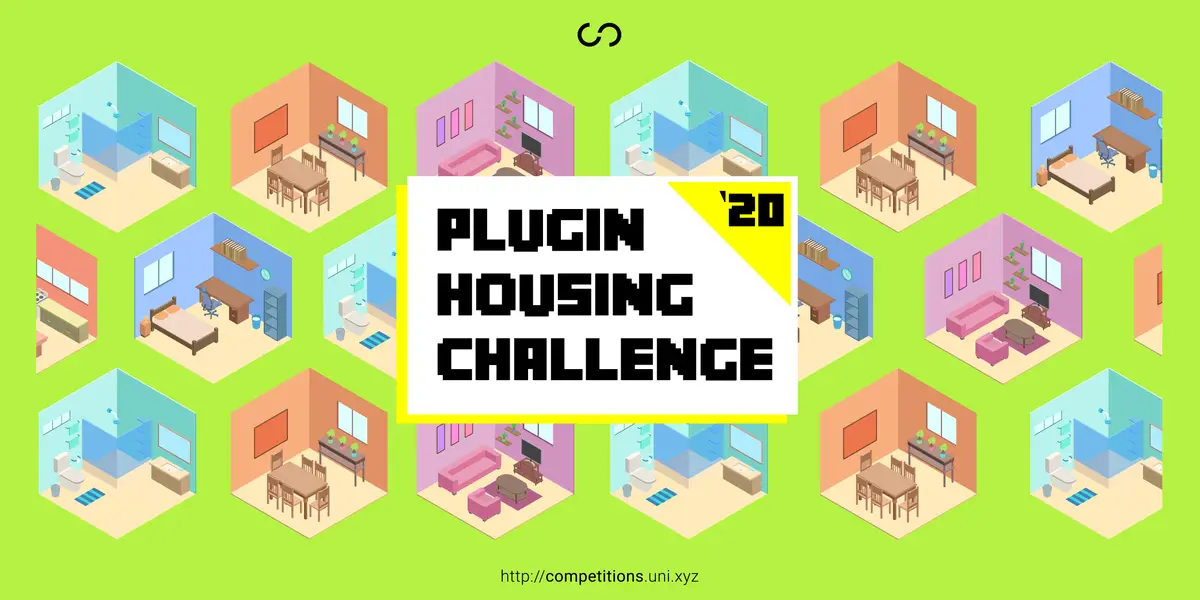
Plugin Housing Challenge 2020
Design an efficient future of housing
Overview
Premise

Img 1: Urban population explosion - A concept
Humankind has lived and worked primarily in rural areas. But now, more than half of the globe's population will be living in towns and cities. The number of urban dwellers is rising, reaching almost 32% of the total world population, and 68% by 2050. It is estimated that 900 million urban dwellers and over one billion rural people now live in overcrowded and poor quality housing without adequate provision for water, sanitation, drainage or the collection of household waste. Even renting affordable houses in the world's largest cities is impossible and people have to resort to long commute hours to reach their workplace.
A remedy for such conditions is required on a large scale that tackles the issue of housing for low-income groups residing in urban areas. In the coming decades, the cost of constructible land will increase, making the situation worse.
Plugging in

Img 2: Plugin houses - A concept
Working individuals and young migrants who move into big cities are constantly in search of affordable living options in the vicinity of their workplace or institution. They often stay for a temporary basis and hence rent a house.
A possible long-term solution would be to design compact housing units that are affordable for construction as well as usage.
Compact Housing can also be referred to as micro or capsule housing. This concept has been derived from the necessity of providing a shelter along with basic facilities for its users. It is a small, self-contained, single or double occupancy unit, typically in urban crowded areas. The interiors of such apartment, units are also complacent with the concept itself and kept flexible enough to have adaptive furniture that reduces the need for more space.
Brief - Future of Housing

Img 3: Various configuration in different housing units - A concept
A well designed affordable house reflects the need of the user. The spaces are defined by functions that vary depending on the need. Some basic necessities like food, sanitation, and resting area are inevitable requirements of a house.
Micro Housing aims to compose these basic necessities by optimizing space usage and creating common interactive spaces for the communication and recreation of the residents. These common areas can include recreation as well as break out spaces for the users.
Challenge: The challenge is to design micro/compact housing units of single and double occupancy that can be plugged in together depending on the demand of the urban locality. These units must be modular in nature ready to be plugged in together to form blocks of not more than 100 units each. The participants are expected to conceptualize complete functional blocks which would include interactive areas/common service areas and corridors for circulation. The units can be technology-driven and added or subtracted from one block to another depending on the demand of the locality.
Modules & Users

Single Occupancy Carpet Area: 25-30 m2 Double Occupancy Carpet Area: 65-70 m2
The design of houses/units would be based on two kinds of modules namely Single or Double occupancy for User Groups mentioned below. The blocks created from these units can be a combination of different units with common areas for interaction and services.
Youngsters AGE: 18-25 Years User group from this age category may be full time or part-time workers or students depending on their occupation and education.
Working Professionals AGE: 25-40 Years User groups from this age category would have different kinds of occupations (creative freelancers, healthcare, software developers etc). However, the house units are expected to be universal and not specific.
Modules and Users
You have to create a housing complex/tower of about 80-100 units on the site details as given on the following pages. The following objectives can be a point of beginning for the participants to initiate brainstorming their design ideas.
- Lighting and Ventilation: All living spaces must have optimum natural lighting and ventilation.
- Modular: Housing units should be modular and fabrication friendly with minimal variations.
- Optimization: Furniture of the house units must be optimized according to space use.
- Customizable: The house should be customizable according to various users in perspectives.


