
2Portzamparc Crowns Beijing's Central Axis with a 785,000 Square Meter Convention Center
The China National Convention Center Phase II channels the motion of birds in flight at the northern end of Beijing's historic spine.


Beijing's central axis is one of the most symbolically loaded lines in global urbanism, running nine kilometers from the Forbidden City through Tiananmen Square and into the Olympic Green. At its northern terminus, 2Portzamparc has now planted a building that tries to do something genuinely difficult: be monumental without being oppressive, culturally specific without being pastiche, and operationally vast without feeling like an airport terminal. The China National Convention Center Phase II, completed in 2025, stretches 460 meters long, rises 45 meters high, and encloses roughly 785,000 square meters across three above-ground floors and two below. It is, by any measure, enormous. The question is whether it manages to be anything more.
The answer, based on the evidence, is yes. Christian de Portzamparc, the Pritzker laureate who leads the studio, has drawn an explicit parallel between Beijing's axis and the historical axis of Paris, from the Louvre through the Arc de Triomphe to La Défense. That comparison is not just rhetorical. It shapes the building's posture: a sweeping, concave roofline that reinterprets the traditional Chinese flying eave, paired with a facade of enamel-coated steel panels perforated with triangular openings that read, at a distance, like a flock of birds lifting off. The metaphor is the mythological Kunpeng spreading its wings, but the execution is pure contemporary engineering, certified LEED Platinum and Three-Star Green Building. After six years of construction, the complex that served as the Main Media Center for the 2022 Winter Olympics is now fully operational as one of Asia's largest convention and exhibition venues.
A Roof That Lifts

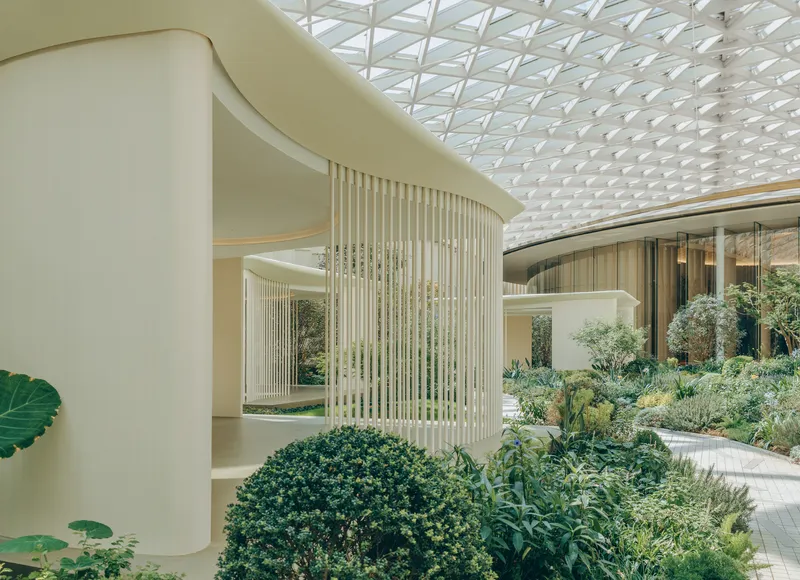
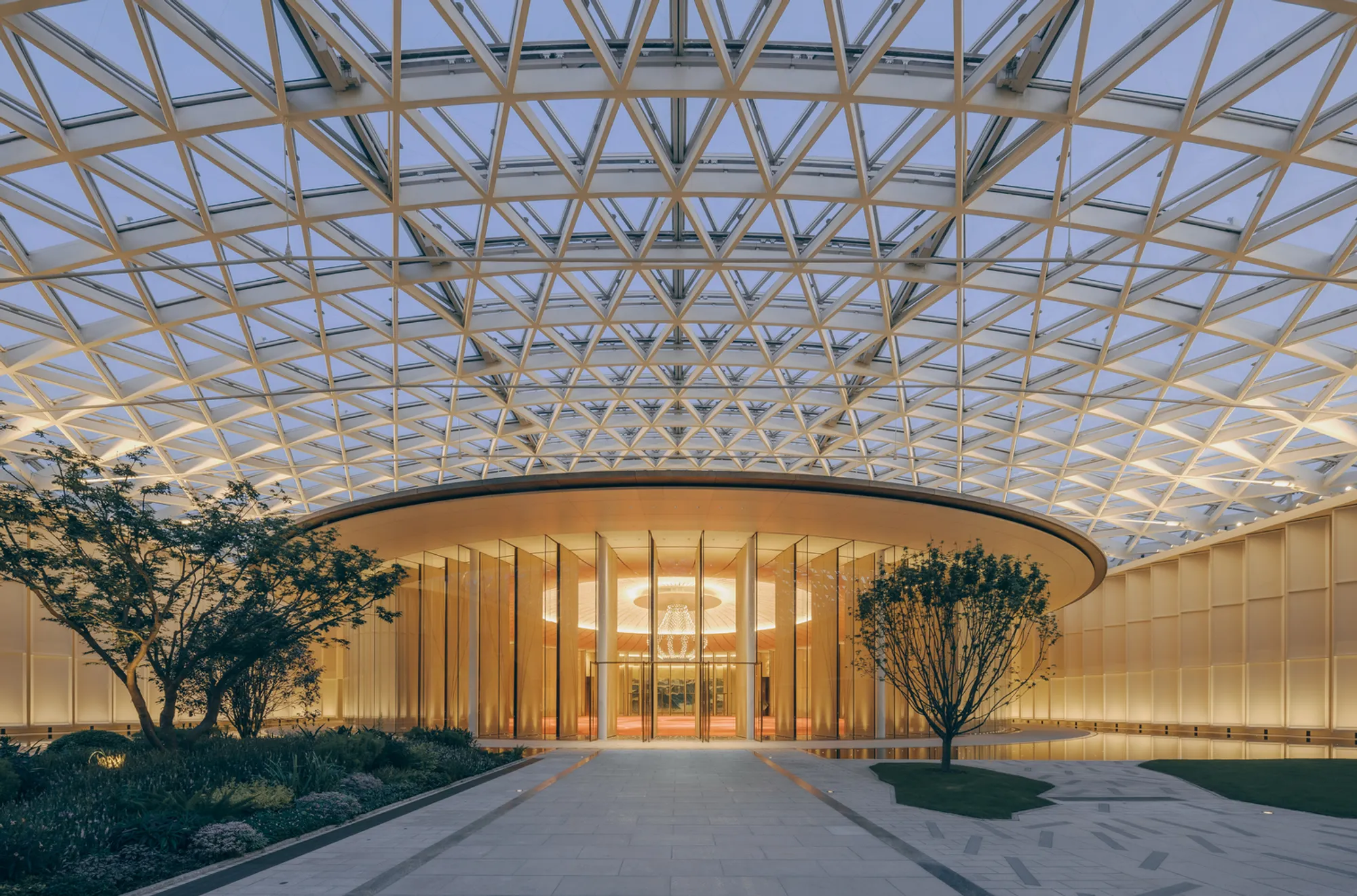
The roof is the building's signature move. Composed of 4,005 equilateral triangular glass skylight panels set within a steel diagrid, it creates interior courtyards that feel closer to landscape than architecture. The geometry is consistent but never monotonous: the triangulated pattern filters light in shifting ways depending on the time of day, casting a lattice of shadows across planted beds, curved screens, and lawn areas below. It is a deliberate inversion of the convention center norm, where interior spaces are typically sealed and artificially lit. Here, the roof functions as a luminous canopy, and the courtyards it shelters become civic rooms open to the sky.
A 2,900 square meter motorized retractable section, the largest of its kind in China, adds a functional dimension to the spectacle. The steel roof was assembled at 52 meters above grade and slid into position hydraulically over 30 days, a construction sequence that required 205 temporary support columns later removed to create the column-free spans below. The structural gymnastics are invisible from the inside, which is exactly the point. What you experience is openness.
Enamel, Steel, and the Logic of the Facade

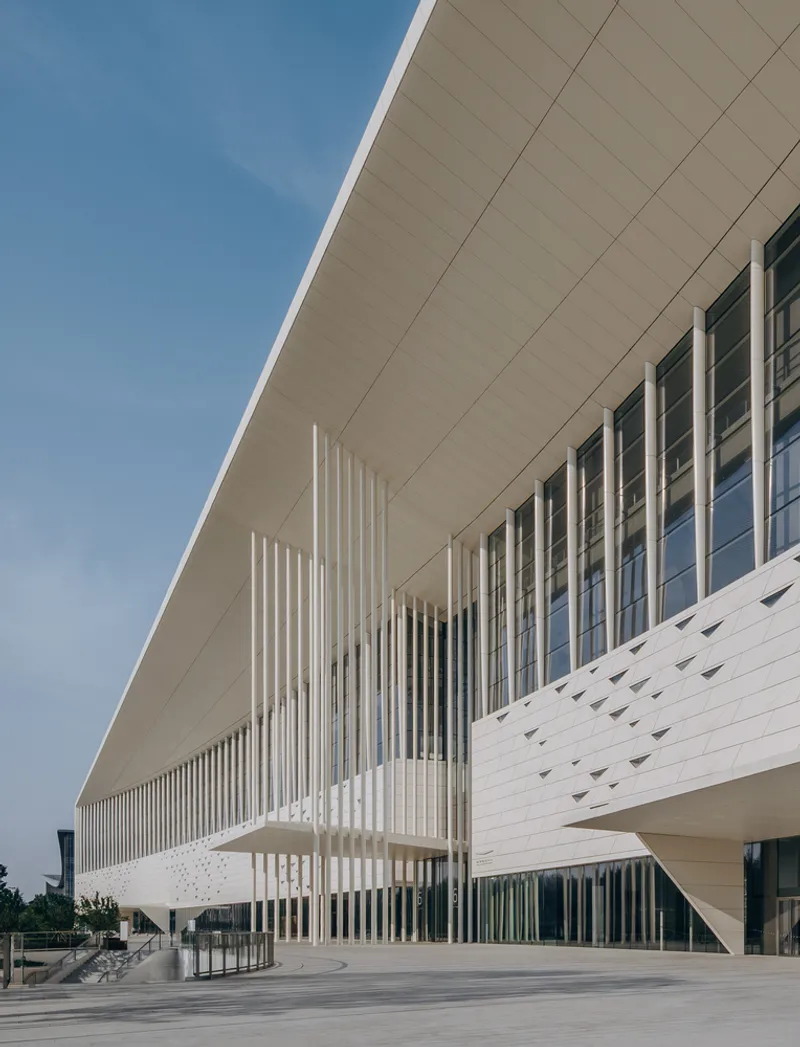
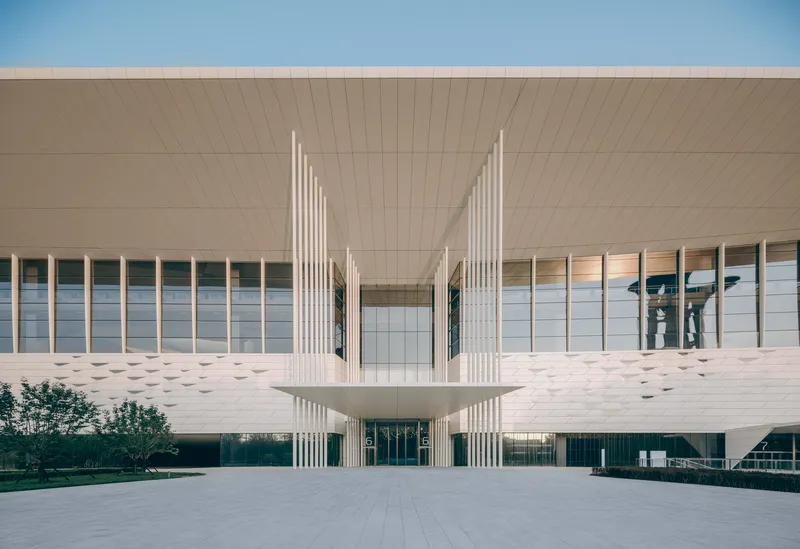
The choice of enamel-coated steel for the exterior cladding is one of the project's most deliberate cultural gestures. Enamel carries deep resonance in Chinese craft traditions, and its crystalline surface gives the panels a luminosity that raw metal or painted aluminum could not achieve. More practically, it is extremely durable, a sensible choice for a building of this civic importance and expected lifespan. The panels are punctured with triangular openings on the east facade and transition into diamond-shaped windows on the north and south elevations, creating a parametric curtain wall that modulates daylight and ventilation across the building's considerable depth.
The east facade's overhanging eaves reference traditional Chinese architecture directly, and vertical white fins articulate the entrance zones with a rhythm that is both structural and ornamental. From street level, the building reads as a continuous, breathing surface. The perforations prevent the mass from becoming a wall; instead, the facade operates as a screen, filtering views in and out and giving the building a porosity that its program, which includes 420,000 square meters of exhibition space and 360,000 square meters of supporting facilities, desperately needs.
Interior Thresholds and Transitional Spaces
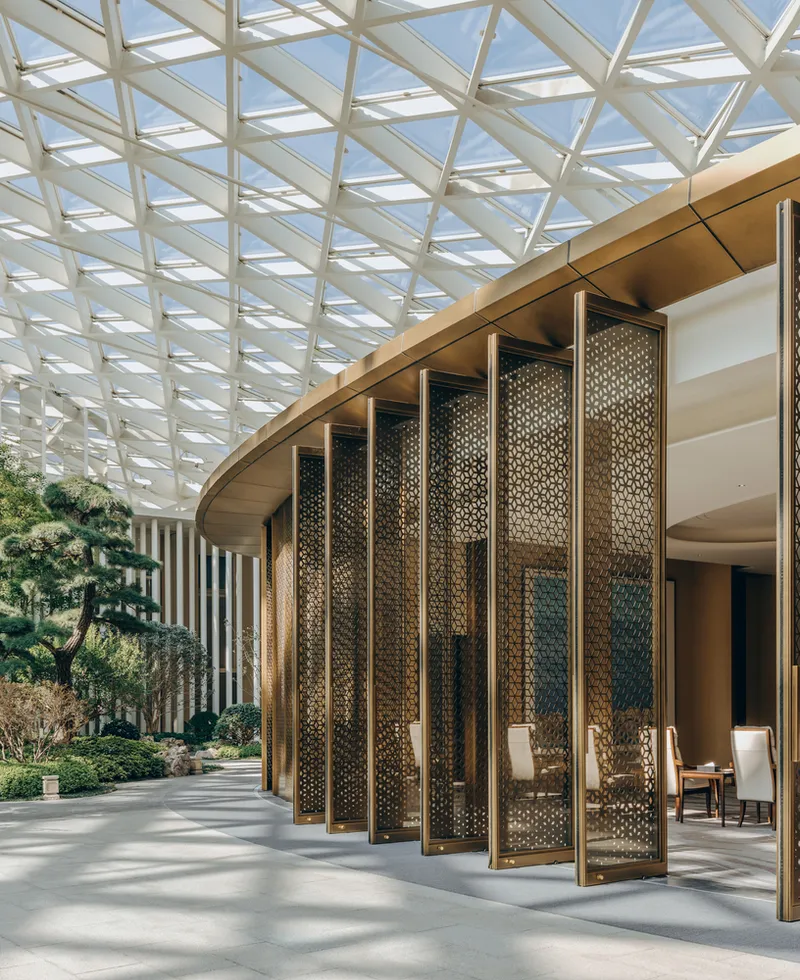
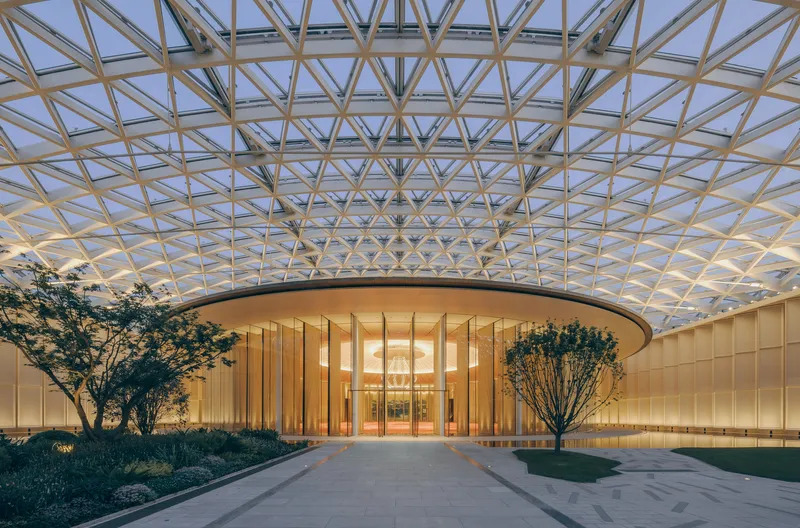
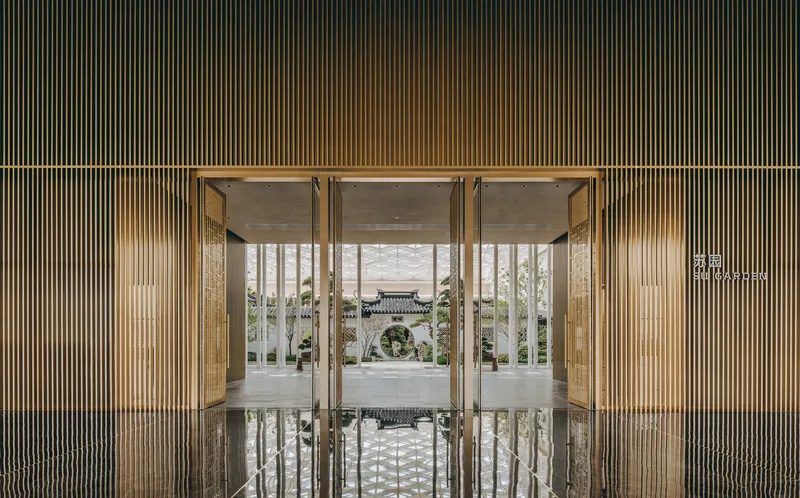
Convention centers live or die at their thresholds. The moment between outside and inside, between public plaza and controlled event space, is where most buildings of this type fail, defaulting to revolving doors and security lobbies. 2Portzamparc has invested heavily in these transitions. Perforated bronze folding screens frame entries beneath the diagrid roof, creating a zone that is neither fully interior nor exterior. At dusk, the covered entrance courtyard with its cylindrical louvered volume becomes a piece of urban theater, lit from within and open to the plaza.
The glass vestibules, framed by vertical timber louvers and reflected in polished stone floors, extend this logic of graduated enclosure. You are never abruptly inside. The building unfolds in layers, each one calibrating the relationship between natural light, material warmth, and spatial scale. For a project of nearly 800,000 square meters, this attention to the in-between is remarkable and, frankly, unusual.
Interior Scale and Material Warmth
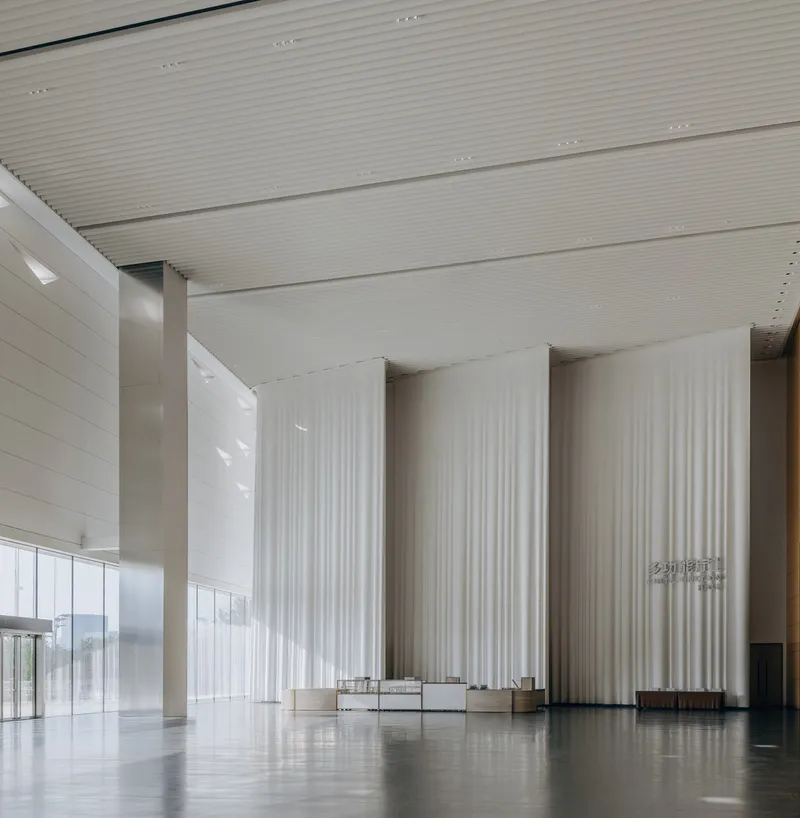

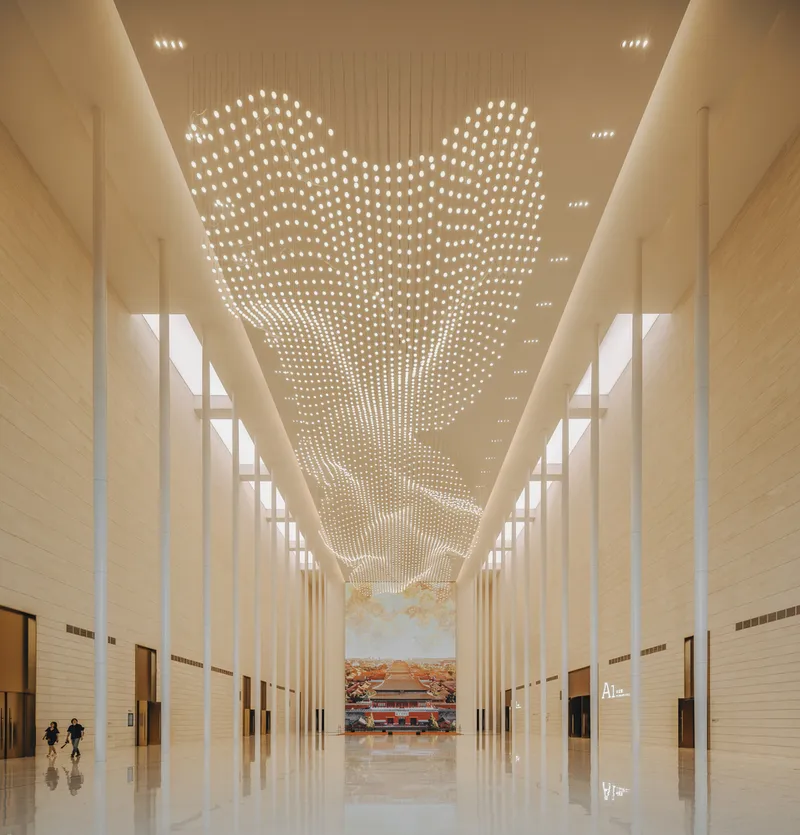
Inside, the building works hard to counteract its own enormity. The double-height lobby with its ribbed ceiling panels and floor-to-ceiling fabric curtains is a space designed for atmosphere, not just throughput. The stone flooring grounds the room, while the curtains soften acoustics and break the visual field into more intimate zones. It is a fundamentally hospitable space, which sounds like a low bar until you consider how many convention centers feel like aircraft hangars with carpet.
Curved corridors lined with angled timber wall panels and warm-toned carpet create a sense of directed movement that the building's vast floor plates would otherwise resist. The perforated ceiling lights in the tall lobby corridors produce a diffused glow that avoids the institutional harshness typical of public assembly buildings. Even the sculptural staircase, a flowing white form set against a glass curtain wall overlooking planted landscape, functions less as a showpiece than as a spatial hinge, connecting levels while offering a moment of visual release.
The Courtyard as Civic Room
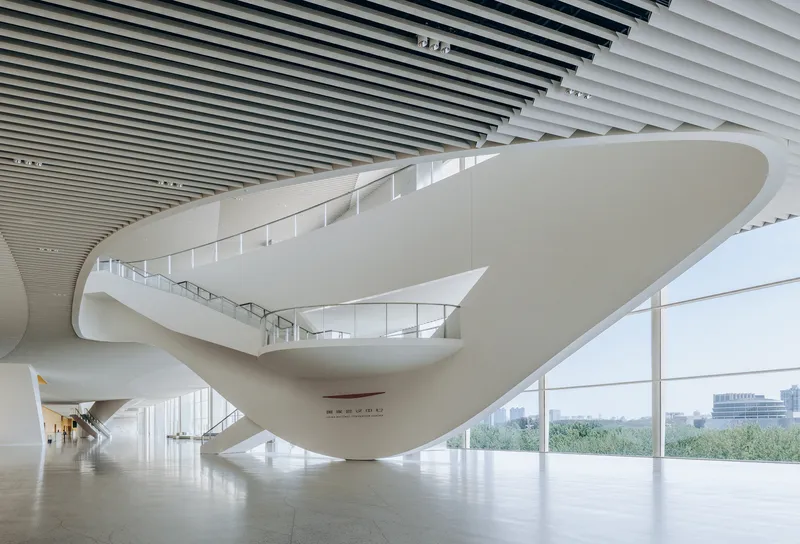
The 9,500 square meters of rooftop gardens on Level 3, combined with the planted interior courtyards, represent a real commitment to integrating landscape into a building type that rarely makes room for it. The courtyards, sheltered by the triangulated glass roof, function as orienting devices within the plan. In a building this large, legibility is a design problem as much as signage is, and the courtyards provide visual anchors that help visitors locate themselves without constant reference to maps or digital wayfinding.
Landscape consultant Florence Mercier Paysagiste deserves credit here. The planted beds, lawns, and trees beneath the glass canopy are not decorative afterthoughts; they are spatial infrastructure, defining edges, creating shade, and introducing seasonal change into what could easily be a hermetically sealed environment.
Why This Project Matters
Convention centers are typically architecture's least loved building type. They are too big, too generic, and too beholden to operational logistics to attract serious design attention. The China National Convention Center Phase II challenges that assumption directly. 2Portzamparc has produced a building that takes its cultural context seriously, deploys structural innovation in service of spatial quality rather than spectacle, and treats the act of gathering as something worthy of architectural care. The LEED Platinum and Three-Star certifications are not greenwashing gestures; they reflect genuine decisions about daylighting, passive shading, and material longevity.
More broadly, CNCC II demonstrates that the mega-scale civic building, a type that seemed to belong to the early 2000s Olympic boom, still has architectural life in it. The key is specificity. By rooting the design in the particularities of Beijing's axis, in Chinese material traditions, and in a clear formal concept, the bird in flight, 2Portzamparc has avoided the trap of producing another interchangeable global box. Whether this building ages as gracefully as its enamel facade promises remains to be seen, but as a statement of intent, it is among the most ambitious convention center designs completed this decade.
China National Convention Center Phase II by 2Portzamparc, with cooperative design by Beijing Institute of Architectural Design (BIAD), landscape by Florence Mercier Paysagiste, facade by TESS, and MEP by WSP. Located in Olympic Park, Beijing, China. Approximately 785,000 square meters. Completed 2025. Photography by Yumeng Zhu.
About the Studio
Share Your Own Work on uni.xyz
If projects like this are the kind of work you want to make, uni.xyz is a place to publish your own, find collaborators, and enter design competitions.




Popular Articles
Popular articles from the community


The Earth Pod: 3D Printed Homes for Resilient Refugee Communities
The Earth Pod reimagines refugee housing through 3D printed homes made from clay, combining resilience, self-sufficiency, and rapid shelter.

AL-JANNAH: Sustainable Architecture and Permaculture for Afghan Widows
AL-JANNAH uses sustainable architecture and permaculture to create resilient oasis of housing, learning, work and renewal for Afghan widows.

Conexión: Biophilic Design Reimagines High-Rise Living in Hong Kong
Conexión reimagines high-rise living in Hong Kong through biophilic design, green facades, shared spaces, daylight, water and nature within.

Hill & Cross Opera: Sculptural Opera House Architecture Shaped by Tallinn’s Landscape and Identity
Hill & Cross Opera reimagines opera house architecture in Tallinn through its sculptural hill, civic plaza, glass wave and a luminous cross.

Similar Reads
You might also enjoy these articles


Hodi-Mandai Geram
Project Function: Preservation and revitalization of the Intangible heritage and socio-spatial identity of the Hodi by Housing, Cultural Memory Center, Sacred Grove, landscape, local tourism economy


Olio Towers: A Mid-Rise for Performers That Fuses Housing, Rehearsal, and Stage
Located blocks from Houston's Theater District, this modular tower stacks living units around a central performance atrium.

Oasis: Modular Green Housing Carved into Dhaka's Urban Fabric
A shortlisted Plugin Housing entry reclaims unauthorized settlements in Dhaka with stepped concrete volumes, green roofs, and ventilation-driven design.

Black Hole: A Floating Megastructure for the Post-Physical Era
Emiliano Mazzarotto envisions a spherical, self-scaling arena where e-sports, digital hotels, and holographic stadiums replace traditional public space.

Explore Convention Centre Competitions
Discover active competitions in this discipline



Challenge to reimagine the Iron Throne


Photograph architecture without architects


Illustrate the lost glory of Angkor Wat - Render Challenge


Bring back Drive In's
Comments (0)
Please login or sign up to add comments
No comments yet. Be the first to comment!