
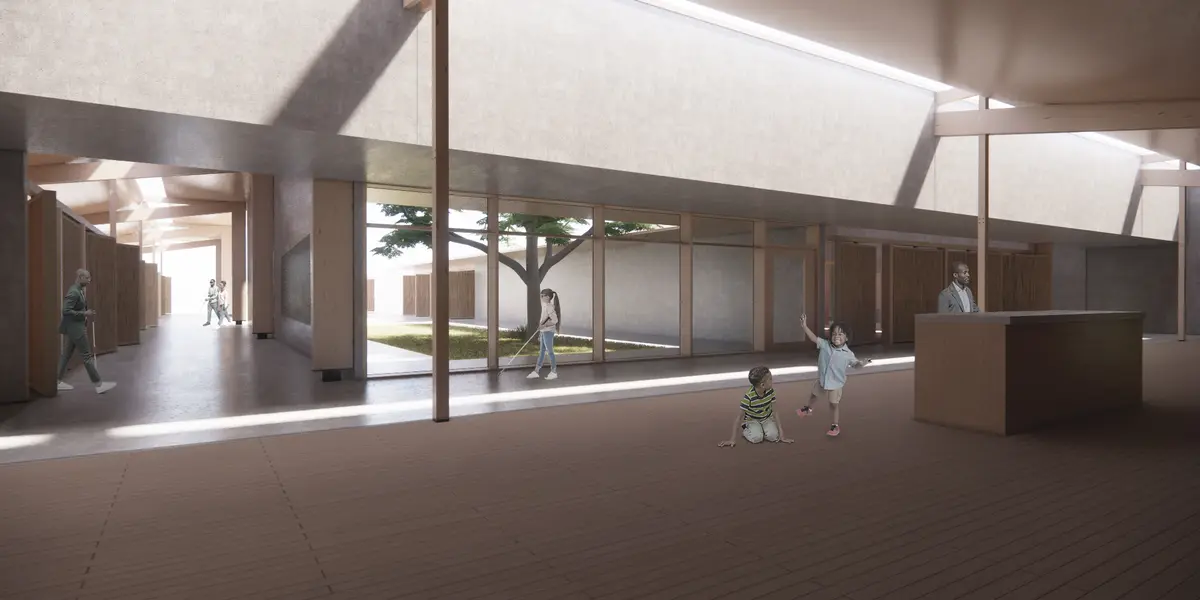
Gauteng Multisensory Center
Learning Center for the Visually Impaired

Sight is the sense that we rely the most on. When walking into a building, we stop and look, we find direction, information about the space, or materiality through our eyes. However, when involving the rest of our senses, sight is enhanced, and our experience in space is improved.
The Gauteng Multisensory Center explores the concept of a building for those that are visually impaired to learn normal-life activities. The incorporation of adapted kitchens and different learning zones is crucial programmatically. However, this building has a big focus on the experience while inhabiting it. After several months of testing how different materials sound against each other (i.e. the metal tip of a cane against concrete vs wood) and visiting different spaces through my other senses, it was clear that our encounter with a space is highly determined by how we receive sound.
Putting into practice this observation into t, a clear separation between spaces (i.e. circulation and learning zone) was not created by walls or enclosure, but by reverberation. Sound absorbing materials such as straw, used in the rotating partition walls, allow quieter and more intimate learning. A concrete curved wall, on the other hand, concentrates and bounces off the sound toward the students at the auditorium.
Tactility is as well another important factor when it comes to exploring a space. Textures and patterns are cast in the concrete of the walls that define the circulation areas, incentivizing the learning of different patterns and symbols. Our skin is not the only one that can that gives us direct information about our surroundings. When using a cane, the softness or hardness of the material is conducted, and therefore, any change in its continuity is felt. Expansion joints are aligned with the beginning and end of a classroom, which is as well aligned with the structural grid, columns, and beams. This way, information about spaces is also transmitted.
A series of skylights are parallel to the hallway. They not only bring the light in but also create a high contrast between the natural light and the ceiling, allowing those with partial or low visibility to easily distinguish the direction.
A curved and sloping roof brings in the natural light from its highest point adjacent to the skylights. The curvature softens the light, sliding it toward its lowest point, where the more intimate classrooms are located.
The form of the building also expresses enclosure vs openness. A courtyard is tucked in between three sides of the building, providing a quiet outdoor space with access to the auditorium and circulation spaces. The courtyard opens up on the fourth side towards another, more public and open, green area. Such is exposed to the rest of the public site, where more vegetation is found. Thanks to this openness toward the public, expansion of the building is possible in the future. its modularity form will make this an easy project to add on to, without losing the scheme and hierarchy of circulation versus learning areas.
In conclusion, this project shows the ability to involve more than just our sight when inhabiting a space, and how this is beneficial to achieving equitable architecture.

Popular Articles
Popular articles from the community


Conexión: Biophilic Design Reimagines High-Rise Living in Hong Kong
Conexión reimagines high-rise living in Hong Kong through biophilic design, green facades, shared spaces, daylight, water and nature within.

ALGAL REALM: A Bio-Integrated Lunar Habitat Design for Life Beyond Earth
ALGAL REALM reimagines lunar habitat design with algae-powered life support, 3D-printed regolith, and vertical living for a lunar future.

Co-life: Sustainable Architecture for Age-Friendly Community Living
Co-life reimagines sustainable architecture for seniors through courtyards, rammed earth, shared gardens, and spaces designed for belonging.

The Ocean Hive: Sustainable Architecture for a Self-Sufficient Civilization at Sea
The Ocean Hive imagines sustainable architecture at sea, where modular habitats, algae, wave power and ocean waste sustain a growing colony.

Similar Reads
You might also enjoy these articles

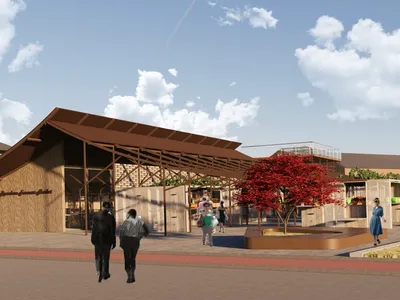
The Rhythm of Seasons
A Farmers' Market Connecting Nature and the City

More Than a Building-Designing a Living System
More Than a Building-Designing a Living System
Base Beyond
DESERT COMPOUND ARID: TOURISM OF ABSENCE AND ABUNDANCE

Explore Multi-Sensory Architecture Competitions
Discover active competitions in this discipline


Challenge to reimagine the Iron Throne

Photograph architecture without architects

Illustrate the lost glory of Angkor Wat - Render Challenge

Design challenge to reuse E-waste
Comments (0)
Please login or sign up to add comments
No comments yet. Be the first to comment!