
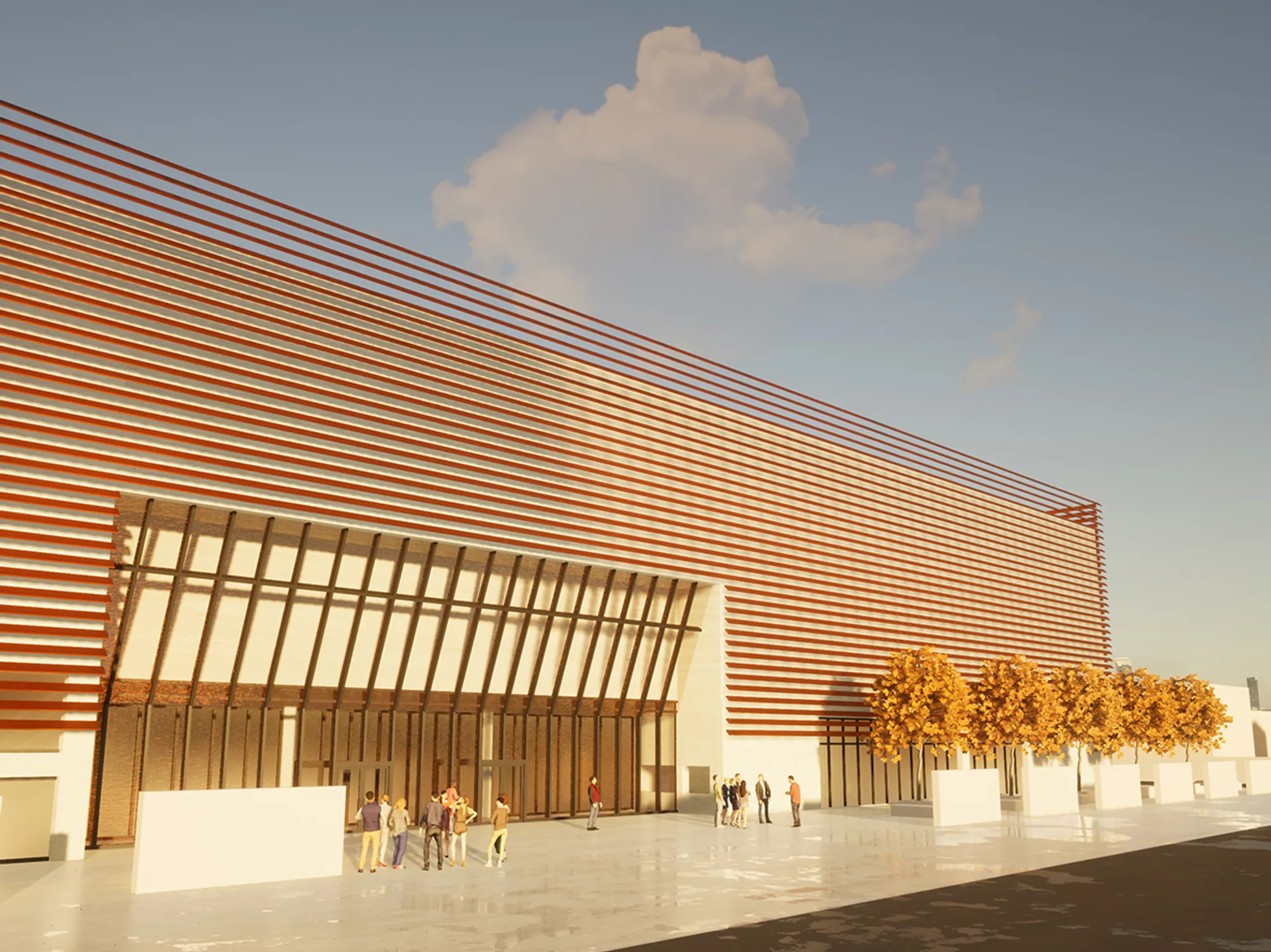
PERFORMING ARTS CENTER IN BERLIN
The project of the Performing Arts Center in Berlin, which is a place for performing arts such as music, dance or theatre.

Architecture has always served all the needs and requirements of society. It also fostered the evolution and definition of the performative arts through a variety of iconic buildings, stage surfaces, and applied acoustic mechanisms in different parts of the world. Among them, France, Italy and Germany witnessed many of the first institutions and spaces for the performing arts that showed off the greatness of artists and unique architectural styles.
The ever faster pace of life, the dependence of society on the mass media, which often flatten the deeper layers of the content published there, less and less ability to focus attention on a longer audiovisual message and sometimes human disconnection from full awareness of the surrounding world leads to the desire to look for solutions and places, which will restore such experiences of art.
The aim of the project is to create a convenient place for the performing arts. The designed object - A Conservatory For Performing Arts - is to contribute to the full and conscious experience of art - passive - through its reception during concerts and performances, or active, while learning to play instruments, singing or acting - both at the level of training and the final form of speeches and their reception by the audience. The facility aims to create an environment conducive to connecting people with art in the hustle and bustle of bustling Berlin. It is supposed to be a place of permanent work for professionals and at the same time open to music, dance or acting enthusiasts - for all interested people, enabling the preparation of programs that are available and useful for the local community.
The project consists of a main stage with an audience surrounded by the necessary functional zones. They were divided into a zone closed for artists and professionals, within which the following were created:
• main stage,
• main rehearsal room, approximately corresponding to the dimensions of the main stage,
• music training room,
• dance training room.
A public zone has also been separated - for viewers participating in the events taking place on the premises of the facility, within which the following have been separated:
• audience,
• a foyer with cloakrooms,
• exhibition spaces and smaller galleries as well as relaxation zones,
• lecture hall,
• workshop and class rooms for interested people.
The place is served from Bitterfelder Str., which widens towards the intersection on the eastern side of the plot, therefore the proposed entrance for cars into the property is organized from the west. The 6.0 m wide entry road leads to the proposed car park on the adjacent plots. From the car park, you can drive towards Boxberger Str.
The entrance street also serves trucks and vans, enabling the transport of stage equipment, deliveries to cafes and the collection of waste from the waste rooms located in the northwest corner.
At the border of the plot, on the side of Bitterfelder Str., walls have been installed as acoustic screens, reducing unfavorable sounds coming from the road. In the vicinity of the walls, there are benches with pots with trees planted in them. For aesthetic and acoustic reasons, on the plot boundaries there are green walls isolating the building from the neighboring plots. On the north-eastern side, bicycle stands are located behind the acoustic walls.
The main entrance for the public is organized on the North-East side. Employees have separate entrances: to the cafe - on the north-west side, while the entrance for artists and other employees of the facility has been designed, together with the concierge, on the south-west side.
The main goals of the project are to ensure:
• Accessibility of the facility to promote openness and a sense of community among people of all backgrounds, including people with disabilities.
• Inclusiveness, accessibility for everyone (different social and age groups), through such functional and spatial solutions that will enable dialogue between artists and visitors.
• Adaptability, or functional variability or flexibility, through easy use of spaces present in the facility for various activities, also outside performances.
• Promotion of all forms of dance and music through active participation, as well as exhibitions, presentations, meetings.
The above goal were the starting point for the concept of the project - designed as a music and dance center with a stage that can also be accessed by the community for various types of activities such as music performances, festivals, etc.
The main assumption of the project was to create A Conservatory For Performing Arts, which will fulfill the basic functions of artistic activities such as music, dance and theater. The aim of the project was to create a place that would provide space for both the performances of actors and musicians for the audience, as well as for private and group training sessions. Thanks to this combination, the facility has gained a multifunctional character, making it a place accessible to everyone, from professional artists, through more amateur artists, to the final recipients of art. Thanks to the arrangement of individual rooms, the building has been divided into comfortable zones and corresponding functions.


Popular Articles
Popular articles from the community


Co-life: Sustainable Architecture for Age-Friendly Community Living
Co-life reimagines sustainable architecture for seniors through courtyards, rammed earth, shared gardens, and spaces designed for belonging.

The Musturak Paradise: Senior Living Architecture for a Connected Future in Temara, Morocco
The Musturak Paradise reimagines senior living architecture in Temara via private homes, social spaces, culture, community, and shared care.

Lunar Spiral: Space Architecture Shaped by the Mathematics of the Universe
Lunar Spiral reimagines space architecture through Fibonacci geometry, lunar regolith, levitating habitats, and self-sustaining Moon living.

Conexión: Biophilic Design Reimagines High-Rise Living in Hong Kong
Conexión reimagines high-rise living in Hong Kong through biophilic design, green facades, shared spaces, daylight, water and nature within.


Similar Reads
You might also enjoy these articles
The Rhythm of Seasons
A Farmers' Market Connecting Nature and the City

More Than a Building-Designing a Living System
More Than a Building-Designing a Living System
Base Beyond
DESERT COMPOUND ARID: TOURISM OF ABSENCE AND ABUNDANCE
Explore Performing Arts Center Competitions
Discover active competitions in this discipline



Challenge to design locus for the upliftment of human rights

Bring back Drive In's


Design challenge to reuse E-waste
Comments (0)
Please login or sign up to add comments
No comments yet. Be the first to comment!