
Plugin House by Ainaz Alafchi, Faeze Ghazanfari, Mozhgan Mousaeipour
An adaptable modular housing model addressing affordability, energy efficiency, and sustainability for resilient urban living.

As cities expand and housing costs soar globally, innovative and sustainable solutions are urgently needed to address the growing housing crisis. The Plugin House project, a shortlisted entry in the Plugin Housing Challenge, offers a replicable and adaptive model grounded in "modular housing architecture"—a solution that is not only affordable and efficient but also resilient and environmentally responsive.
The Global Housing Crisis
Housing affordability continues to be one of the most pressing challenges of our time. The World Bank projects that by 2025, over 1.6 billion people will be affected by housing shortages. In a global survey of 200 major cities, nearly 90% were deemed unaffordable, with average housing prices exceeding three times the average household income. The International Monetary Fund reports that in most nations, the cost of housing is increasing at a pace much faster than wage growth, placing immense pressure on urban populations. This disparity underscores the urgent demand for innovative, scalable, and sustainable housing models that can be implemented quickly and affordably across regions.
Tehran’s Housing Landscape
Tehran, Iran's capital and most populous city, faces immense strain from a continuous influx of internal migrants seeking education and employment opportunities. This high rate of urban migration has led to overcrowding, the proliferation of informal settlements, and deteriorating living conditions. In particular, District 17 has become emblematic of the city’s housing crisis, where a majority of low-income residents reside in aging, inefficient, and congested housing stock. Addressing these challenges requires innovative urban strategies that consider social equity, economic accessibility, and environmental responsibility.
Site Strategy
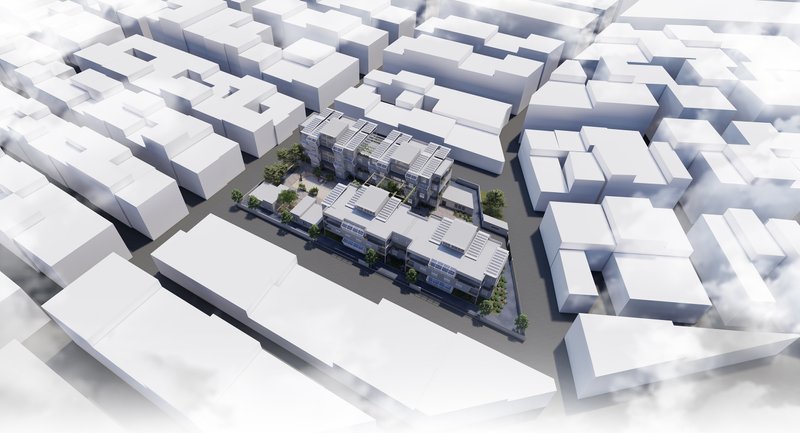
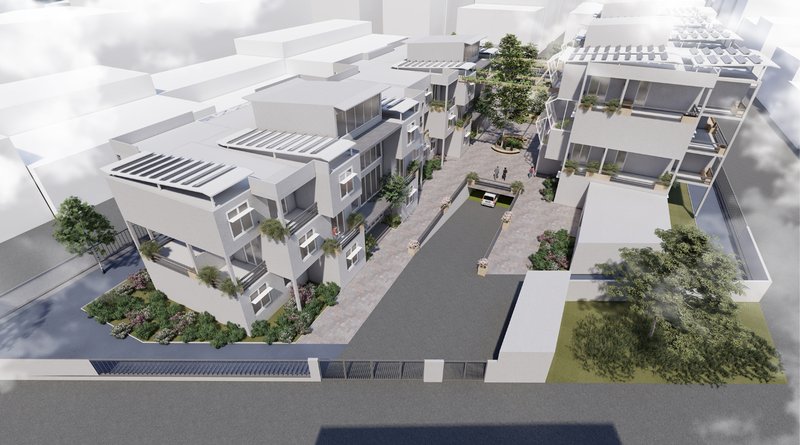
Due to the unavailability of vacant plots, the design team identified a regenerable area within the city’s worn-out urban fabric. The site, bordered on all four sides by roads and slightly oriented to the east, posed geometric and spatial limitations due to its trapezoidal shape. Nonetheless, it presented a unique opportunity for redevelopment. The designers prioritized creating vibrant courtyards and shared public spaces, using spatial geometry and climate analysis to optimize daylighting, reduce energy dissipation, and enhance natural airflow throughout the site.
Design Evolution and Concept
Initial Concept – L-Shaped Module: The initial proposal adopted an L-shaped module layout, which, while providing maximum contact with the external environment, introduced several challenges. These included excessive thermal loss, spatial inefficiency, and an inability to form communal spaces of value due to limited site width and overcrowded layout.
Final Concept – Rectangular Modular Block: The evolved design shifted to a cuboidal configuration, optimizing internal layout and increasing volumetric efficiency. This form significantly enhanced environmental performance by promoting better cross-ventilation, maximizing passive daylighting, and reducing construction waste through more efficient material dimensions. Furthermore, it enabled a better site arrangement, encouraging the creation of green corridors, pedestrian-friendly paths, and public gathering zones within the neighborhood.
Project Objectives
- Modular, Prefabricated Housing: Leveraging prefabrication and modular construction, the housing units use pre-cast concrete elements that are cost-efficient, time-saving, and significantly reduce on-site material waste.
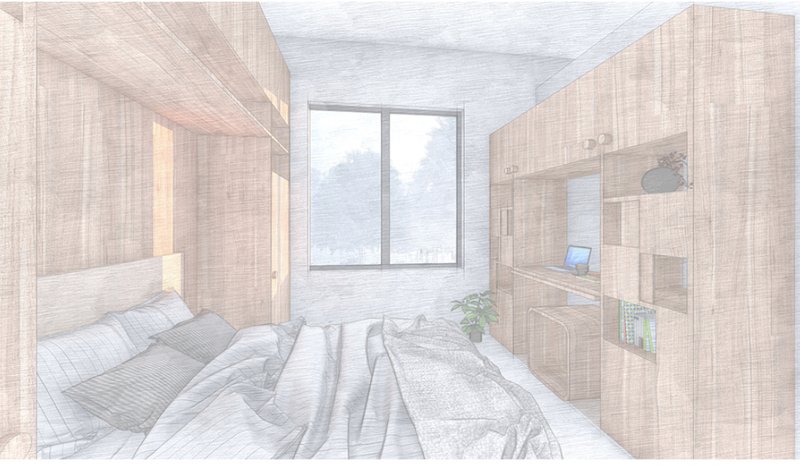
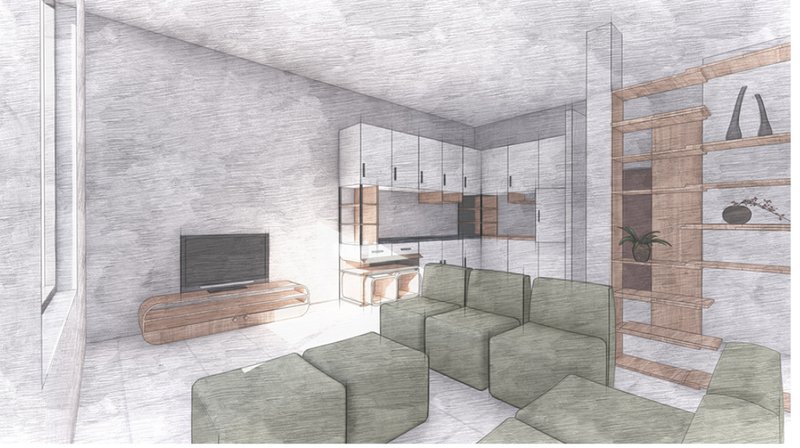
- Flexible Furniture & Interior Use: The interiors are designed to be modular, with furniture systems that allow residents to transform their spaces based on evolving lifestyle needs, supporting adaptability over time.
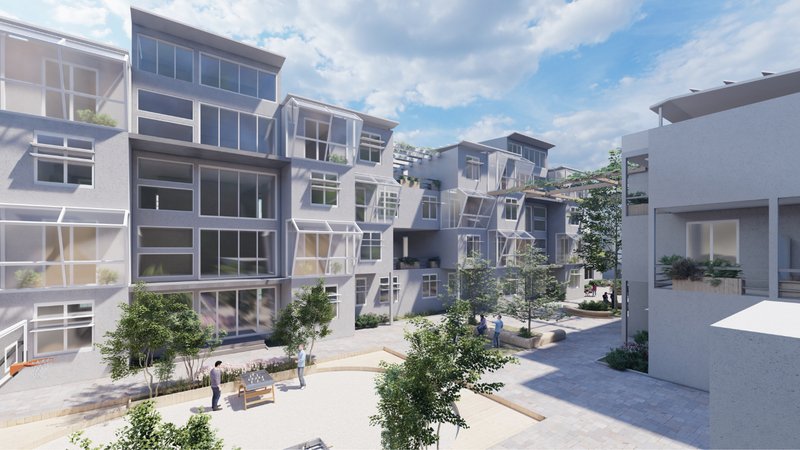
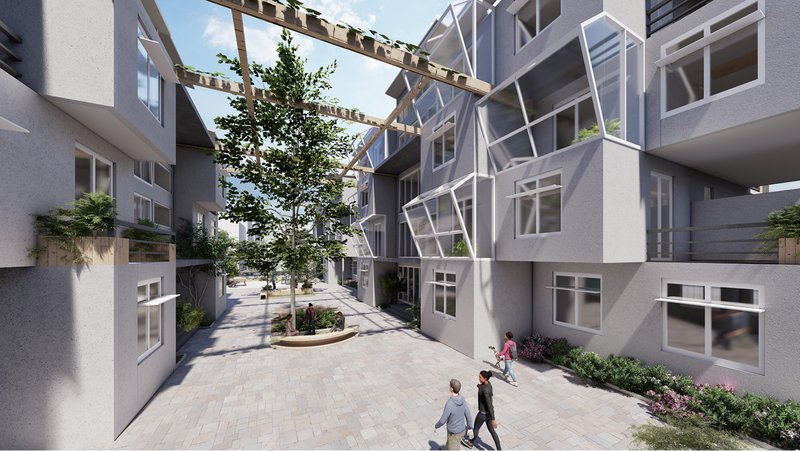
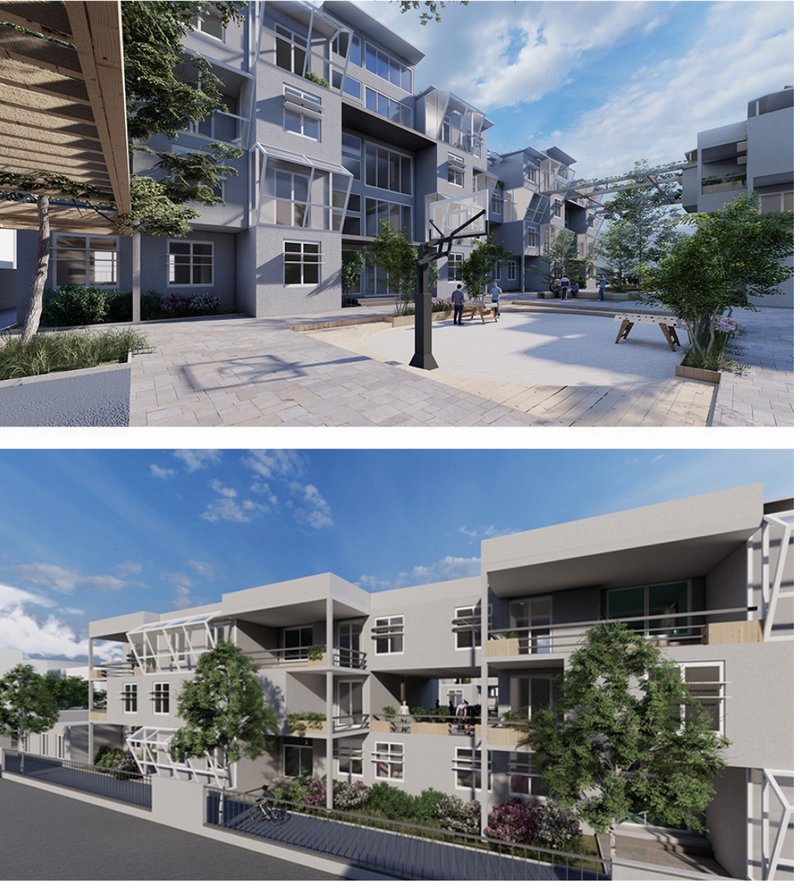
- Interactive Public Spaces: Open courtyards, shaded walkways, and recreational spaces are interspersed among the residential clusters to strengthen social interaction and collective urban living.
- Daylighting and Ventilation: The design incorporates a dual-shell roof topped with photovoltaic panels and ventilated cavities to cool interior spaces, reduce heat island effects, and achieve near net-zero energy consumption.
Sustainability Performance
Comprehensive computational simulations, including CFD and solar daylight analysis, guided the environmental responsiveness of the project. Key innovations include:
- Optimized solar orientation with light shelves and shading devices to minimize glare and reduce reliance on artificial lighting.
- Seasonal greenhouses that buffer thermal fluctuations, creating energy-efficient transitional spaces in both summer and winter.
- Rooftop photovoltaic panels strategically placed for maximum solar gain, directly supporting the energy demands of the buildings while reducing the carbon footprint.
The Plugin House is a forward-thinking response to one of the most urgent issues of the 21st century—housing affordability. It is a robust demonstration of how modular housing architecture can integrate flexibility, environmental efficiency, and urban livability. Designed to be replicated across similarly dense and economically strained urban fabrics, this project exemplifies how responsible architectural intervention can restore dignity and functionality to underserved communities.
Project by: Ainaz Alafchi, Faeze Ghazanfari, Mozhgan Mousaeipour


Popular Articles
Popular articles from the community

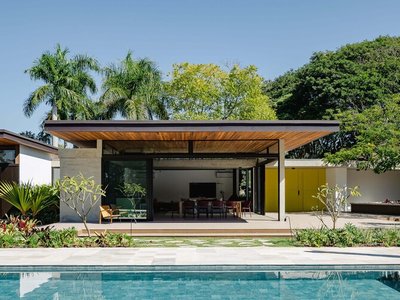
Flamboyant House by Juliana Camargo + Prumo Projetos
Modern Brazilian house integrating existing tree, pool, and volumes with glass, wood, and transitional spaces blending interior, exterior, and landscape seamlessly.
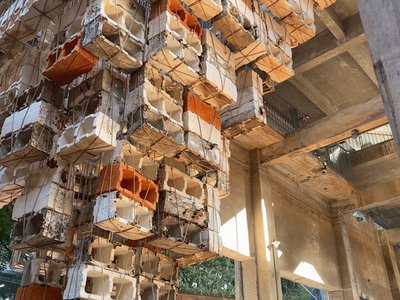
Inverted Architecture Installation by Studio Link-Arc: Exploring the Intersection of Architecture and Living Organisms
Inverted Architecture Installation by Studio Link-Arc blends mycelium, sustainability, inverted design, ecological cycles, and urban adaptive architecture in Shenzhen.
Atelier Macri Concept Store Interior Design by CASE-REAL
Atelier Macri store features a "ko" counter, walnut wood details, cork displays, blending retail, gallery, and seamless customer experiences.
Treehouse Apartment: A Warm Timber Interior Blending Craft, Play, and Contemporary Living
Warm timber apartment with integrated treehouse, combining natural materials, craftsmanship, and playful design to create a flexible, family-oriented living environment.

Similar Reads
You might also enjoy these articles


The Ken Roberts Memorial Delineation Competition (Krob)
As the most senior architectural drawing competition currently in operation anywhere in the world, it draws hundreds of entries each year, awarding the very best submissions in a series of medium-based categories.


Waterfront Redevelopment and Urban Revitalization in Mumbai: Forging a New Dawn for Darukhana
A transformative waterfront redevelopment project reimagining Darukhana’s shipbreaking heritage into an inclusive urban future.

OUT-OF-MAP: A Call for Postcards on Feminist Narratives of Public Space
Rhizoma Design and Research Lab invites artists, designers, architects, researchers, and students to reflect on how feminist perspectives can reshape public space. Selected works will be exhibited in Barcelona, October 2026. Submissions open until 15 April 2026.


Documentation Work on Buddhist Wooden Temple
Architectural syncretism and cultural hybridity: A comparative study of the Buddhist temples in Chattogram Hill tracks
Explore Low Cost Design Competitions
Discover active competitions in this discipline




The Global Benchmark for Architecture Dissertation Awards

Challenge to design mud housing for contemporary communities
Comments (0)
Please login or sign up to add comments
No comments yet. Be the first to comment!