
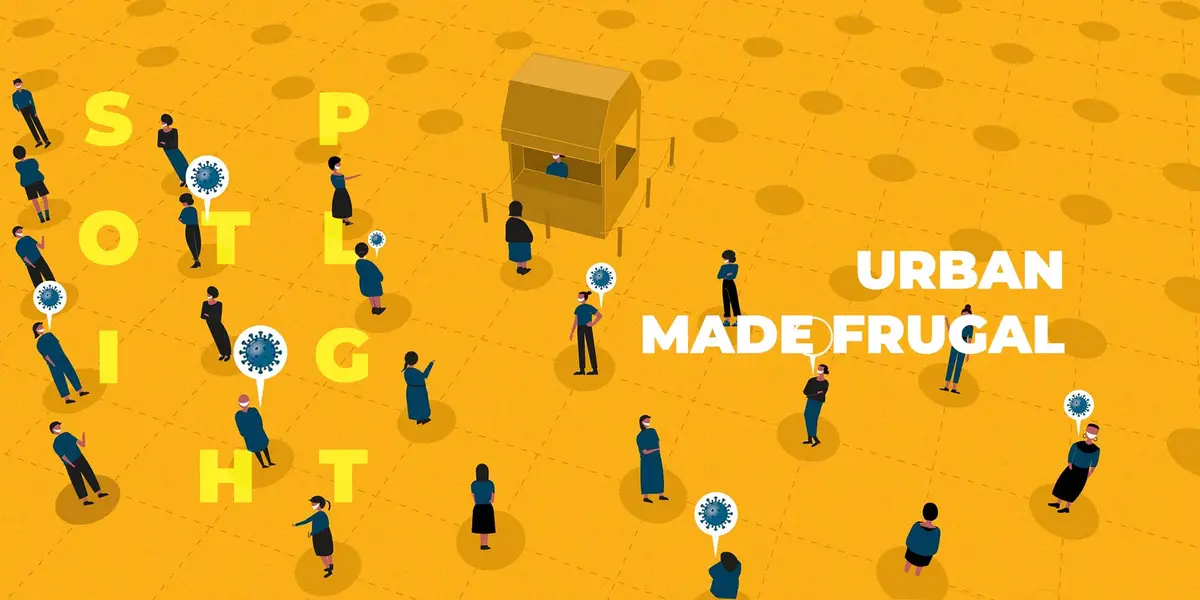
Tactical Urbanism Is Shaping Our Future
Many countries are adapting temporary urban tools to shape their response towards the ongoing crisis


Figure 1: (Left) Temporarily protected bicycle lane in Berlin Photo: Paul Zinken/DPA - (Right) Sidewalk Extension in DC, USA Image by BeyondDC licensed under Creative Commons.

Figure 2: (Left) Chalk circles drown out to keep people apart in Kolkata, India. Photo: Rupak De Chowdhuri/Reuters - (Right) Italians keeping distance at a supermarket in Milan. Photo: Emanuele Cremaschi/Getty
.

Figure 3: (Left) Dividing public space through visual cues in Singapore. Photo: Rupak De Chowdhuri/Reuters - (Right) Tape over tables and chairs as a precautionary measure in café Photo: MatadorNetwork
A tinge of positivity in the harrowing times – these pictures have become a statement, a sobering image of change and for some a necessity. But what threads them together, is the intent. A DIY solution to accustom the city towards an impertinent change.
These temporary changes to the built environment are known as Tactical Urbanism. Or in other words low-cost, temporary changes that are undertaken in cities to improve local neighbourhoods. Its foundation is rooted in the total reversibility, adaptability and recycling of an existing landscape.
Tactical urbanism can involve many forms of interim improvements. Like widening of sidewalks and bike lanes with painted concrete blocks. Also plants, urban furniture, temporary patios or terraces functioning as cafes, restaurants, etc.
How are cities adapting these tools?
The modern usage coined by urban planner Mike Lydon in 2010 has become an irrefutable design tool. Cities all over the world are using Tactical Urbanism to put in place the much needed physical distancing. Countries like Malaysia, Singapore, Bhutan are using barricades, tapes, stanchions, delineators to texture an ordered movement. In Chicago, many sidewalks are offering uplifting messages with words “Let’s be all well".
While in India, circles were chalked in front of shops for the public to proceed on a first-come-first-served basis.
Countries have adapted this language in their architecture interventions, primarily due to the ease in accessibility. As Tony Garcia, Lydon's co-author said “Somewhere in your city, some department store has a lot of (traffic) cones sitting around right now. Anything that’s going to make a street look like a construction site is going to slow a city down.”

Figure 4: Traffic cones being used in front of testing facility in Philadelphia area. Picture: The Philadelphia Inquire
Regenerating our cities
Tactical Urbanism is also aiding cities to mobilize an urban level post-pandemic change.
In New Zealand transport minister, Julie Genter invited cities to apply for 90% funding to widen sidewalks and create temporary cycleways. The intent is to provide extra space for key workers to mobilize. So that they maintain physical distance in the absence of an efficient public transit. This policy will put the infrastructure in place within days rather than in months. But the government had been testing this tool sporadically before the pandemic. Only now has it decided to roll out the technique to improve the city’s coherent functioning.
Inspired by the policy, councils in London, Manchester and Brighton are now drawing up proposals to ban motorized traffic. In order to convert roads into temporary cycle lanes. This is also being seen as a potential change in how cities want to map their future. A shift from automobile intensive planning to a pedestrian and eco-friendly interface.
And they are planning to do so by implementing tools that bring social and behavioural change. These tools are rooted in the accidental world of tactical urbanism. For instance, in the States, owners are restricting cars to park in front of their shops. This is inadvertently leading to the expansion of sidewalks. And no one is batting an eye at the intervention, but instead are embracing it.
It is an effective way to transform places, gather public and political support, and then see how successful it is before implementing it permanently. These short term temporary actions become useful in initiating a long term change.
Final Note
Over the past decade, tactical urbanism has become a movement. It is temporary. It is cheap. It is a tool with diverse bandwidth bringing a shift in how communities function.
It has also become a necessity in substantiating ordered social change in cities during the pandemic. Despite the restricted movement, people will have to go outside. Especially essential workers who are traveling and risking their lives on a daily basis. The importance of leveraging solutions that can be put in place at an efficient speed becomes paramount. So rather than planning out a time-consuming reinvention, involving a lengthy analysis and public process – emergency interventions are the need.
When frugal meets urbanism, tactical urbanism finds its meaning.
Like what you just read? The appreciation button below is a clear way to motivate our editorial team to pen useful things for you to learn.
Do you have something similar to write about? Why not reach out to us on editors@uni.xyz? Share your thoughts/appreciations and feedback. We'd love to listen!


Popular Articles
Popular articles from the community


Play: Fragments of Their World
Familiar architecture becomes modular playground design, creating safe spaces where displaced children can learn, connect, imagine and play.

Hill & Cross Opera: Sculptural Opera House Architecture Shaped by Tallinn’s Landscape and Identity
Hill & Cross Opera reimagines opera house architecture in Tallinn through its sculptural hill, civic plaza, glass wave and a luminous cross.

Co-Life: Senior Housing Design That Reconnects Older Adults With the City
Co-Life reimagines senior housing design through healing gardens, shared streets, workshops, and a sustainable community across generations.

Conexión: Biophilic Design Reimagines High-Rise Living in Hong Kong
Conexión reimagines high-rise living in Hong Kong through biophilic design, green facades, shared spaces, daylight, water and nature within.

Similar Reads
You might also enjoy these articles

Day and Night Park: A Time-Based Urban Newsstand in Beijing
A temporary urban newsstand in Beijing blending travel, light, and reading through poetic colors, compact form, and community-focused design.

Modernist Patio Renovation in El Masnou, Barcelona by Oliver Segura Arquitectura + Cebrià Arquitectura
Modernist patio renovation blending tradition and innovation with a movable pool, leveled floors, and Catalan materials in El Masnou.
Alto Residencial Coop: Cooperative Housing Development in Santiago de Compostela by Carbajo Barrios Arquitectos
A linear cooperative housing complex blending white volumes and perforated metal façades, enhancing community living, natural light, privacy, and urban integration.
Vil Genis School by BPA ARCHITECTURE – Massy, France
Vil Genis School in Massy, France, features sustainable design, south-facing classrooms, community integration, accessible spaces, and modern educational architecture.

Comments (0)
Please login or sign up to add comments
No comments yet. Be the first to comment!