

Nature talk
Design inspired from nature: A short on Biomimicry
Humans have heavily impacted the environment. Instead of continuing on the same path and furthering our destruction, we must take a holistic approach to preserving nature. In doing so, we will be able to leave a more sustainable footprint for generations to come. Biomimetics is essential in fostering such an attitude shift. Paralleling biomimetics, there are many other efforts being made that address this exact issue of conservation and help ensure that Earth remains habitable for generations to come...
Biomimetics is the development of technologies that emulate structures, materials, and patterns found in nature, for uses such as creating synthetic materials for human use, like stronger-than-steel spider silk. It can also refer to new classes of scientific theories, such as biophilic hypothesis and biophilic design. We have seen this in recent years; people have looked at nature and implemented certain solutions they find most beneficial.
Biomimicry in architecture and manufacturing refers to the practice of mimicking the properties, forms and processes of nature. Human-designed solutions are primitive and are always followed by unintended side effects. Natural processes work synergistically using material selected according to its unique geometry and physical qualities, allowing them to react carefully in a controlled way. Mimicking nature can be done in varied processes leading to distinct solutions and patterns.
Organic architecture uses nature-inspired geometric forms in design and seeks to connect an environment back to its surrounding natural surroundings. It constantly reminds humans to respect nature and give back to it – just as we would any other human being. We inhibit nature when we take her for granted, by not thanking her for what she gives us, nor not caring what happens with her resources, so therefore it is our duty as organic architects to work with Mother Nature instead of against her. By using man-made solutions in conjunction with natural aesthetics, organic architects bring about awareness of the importance of a healthy environment in order to promote peace and love toward our surroundings.
Metabolist architecture stressed the idea of endless change in the biological world. Metabolists promoted flexible architecture and dynamic cities that could meet the needs of a changing urban environment. The city was likened to a human body in that its individual components were created and became obsolete, but the entity as a whole continued to develop. Like the individual cells of a human body, which grow and die although human body continues to live, the city too was in a continuous cycle of growth and change.
Biomimetic architecture operates on concepts on different levels. The design of a building can affect and reflect the organism level, which involves putting its structure to use. This entails that an organism should most often be observed in motion rather than static form. On the behaviour level, a building is meant to replicate how organisms operate in an environment as well as interact with it dynamically. The architect then makes use of such behaviour to build a structure that will reflect interaction within the surrounding environment and cause it to coalesce into its surroundings without friction. And finally, the ecosystem-level design helps demonstrate how multiple components function together interdependently; this sort of design works with what we commonly refer to as urban space instead of one single solitary structure. The concept in question tends to live on the scale of a city or group of buildings as opposed to a solitary structure.
Our creativity for new materials and innovation is limited by how much we are able to employ the great idea bank of nature. As human beings, it is our responsibility to do what we can to protect the environment and the wildlife from degeneration so that we can increase the quality of our lives. Biomimetics offer some exciting opportunities for more suitable technological development and a more cooperative kind of evolution!
Evidence of Biomimicry in architecture
One of the most sustainable forms of architecture is a form that takes after its natural counterparts. A great example of this is the termite mound. These nests are made up of soil, bark, sand and saliva. Yet they are able to survive even in hot temperatures as high as 40 degrees Celsius! The interior of these nests maintain an optimal temperature at around 30 degrees Celsius making it one framework that uses heat better than any air-conditioning or heating system created by human hands.
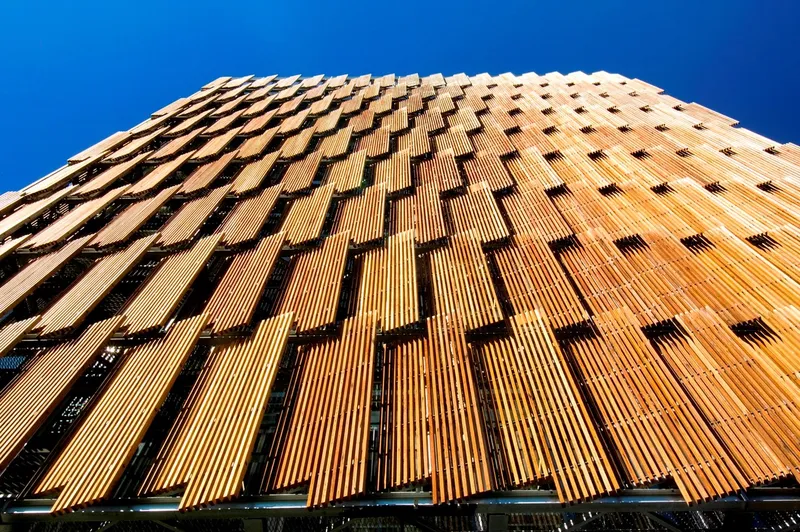
Image of a Council house in Melbourne inspired by a termite mound.
Mike Pearce of Zimbabwe took note of this natural phenomenon and applied it to his East gate Centre, which is both the world’s first naturally ventilated and temperature-controlled building. Made from local, natural materials like earth and rock, this building’s roof features vents that allow hot air to exit upwards via chimneys, as well as intake ports that serve to chill air inside the structure by allowing cold air to enter from below. The port surrounding area’s average temperature of 38°C is maintained at about 24°C inside the building even when external temperatures reach highs of over 42°C.
Furthermore, Esplanade - Theatres on the Bay in Singapore has a unique exterior that is reminiscent of the eyes of a fly or the surface of a durian fruit. Over 2,000 aluminium projections cover the exterior glass walls, each providing a shade for each glass wall of its greenhouse-shaped towers. As a result, guests have numerous vantage points from which to observe the Singapore skyline.
Earthquakes throughout the world have shown that our current buildings and other man-made structures are not capable of withstanding their tremendous impact. Building professionals have been warned that current methods, materials, and techniques are insecure, and new structures must be adapted to withstand future seismic events. Research suggests that a way to adapt existing building structures to withstand earthquakes is by making them out of concrete, if they were able to produce significant compressive stress in the long run. Such “force driven force” bears great resemblance to organic bones and may allow the structure to withstand tremendous amounts of pressure generated by earthquakes.
We are naturally in awe of the beauty of animals, their unique appearances and ingenious ways. And it may seem unbelievable that copying the way the natural world works is just now coming to the fore, but worldwide emphasis on sustainability is forcing people to look at efficient systems of all types. And until recently, engineers didn’t have tools to simulate natural processes. So what can architecture and engineering learn and emulate from nature? The answer is much more, as long as there’s a rise in multidisciplinary collaboration. The more biologists, architects, mechanical engineers, and materials scientists collaborate, the more likely it becomes that new hybrid fields like biomimicry architecture can take root.
References (5)

Popular Articles
Popular articles from the community


Cube Design Draws an Ecological Corridor Between Two Shenzhen Hills with the Nankai Building
Beside Shenzhen's container docks, the Nankai Building pairs stacked balconies with a climbing green screen to connect two hillsides across its height.

Juan García Correa, John González and Claudia Rueda Sink a Circular Amphitheater into a Manizales Engineering Building
On the La Nubia campus in Manizales, Colombia, the S1 Building folds labs and offices into a hillside of ramped lawns that double as a campus route.

David Ortega Stacks a Two-Story Mexico City Penthouse Around a Steel Stair and a Pergola-Shaded Roof Terrace
In Colonia Roma, a 300 m² penthouse uses oak joinery, a planted steel stair and a slatted roof pergola to make a new-build apartment feel like a house.

Jaramillo Van Sluys Arquitectura and Urbanismo Turn a Demolished Registry Lot in Quito into an Orchard Plaza
In Quito's Centro Histórico, a 2,800 m² plaza exposes the San Agustín convent wall and redraws its lost Augustinian orchard in volcanic stone.

Similar Reads
You might also enjoy these articles


Vereda Arquitetos Renovates a 40-Square-Meter Apartment Inside Niemeyer's Copan Building
A compact unit in São Paulo's most iconic residential tower gets a material overhaul that pairs exposed concrete with bold blue Formica.

Shakur's House: Exposed Brick as an Interior Organiser in a 168 m² Mashhad Residence
Brick moves indoors in this Mashhad residence, where masonry walls, glass partitions and teal planes sequence a compact home without closing it off.

Day and Night Park: A Time-Based Urban Newsstand in Beijing
A temporary urban newsstand in Beijing blending travel, light, and reading through poetic colors, compact form, and community-focused design.

Modernist Patio Renovation in El Masnou, Barcelona by Oliver Segura Arquitectura + Cebrià Arquitectura
Modernist patio renovation blending tradition and innovation with a movable pool, leveled floors, and Catalan materials in El Masnou.


Comments (0)
Please login or sign up to add comments
No comments yet. Be the first to comment!