
Atelier Régis Roudil Builds Social Housing from Quarry Stone and Timber Near Marseille
Eight apartments in two gabled volumes use massive stone from Vers Pont du Gard to root social housing in Provençal identity.


Social housing in the south of France rarely gets to claim a material identity. Budgets are tight, timelines are compressed, and the default answer is rendered blockwork in a color that offends nobody. Atelier Régis Roudil Architectes rejected that default for a small project in Gignac-la-Nerthe, a residential commune roughly ten kilometers north of Marseille. The result is a pair of gable-roofed volumes clad in timber and built from massive cut stone sourced from the quarries of Vers Pont du Gard, the same geological seam that supplied the Romans two millennia ago. At 529 square meters and just eight units, the project is modest in size. Its argument about what social housing can look and feel like is not modest at all.
Positioned at the prow of a new subdivision marking the city entrance, the two buildings sit at the center of their parcel, orienting generous loggias south toward unobstructed light and balconies west toward the hills of the Massif de La Nerthe. The mix of two T2, four T3, and two T4 apartments serves a range of household sizes, while shared walkways, ramps, and meeting areas between the volumes nudge residents toward the kind of casual encounter that denser typologies often promise but seldom deliver. Delivered in March 2022 on a construction budget of €1,080,000 excluding tax, the project meets RT 2012 minus ten percent thermal performance and carries rooftop solar panels. It is proof that locality and economy are not opposing forces.
Two Volumes, One Territory
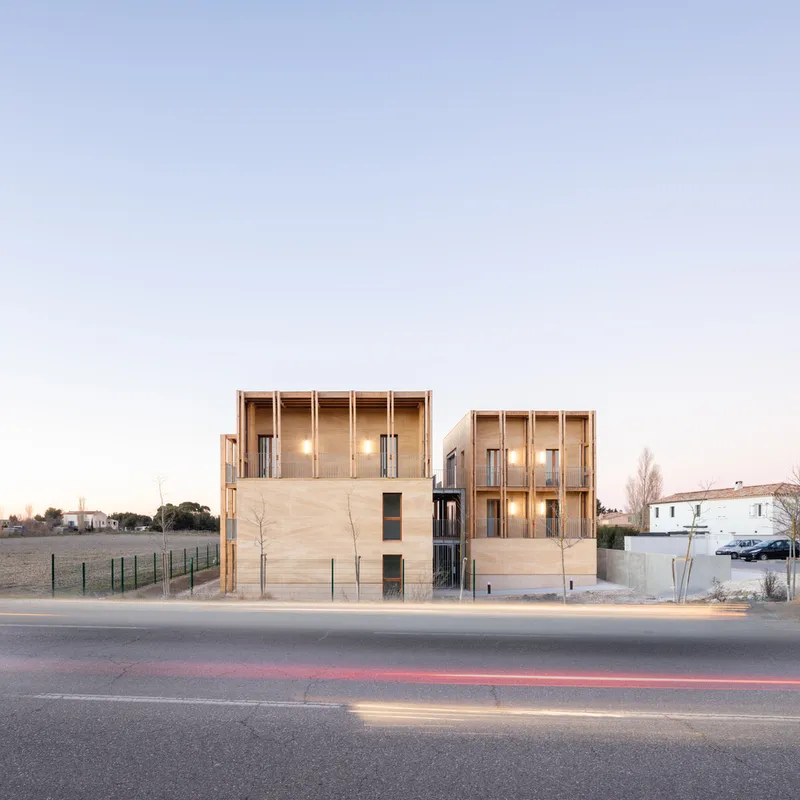
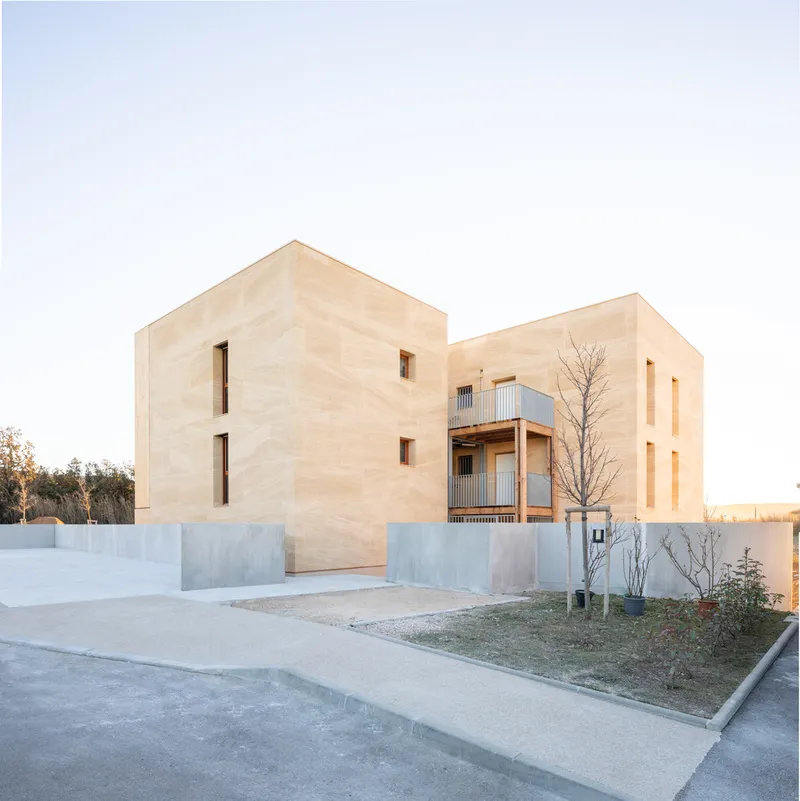
The two buildings read as siblings rather than twins. Both carry steep gable profiles that echo the surrounding fabric of detached and clustered houses, but they differ in footprint and program. The smaller volume holds technical spaces and cellars at ground level; the larger one concentrates the residential units. Seen from the street at dusk, the vertical window slots and warm timber surfaces give the pair a lantern quality, glowing against a sky that fades over the Mediterranean hinterland.
Setting the buildings at the center of the site rather than its edges was a deliberate landscape move. It preserves sightlines through the parcel for passersby and carves out usable ground between the volumes for pedestrian paths and communal outdoor space. The eight parking spots and bicycle storage are tucked away so that the public face of the project is overwhelmingly human scaled, not automotive.
Stone, Concrete, Wood: A Vertical Material Story
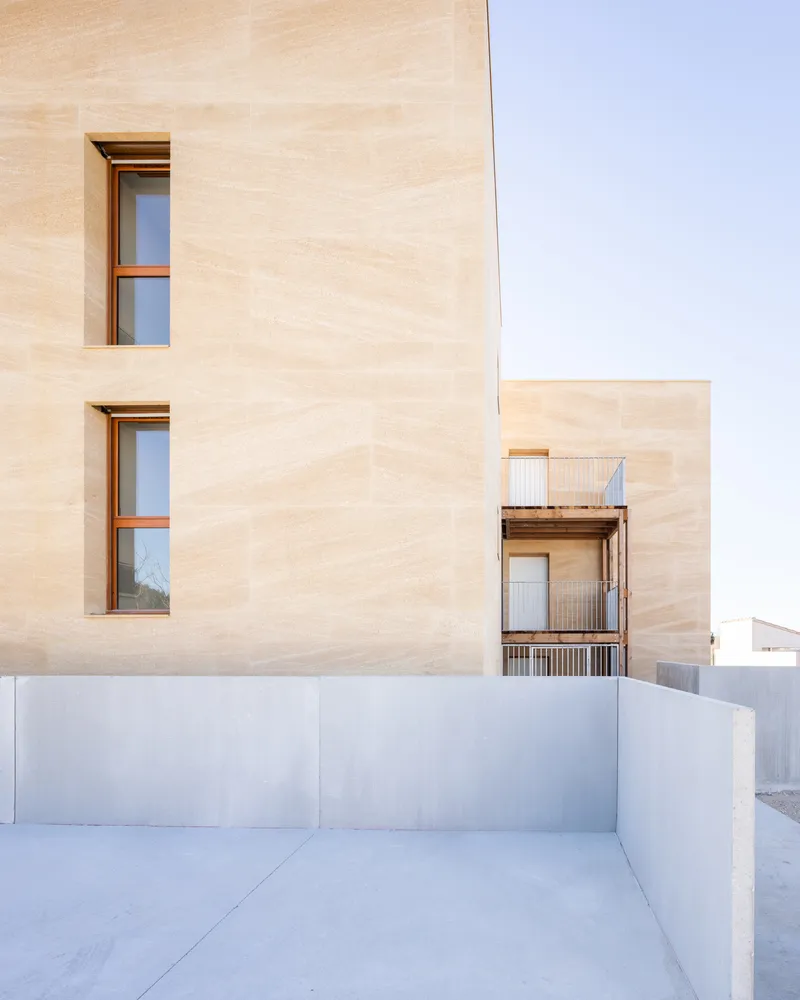
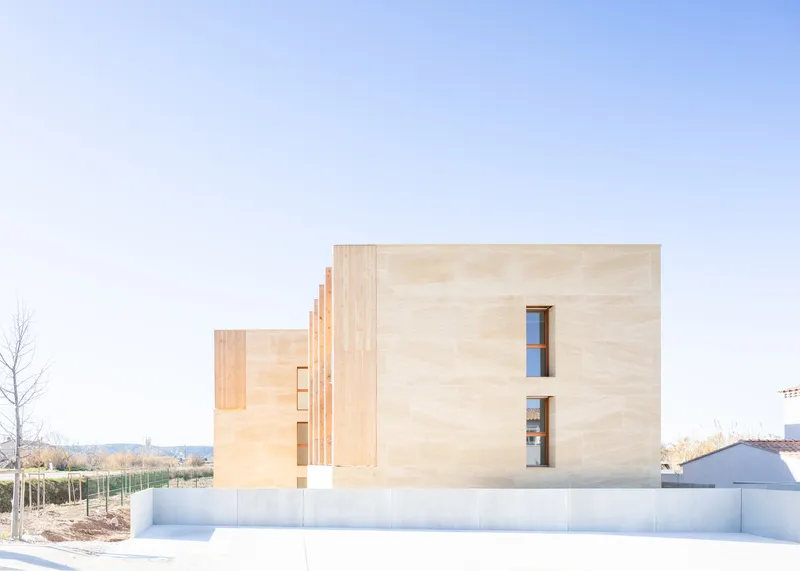
The material sequence reads from the ground up: an ochre-toned concrete plinth, then massive stone, then timber cladding and structure. Each layer has a functional rationale. Concrete lifts the stone clear of soil moisture. The stone walls carry load and thermal mass, stabilizing interior temperatures in a climate that swings between Mistral cold and August heat. The timber frame takes over where weight can be lighter, wrapping the upper levels and outdoor spaces in a material that will silver toward gray over time, shifting the building's appearance season by season.
The choice of stone from Vers Pont du Gard is not decorative nostalgia. It is a structural commitment. Massive cut stone demands different site logistics, different tolerances, and a different relationship between architect and mason than precast panels. The payoff is a wall that breathes, ages gracefully, and carries a geological memory of the region. Against the plywood-clad upper sections, the stone base gives each volume a tectonic weight that most social housing simply cannot claim.
The Timber Framework as Social Infrastructure
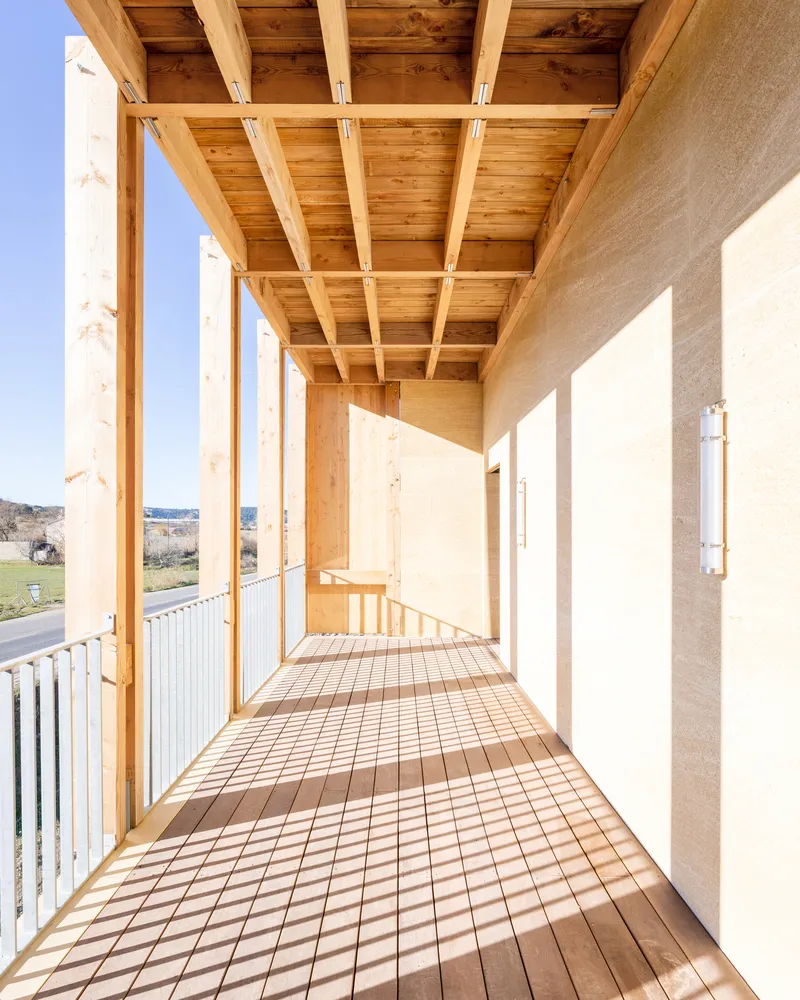
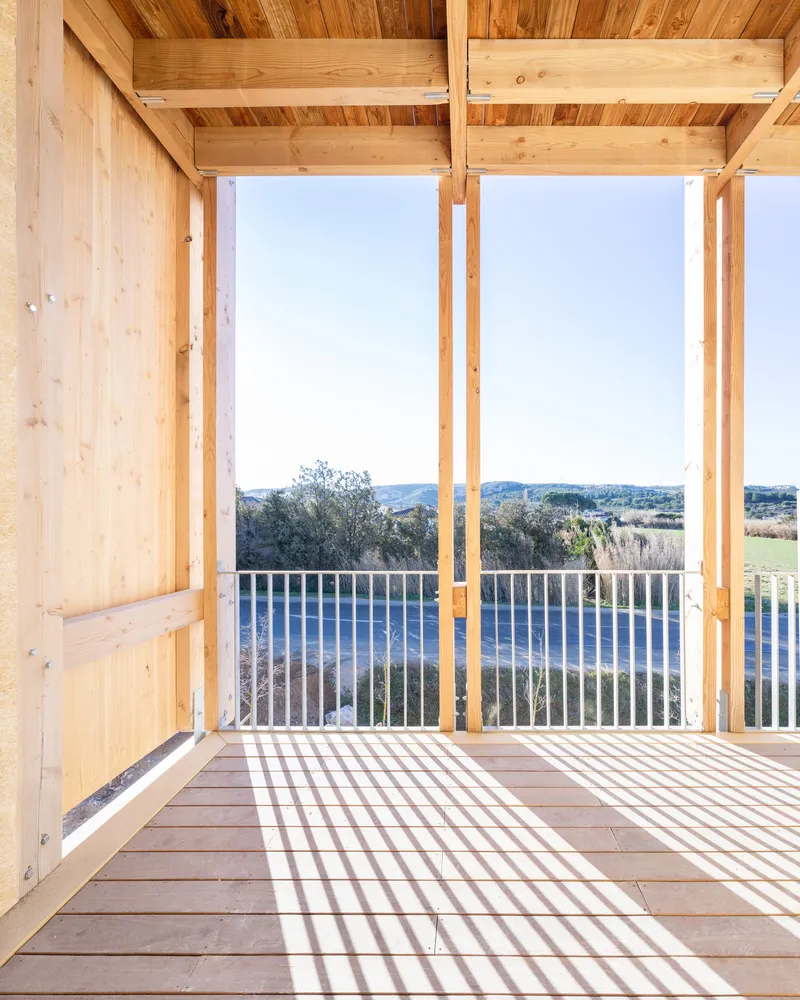
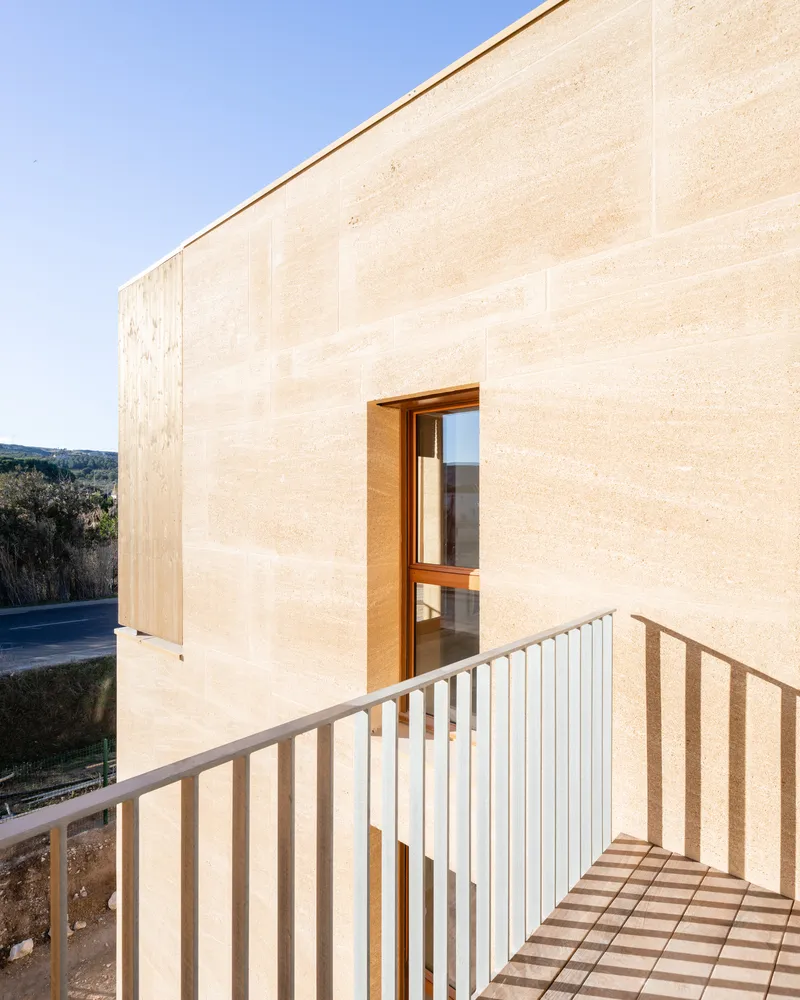
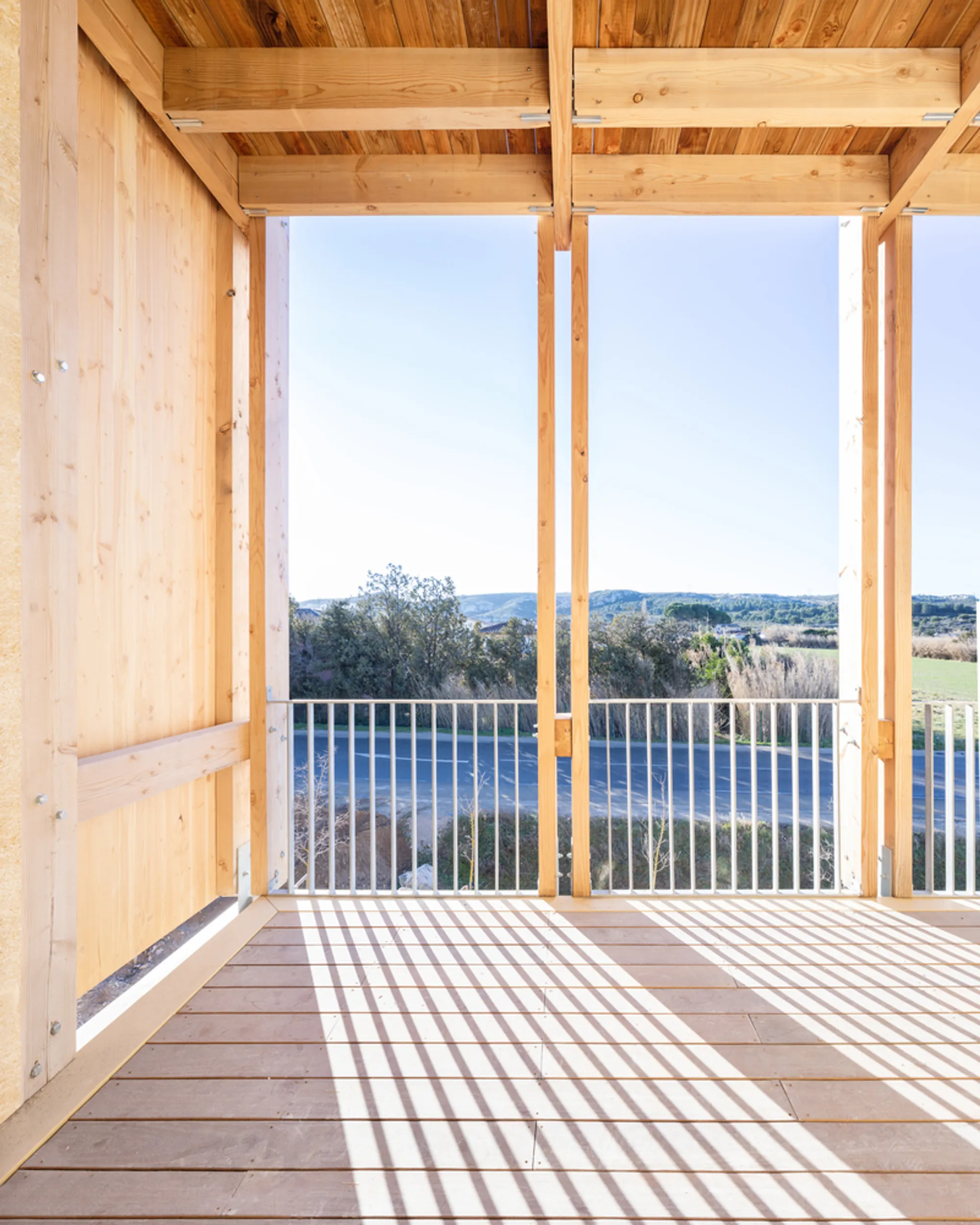
The deep balconies and loggias are the project's most generous gesture. Framed in exposed timber with slatted wood floors and vertical balustrades, they function as outdoor rooms rather than ornamental ledges. The upper-level balcony captures afternoon light filtering through the structural members, casting long shadows across the floor that shift through the day. From these perches, residents look out over rolling countryside, a view that would be unremarkable in a private villa but feels almost radical in a social housing context.
Roudil treats the timber framework as more than structure. Its repetitive vertical fins create a rhythm of privacy and openness, screening the interior from direct view while preserving airflow and light. As the wood weathers from pale gold to a natural gray patina, the contrast against the warm ochre stone will deepen, giving the buildings a layered character that improves with age rather than deteriorating.
Interior: Honest Structure on Display
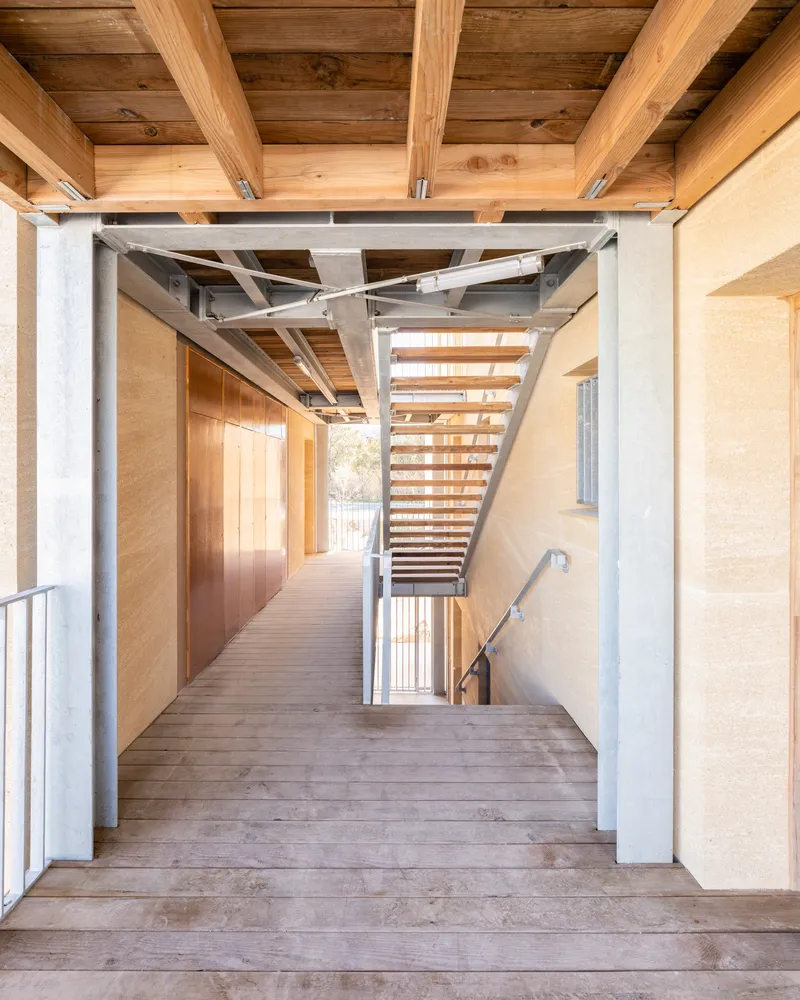
Inside, the corridors and stairwells continue the logic of exposed materiality. Timber beams span overhead, steel columns mark the structural grid, and an open staircase connects levels without the claustrophobia of a typical enclosed stair core. The palette is spare: raw wood, white walls, metal rails. Nothing is concealed behind suspended ceilings or plasterboard soffits, which keeps maintenance legible and costs honest.
The recessed doorways visible on the upper terrace walls hint at how the cross-laminated timber panels do double duty, serving as both envelope and finish. This is not a building that hides its construction behind cosmetic layers. For residents, that transparency is a quiet form of respect: the building shows you exactly what it is made of.
Why This Project Matters
France builds thousands of social housing units every year, and the vast majority disappear into an aesthetic no-man's-land of rendered insulation and aluminum windows. Atelier Régis Roudil's project in Gignac-la-Nerthe refuses that erasure. By selecting materials that carry regional identity, specifically massive stone from a historically significant quarry and locally familiar timber framing, the studio demonstrates that affordability does not require anonymity. The total construction cost of just over one million euros for eight units is competitive by any standard, yet the building reads as specific, rooted, and considered.
The deeper lesson here is about time. Rendered facades stain and crack within a decade, demanding maintenance budgets that social landlords rarely have. Stone and timber weather. They acquire patina, not decay. In a climate shaped by strong sun and salt-laden wind, that distinction matters enormously for long-term stewardship. Roudil has designed a building that will look better in twenty years than it does today, and that alone makes it worth paying attention to.
8 Social Housing Units by Atelier Régis Roudil Architectes, Gignac-la-Nerthe, France. 529 m². Completed 2021. Photography by Florence Vesval.
About the Studio
Share Your Own Work on uni.xyz
If projects like this are the kind of work you want to make, uni.xyz is a place to publish your own, find collaborators, and enter design competitions.


Popular Articles
Popular articles from the community


Conexión: Biophilic Design Reimagines High-Rise Living in Hong Kong
Conexión reimagines high-rise living in Hong Kong through biophilic design, green facades, shared spaces, daylight, water and nature within.

The Ocean Hive: Sustainable Architecture for a Self-Sufficient Civilization at Sea
The Ocean Hive imagines sustainable architecture at sea, where modular habitats, algae, wave power and ocean waste sustain a growing colony.

Co-Life: Senior Housing Design That Reconnects Older Adults With the City
Co-Life reimagines senior housing design through healing gardens, shared streets, workshops, and a sustainable community across generations.

The Earth Pod: 3D Printed Homes for Resilient Refugee Communities
The Earth Pod reimagines refugee housing through 3D printed homes made from clay, combining resilience, self-sufficiency, and rapid shelter.

Similar Reads
You might also enjoy these articles


Hodi-Mandai Geram
Project Function: Preservation and revitalization of the Intangible heritage and socio-spatial identity of the Hodi by Housing, Cultural Memory Center, Sacred Grove, landscape, local tourism economy


Olio Towers: A Mid-Rise for Performers That Fuses Housing, Rehearsal, and Stage
Located blocks from Houston's Theater District, this modular tower stacks living units around a central performance atrium.

Oasis: Modular Green Housing Carved into Dhaka's Urban Fabric
A shortlisted Plugin Housing entry reclaims unauthorized settlements in Dhaka with stepped concrete volumes, green roofs, and ventilation-driven design.

Black Hole: A Floating Megastructure for the Post-Physical Era
Emiliano Mazzarotto envisions a spherical, self-scaling arena where e-sports, digital hotels, and holographic stadiums replace traditional public space.
Explore Housing Competitions
Discover active competitions in this discipline



Challenge to reimagine the Iron Throne


Photograph architecture without architects


Illustrate the lost glory of Angkor Wat - Render Challenge


Design challenge to reuse E-waste
Comments (0)
Please login or sign up to add comments
No comments yet. Be the first to comment!