

A Case for Holistic Sustainability
An essay on a probable solution to socio-economics and the relationship of architecture to the economy.

Two schools of thought take charge when talking about money and its influence: “The love of money is the root of all evil”, and “Money cannot buy happiness”. While both are equally valid, both ideas are also exceedingly philosophical. There are many facets to these ideologies and the philosophical analytics of the true meanings of both ideas are immaterial to the real problem. The problem is that money, the lack or excess of it, births new problems and contrasting ideologies with no true way of addressing both harmoniously. In the architecture profession, we are trained to consider all angles when designing. We are trained to leave no stone unturned and to consider and solve as much as we can. In this case, we are tasked to answer a complex question: how has socioeconomics affected the way we design cities, and conversely, how has our design changed socioeconomics?
Based on empirical metrics, we know that the extremities of the social classes present contrasting wants and needs. Ironically, these wants and needs present two very distinct ways of designing our cities. One side needs easy access to daily necessities and the other wishes to find meaning in wealth (hence my introductory schools of thought). While both are valid from certain points of view, the fact remains that these contrasting wants and needs are in no way shape, or form our primary focus. Our focus is on the realistic aspects of their ideologies that can help us build better, more livable cities, now and in the future.
A livable city, in modern times, is usually paired in meaning with a sustainable city. According to the Global Liveability Index by the Economic Intelligence Unit, the most livable cities in the world are those that have a healthy balance of stability, healthcare, culture, environment, education, and infrastructure. Simply put, livable traditionally means sustainable (with the prime distinction of sustainability defined in more ways than one). 2021’s most livable city according to the organization was Auckland, New Zealand. New Zealand produces only .2% of the world’s greenhouse gas emissions and has pledged to a carbon-neutral future. Additionally, according to the World Happiness Report 2021, New Zealand ranked 9th worldwide in happiness among its citizens. These facts about New Zealand reinforce my initial statement that sustainability goes hand-in-hand with livability.
With the definition out of the way, what does all this mean for people worldwide? It conclusively means that holistic sustainability is the key to livable cities and a livable city (or country, for that matter) is one of the building blocks of a healthy economy. Case in point, according to the 2022 Index of Economic Freedom, New Zealand is the 4th freest economy in the world, and in the Asia-Pacific region, New Zealand ranks 2nd in that regard (1st being Singapore). For us designers, this means that we must strive to create and design with sustainability in mind. This sustainability I mention isn’t an advertisement for sustainable tokenism. It’s a reinforcing ideology that the trends of sustainable design have a real and lasting impact on today’s society. Sustainable design isn’t just a trend that will move away with time, but a true commitment and a proven avenue of societal improvement.
Sustainability is the answer to the perpetual struggle of the extremities of the social classes. As designers, it is our duty and responsibility to implement this solution wherever we can, whenever we can. This new brand of sustainability that we should espouse is one of environmental, social, and human-centered sustainability. It is, after all, the people whom we design for. If there is one issue with this responsibility of ours it’s this: clients, in all shapes and forms, might not necessarily agree with the monetary price of sustainability. Granted, some forms of sustainability are cheap but there are also sustainable technologies that are expensive and out of reach to most. This problem can be solved by returning to the core solution of the socioeconomic problem: holistic sustainability. Holistic sustainability not only focuses on net-zero structures or carbon-neutral buildings but also on people. It also focuses on how the design affects people. Luckily, the human aspects of design aren’t as expensive as its technological aspects, and as such, it’s something we can push harder for if the aforementioned problem arises.
On top of that, there’s still the problem of public interest. Even if it’s proven that the solution to livable cities is sustainable design, how can we get people to invest in creating more sustainable cities? This, in my opinion, is the greatest detriment to the livability and human-centric design in cities. Fact is, the majority of the rich members of society are predominantly focused on maintaining their wealth and status, while the poor clamor for help and better practices. This inequality isn’t something that architecture can directly fix. While there are many ways to solve this problem, there’s little we can do to directly amend the issue. We can lobby and fight for more democratic space and humane treatment of the urban poor, but the fact remains that solving this problem is a steep hill to climb.
In conclusion, money doesn’t equate to happiness, it never has, and it never will. Solving the socio-economic imbalances in our society is a very tall order that architecture alone cannot solve. While we cannot solve the problem directly, instilling firm ideals of holistic sustainability (in its many forms and facets) has proven that there is a way for us to solve the issue. Unfortunately, we have quite a ways to go and some money to spend before the solution becomes a reality. The economic influence of architecture can be a way to help solve the issue, but the issue cannot be solved by architecture alone. Creating stop-gap methods is one thing, but dedicating resources to a singular vision is a Herculean feat to accomplish. The simple answer is we are all responsible for how the socioeconomic status of our cities currently is (some more than most). As such, it is only a strong drive of a united initiative that will progress the solutions forward.
Only a society that has truly embraced the balance between enough and excess, can truly solve this problem with relative ease. While we are still a long way from a utopian society, we should focus on human-centered sustainable solutions that balance wants and needs. I do not doubt that looking at this problem humanely will help speed things along and help those struggling in our society to move forward better.
References (5)
NZ report card 2021: from COVID to housing and happiness, it was a tale of two countries
ISBN: None

Popular Articles
Popular articles from the community


Architekt Andreas Gruber Scatters 23 Dark Timber Chalets Across a South Tyrolean Forest Edge
In Molini di Tures, Amonti Chalets breaks a resort into a hamlet of gabled timber houses, with parking, storage and services pushed into the slope.

Some Thoughts Clamps Felt and Metal Together to Build a Modular Eyewear Store in Wuhan
A 98 m² MOLSION eyewear shop in Wuhan builds its displays from stacked red and grey felt modules held by custom triangular metal fasteners.

U.GA Architects Wraps an Oval Rooftop Pool in Curved Board-Formed Concrete on Busan's Jeollidan-gil
In Busan's Jeonpo-dong, a 454 m² mixed-use block stacks a neighborhood facility, guest rooms and an oval rooftop pool inside spiraling concrete walls.

Tenter Studio Steps a Valle de Bravo Holiday House Down a Slope Around a Void Built for Pausing
In Valle de Bravo, Mexico, two dark brick volumes descend a steep plot and frame a deliberate gap, keeping the landscape quiet rather than staged.

Similar Reads
You might also enjoy these articles


Vereda Arquitetos Renovates a 40-Square-Meter Apartment Inside Niemeyer's Copan Building
A compact unit in São Paulo's most iconic residential tower gets a material overhaul that pairs exposed concrete with bold blue Formica.

Shakur's House: Exposed Brick as an Interior Organiser in a 168 m² Mashhad Residence
Brick moves indoors in this Mashhad residence, where masonry walls, glass partitions and teal planes sequence a compact home without closing it off.
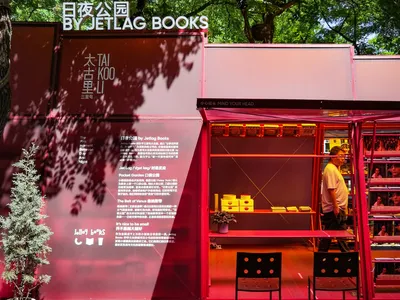
Day and Night Park: A Time-Based Urban Newsstand in Beijing
A temporary urban newsstand in Beijing blending travel, light, and reading through poetic colors, compact form, and community-focused design.

Modernist Patio Renovation in El Masnou, Barcelona by Oliver Segura Arquitectura + Cebrià Arquitectura
Modernist patio renovation blending tradition and innovation with a movable pool, leveled floors, and Catalan materials in El Masnou.

Comments (0)
Please login or sign up to add comments
No comments yet. Be the first to comment!