
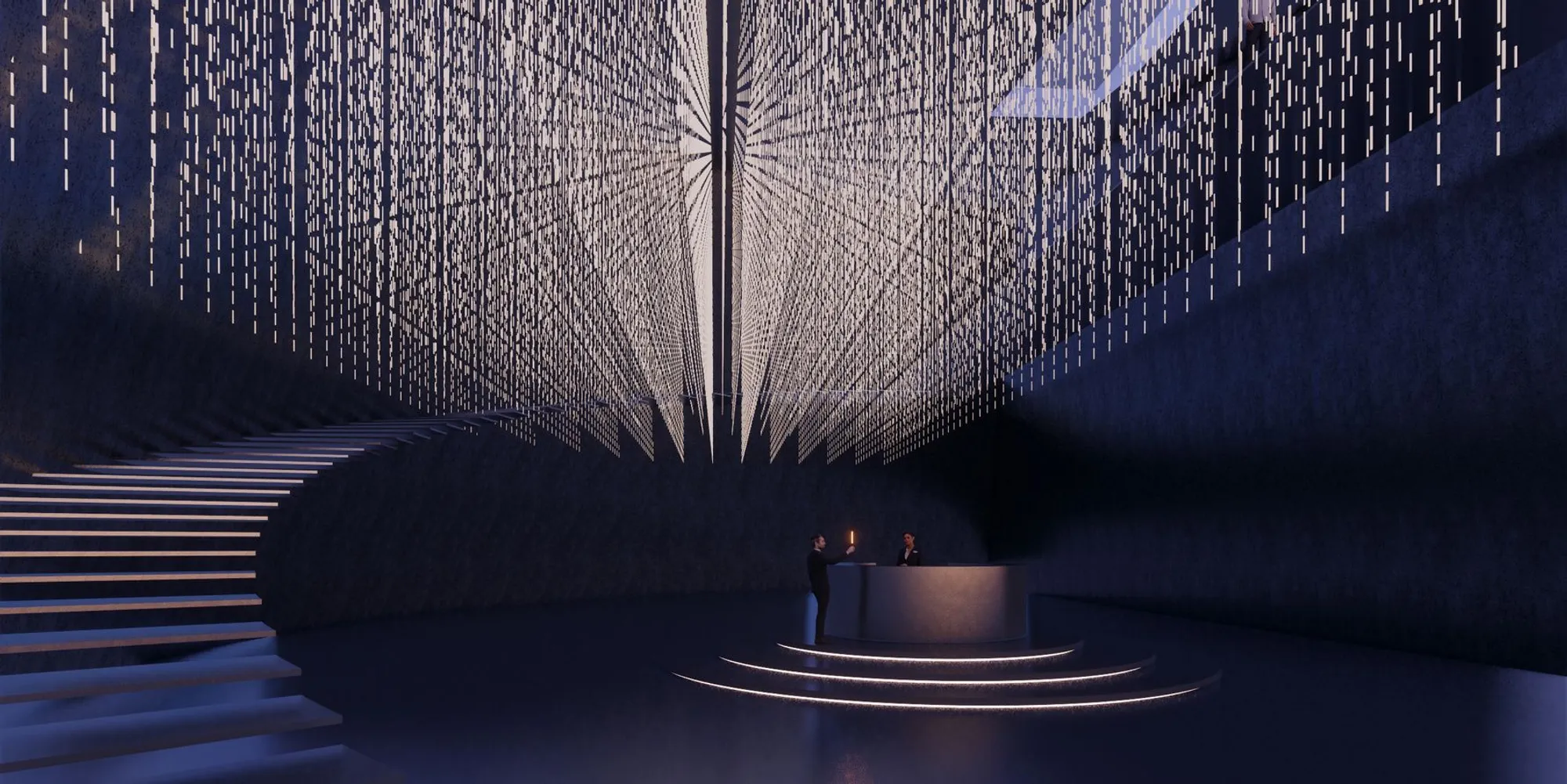
A Horcrux In The City: Where a Vertical Cemetery Becomes a Public Library
Qiwen Cao's hybrid typology merges burial infrastructure with civic reading rooms, storing the dead in tubes and their stories in books.


What if the dead could speak through the books they loved? A Horcrux In The City proposes a vertical cemetery fused with a public library, where the physical remains of the deceased are preserved in slender vertical tubes while their memories, reflections, and chosen narratives occupy shelves accessible to anyone willing to read. The title borrows from fiction, but the architectural proposition is serious: by splitting relics from information, the project compresses the spatial footprint of burial while amplifying its emotional resonance. Mourning stops being a pilgrimage to the periphery and becomes something woven into the daily rhythm of a city block.
Designed by Qiwen Cao, the project reimagines commemorative architecture for the spatial pressures of contemporary metropolises. Rather than isolating death in suburban memorial parks, the scheme places it inside an active civic institution, a library open to both grieving families and the general public. Rites of remembrance happen inside elevator cabins hidden between bookshelves, small sacred pockets of solitude that never interrupt the flow of readers moving through the stacks. The result is a building that refuses to separate mortality from everyday life.
Concentric Rituals and a Layered Ground Plane
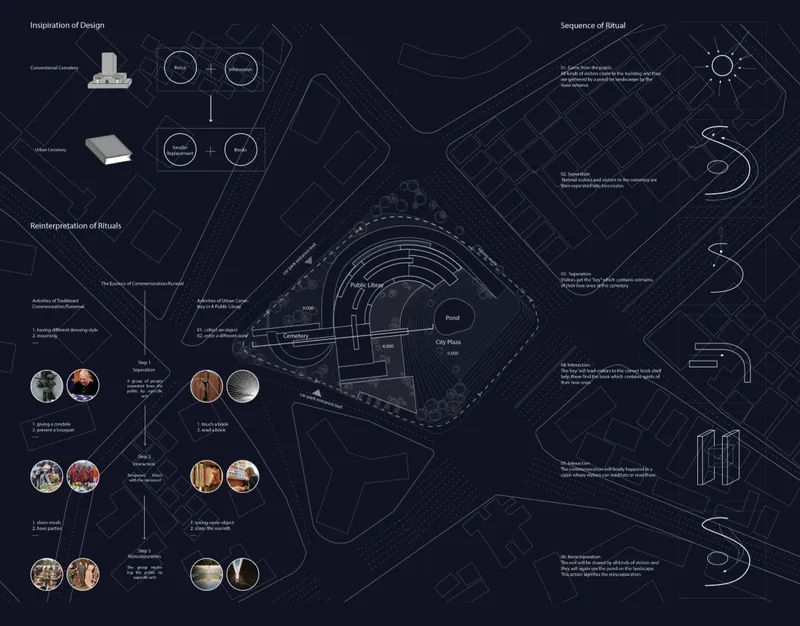
The site plan reveals the project's organizational logic: concentric pathways trace a ritual sequence from the public edge of a city plaza inward toward the memorial core. Diagrams map the choreography of movement, distinguishing between general library visitors and those participating in commemorative ceremonies. Material reference photographs embedded in the presentation hint at a tactile palette of timber and masonry. The drawing makes clear that this is not a building dropped onto a site but a landscape strategy, one that treats arrival, procession, and departure as spatial experiences calibrated to different emotional states.
Stacked Volumes Around a Civic Plaza
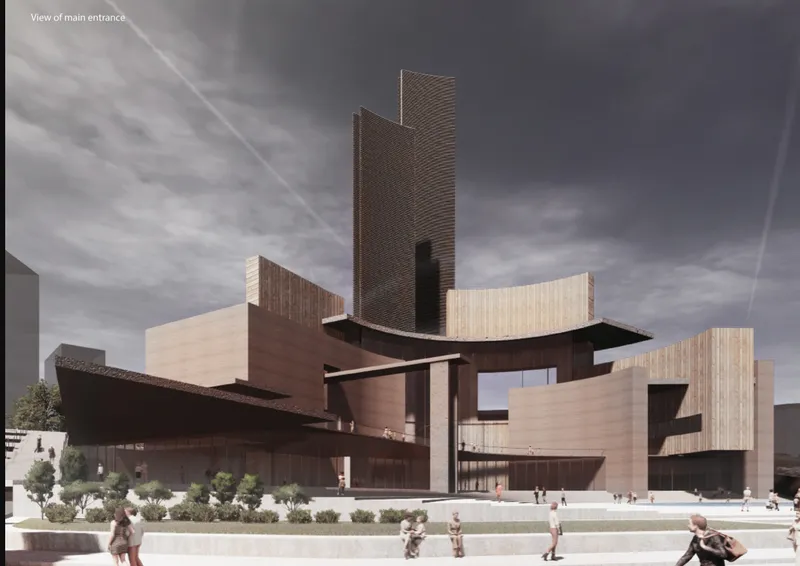
At street level, the building reads as a stack of offset volumes clad in timber and brick, their warm surfaces grounding the structure in material familiarity rather than funereal austerity. A public plaza at the base draws visitors in, functioning as a gathering space that belongs to the city before it belongs to any memorial programme. Rooftop gardens visible on upper terraces reinforce the idea of environmental integration, offering green space that fosters community engagement. The massing strategy maximizes vertical real estate while ensuring the building's civic face remains inviting, accessible, and legible as a place people actually want to enter.
The Narrow Chamber: Light as Memorial Language
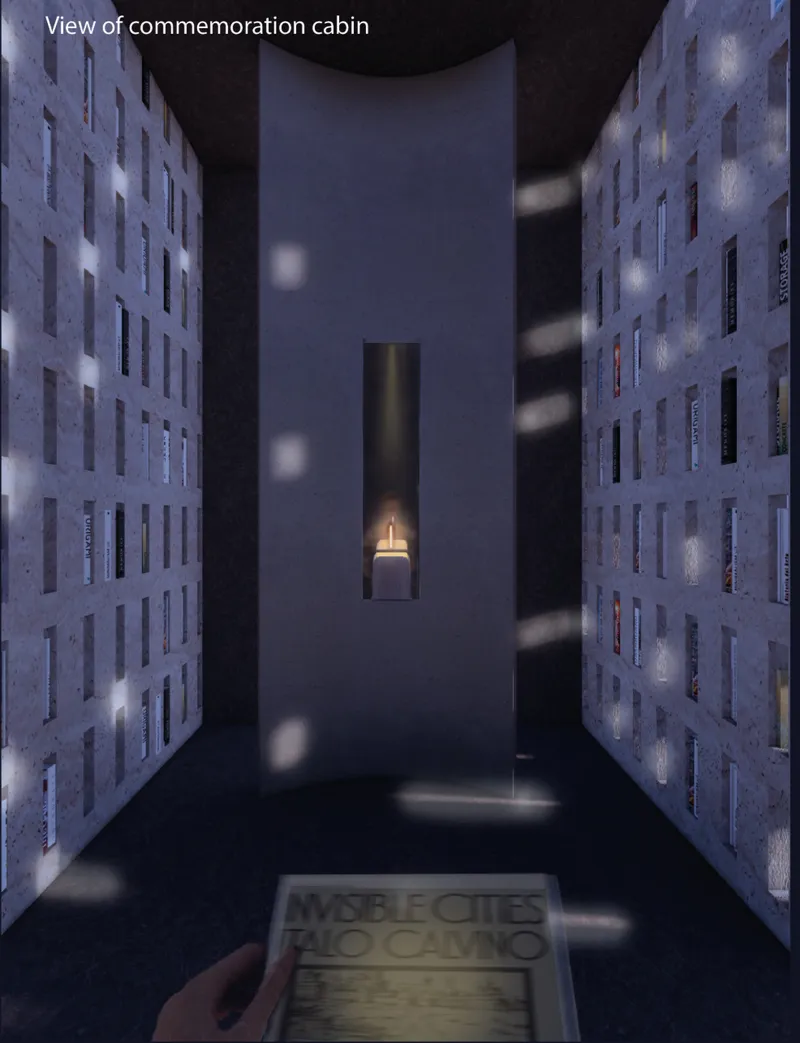
The nighttime rendering of a tall, narrow memorial chamber is perhaps the project's most arresting image. Illuminated niches line the flanking walls, each one holding a vertical tube or book, each one representing a life. The proportions are deliberately compressed: the chamber is barely wide enough for one or two visitors, forcing an intimate confrontation with the vertical column of memory rising above. Soft light emanates from the niches themselves, turning the architecture into a lantern visible from outside. Here, the boundary between library shelf and columbarium wall dissolves entirely. You are standing in both places at once.
A Multi-Level Atrium Where Grief Meets Curiosity
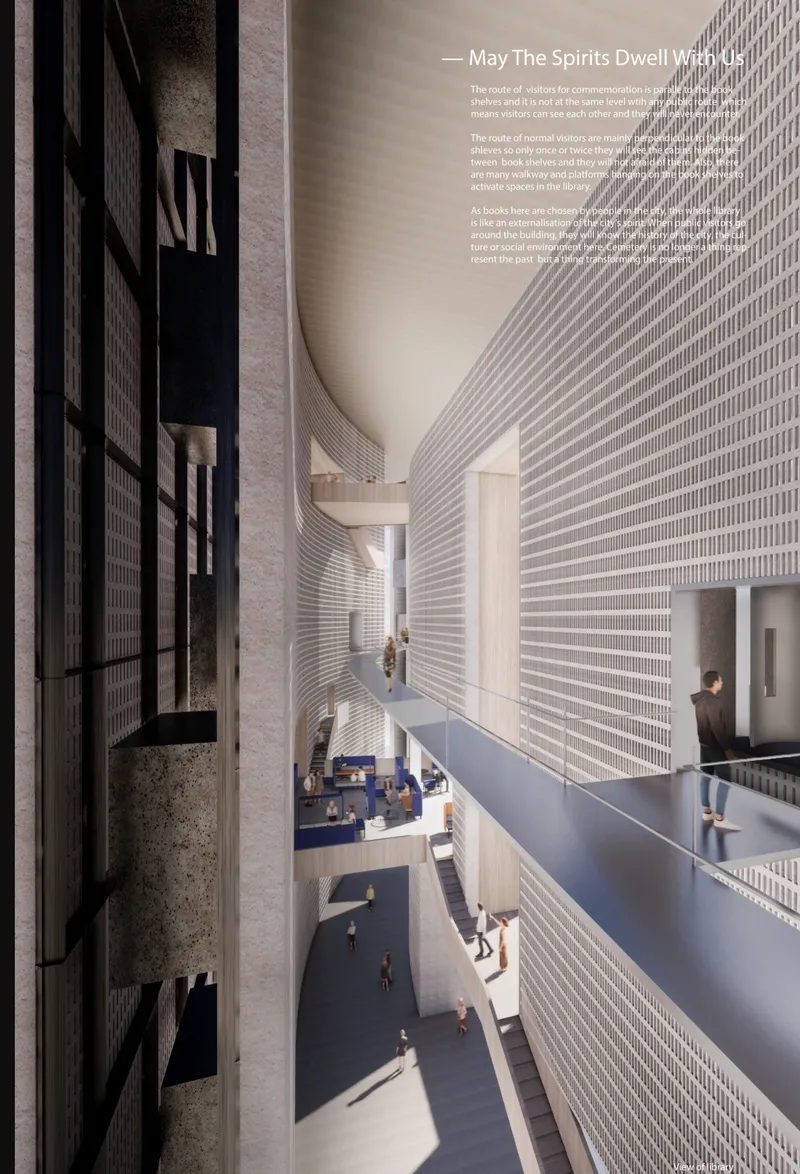
The interior section reveals a generous multi-level atrium crossed by horizontal louvers that filter light and regulate views between floors. Terraced levels host visitors who may be browsing, studying, or quietly mourning; the architecture makes no outward distinction. The continuously flowing pedestrian system threads ritual, remembrance, and civic life into a single spatial loop. Those participating in commemorative ceremonies travel discreet paths that diverge from the main circulation, leading them to private elevator cabins tucked between shelving bays. Library users encounter only subtle environmental cues, soft light filtering through from the memorial side, a gentle reminder that the building holds more than books.
The strategic separation of routes is critical to the project's sensitivity. Cao's design mediates between presence and absence, making grief gently visible without imposing it. Visitors who stumble upon a deceased person's chosen book are free to read it, contributing to what the designer calls a collective memory, a sense of continuity between generations built not on stone monuments but on shared stories.
Why This Project Matters
A Horcrux In The City challenges a deep cultural assumption: that the spaces of the dead must be separated from the spaces of the living. By embedding a cemetery inside a public library, Cao proposes a typology that is simultaneously more spatially efficient and more emotionally generous than conventional memorial architecture. The slender tubes and shelved books occupy a fraction of the land a traditional cemetery would require, yet the commemorative experience is richer because it is layered with narrative, social encounter, and the serendipity of a public institution.
In an era when urban land is scarce and spiritual practices are evolving, projects like this one test whether architecture can preserve intangible values without retreating into nostalgia. Cao's answer is a building that honors the dead, comforts the living, and trusts the city to hold both. It is a provocation worth taking seriously: the cemetery not as a place apart, but as the most civic room in the city.
View the Full Project
About the Designers
Designer: Qiwen Cao
Enter a Design Competition on uni.xyz
uni.xyz runs architecture and design competitions year-round that reward proposals with spatial conviction and real site intelligence.
Project credits: A Horcrux In The City by Qiwen Cao.




Popular Articles
Popular articles from the community


The Earth Pod: 3D Printed Homes for Resilient Refugee Communities
The Earth Pod reimagines refugee housing through 3D printed homes made from clay, combining resilience, self-sufficiency, and rapid shelter.

Riyadh For All: Intergenerational Urban Design for Active Aging in Rabat
Riyadh For All reimagines urban design in Rabat with intergenerational co-living, adaptive courtyards, and Moroccan cultural exchange today.

Play: Fragments of Their World
Familiar architecture becomes modular playground design, creating safe spaces where displaced children can learn, connect, imagine and play.

Co-life: Sustainable Architecture for Age-Friendly Community Living
Co-life reimagines sustainable architecture for seniors through courtyards, rammed earth, shared gardens, and spaces designed for belonging.


Similar Reads
You might also enjoy these articles

Day and Night Park: A Time-Based Urban Newsstand in Beijing
A temporary urban newsstand in Beijing blending travel, light, and reading through poetic colors, compact form, and community-focused design.

Modernist Patio Renovation in El Masnou, Barcelona by Oliver Segura Arquitectura + Cebrià Arquitectura
Modernist patio renovation blending tradition and innovation with a movable pool, leveled floors, and Catalan materials in El Masnou.
Alto Residencial Coop: Cooperative Housing Development in Santiago de Compostela by Carbajo Barrios Arquitectos
A linear cooperative housing complex blending white volumes and perforated metal façades, enhancing community living, natural light, privacy, and urban integration.
Vil Genis School by BPA ARCHITECTURE – Massy, France
Vil Genis School in Massy, France, features sustainable design, south-facing classrooms, community integration, accessible spaces, and modern educational architecture.
Explore Vertical Cemetery Competitions
Discover active competitions in this discipline



Challenge to reimagine the Iron Throne


Photograph architecture without architects


Illustrate the lost glory of Angkor Wat - Render Challenge


Design challenge to reuse E-waste
Comments (0)
Please login or sign up to add comments
No comments yet. Be the first to comment!