
Visual Art School: Where a Single Square Becomes a Complete Campus
Amna Alblooki's modular art school repeats one geometric module to build dedicated studios, galleries, and private workspaces for student artists.


Take a square, repeat it, stack it, stagger it, and connect the pieces with elevated walkways. That is the entire formal vocabulary of this Visual Art School, and it turns out to be more than enough. By constraining herself to a single geometric module, designer Amna Alblooki builds a campus that is simultaneously disciplined and generous: every studio, gallery, and common room occupies its own clearly defined box, yet the spaces breathe through transparency, light, and open-air circulation between volumes.
The project was shortlisted in the Bauhaus Neue competition, which challenged designers to rethink educational architecture in the spirit of the original Bauhaus school. Alblooki situates her proposal within the campus of Zayed University, placing the two-storey structures between the male and female campus zones. The jury recognized the clarity of the scheme but pushed for even wilder ambition. Juror Martin Schmidt Radic of Schmidt Arquitectos Asociados remarked: "Even in the real world we are planning better projects, you are not dealing with the reality, let's fly, imagine something different than what exists!" That tension between rigorous order and imaginative freedom is exactly what makes the project worth studying.
Two Staggered Volumes, Connected in Mid-Air


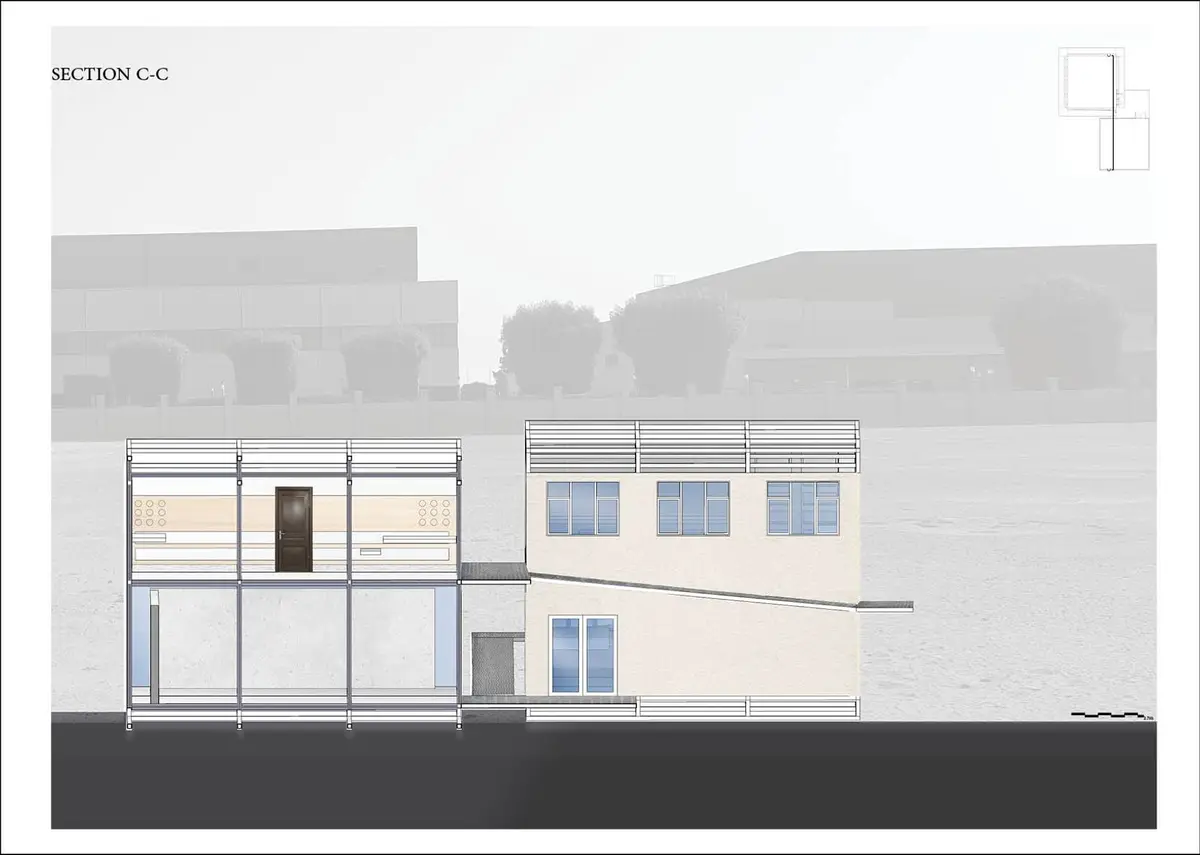
The school consists of two buildings, each two floors tall, arranged in a staggered open configuration so that outdoor space flows between and around them. Section drawings reveal generous floor-to-ceiling heights in the studios, with large window openings pulling daylight deep into the work areas. Elevated pathways bridge the two volumes, creating a circuit of movement that keeps the ground plane open and free. The physical study models and early plan sketches show how Alblooki tested dozens of grid arrangements before landing on this configuration, which balances proximity between programme zones with clear spatial separation.
Functional zoning is vertical. The ground level houses gallery space and social interaction areas, turning the publicly accessible floor into a showcase for student work. The upper floor is reserved for practical workspaces: drawing studio, painting studio, and sculpture class. This split means visitors can engage with the school's output without interrupting the creative process upstairs.
Exploded Modules and the Logic of Assembly


The axonometric view makes the modular logic immediately legible. Flat-roofed square volumes sit on a shared datum, connected by exterior stairs and ramps that double as casual gathering spots bathed in sunlight. The exploded axonometric goes further, peeling apart the material palette layer by layer: structure, railings, interior partitions, and figures that indicate scale and use. What emerges is a construction system that could, in principle, be prefabricated and assembled on site, then reconfigured or expanded as the school's needs evolve. Modularity here is not just a formal conceit; it hints at a genuinely adaptable building strategy.
Private Desks, Terrazzo Floors, and Blue Curtains


One of the most distinctive commitments of the project is its insistence on individual student workspaces. Rather than large shared tables, each artist-in-training receives a dedicated desk, a rare consideration in art education buildings that prioritizes focused creativity over communal sprawl. The interior perspectives confirm this intention: terrazzo flooring provides a durable, easy-to-clean ground surface suited to messy studio work, while timber furniture adds warmth. Blue curtains filter and soften the light at each window, allowing students to control glare without closing off the view entirely.
Alblooki even extends her design attention to the furniture itself. Detailed elevation, axonometric, and plan drawings present a custom seating unit integrated with storage shelves. It is a small detail, but it reinforces the project's core thesis: every element, from campus plan to chair, derives from the same modular discipline and the same concern for the individual learner.
Why This Project Matters
The jury's provocation to "fly" and "imagine something different" is fair, and it points to a real question about whether formal restraint can coexist with creative risk. But the strength of Alblooki's scheme is precisely its restraint. By committing fully to the square module, she demonstrates how far a single decision can carry an entire design: from site plan to section to furniture. That kind of rigor is itself a Bauhaus inheritance, one that values systematic thinking over arbitrary gesture.
More importantly, the project takes the programme seriously. Art schools too often treat studios as generic open floors, leaving students to carve out territory informally. Alblooki's decision to give each student a private workspace, housed within a clearly zoned and daylit module, suggests a pedagogy that values sustained individual practice alongside collective exchange. For a school that teaches visual art, that spatial commitment to the individual maker is a statement worth defending.
View the Full Project
About the Designers
Designer: Amna Alblooki's
Enter a Design Competition on uni.xyz
uni.xyz runs architecture and design competitions year-round that reward proposals with spatial conviction and real site intelligence.
Project credits: Visual Art School by Amna Alblooki's Bauhaus Neue (uni.xyz).


Popular Articles
Popular articles from the community


longwave studio Reorganizes a 112 m² Tainan Apartment Around the Daily Routines of a Family and Two Cats
In Tainan, Taiwan, birch plywood, rust-red furniture and a freestanding plaster wall link arrival, storage, work and family life in one apartment.

U.GA Architects Wraps an Oval Rooftop Pool in Curved Board-Formed Concrete on Busan's Jeollidan-gil
In Busan's Jeonpo-dong, a 454 m² mixed-use block stacks a neighborhood facility, guest rooms and an oval rooftop pool inside spiraling concrete walls.

Juan García Correa, John González and Claudia Rueda Sink a Circular Amphitheater into a Manizales Engineering Building
On the La Nubia campus in Manizales, Colombia, the S1 Building folds labs and offices into a hillside of ramped lawns that double as a campus route.

Architekt Andreas Gruber Scatters 23 Dark Timber Chalets Across a South Tyrolean Forest Edge
In Molini di Tures, Amonti Chalets breaks a resort into a hamlet of gabled timber houses, with parking, storage and services pushed into the slope.

Similar Reads
You might also enjoy these articles


Vereda Arquitetos Renovates a 40-Square-Meter Apartment Inside Niemeyer's Copan Building
A compact unit in São Paulo's most iconic residential tower gets a material overhaul that pairs exposed concrete with bold blue Formica.

Shakur's House: Exposed Brick as an Interior Organiser in a 168 m² Mashhad Residence
Brick moves indoors in this Mashhad residence, where masonry walls, glass partitions and teal planes sequence a compact home without closing it off.

Day and Night Park: A Time-Based Urban Newsstand in Beijing
A temporary urban newsstand in Beijing blending travel, light, and reading through poetic colors, compact form, and community-focused design.

Modernist Patio Renovation in El Masnou, Barcelona by Oliver Segura Arquitectura + Cebrià Arquitectura
Modernist patio renovation blending tradition and innovation with a movable pool, leveled floors, and Catalan materials in El Masnou.

Explore Mes School Of Architecture Competitions
Discover active competitions in this discipline

Challenge to design public laboratory

Competition to design a workstation for architects
Comments (0)
Please login or sign up to add comments
No comments yet. Be the first to comment!