

Aaaaaa Builds a Temporary Office on Stilts from Corrugated Metal in Ho Chi Minh City
A 240-square-meter workspace in Thủ Đức treats impermanence as a design principle, lifting itself off rented land it may one day leave behind.


Most architecture aspires to permanence. TBD Office, designed by Aaaaaa for a general contractor in Thủ Đức, Ho Chi Minh City, does the opposite. Sitting on rented land in a fast-growing urban district, the 240-square-meter workspace was conceived from the start as a temporary building, one that could be dismantled, relocated, or broken down for scrap when the lease expires. The entire structure is raised on stilts and clad in corrugated metal plates, borrowing from Vietnam's rural vernacular while operating firmly in the logic of urban contingency.
What makes the project compelling is not just its material economy but the seriousness with which it treats a building's complete life cycle. Instead of accepting disposability as an excuse for carelessness, Aaaaaa has produced something spatially generous and climatically intelligent. The stilts, the operable panels, the planted courtyards below, and the relationship between interior and exterior all speak to a design ambition that transcends the building's provisional status. TBD Office proves that designing for impermanence can demand more rigor, not less.
A Corrugated Shell with Character
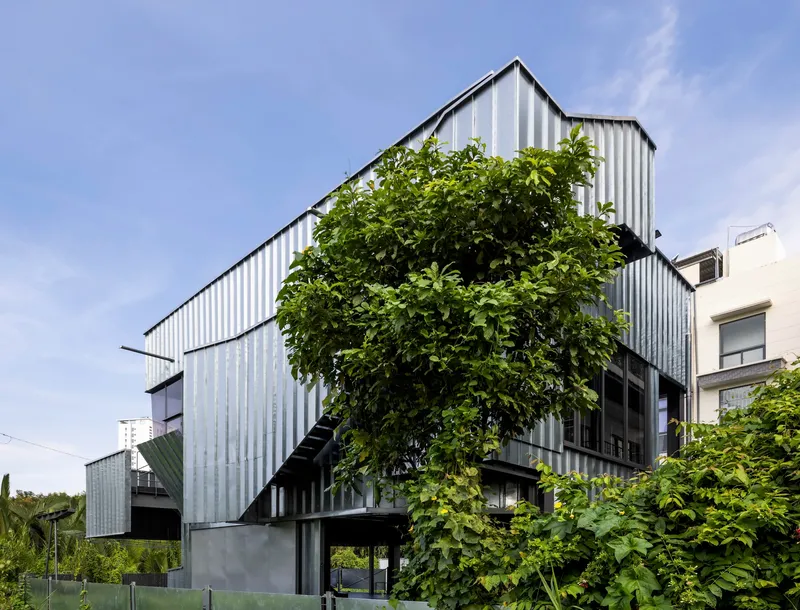
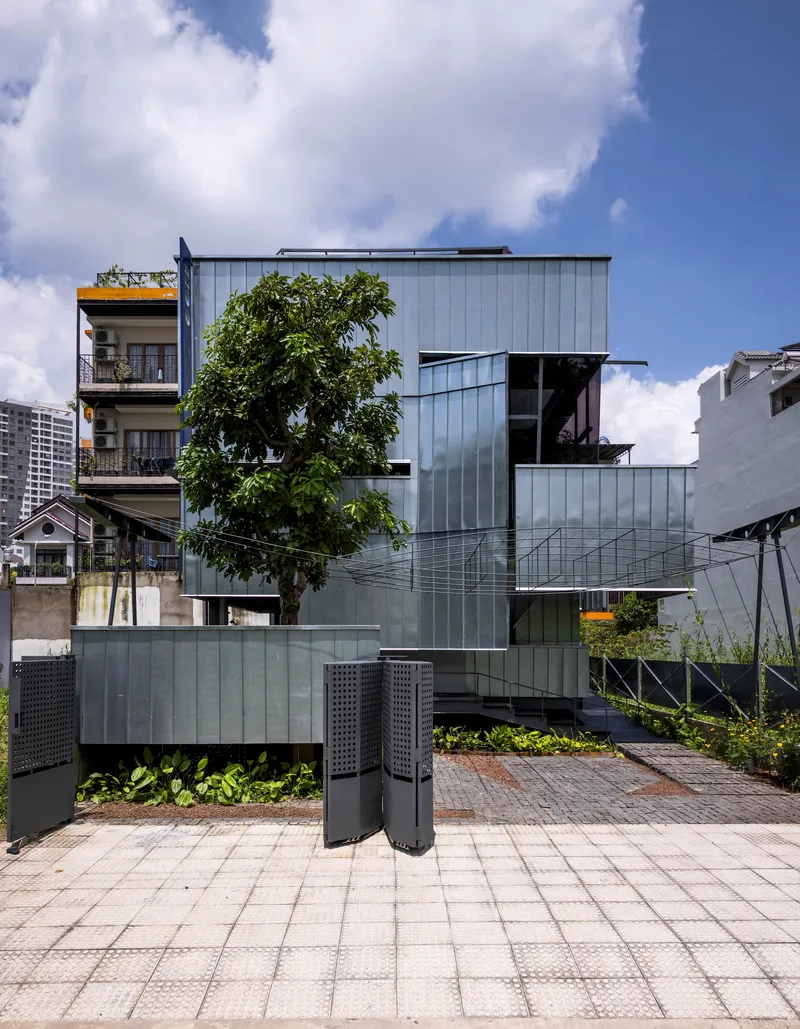
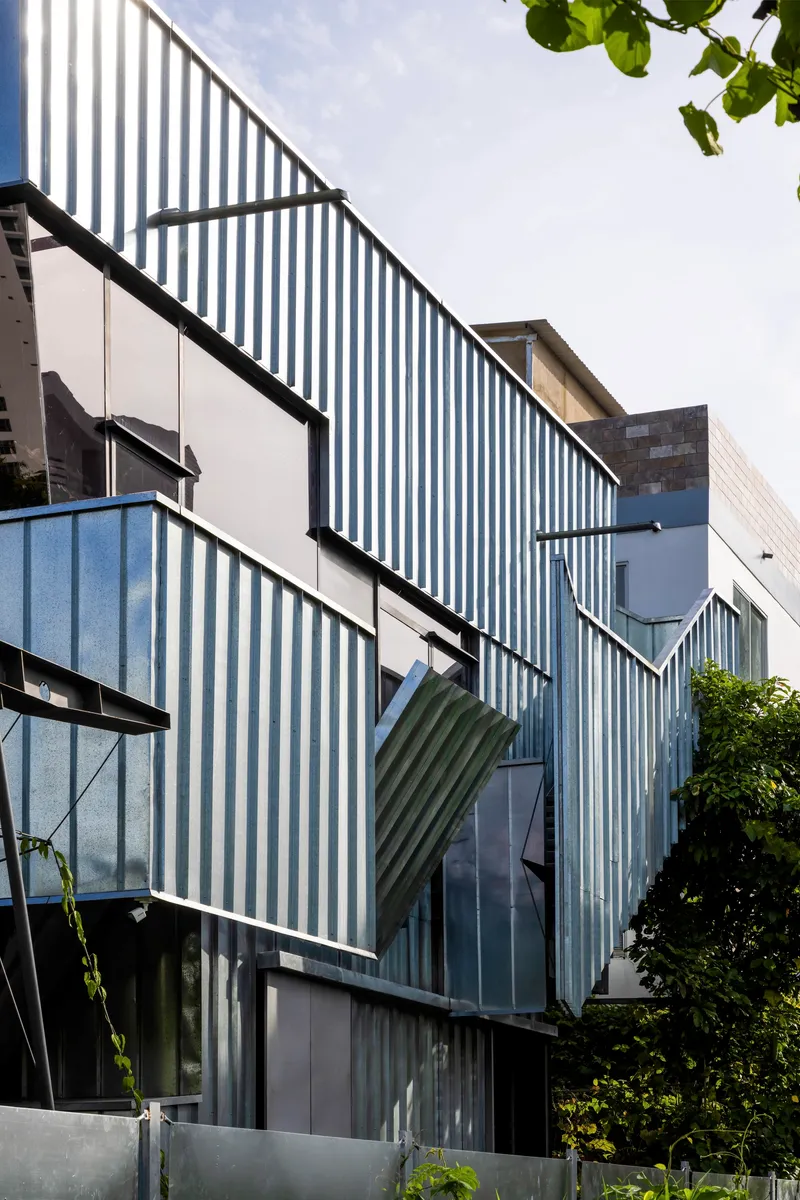
The facade reads as a composition of angled corrugated metal panels, articulated with deep folds and integrated window openings that catch light at different angles throughout the day. A large fig tree pushes through the volume, giving the building an immediate, almost accidental quality, as if the architecture arrived around the landscape rather than the other way around. The gabled form references familiar warehouse and industrial typologies, but the faceted cladding elevates it well beyond shed territory.
At street level, the stacked metal-clad volumes read as a single monolithic object. Up close, the material reveals its seams, fasteners, and intentional imperfections. The corrugated panels are not trying to simulate something more refined. They are honest about what they are: affordable, recyclable, and entirely appropriate for a building that may not be here in ten years.
Lifted Ground: Stilts as Strategy
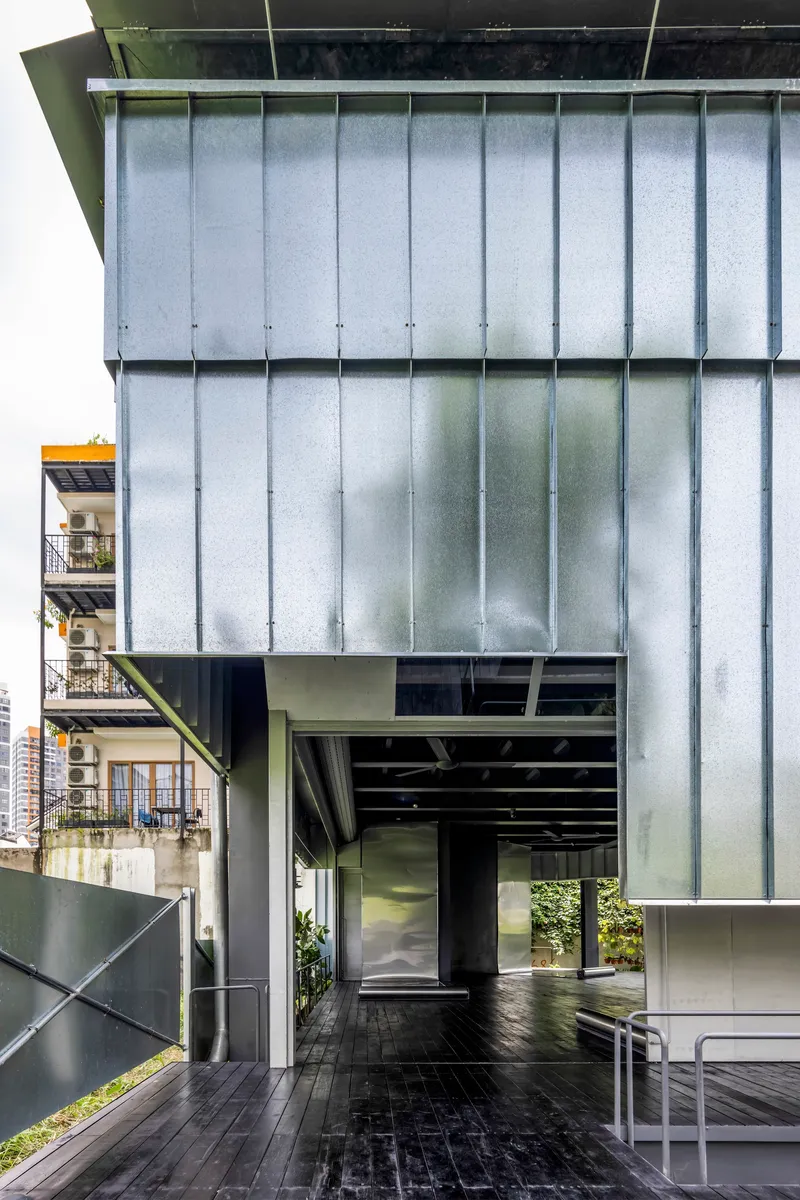
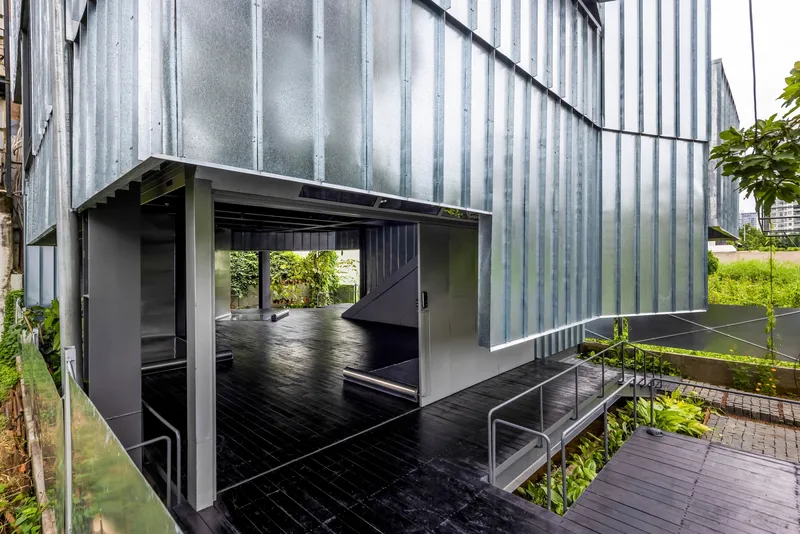
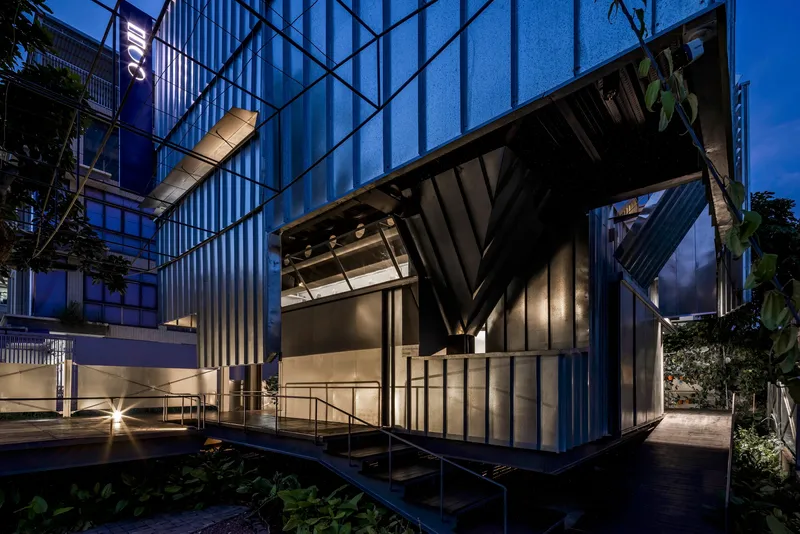
Raising the building on stilts accomplishes three things at once. It facilitates natural ventilation beneath and through the structure, a critical move in southern Vietnam's tropical climate. It protects the interior from flooding, a persistent risk in Thủ Đức's low-lying terrain. And it allows rainwater to percolate directly into the soil, recharging the aquifer rather than being channeled into overloaded drainage systems. The elevated timber decks and vertical metal cladding create a covered terrace condition that is neither fully inside nor fully outside.
This approach recalls the vernacular-tropical practice of building on stilts, a technique common across rural Vietnam but largely abandoned in the rush of urban development. Aaaaaa reintroduces it here not as nostalgia but as a practical response to the realities of rented land and a changing climate. The planted courtyards visible below the raised volumes reinforce the sense that the building sits lightly on its site.
Thresholds Between Inside and Outside
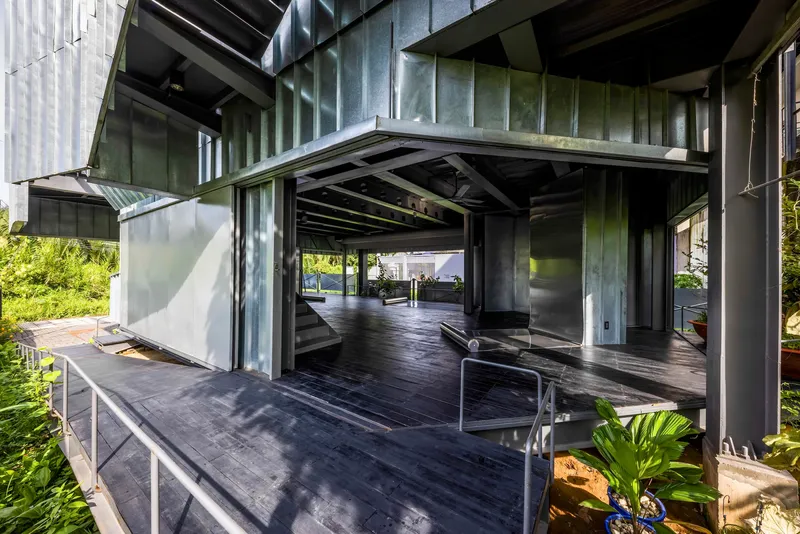
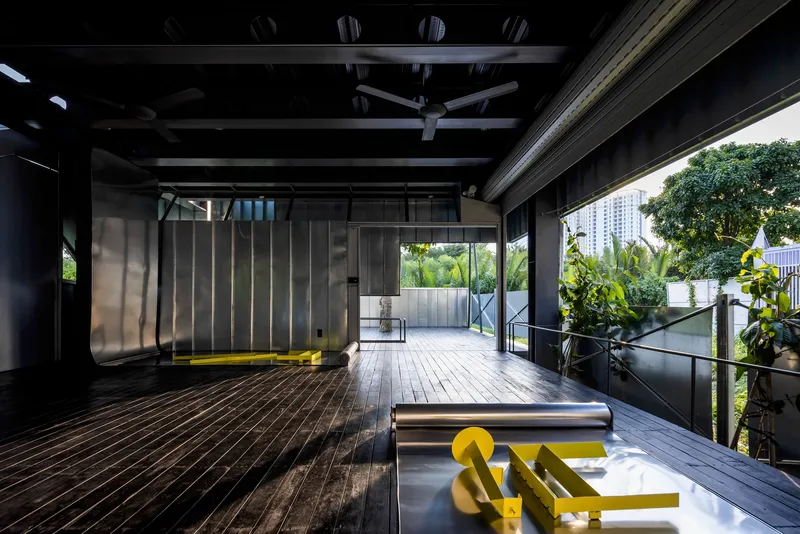
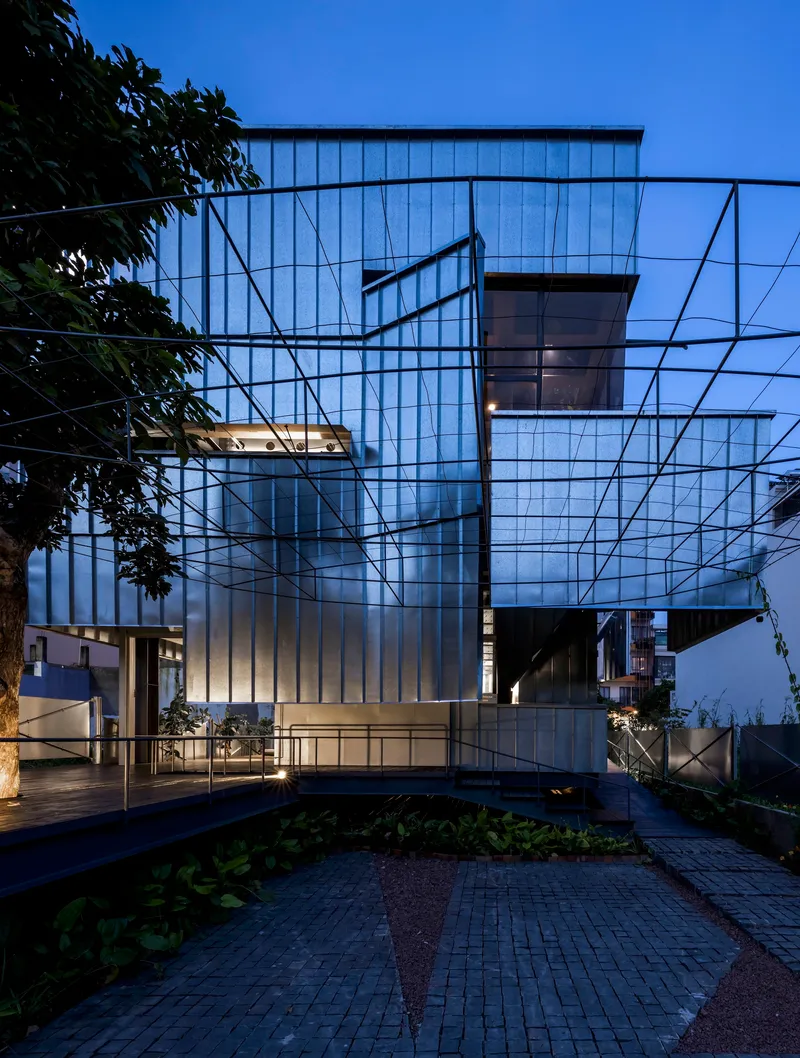
The building's most satisfying spatial quality is its refusal to draw a hard line between interior and exterior. Operable metal panels on the covered terraces allow the occupants to modulate exposure to wind, light, and rain. Exposed concrete columns and timber decking define a series of transitional zones that function as meeting areas, breakout spaces, or simply places to sit with the landscape in view. At dusk, the translucent corrugated panels glow from within, dissolving the boundary between the lit interior and the planted courtyard.
Green plantings are integrated at every level, visible through large openings and from the elevated decks. The yellow metal seating in the open-plan interior adds a deliberate note of contrast to an otherwise monochromatic palette. It is a small gesture, but it signals that the design is not simply utilitarian. There is pleasure embedded in these spaces.
The Workspace Itself
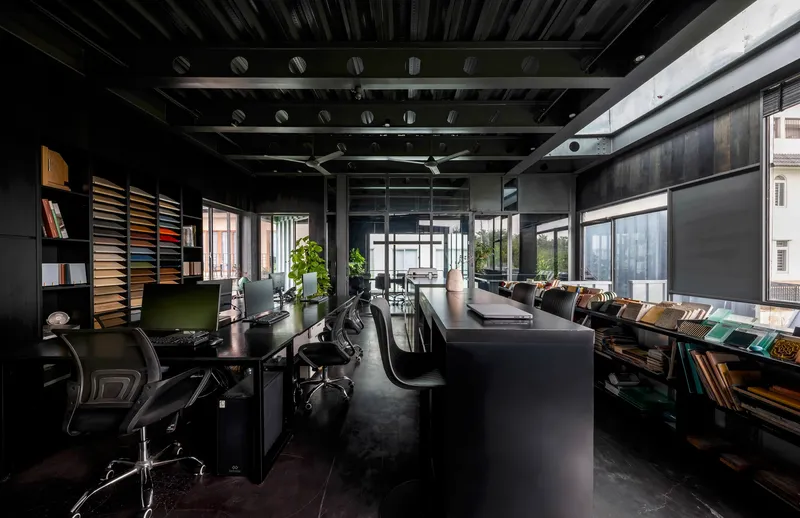
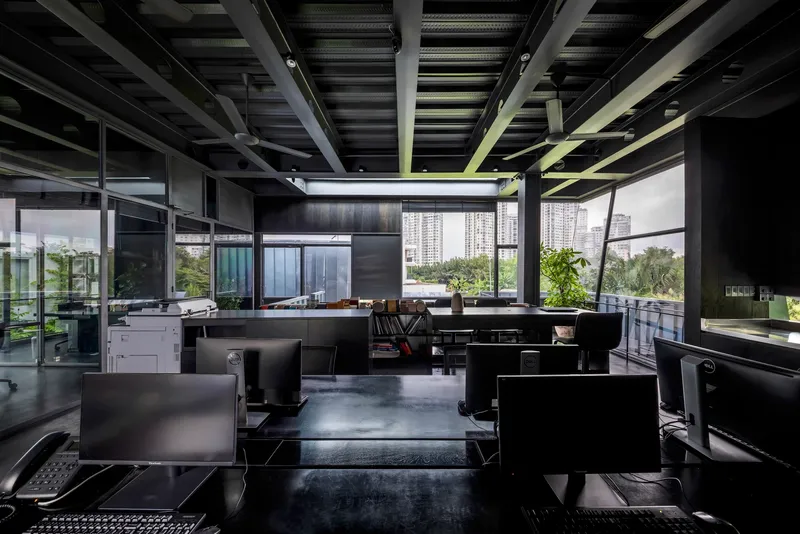
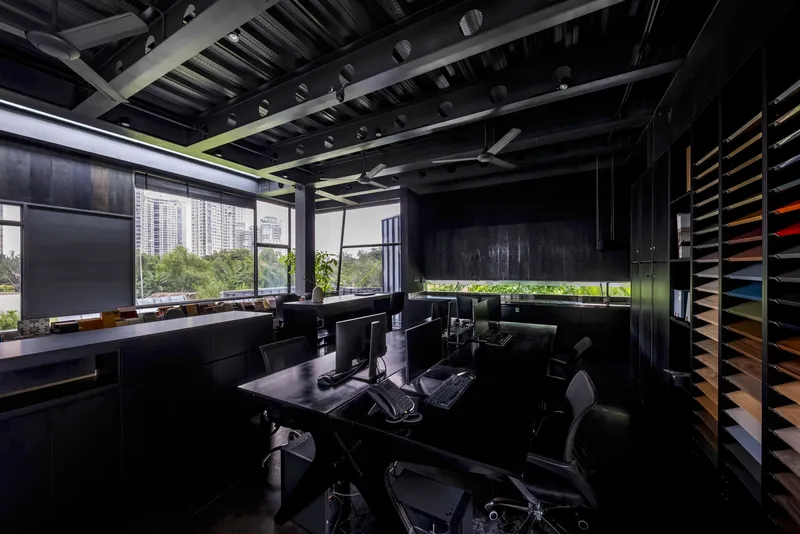
Inside, the office is organized as an open-plan layout beneath exposed steel trusses and continuous skylights. Workstations are arranged below the skylight strips, ensuring that most of the day's tasks happen in natural light. Material sample shelving lines one wall, a fitting detail given the client's work in interior fit-out. The exposed structure is not decorative: every beam, connection plate, and bolt is visible, reinforcing the building's identity as something assembled rather than poured.
Horizontal window slots frame views of vegetation in the foreground and high-rise towers in the distance, a juxtaposition that captures the exact tension of Thủ Đức's development trajectory. The monochromatic interior, rendered largely in black steel and timber, blurs the edges of the space, making the 240 square meters feel more expansive than the number suggests.
Vertical Circulation and the Skylight Shaft
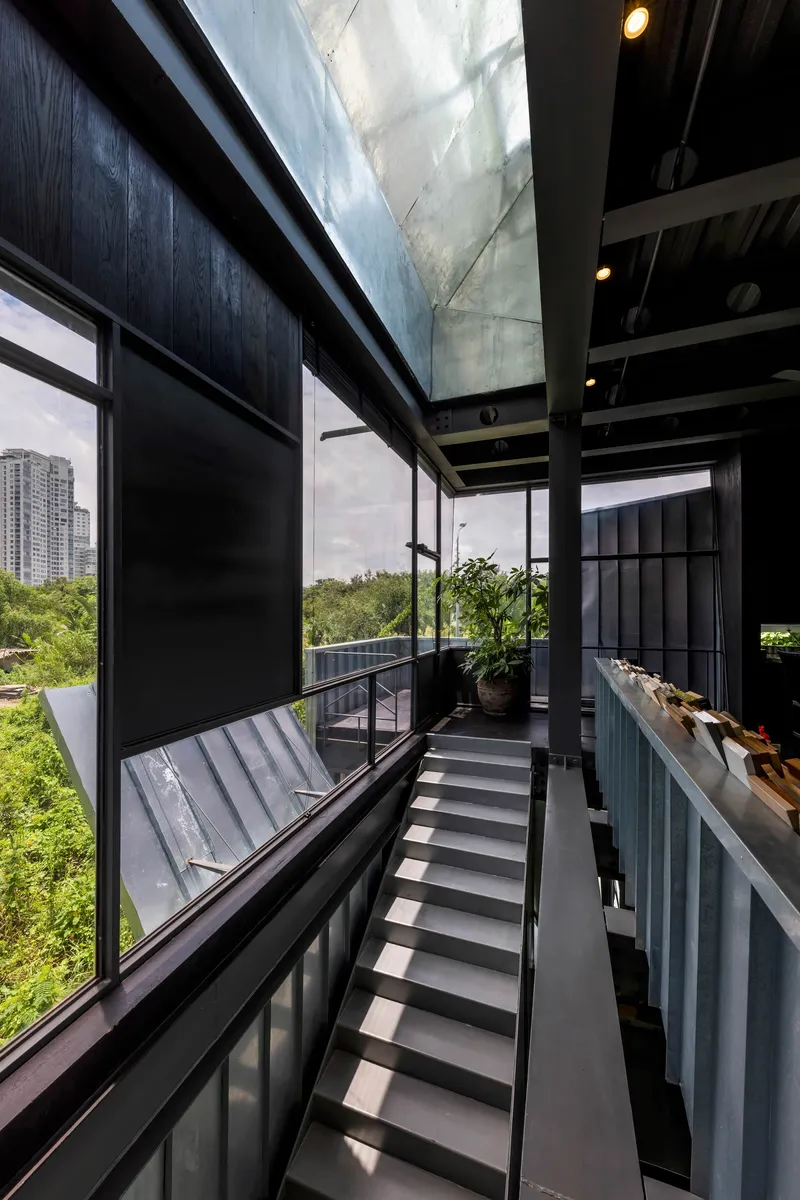
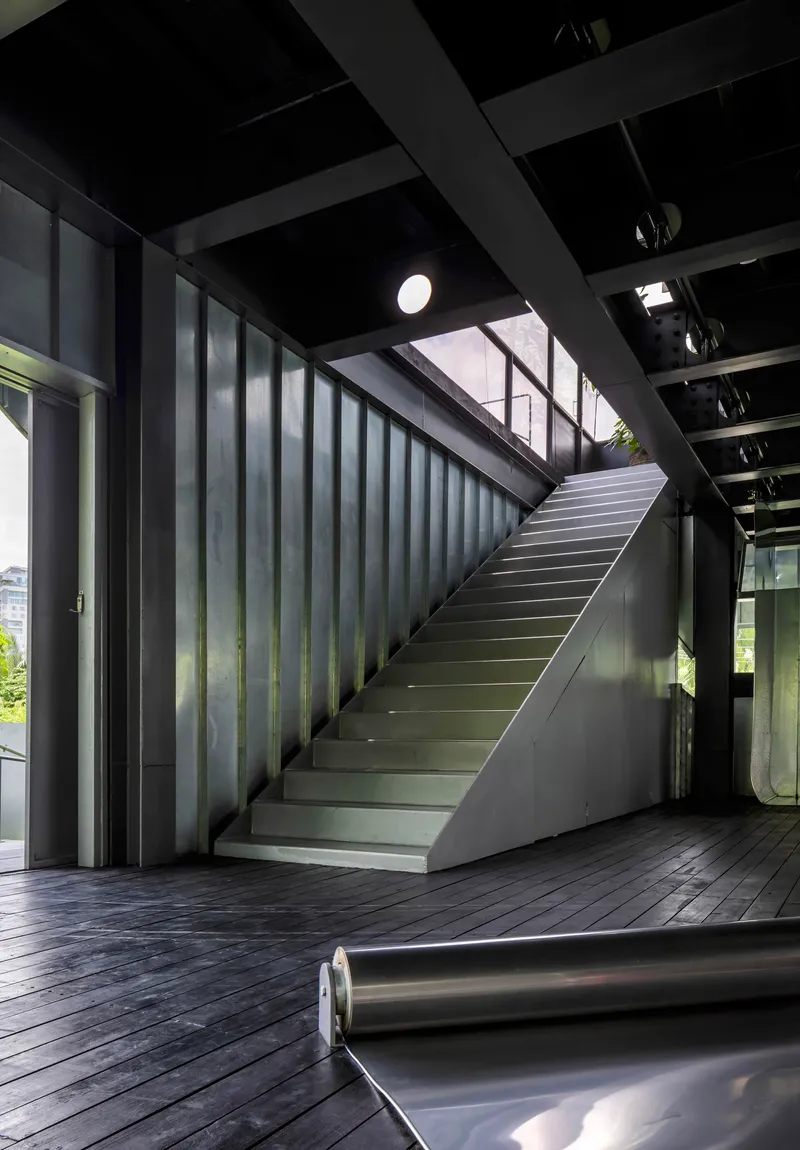
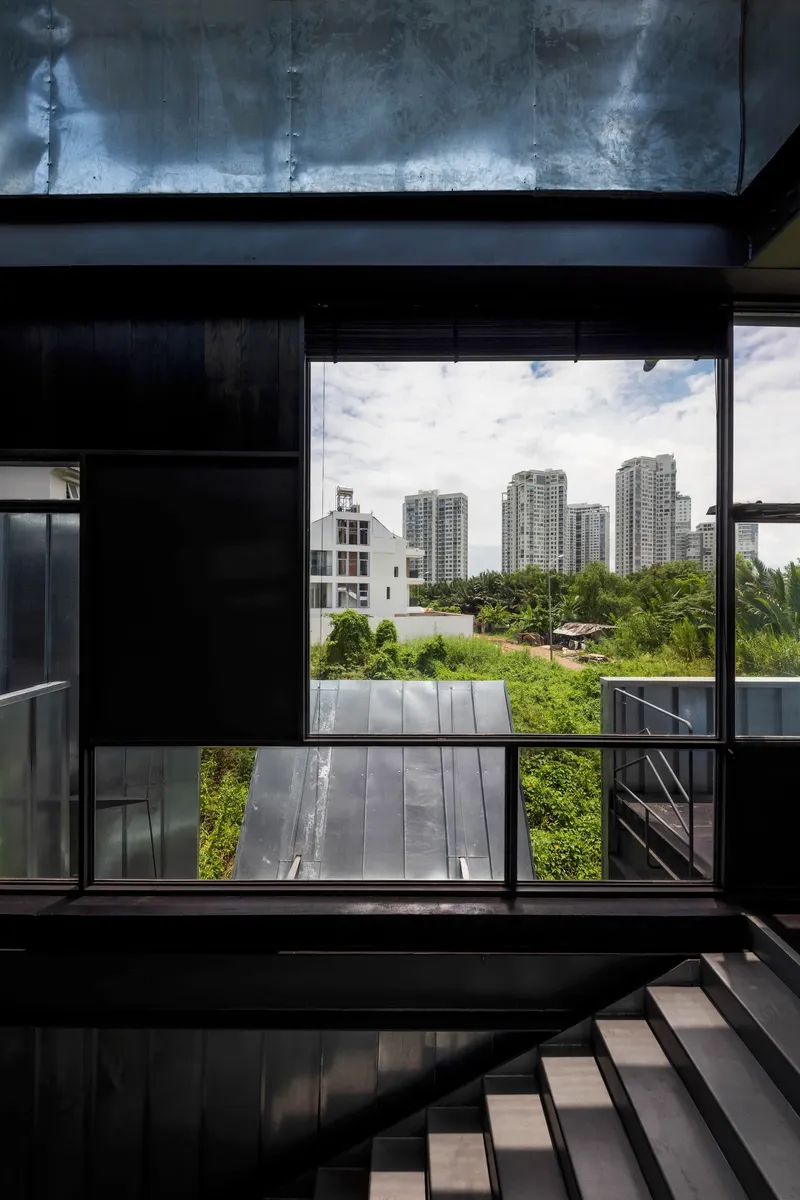
The staircase is treated as a sculptural element within the volume, its blackened steel cladding and metal treads sitting beneath a concrete skylight shaft that draws light deep into the core of the building. This vertical cut through the structure provides orientation and drama in a plan that is otherwise deliberately horizontal. The transition from the dark, enclosed stair to the bright framed window openings above creates a compressed sequence of spatial experiences that rewards moving through the building slowly.
One window in particular, a large opening framed by blackened steel beams, reveals the towers of Ho Chi Minh City's eastern expansion on the horizon. It is a deliberate framing: this temporary building looking out at the permanent city growing toward it.
Plans and Drawings
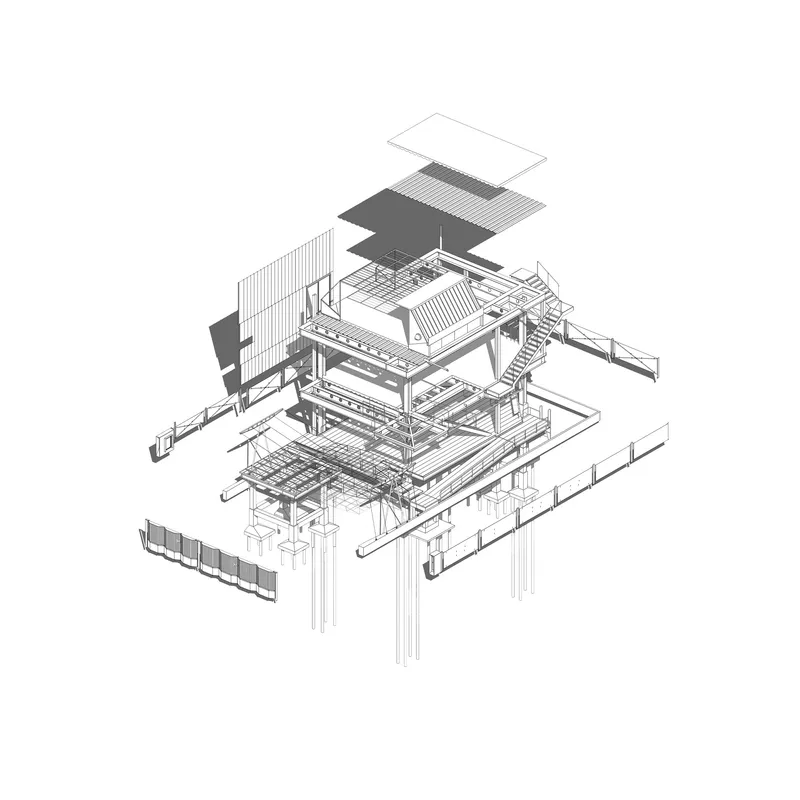
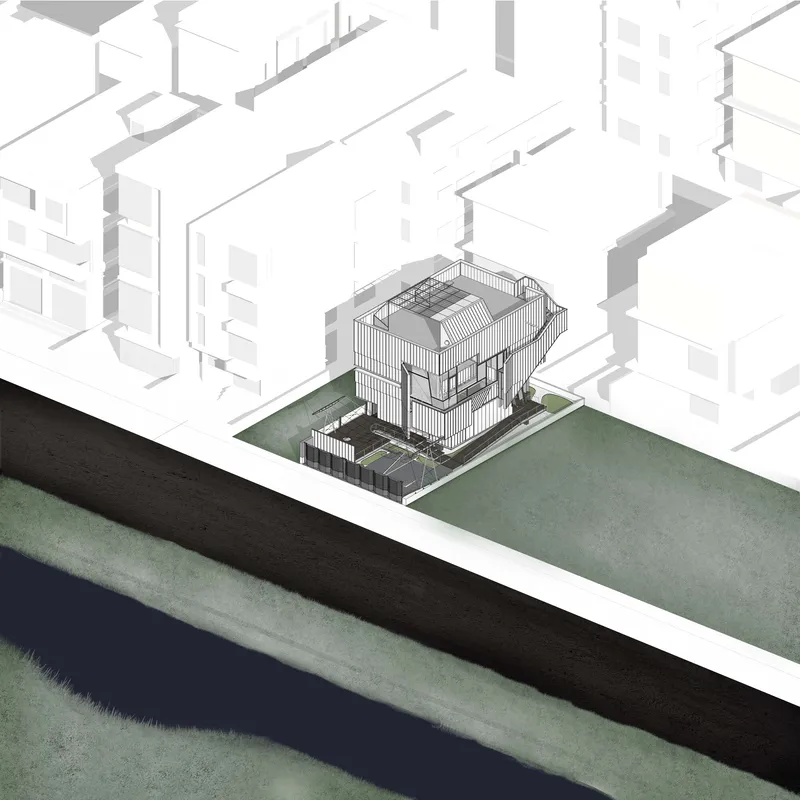
The exploded axonometric reveals the layered logic of the structural frame and roof assembly. Steel columns support a clear-span truss system, which in turn carries the corrugated metal skin and skylight strips. The drawing makes legible how every component is bolted rather than welded or cast, a critical detail for a building designed to be taken apart. The site axonometric places TBD Office within its waterfront and street context, showing just how much of the surrounding landscape remains undeveloped. The building is less a finished composition than a proposition for how to occupy uncertain ground.
Why This Project Matters
Cities across Southeast Asia are growing faster than their legal and infrastructural frameworks can accommodate. Land tenure is uncertain, flood risk is increasing, and the environmental cost of demolition waste is staggering. TBD Office does not solve any of these problems at scale, but it demonstrates a coherent design response to all of them simultaneously. It is a building that takes its own temporality seriously, embedding disassembly into the logic of its construction from day one.
More broadly, the project challenges the assumption that temporary architecture must be provisional in quality. By drawing on vernacular intelligence, working within tight material constraints, and investing in spatial generosity, Aaaaaa has produced an office that would hold up against far more expensive, far more permanent peers. If the lease ends and TBD Office disappears, the ground beneath it will be no worse for its presence. That is a standard worth taking seriously.
TBD Office by Aaaaaa. Located in Thủ Đức, Ho Chi Minh City, Vietnam. 240 m². Completed in 2022. Photography by Hiroyuki Oki.
About the Studio
Aaaaaa
Share Your Own Work on uni.xyz
If projects like this are the kind of work you want to make, uni.xyz is a place to publish your own, find collaborators, and enter design competitions.


Popular Articles
Popular articles from the community


Opera on the Sea: Driftwood Logic Shapes a Timber Opera House on Estonia's Coast
Trevor Orgill's opera house translates the entangled drift of floating timber into a civic building where wood, water, and music converge.

The Amber Palace Opera: A Geological Fiction Surfaces on Tallinn's Baltic Waterfront
Pierre Brillard reimagines a Baltic legend as a public landscape, opera house, and waterfront promenade rooted in Tallinn's coastal identity.

Singing Woman: Contemporary Architecture Inspired by Estonia’s Voice and the Sea
Singing Woman turns Estonia’s song culture into flowing opera house architecture, blending public life, landscape, sea, and national memory.

Extended Shell: Retrofitting Kolkata's Balconies as Living Urban Thresholds
A modular retrofit system recovers the social and environmental intelligence of Kolkata's historic verandas for contemporary Park Street residents.

Similar Reads
You might also enjoy these articles

Bao Huynh Watercolor Atelier: A Serene Art Retreat in Hội An
Bao Huynh Watercolor Atelier in Hội An blends multifunctional art spaces, sustainable design, local materials, and family-friendly living in a serene environment.

Atelier Macri Concept Store Interior Design by CASE-REAL
Atelier Macri store features a "ko" counter, walnut wood details, cork displays, blending retail, gallery, and seamless customer experiences.

Manuel Vargas Izquierdo Stadium and High-Performance Sports Center: Architectural Excellence in Jalpa de Méndez
The Manuel Vargas Izquierdo Stadium blends sustainable design, inclusive sports facilities, and cultural-inspired architecture, revitalizing Jalpa de Méndez’s public spaces.

KAKR Buluh Awar Hall: Revitalizing Community and Ecology Through Bamboo Architecture
Community built bamboo hall revitalizes Buluh Awar village, empowering youth, restoring ecology, celebrating vernacular craftsmanship through sustainable architecture and culture.

Explore Office Competitions
Discover active competitions in this discipline

Challenge to reimagine the Iron Throne

Photograph architecture without architects

Illustrate the lost glory of Angkor Wat - Render Challenge

Design challenge to reuse E-waste
Comments (0)
Please login or sign up to add comments
No comments yet. Be the first to comment!