
Aarohan: A Learning Curve
A library where learning is an experience

"Libraries store the energy that fuels the imagination. They open up windows to the world and inspire us to explore and achieve, and contribute to improving our quality of life." - Sidney Sheldon.
Libraries in the past were beacons of information. But today, libraries are slowly becoming absolute with the rise of digital age. The internet and world wide web has made it extremely easy for everyone to access any kind of information including academic literature. However, a lot of the essence of libraries is still retained in remote rural and economically weaker areas where everyone does not have access to a stable internet connection or a medium to access the same. This project presented itself with a brief, which provoked thoughts of what libraries should be today. Libraries today need to be spaces where knowledge and information are not just gained but shared itself. Where the library itself teaches you, providing spaces for community interaction.
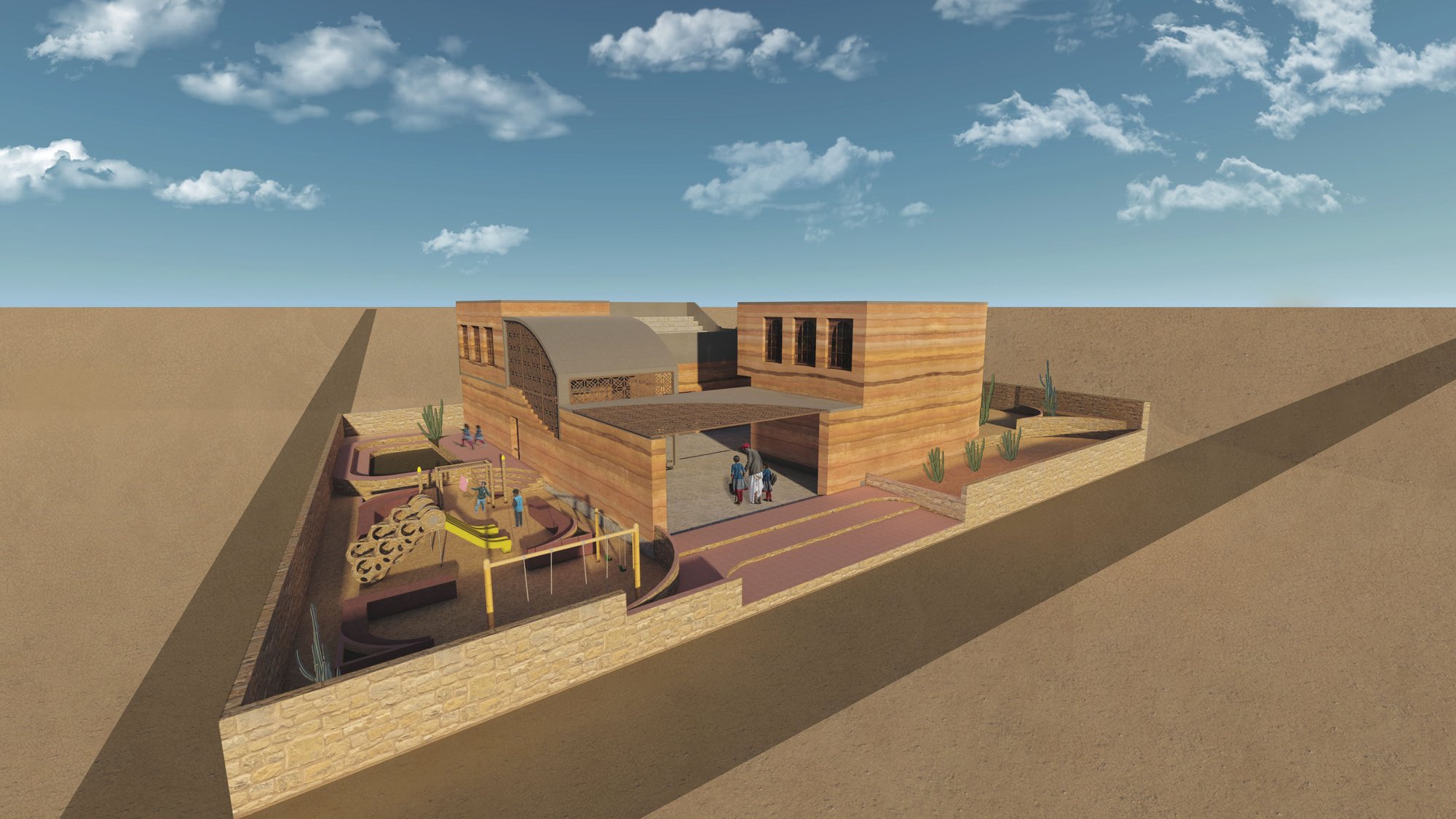
The conceptual idea of the design adheres to the main objective of the project , which is -to design a library for rural children to overcome the difficulties of online education due to unavailability of resources. The concept ‘Aarohan’ - means to ascend towards a destination. This library serves that purpose. The library ‘Aarohan’ is a space with dynamic as well as subtle features- just like a child's mind. Each volume of this space has its own definition and it speaks for itself. Together the constitution of all the volumes loops around to provoke and nurture all the senses. This space which embodies the visual, vocal, audible and tactile sensory learning is Aarohan.
The overall form grew from a zoning which was based directly as a response to the climatic conditions of Rajasthan. The spill-outs are designed to be usable even under the harsh conditions of the region. The shaded courtyard itself is connected to almost all the spaces, hence it acts as the central node of the design. Even the wall at the entrance helps channelize the prevailing wind into the courtyard. The stained glass windows and jaalis(perforated screens) also add a local touch, since they're often seen in local Rajasthani architecture, while the curves add an even more playful touch to the design. Numerous iterations were tried before we even started with a form close to the one that resembles our final design. Initially, we took an extremely practical approach and the form looked extremely orthogonal. Further, we thought of making the form follow the tessellations of the Jaali walls used in Rajasthan. Eventually, we tried incorporating some curves into the design to make it playful. The inspiration for these curves came from the oasis of the Thar desert of Rajasthan.
The primary building material is rammed earth. The use of rammed earth minimizes the need for resources away from the site. Since rammed earth is abundantly available on the site, it negates the need to bring in bricks, additional cement etc. to the site. The rainfall received here is not extensive either, this construction method would also remain extremely durable in the long run. The skills required for building the rammed earth walls can also possibly be taught in order to achieve the design as a community. Rammed earth construction does not use a strong binding agent and lacks undergoing any chemical reaction, the materials can be reused. This keeps the design modular since it can be replicated while using the local material of the region and since most places do have earth available, rammed earth construction helps. A few local elements such as jaali walls, stained glass windows and locally available ornate doors are also carefully integrated within to achieve context relevant design.
At the same time, the design scheme is such that it integrates spaces with distinct functions by using a courtyard. Variations of courtyards have been found in architecture all over the world so even something as scaling the individual spaces in relationship to the need and in relationship to the rest of the spaces, keeps the design replicable at other sites with the courtyard binding the design together.
The idea throughout designing was to maintain a friendly character and ambiance. This is achieved firstly by using subtle elements of local architecture such as jaali walls(perforated screens), stained glass windows and locally available ornate doors. This is aimed to help the local users from within the village to identify this library as one of their own. Since the construction technique also put little strain on any existing resources, in the short and long run, the design is also aimed to be more acceptable to the locals.
The aim of the library is to create an environment to encourage community learning as well as living. It is, to encourage the children of Kalasar and from rural areas across India to make an impact through their thoughts, words and actions.



Popular Articles
Popular articles from the community

Inverted Architecture Installation by Studio Link-Arc: Exploring the Intersection of Architecture and Living Organisms
Inverted Architecture Installation by Studio Link-Arc blends mycelium, sustainability, inverted design, ecological cycles, and urban adaptive architecture in Shenzhen.
Atelier Macri Concept Store Interior Design by CASE-REAL
Atelier Macri store features a "ko" counter, walnut wood details, cork displays, blending retail, gallery, and seamless customer experiences.
Treehouse Apartment: A Warm Timber Interior Blending Craft, Play, and Contemporary Living
Warm timber apartment with integrated treehouse, combining natural materials, craftsmanship, and playful design to create a flexible, family-oriented living environment.
A Contemporary Take on Iranian Residential Architecture
A modern interior design in Mashhad that reinterprets brick, light, and spatial flow to create a warm, contemporary residential architecture.


Similar Reads
You might also enjoy these articles

The Ken Roberts Memorial Delineation Competition (Krob)
As the most senior architectural drawing competition currently in operation anywhere in the world, it draws hundreds of entries each year, awarding the very best submissions in a series of medium-based categories.
A Contemporary Take on Iranian Residential Architecture
A modern interior design in Mashhad that reinterprets brick, light, and spatial flow to create a warm, contemporary residential architecture.
Franche-Comté Advanced School of Engineering by Dominique Coulon & associés, Besançon
A flexible engineering school immersed in woodland, combining concrete minimalism, adaptable spaces, and natural light to support evolving educational environments.


Waterfront Redevelopment and Urban Revitalization in Mumbai: Forging a New Dawn for Darukhana
A transformative waterfront redevelopment project reimagining Darukhana’s shipbreaking heritage into an inclusive urban future.

Explore Journalism Competitions
Discover active competitions in this discipline




The Global Benchmark for Architecture Dissertation Awards


Challenge to design public laboratory
Comments (0)
Please login or sign up to add comments
No comments yet. Be the first to comment!