

An Interior at Giomein Cervinia by co.arch studio, Italy
A refined alpine interior balancing 1970s spatial identity with contemporary minimalism, framing mountain views through material clarity, geometry, and curated design.


Set within the iconic Giomein complex in Breuil-Cervinia, Italy, An Interior at Giomein Cervinia by co.arch studio reinterprets a 1970s alpine apartment through a refined process of subtraction, material clarity, and spatial recalibration. Originally designed by Mario Galvagni during the peak of Alpine tourism development, the Giomein complex embodies a vision of architecture deeply embedded in the mountain landscape, not as a backdrop, but as an active morphological and perceptual system.

The intervention, designed by Andrea Pezzoli and Giulia Urciuoli of co.arch studio, focuses on a duplex apartment spanning the fourth and fifth floors. Commissioned by a couple of art collectors, the project required a delicate balance between preserving the strong spatial identity of the original interior and introducing a contemporary domestic language suited to modern living.


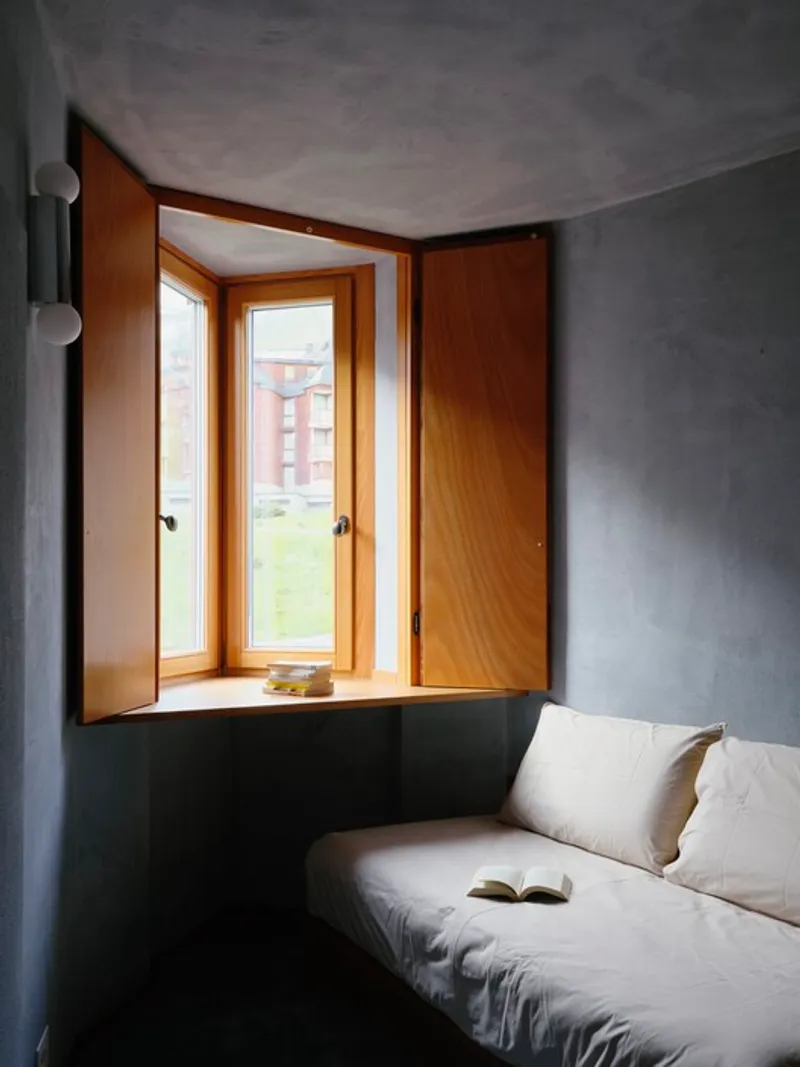
The existing apartment featured a dense decorative vocabulary typical of the 1970s, including jacquard wall fabrics, continuous carpeting, timber boiserie, mirrored surfaces, and gridded ceilings. Rather than layering new stylistic elements, the architects adopted a reductive approach, removing deteriorated finishes to reveal the essential spatial framework. This process exposed the architectural intensity of the interior: sloping ceilings, irregular geometries, curved walls, and distinctive bow windows that frame the alpine landscape.
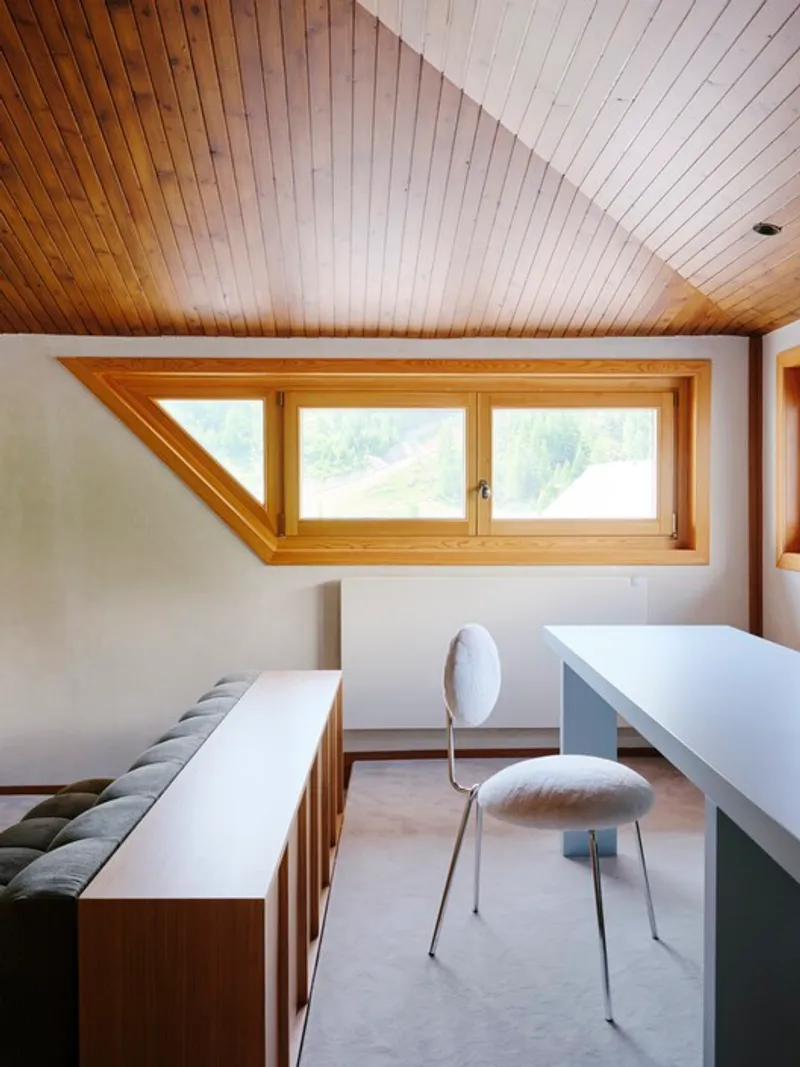

The design strategy centers on enhancing this inherent complexity while re-establishing coherence between geometry and materiality. The larch-clad ceilings echo the external copper roof, translating the rugged profile of the mountains into interior form. Bow windows act as optical instruments, carefully directing views toward the Cervino, transforming the landscape into an integral component of everyday life.
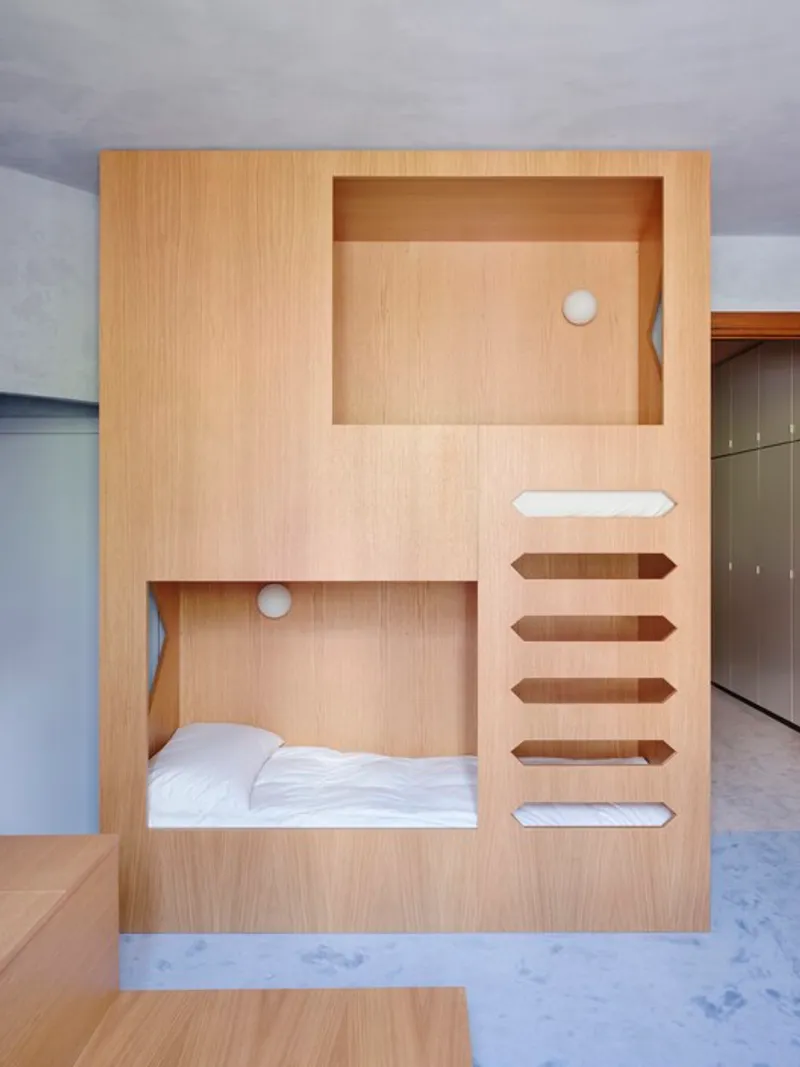
Material choices are deliberately restrained yet expressive. Besana carpeting runs throughout the living spaces, introducing subtle tonal variations that differentiate functional zones. In contrast, bathrooms and the kitchen are defined by beige limestone surfaces, creating a cooler, mineral palette that complements the warmth of timber elements. Walls are finished with Calce del Brenta plaster, offering a tactile, breathable surface that resonates with the building’s original material logic.
At the heart of the home lies the living room, conceived as a relational nucleus. Here, the architects reinterpret the iconic 1970s “conversation pit” as a contemporary spatial device. A lowered seating area, defined by custom-built sofas, creates intimacy within the larger volume. An oak perimeter structure frames this sunken space, anchoring it visually to a monolithic fireplace clad in Verde Alpi marble. The interplay of levels enhances spatial depth while maintaining continuity.


Adjacent to the living area, the dining space is positioned on an elevated plane, featuring a custom-designed refectory table in a soft light-blue tone. A built-in bench aligns with the windows, reinforcing the connection to natural light and panoramic views. The kitchen, partially concealed, is accessed through a geometrically rotated opening, an abstract reference to the original architectural language of the complex.

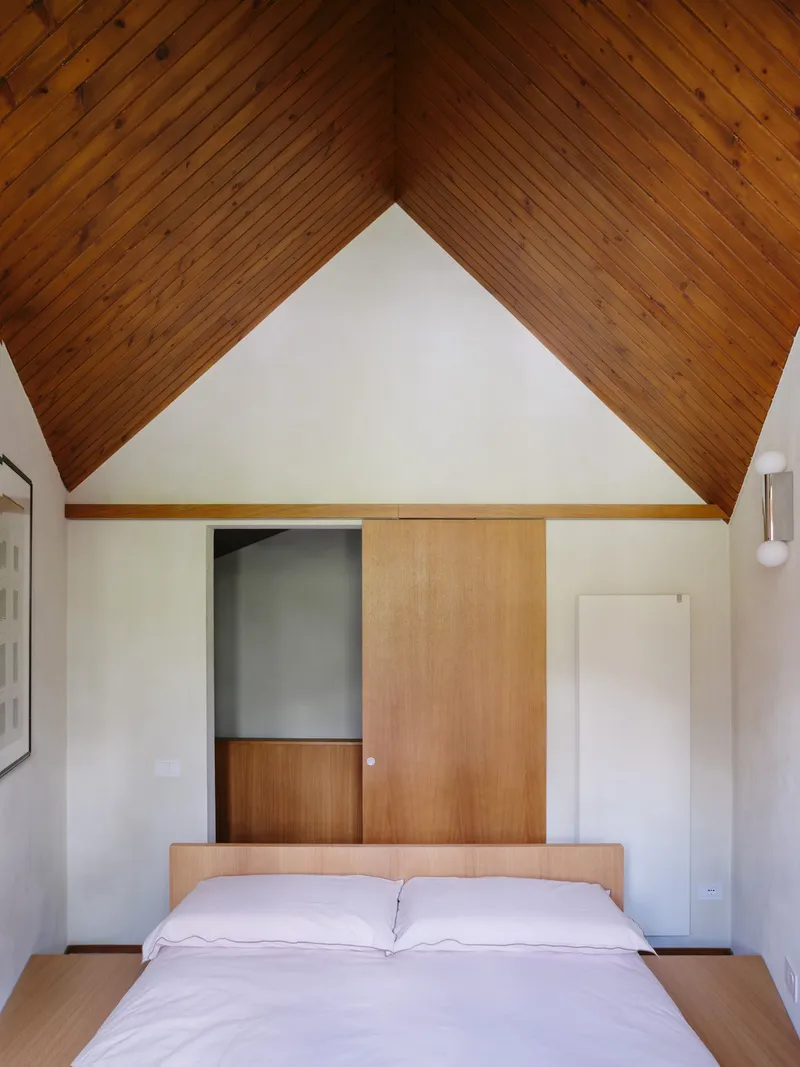
Private spaces continue this narrative of crafted intimacy. The children’s room incorporates a custom bunk bed system reminiscent of a Nordic cabin, while the master bedroom in the attic is conceived as an autonomous retreat. A timber platform evokes the atmosphere of a ship’s cabin, orienting the bed toward a corner window that frames uninterrupted views of the Cervino. Wooden shutters allow precise control of light, enhancing the sensory relationship with the surrounding environment.


Art plays a fundamental role in the composition of the interior. Carefully curated contemporary works are integrated into the spatial sequence, interacting with materials and geometry. Rather than acting as decorative additions, these artworks contribute to the intellectual and emotional depth of the space, reinforcing its identity as both a home and a cultural environment.


Ultimately, the project exemplifies a disciplined architectural approach grounded in clarity and respect for context. By stripping away excess and focusing on essential elements, co.arch studio has restored the apartment’s spatial integrity while adapting it to contemporary life. The result is an interior where architecture and landscape are inseparable: where light, material, and form work together to transform the alpine environment into a lived, intimate experience.

All the Photographs are works of Francesca Iovene


Popular Articles
Popular articles from the community


Jaramillo Van Sluys Arquitectura and Urbanismo Turn a Demolished Registry Lot in Quito into an Orchard Plaza
In Quito's Centro Histórico, a 2,800 m² plaza exposes the San Agustín convent wall and redraws its lost Augustinian orchard in volcanic stone.

Cube Design Draws an Ecological Corridor Between Two Shenzhen Hills with the Nankai Building
Beside Shenzhen's container docks, the Nankai Building pairs stacked balconies with a climbing green screen to connect two hillsides across its height.

GROUP A Strips a 1969 Rotterdam Harbor Headquarters to Its Frame and Wraps It in Timber Louvers
In Rotterdam's M4H harbor district, Ferro Offices reuses a 1969 frame, adds one timber storey and reaches BREEAM-NL Outstanding.

Juan García Correa, John González and Claudia Rueda Sink a Circular Amphitheater into a Manizales Engineering Building
On the La Nubia campus in Manizales, Colombia, the S1 Building folds labs and offices into a hillside of ramped lawns that double as a campus route.

Similar Reads
You might also enjoy these articles


Hodi-Mandai Geram
Project Function: Preservation and revitalization of the Intangible heritage and socio-spatial identity of the Hodi by Housing, Cultural Memory Center, Sacred Grove, landscape, local tourism economy


Olio Towers: A Mid-Rise for Performers That Fuses Housing, Rehearsal, and Stage
Located blocks from Houston's Theater District, this modular tower stacks living units around a central performance atrium.

Oasis: Modular Green Housing Carved into Dhaka's Urban Fabric
A shortlisted Plugin Housing entry reclaims unauthorized settlements in Dhaka with stepped concrete volumes, green roofs, and ventilation-driven design.

Black Hole: A Floating Megastructure for the Post-Physical Era
Emiliano Mazzarotto envisions a spherical, self-scaling arena where e-sports, digital hotels, and holographic stadiums replace traditional public space.

Explore Residential Building Competitions
Discover active competitions in this discipline

Challenge to design mud housing for contemporary communities

Challenge to reimagine the Iron Throne

Photograph architecture without architects

Illustrate the lost glory of Angkor Wat - Render Challenge
Comments (0)
Please login or sign up to add comments
No comments yet. Be the first to comment!