
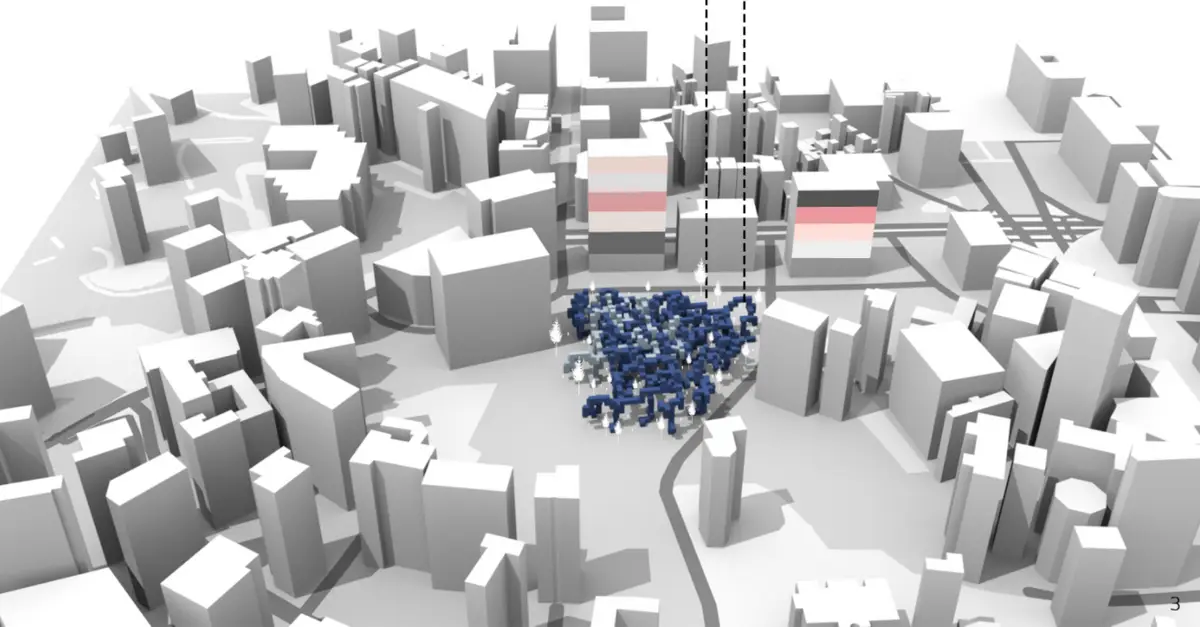
ANYSPACE: Modular Architecture That Turns Seoul's Obsolete Offices into Civic Toolkits
A shortlisted competition entry reimagines Seoul's Central Business District as a network of 3D-printed, AI-driven modular workspaces for 2050.


What happens when an entire district's office towers become obsolete? Rather than demolishing or abandoning them, ANYSPACE proposes turning Seoul's Central Business District into a vertically stacked ecosystem of interchangeable modules: healthcare clinics, urban farms, community hubs, and flexible workspaces, all fabricated through 3D printing and orchestrated by AI. The premise is deliberately radical. Architecture should stop dictating function and start enabling freedom.
Designed by Yasemen Engin, ANYSPACE was shortlisted in the Breaking Work - Singularity competition. The brief asked entrants to rethink how we will work in the future, and Engin's response anchors itself in a specific place and a specific timeline: Seoul in 2050, a hyper-connected metropolis where automation has absorbed routine tasks and traditional office typologies no longer serve the people who once filled them.
From Monasteries to Networks: Tracing the Workspace Through Centuries
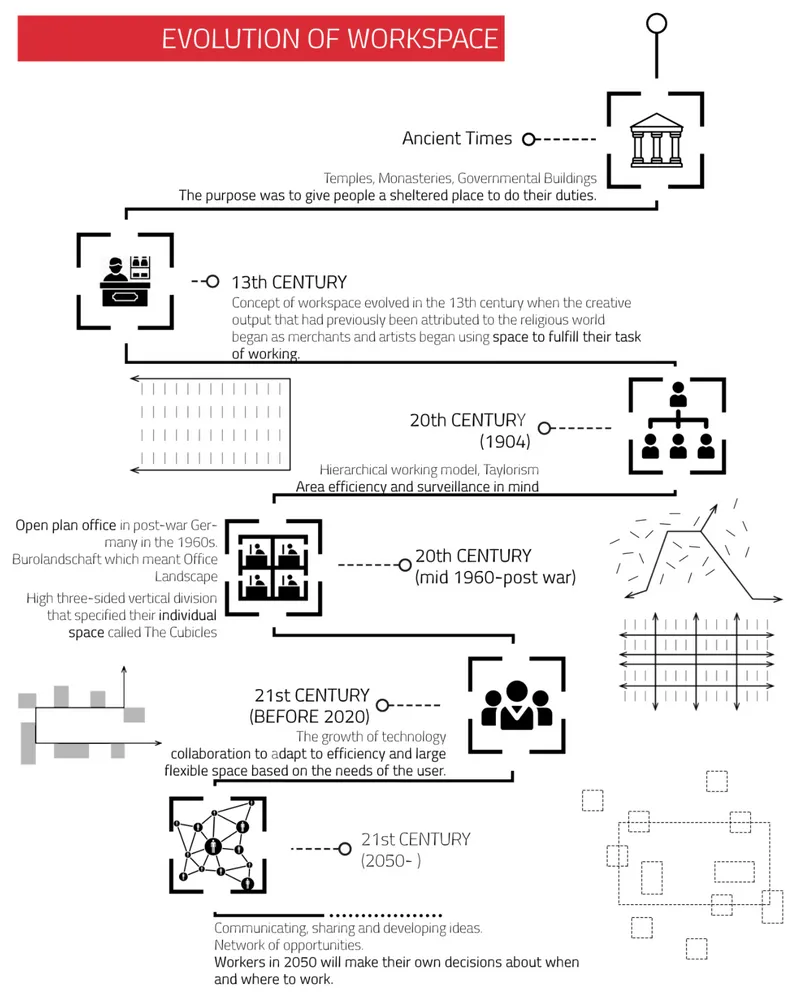
Engin grounds the project in a careful reading of workspace history. The timeline diagram above traces that evolution from ancient temples and monasteries, where work and spiritual life were inseparable, through 13th-century merchant guilds that introduced space as a facilitator of productivity, to the Taylorist cubicle farms of the 20th century and the Burolandschaft (office landscape) movement that emerged in postwar Germany. Each era's workspace mirrored its societal structure: hierarchical organizations produced hierarchical floor plans.
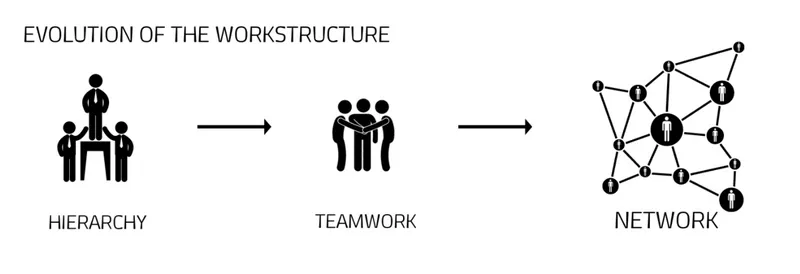
The accompanying organizational diagram makes the trajectory explicit. Rigid top-down hierarchies gave way to team-based clusters, which in turn are dissolving into distributed network systems. By 2050, Engin argues, the individual will have complete autonomy over how and where to work. If the organizational model is a network, then the architecture that supports it must be equally fluid. That conviction drives every spatial decision in the project.
A Toolkit of Interchangeable Modules, Not a Fixed Building

The ten circular icons above read like a parts catalog for a future city. Each represents a core principle of the ANYSPACE system: modular and integrated design, 3D-printed fabrication for precision customization, strategic green voids that preserve ground-level planting, public-oriented ground floor programs, short-term lease adaptability, and cross-virtual operation that supports digital collaboration across geographies. Taken individually, none of these ideas is unprecedented. Taken together, they form a coherent argument for architecture as a deployable, relocatable kit of parts rather than a permanent monument.
The emphasis on machine- and AI-driven construction is worth pausing on. Engin envisions a fabrication pipeline where modules are stackable, interchangeable, and rapidly deployable. Speed matters here not for its own sake, but because a city that can assemble and reassemble its built environment quickly is a city that can respond to shifting demographics, economic shocks, and new modes of working without generating vast quantities of architectural waste.
Stacking Programs: Agriculture, Healthcare, and Work in One Vertical Frame

The isometric diagram reveals how ANYSPACE organizes its programmatic diversity vertically. Cubic modules are color-coded by use: agriculture, healthcare, accommodations, community functions, and workspace. Rather than segregating these programs into separate buildings or separate districts, Engin layers them within a single structural frame. Ground-level modules are reserved for shared public functions, ensuring the building's footprint remains accessible and civic in character. Upper levels accommodate the more private or specialized programs, with voids introduced at strategic intervals to allow daylight penetration and maintain visual connections to the city.
The real ambition here is the repurposing of Seoul's existing CBD towers. As traditional offices empty out, ANYSPACE treats the redundant structural grid as an armature for new life. Inserting modular units into existing vertical zones turns corporate shells into hybrid-use infrastructure without starting from scratch. The project reframes obsolescence not as a problem to be solved through demolition, but as an opportunity to redistribute urban resources back to the public.
Workspace as Civic Asset, Not Corporate Enclosure
One of the quieter but more powerful moves in ANYSPACE is the insistence that workspace belong to the city, not to a single tenant. By placing shared public functions at ground level, by integrating healthcare and agriculture alongside desks and meeting rooms, and by designing for short-term leases and easy relocation, Engin collapses the boundary between office building and urban commons. The workspace becomes a node of culture, care, and interaction rather than a gated corporate precinct.
In a high-density context like Seoul's CBD, this posture has real consequences. It means the sidewalk experience changes: the base of a tower is no longer a lobby for badge holders but an open platform for the neighborhood. It means urban agriculture and community health services coexist with hot-desking pods and virtual collaboration suites. The architecture does not separate these activities; it treats them as interdependent layers of a functioning city.
Why This Project Matters
ANYSPACE succeeds because it refuses to treat the future of work as a purely interior-design problem. Most workplace speculations stop at the furniture layout or the collaboration app. Engin pulls the camera back to the scale of the district and asks what happens to an entire generation of office towers when the workforce no longer needs them. The answer, grounded in modular fabrication, AI-driven assembly, and programmatic diversity, is both pragmatic and optimistic: give the buildings back to the city, piece by piece.
For a shortlisted competition entry, the breadth of thinking is notable. The project connects organizational theory, urban policy, fabrication technology, and spatial design into a single coherent narrative. Whether or not every module gets built by 2050, the framework Engin proposes offers a useful lens for any city grappling with the twin pressures of remote work and urban density. Architecture, at its best, does not prescribe behavior. It creates the conditions for people to decide for themselves.
View the Full Project
About the Designers
Designer: Yasemen Engin
Enter a Design Competition on uni.xyz
uni.xyz runs architecture and design competitions year-round that reward proposals with spatial conviction and real site intelligence.
Project credits: ANYSPACE by Yasemen Engin Breaking Work - Singularity (uni.xyz).


Popular Articles
Popular articles from the community


The Ocean Hive: Sustainable Architecture for a Self-Sufficient Civilization at Sea
The Ocean Hive imagines sustainable architecture at sea, where modular habitats, algae, wave power and ocean waste sustain a growing colony.

Lunar Spiral: Space Architecture Shaped by the Mathematics of the Universe
Lunar Spiral reimagines space architecture through Fibonacci geometry, lunar regolith, levitating habitats, and self-sustaining Moon living.

Co-life: Sustainable Architecture for Age-Friendly Community Living
Co-life reimagines sustainable architecture for seniors through courtyards, rammed earth, shared gardens, and spaces designed for belonging.

Play: Fragments of Their World
Familiar architecture becomes modular playground design, creating safe spaces where displaced children can learn, connect, imagine and play.

Similar Reads
You might also enjoy these articles

Bao Huynh Watercolor Atelier: A Serene Art Retreat in Hội An
Bao Huynh Watercolor Atelier in Hội An blends multifunctional art spaces, sustainable design, local materials, and family-friendly living in a serene environment.

Atelier Macri Concept Store Interior Design by CASE-REAL
Atelier Macri store features a "ko" counter, walnut wood details, cork displays, blending retail, gallery, and seamless customer experiences.

Manuel Vargas Izquierdo Stadium and High-Performance Sports Center: Architectural Excellence in Jalpa de Méndez
The Manuel Vargas Izquierdo Stadium blends sustainable design, inclusive sports facilities, and cultural-inspired architecture, revitalizing Jalpa de Méndez’s public spaces.

KAKR Buluh Awar Hall: Revitalizing Community and Ecology Through Bamboo Architecture
Community built bamboo hall revitalizes Buluh Awar village, empowering youth, restoring ecology, celebrating vernacular craftsmanship through sustainable architecture and culture.

Comments (0)
Please login or sign up to add comments
No comments yet. Be the first to comment!