

Arctic Coffee Table: Bent Steel Straps That Make a Perfectly Still Object Read as a Moving Current
Wai Ho Cheung loops wave-profiled metal strips in opposing phase, letting reflections drift across a static base so the table reads as a current.


Most coffee tables ask nothing of you. They hold a cup, collect magazines and disappear into the rug. The Arctic Coffee Table refuses that role. It never moves a millimetre, yet its base seems to ripple: looped metal strips, each bent into a wave and set against the inverse wave of its neighbour, catch light differently with every step you take around the living room. The motion is entirely in the eye of the viewer, and that is the point.
Designed by Wai Ho Cheung and published as a project on uni.xyz, the piece positions itself within contemporary kinetic furniture design, where movement is suggested rather than mechanised. At 1200 mm wide, 600 mm deep and 420 mm high, it keeps the proportions of a conventional low living-room table. What changes is the job its structure performs: the base carries the load and generates the visual drama at the same time.
A Static Object That Performs Under Light
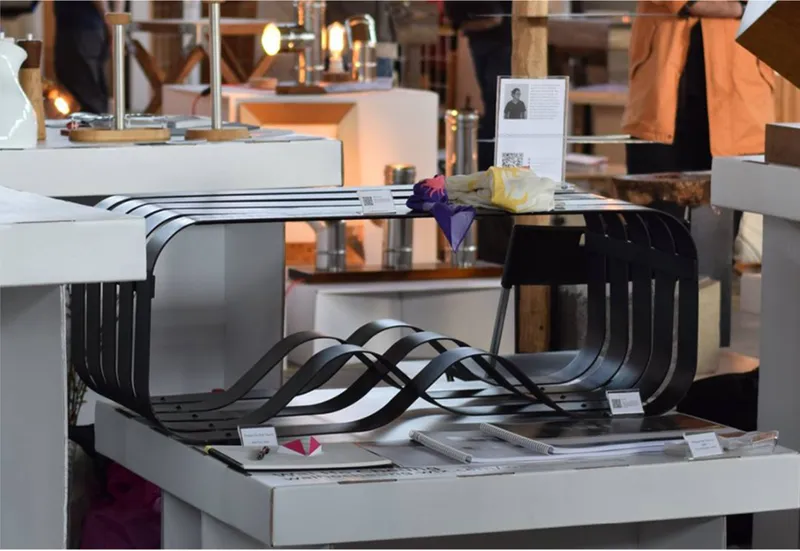
Set on a white plinth among exhibition stands and warm lamps, the table shows how dependent its effect is on its surroundings. The black steel straps read as a dark, layered mass from a distance, but the warm point sources around it pick out highlights along each curve. Walk past and those highlights slide along the bands, which is exactly the illusion Cheung describes: shifting light and shadow standing in for actual motion.
The ocean reference could easily have stayed literal and decorative. Here it becomes a lighting strategy. The curves are not there to depict a wave so much as to give light a surface that changes angle continuously, so the object is never seen the same way twice.
The Wave as a Domestic Shelf
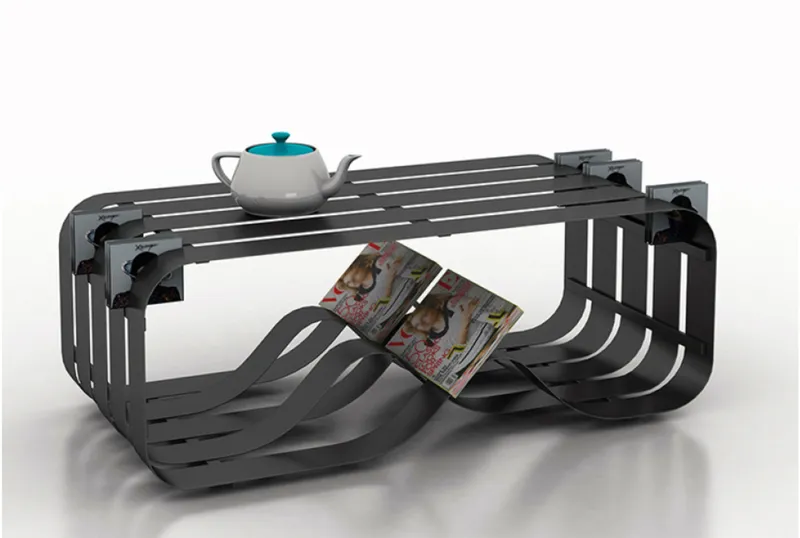
The rendering brings the table back to everyday use: a teapot on the top, magazines tucked into the dip of the wave below. That small detail does real work for the argument. The undulating base is not sealed off as sculpture; its troughs become informal pockets, so the same geometry that animates the object also offers somewhere to put things down.
Cheung frames the table as a centrepiece and a conversation piece, meant to energise a room rather than blend into it. The rendering suggests that ambition sits comfortably alongside ordinary domestic habits, which is where kinetic furniture often stumbles.
Dented Peaks and the Gradient of Reflection
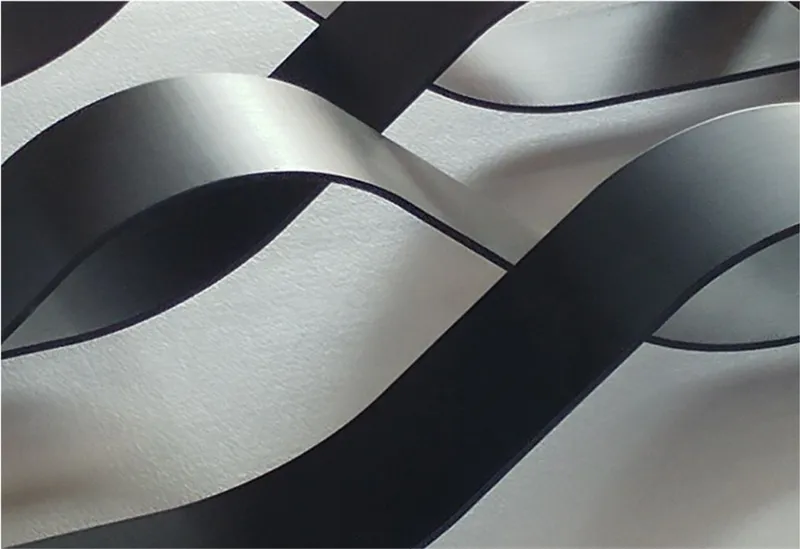
The close-up reveals the most refined decision in the project. Where the black and silver ribbons cross in soft curves, light grades smoothly across each surface. Cheung subtly dents the peaks of the waves to sharpen that grading, increasing the contrast between lit and shaded faces so that reflections jump more dramatically as the viewer moves.
It is a modest intervention with an outsized effect. A smooth wave produces a gentle highlight; a dented crest breaks it into sharper transitions, giving the eye more edges to track. The designer notes the effect is strongest under natural or directional light, an honest admission that the piece is at its best when its environment cooperates.
Straps That Carry the Load
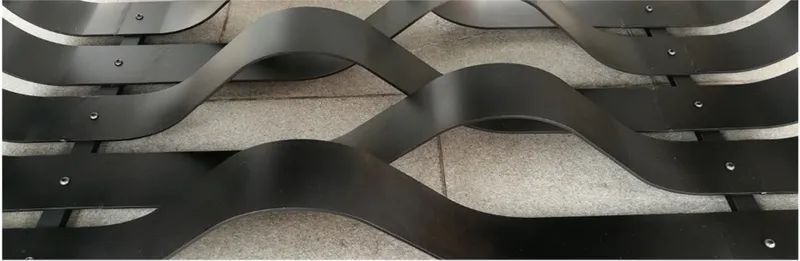
The top-down view strips the illusion back to its mechanics: bent steel straps laid across grey paving, rivet heads exposed at their junctions. The strips are fixed within supporting frames, and their repeated geometry forms an enclosure that stiffens the table while keeping it visually light. Decoration and structure are the same component here, which keeps the material logic lean.
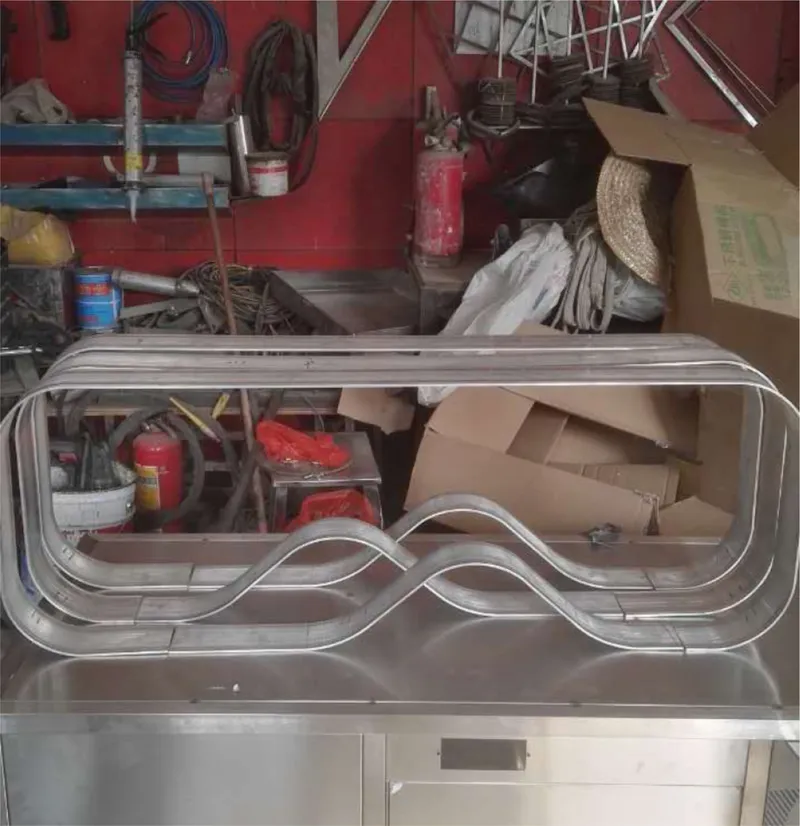
The workshop image confirms the project has moved beyond the screen. An unfinished strap frame sits on a steel workbench, its wavy lower bands already in place, in a cluttered red workshop. Seeing the piece in fabrication matters: the opposing wave profiles and the riveted connections are clearly buildable, not just a rendering trick.
Why This Project Matters
Kinetic furniture usually means hinges, motors or moving parts that add cost and fragility. The Arctic Coffee Table reaches a sense of movement through geometry and finish alone, shifting the work of animation onto the viewer's eye and the room's light. That is a smarter, more durable route, and it makes the table's ambition feel achievable rather than gimmicky.
Just as importantly, Cheung refuses to separate how the object looks from how it stands up. The same looped straps hold the top, generate the shimmer and leave space for magazines. For a young designer, that integration of structure, perception and use is the lesson worth taking from this piece: expression is most convincing when it is doing a job.
View the Full Project
About the Designers
Designer: Wai Ho Cheung
Enter a Design Competition on uni.xyz
uni.xyz runs architecture and design competitions year-round that reward proposals with spatial conviction and real site intelligence.
Project credits: Arctic by Wai Ho Cheung.


Popular Articles
Popular articles from the community


Aquadapt: An Underwater Habitat That Rewrites Its Rooms by the Hour
Curved modules ring the seabed while one shell shifts from breakfast room to cinema, farm and football pitch as residents' needs change.


Cube Design Draws an Ecological Corridor Between Two Shenzhen Hills with the Nankai Building
Beside Shenzhen's container docks, the Nankai Building pairs stacked balconies with a climbing green screen to connect two hillsides across its height.

ETEH Reworks the Shared Spaces of São Domingos School in Brazil Around Timber, Color and Hanging Plants
At São Domingos School in Brazil, 436 m² of hall, refectory and library are recast with timber joinery, a yellow and blue code and trailing greenery.
The Amber Palace Opera: A Geological Fiction Surfaces on Tallinn's Baltic Waterfront
Pierre Brillard reimagines a Baltic legend as a public landscape, opera house, and waterfront promenade rooted in Tallinn's coastal identity.

Similar Reads
You might also enjoy these articles
Healing Façade: A Modular Chapel System That Restores Ethiopia's Sacred Forests
Winner of the Eco-Chapel competition, this circular timber façade collects water from air to rebuild soil and reforest degraded Ethiopian landscapes.
Kaffeebühnen: Where Coffee Shop Architecture Becomes a Civic Stage in Vienna
A linear sequence of timber boxes, transparent shells, and open yards turns the Viennese café tradition into a public performance space.
Eco Chapel: A Modular Forest Pavilion That Grows Like the Landscape It Protects
Hexagonal timber modules weave through existing trees, turning a chapel into a living system for prayer, education, and reforestation.


Urban Forest: A Vertical Ecosystem for 5,000 Workers in Singapore's Changi Business Park
Radially stacked pods and layered green decks turn a 7-acre plot into 47 acres of ecological workspace projected for 2040.

Explore Coffee Table Competitions
Discover active competitions in this discipline

Design challenge to equip cities with modern furniture

Competition to design a workstation for architects

Packaging challenge - Design meets sustainability
Comments (0)
Please login or sign up to add comments
No comments yet. Be the first to comment!