

Arquitectos Aliados Converts a Porto Factory into a Hotel Where Music Sets the Tempo
A 1980s electrical components factory in Porto becomes 62 hotel apartments organized around courtyards, gardens, and a 300-capacity concert hall.


Porto has no shortage of adaptive reuse projects, but few attempt what Arquitectos Aliados pulled off with the M.OU.CO Hotel Apartments. The brief was not simply to gut an old electrical components factory and fill it with guest rooms. It was to build a cultural institution around music, slip 62 accommodation units into the resulting complex, and still return a significant portion of the site's formerly impermeable industrial footprint back to the city as open garden. The result is a 4,890 square meter compound that reads more like a small neighborhood than a hotel, its gabled volumes and courtyard sequences recalling the residential and industrial grain of the surrounding streets rather than announcing themselves as something new.
What makes the project genuinely interesting is the refusal to choose between preservation and reinvention. The original factory's structural configuration was reused where possible, and three volumes were rebuilt to reproduce the proportions and silhouettes of the demolished naves. The main street facade was kept intact, its industrial character left to anchor the building in the memory of the neighborhood. Behind that familiar face, though, a completely new program unfolds: a 180-seat concert hall, rehearsal rooms, a music library, a 50-seat restaurant, bar, swimming pool, and studios ranging from compact rooms to full apartment layouts. Music is the thread that ties it all together, functioning as the converging element that justifies the unusual marriage of hospitality and performance.
An Industrial Face, Kept Honest
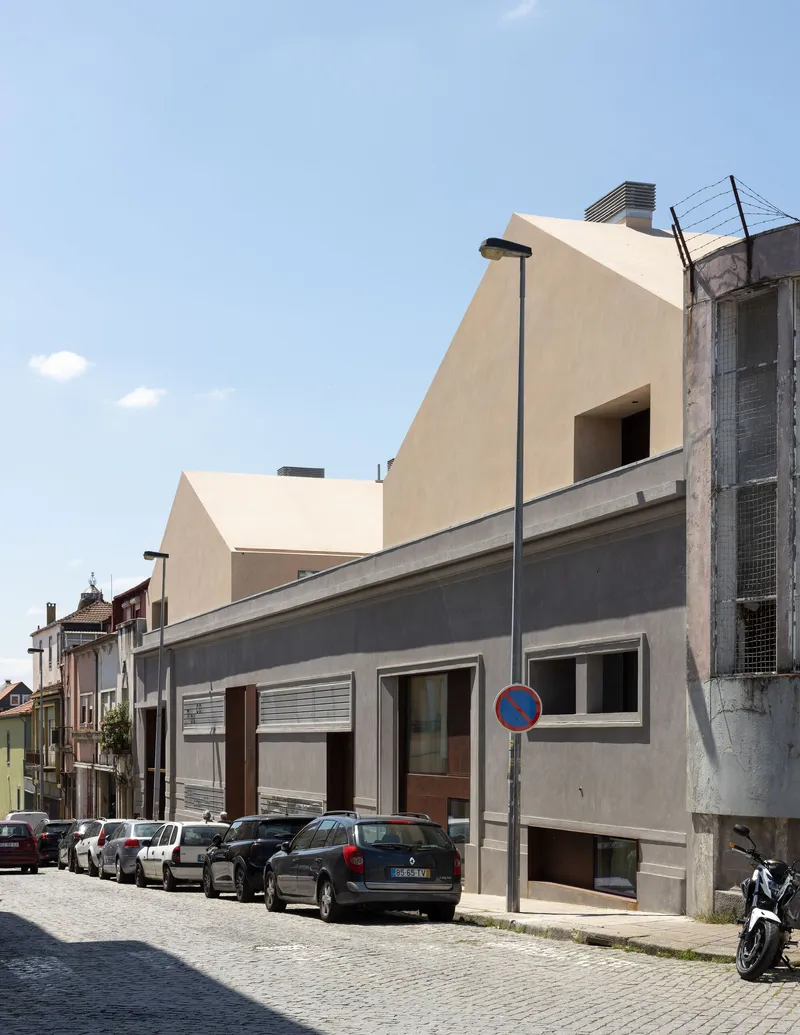
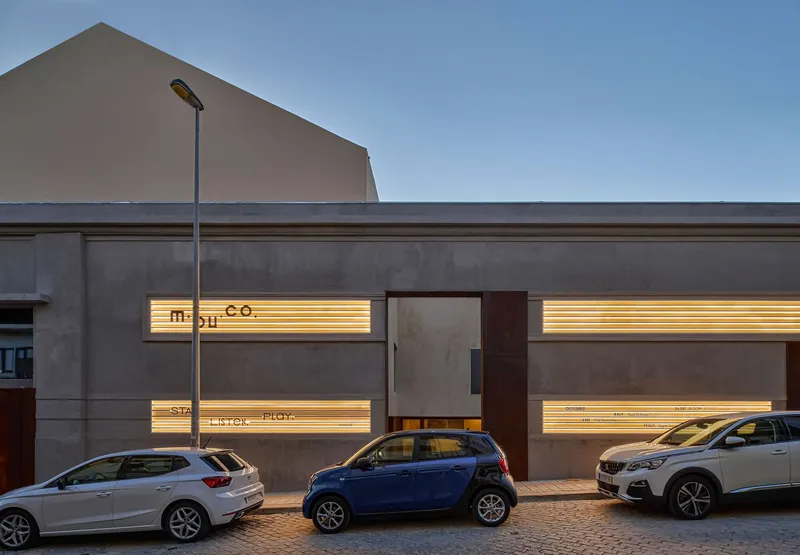
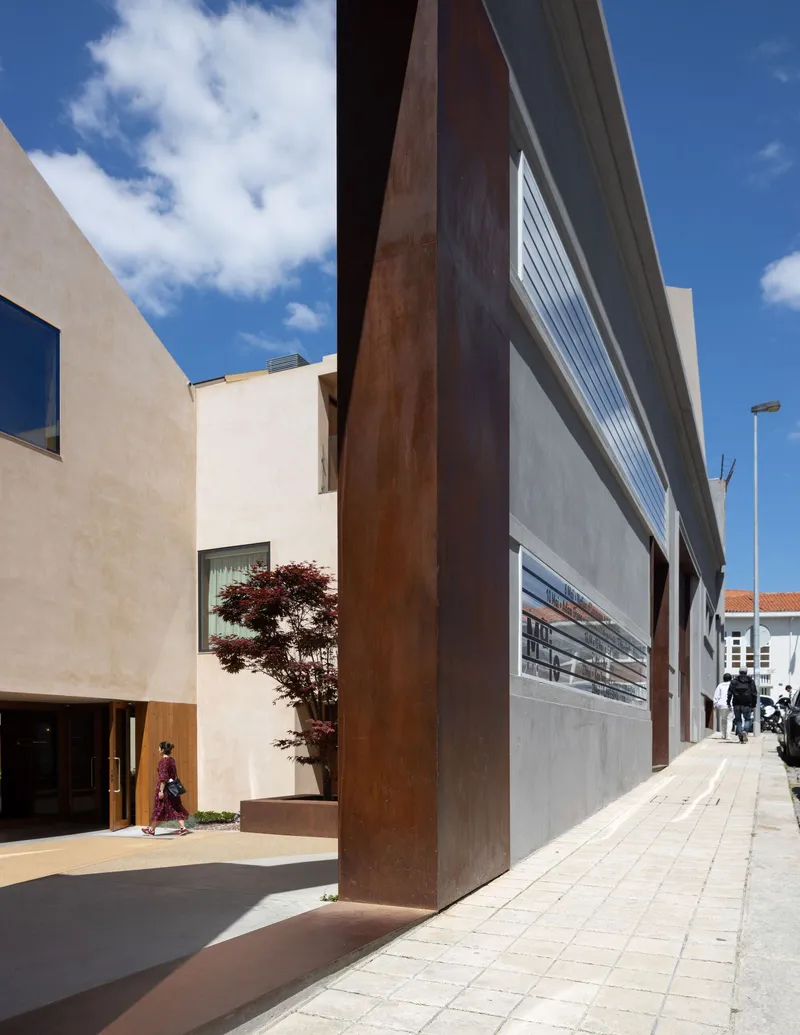
The street elevation is deliberately understated. Cream volumes rise above a grey rendered base, with horizontal lit openings punched behind concrete panels that glow softly at dusk. There is no grand entrance canopy, no glass curtain wall screaming renovation. Instead, a weathered steel portal frame marks the threshold, its patina suggesting duration rather than novelty. You walk through a shadow into the compound and leave the cobblestone street behind.
Retaining the industrial facade was a strategic decision. The surrounding neighborhood is a patchwork of residential and light-industrial buildings, many of them degraded. Imposing a polished hotel front onto this context would have been an act of erasure. By keeping the factory's face and simply cleaning it up, the architects preserved the area's character while signaling that something valuable was happening inside.
Courtyards and Gardens as the Organizing Principle

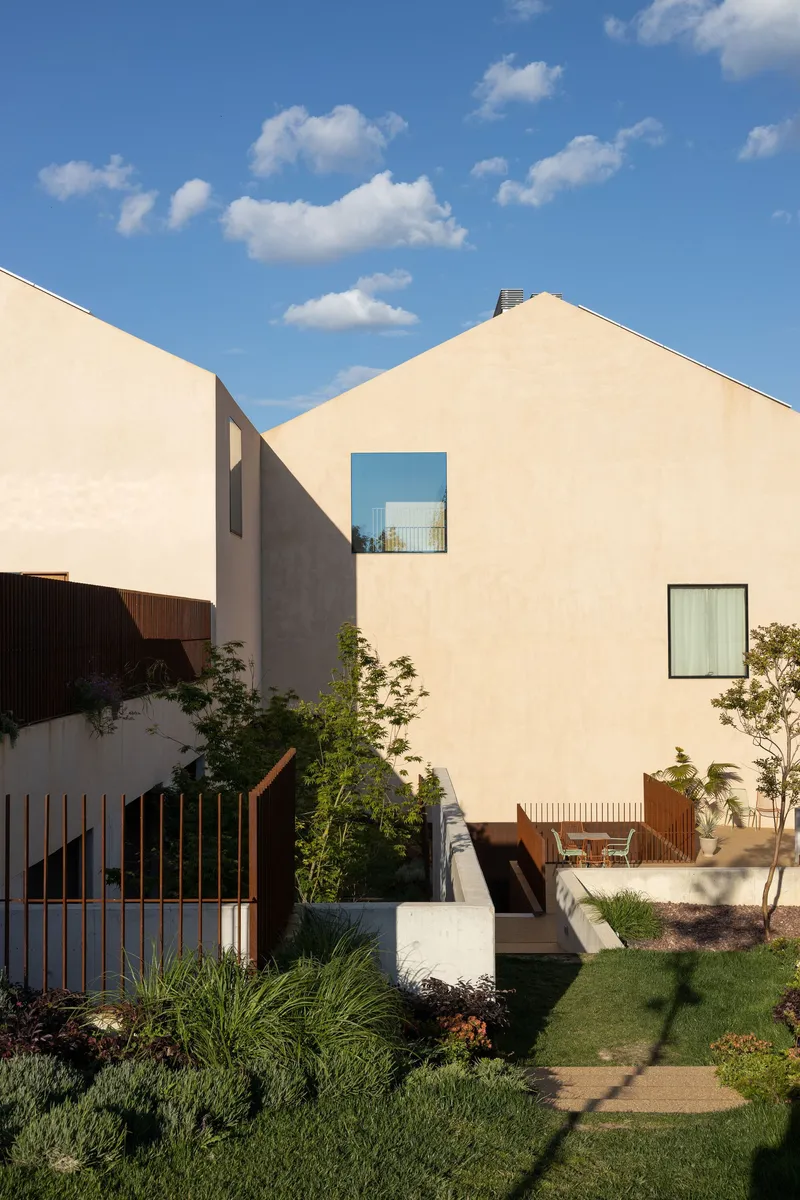

The most consequential design move was converting a large portion of the factory's covered area into open ground. Where industrial bays once sealed the site under roofing, there are now gardens, gravel beds with low plantings, and courtyard spaces shaded by new trees. The result is a series of outdoor rooms that stitch together the hotel's disparate functions: you pass through a planted courtyard to reach the restaurant, cross a garden to get to the pool, walk along a timber-fenced path to arrive at your room.
This is not ornamental landscaping. Returning permeable surface to the city is an ecological gesture, and organizing circulation through open air rather than enclosed corridors is a hospitality strategy. Guests are constantly reminded that they are in Porto, not sealed inside a hermetic interior. The arched openings, stepping-stone paths, and slatted timber screens that frame these transitions treat the garden as architecture, giving it walls and thresholds without roofs.
Material Restraint: Brick, Lime, Wood, Concrete

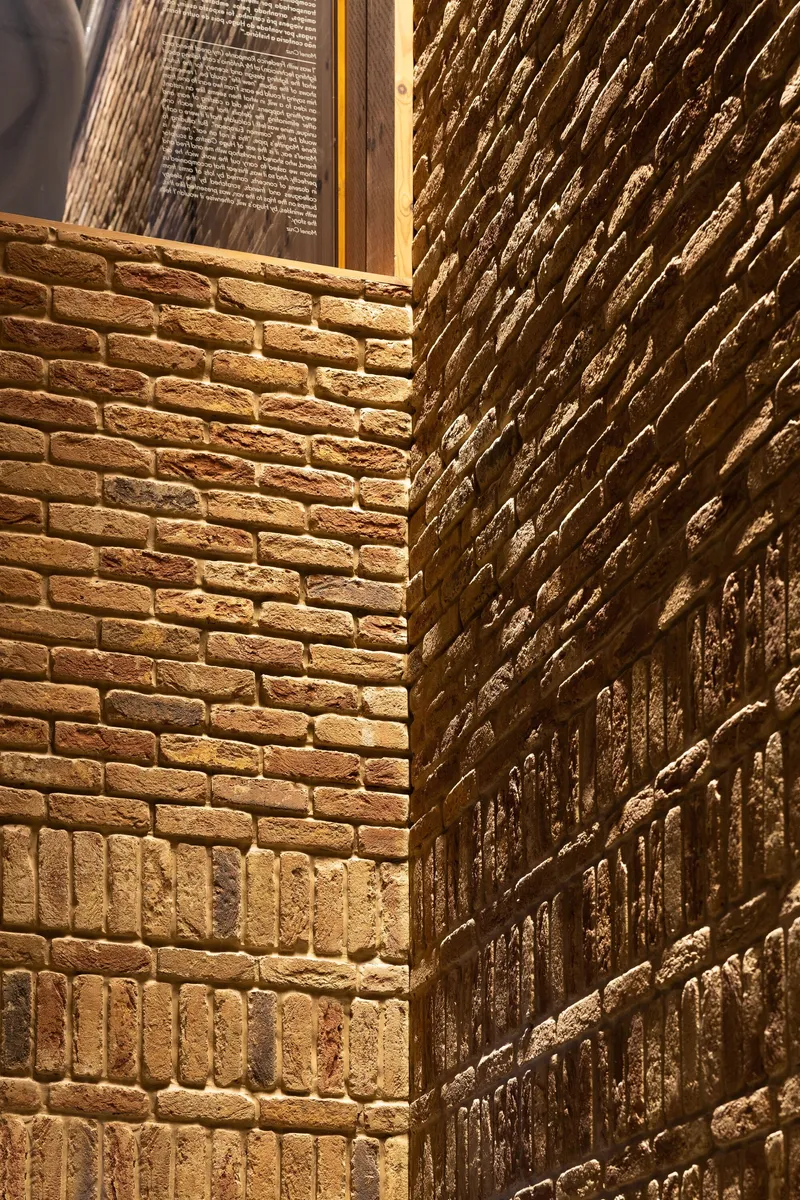
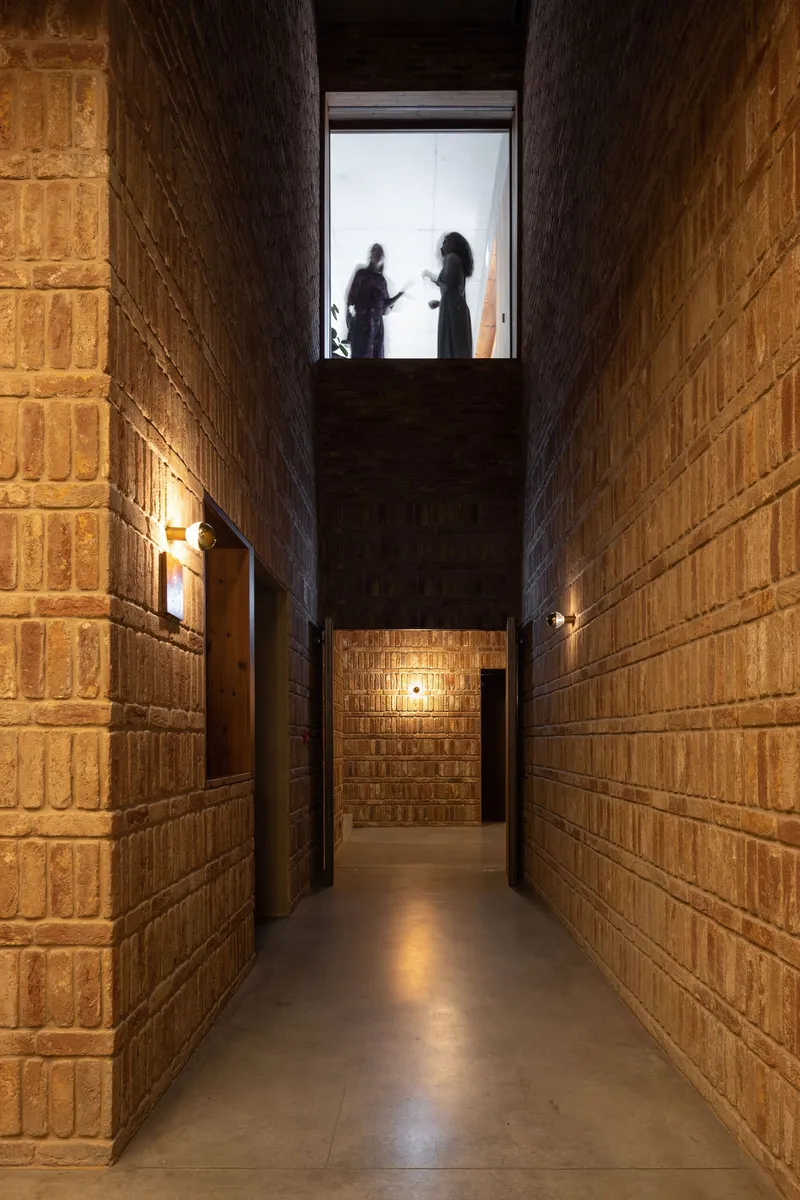
The interiors are governed by what the architects describe as a clean, simple, monolithic language using the smallest number of materials. In practice, that means exposed concrete slabs overhead, lime mortar on the walls, solid brick for accent surfaces, and natural wood for openings, fittings, and paneling. No material is asked to pretend it is something else. Brick walls are left with their textured surface, lit from below to cast long vertical shadows. Concrete corridors receive shafts of light from carefully placed skylights. Plywood lines stairwells without apology.
The palette works because it operates at different scales. A zoomed-out view of a corridor reads as a warm, tonal composition. Up close, the same corridor reveals the grain of the brick, the irregularity of the mortar joints, the soft patina of the copper handrail. These are materials that improve with use, which matters in a building designed to host concerts and accommodate hundreds of guests per week.
Guest Rooms That Feel Like Small Houses

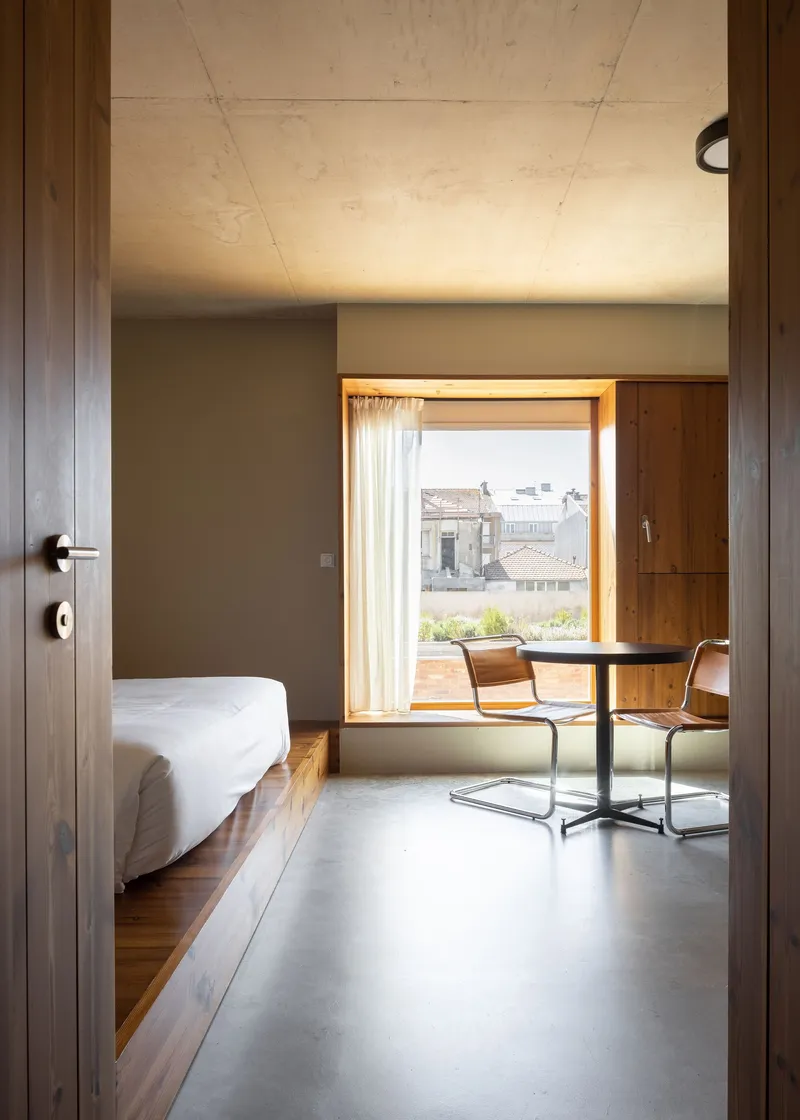
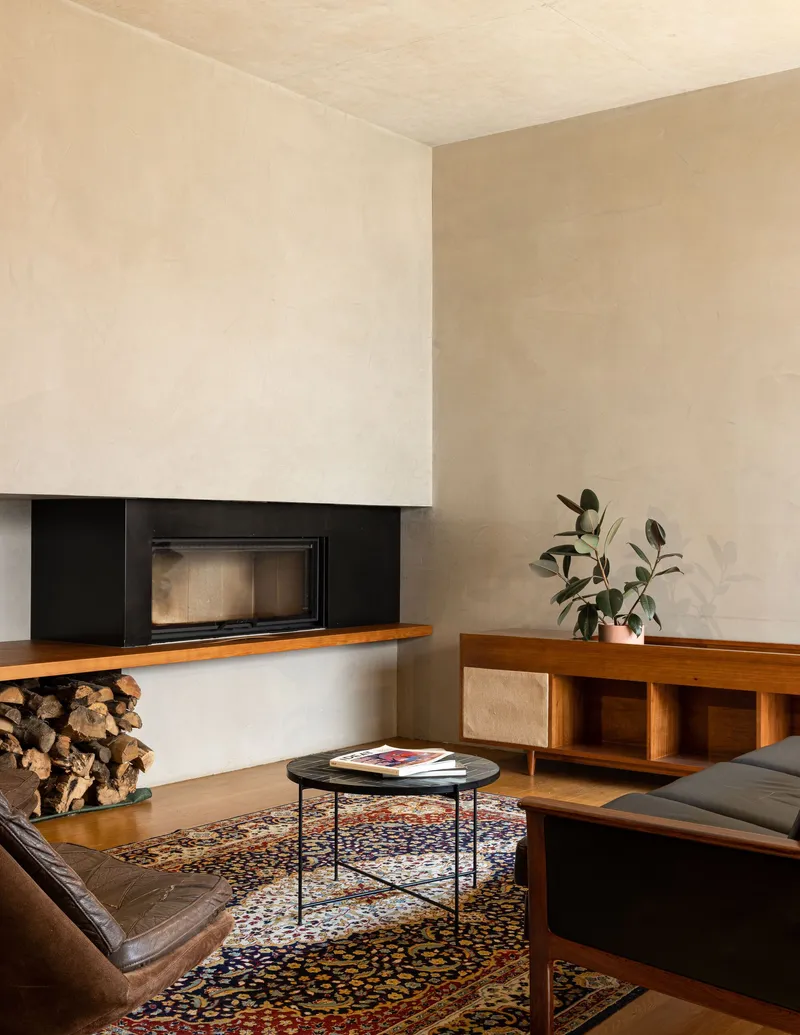
The 62 units are split between apartment studios and rooms, and the best of them feel more like residences than hotel accommodations. Knotty timber paneling wraps bedroom walls, concrete ceilings are left exposed, and timber-framed windows provide views onto lawns or planted courtyards rather than corridors or parking lots. Window seats bathed in daylight, inset fireplaces stacked above real firewood, patterned rugs over concrete floors: the details are domestic in scale and sensibility.
The dining spaces reinforce this impression. Exposed brick walls, pendant lights, corner windows overlooking greenery, and slatted wooden ceilings create rooms you might actually want to cook in. The glazed doors that open onto timber decks blur the line between interior and courtyard, making the unit feel larger than its footprint.
Living Spaces and Communal Areas
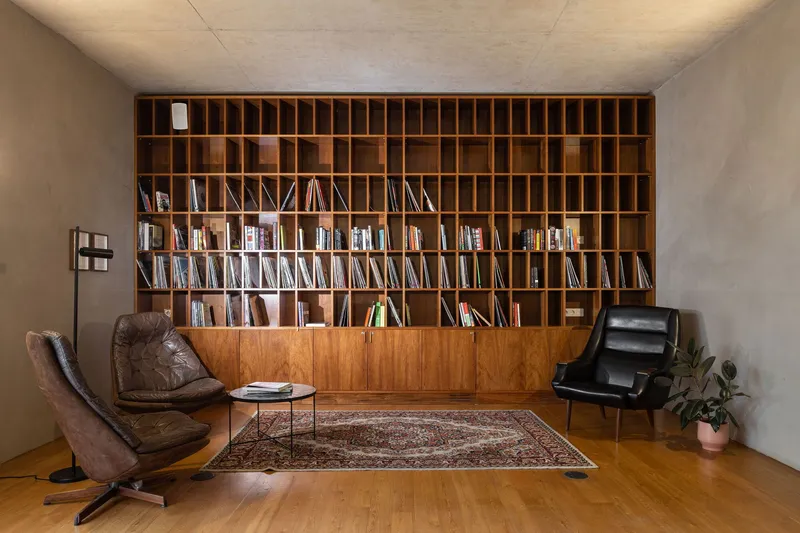
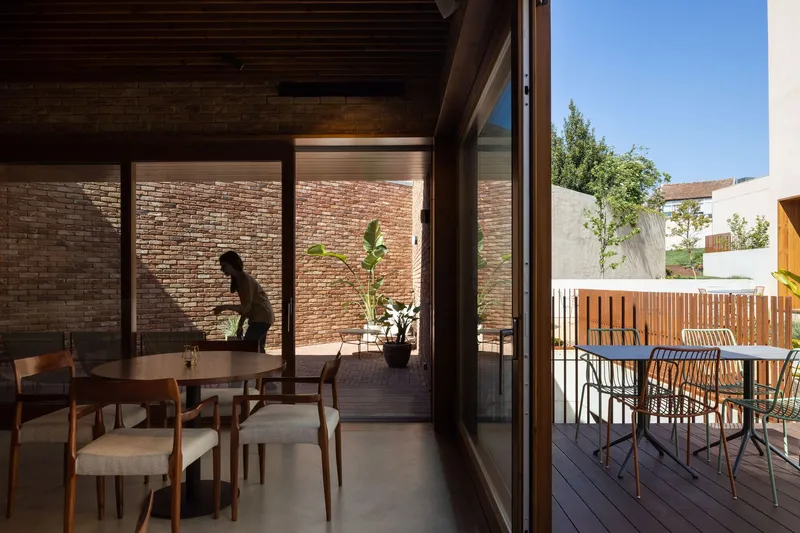
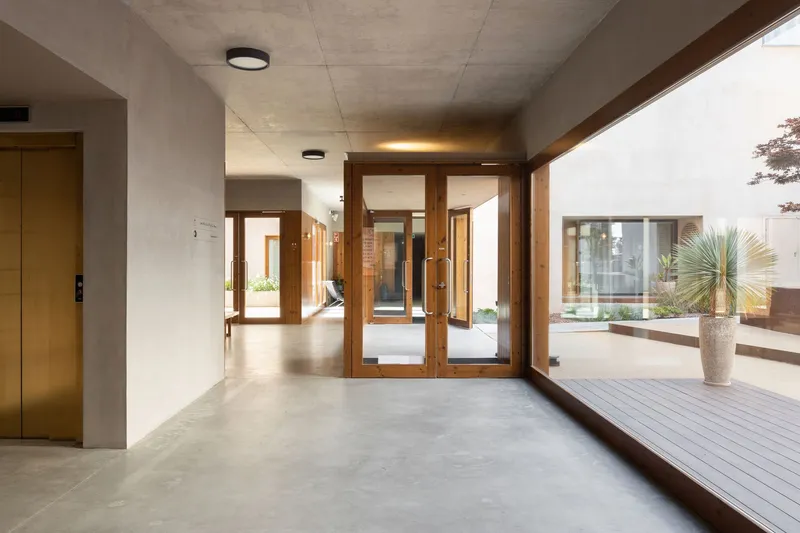
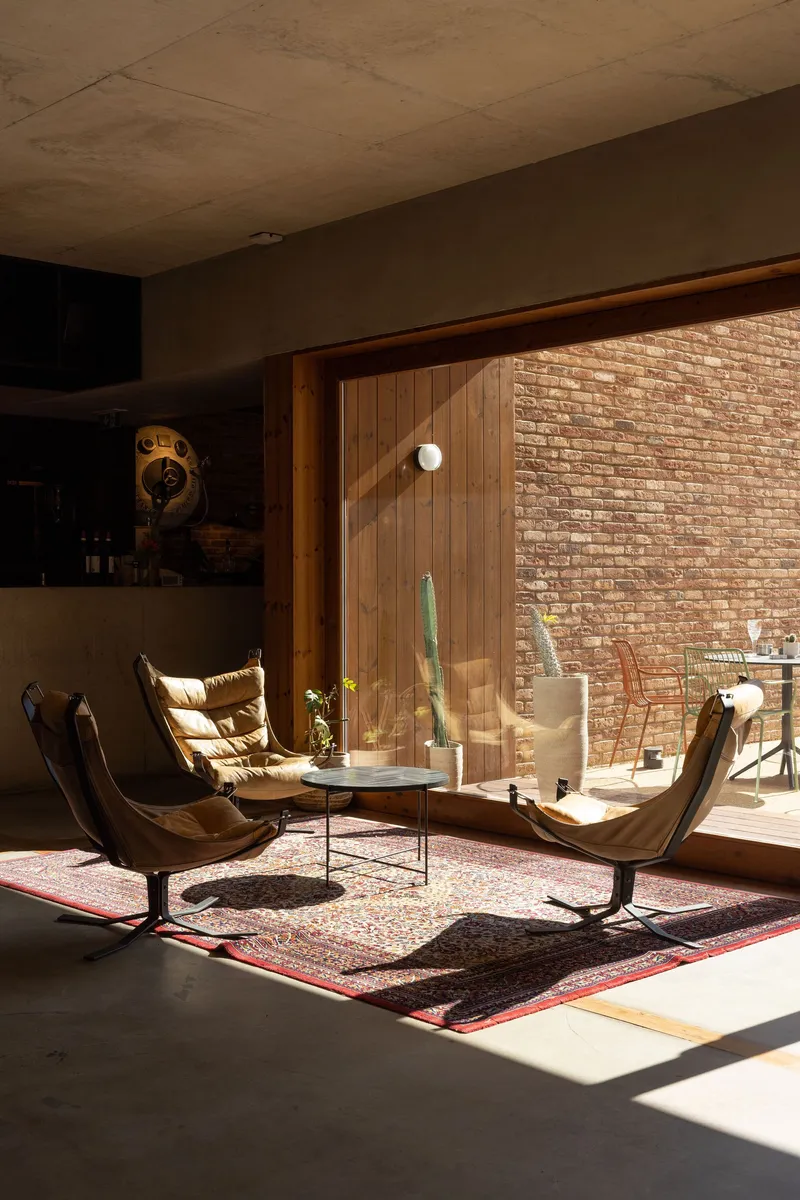
The communal program is distributed across the ground floor and courtyard level. A music library with floor-to-ceiling timber shelving and leather chairs anchors the cultural identity of the project. The restaurant and bar open through glazed doors to timber decks and the brick courtyard wall, making alfresco dining a natural extension of the interior. The entry lobby, with its timber-framed glass doors and view through to palms and wooden decking, sets the tone immediately: this is a place where inside and outside are in constant negotiation.
The Concert Hall and the Logic of Music

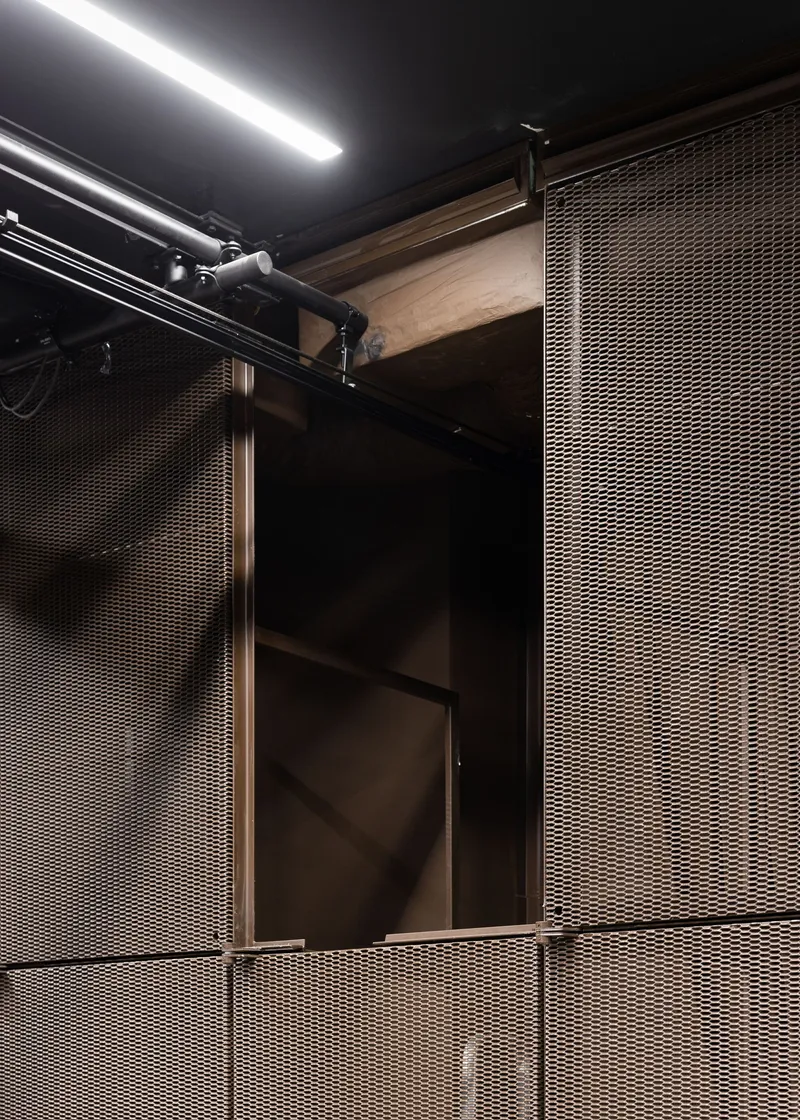
The concert hall is the programmatic engine that separates M.OU.CO from a conventional boutique hotel. With a capacity of 180 seated or 300 standing, it is a proper performance venue, complete with an exposed ceiling lighting grid and dark timber wall panels. The space is designed to open to the city, meaning it serves both hotel guests and the surrounding neighborhood. Rehearsal rooms support the hall, and the music library feeds into the broader cultural program.
Music as the organizing metaphor could have been a hollow branding exercise. Here it operates as an actual spatial strategy. The concert hall generates foot traffic, brings non-guests into the complex, and gives the courtyards and restaurant a reason to stay lively. The hotel supports the venue financially, and the venue gives the hotel a cultural identity that no amount of interior styling could replicate.
Details and Transitions
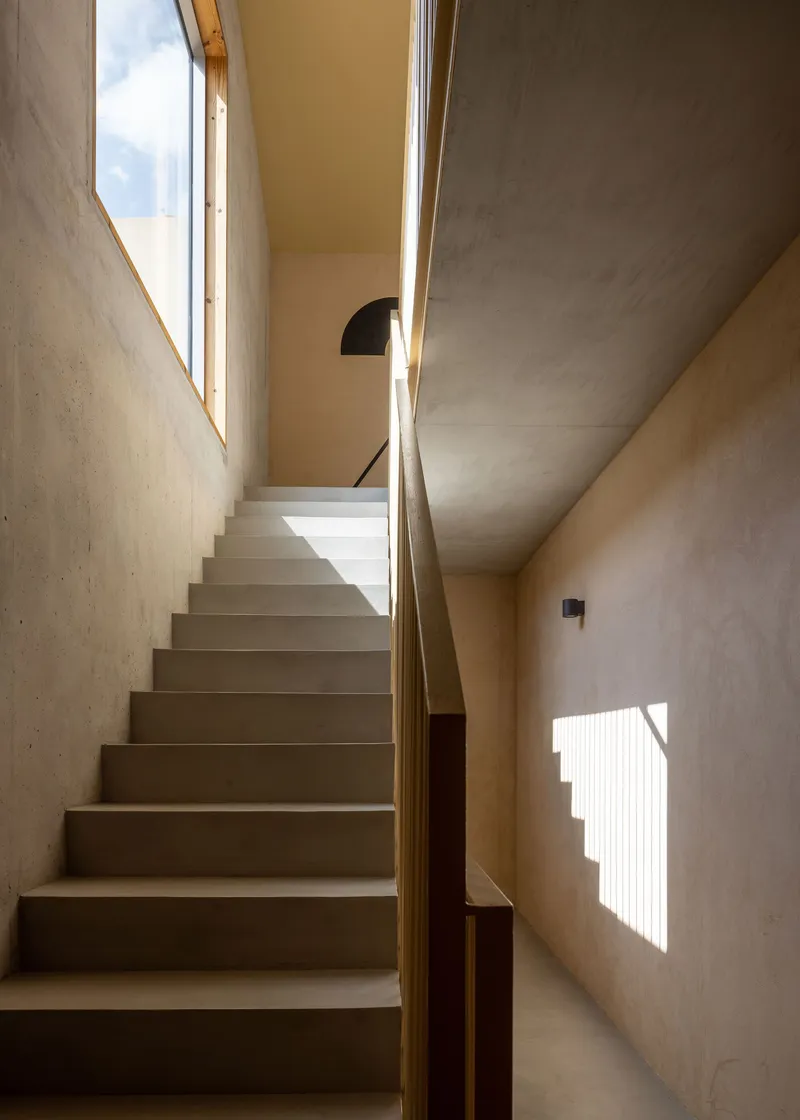
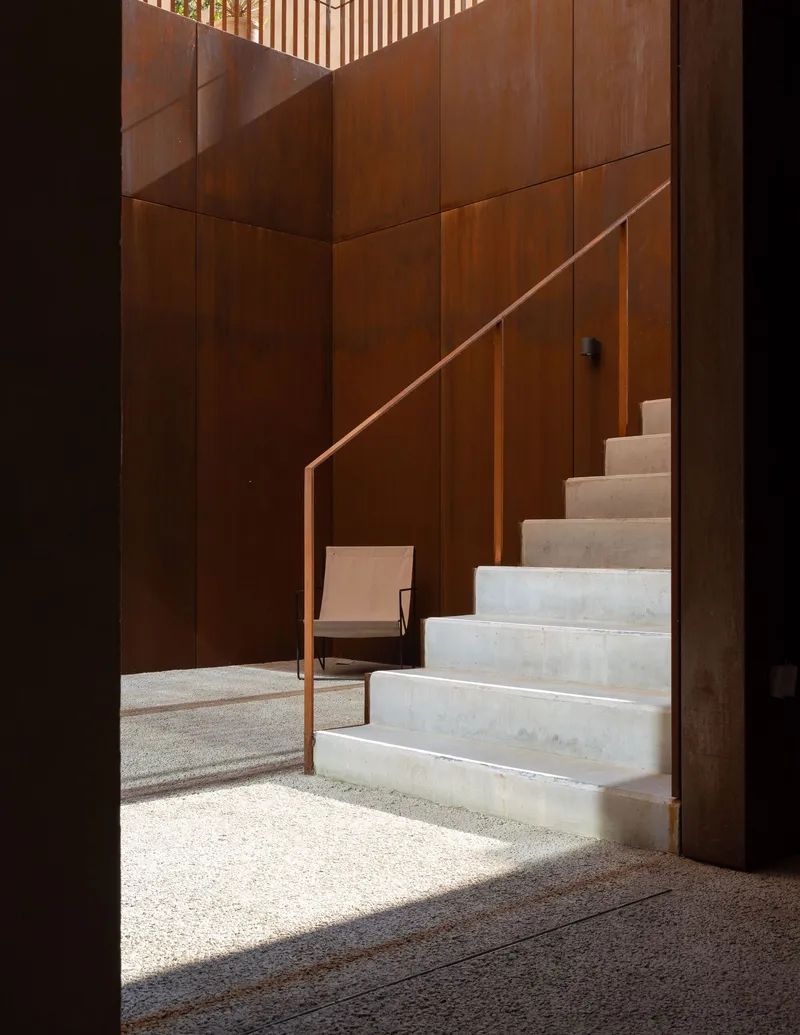
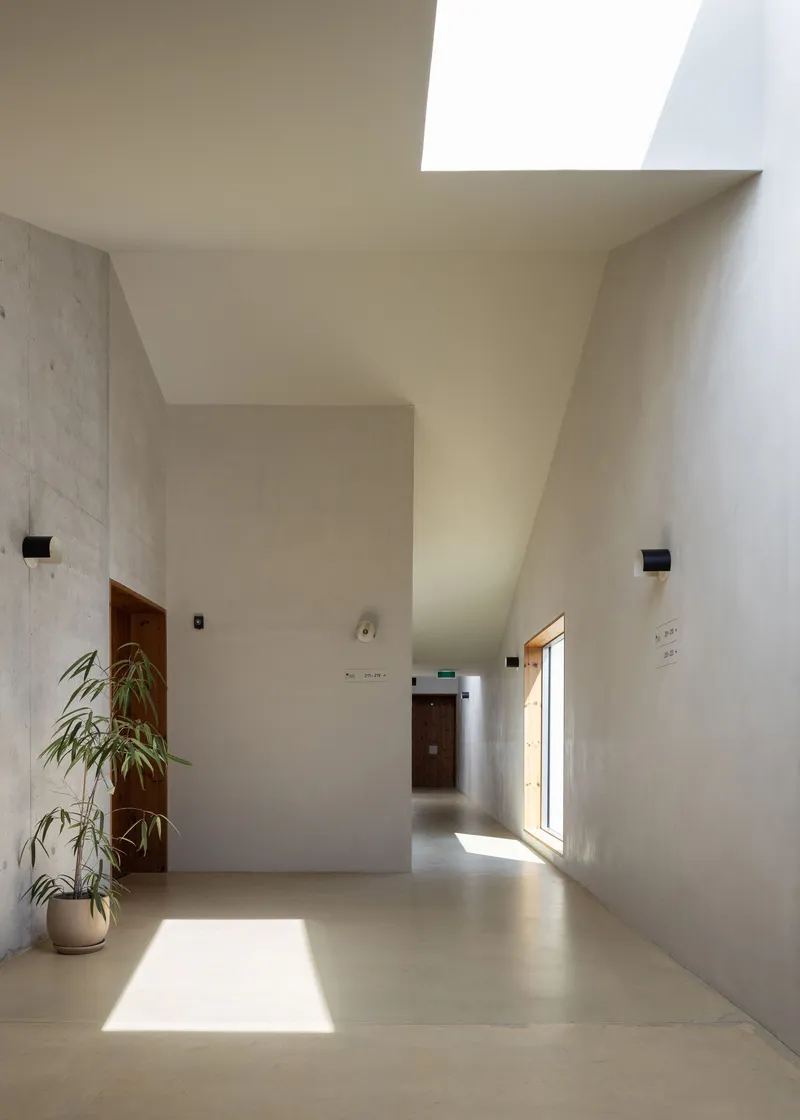
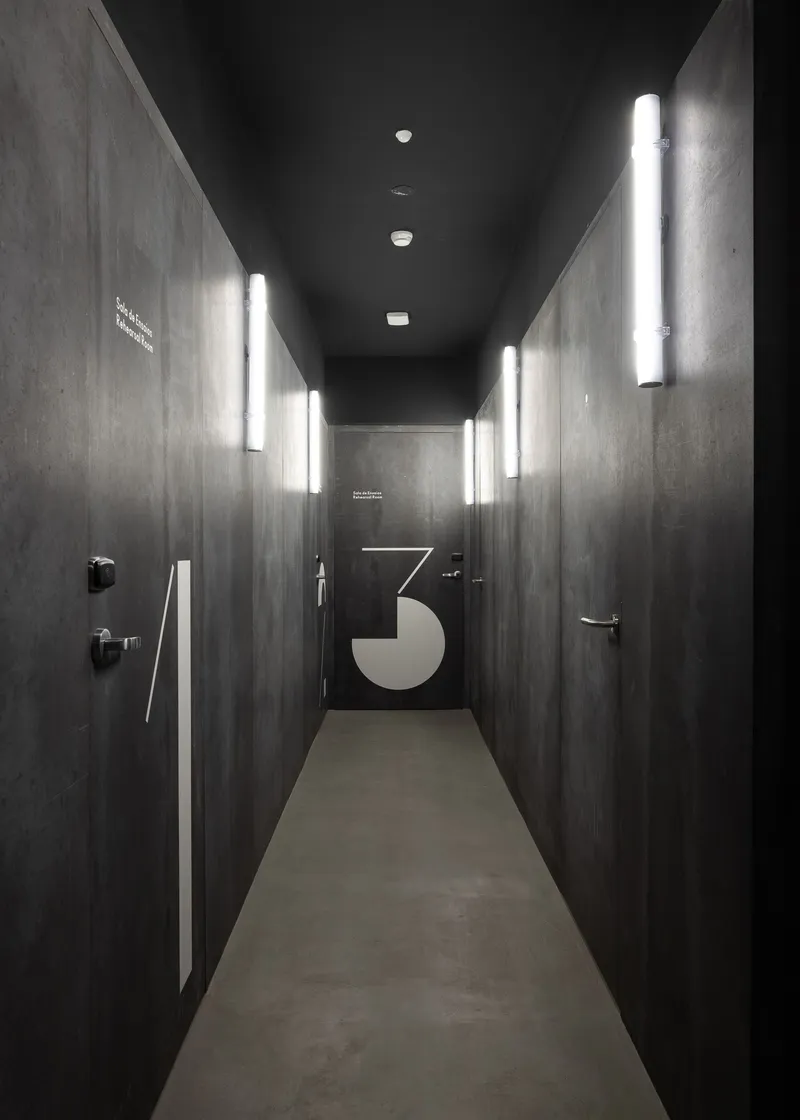
The circulation spaces deserve attention on their own terms. Concrete staircases ascend through skylit volumes, their shadow patterns shifting throughout the day. Copper handrails meet weathered steel panel walls in the sunlit courtyards. Corridors with dark timber walls terminate in graphic wayfinding elements that are clean and functional without being fussy. A potted plant receiving a shaft of morning light through a corridor skylight is not an accident: it is a precisely calibrated moment that rewards walking through the building slowly.
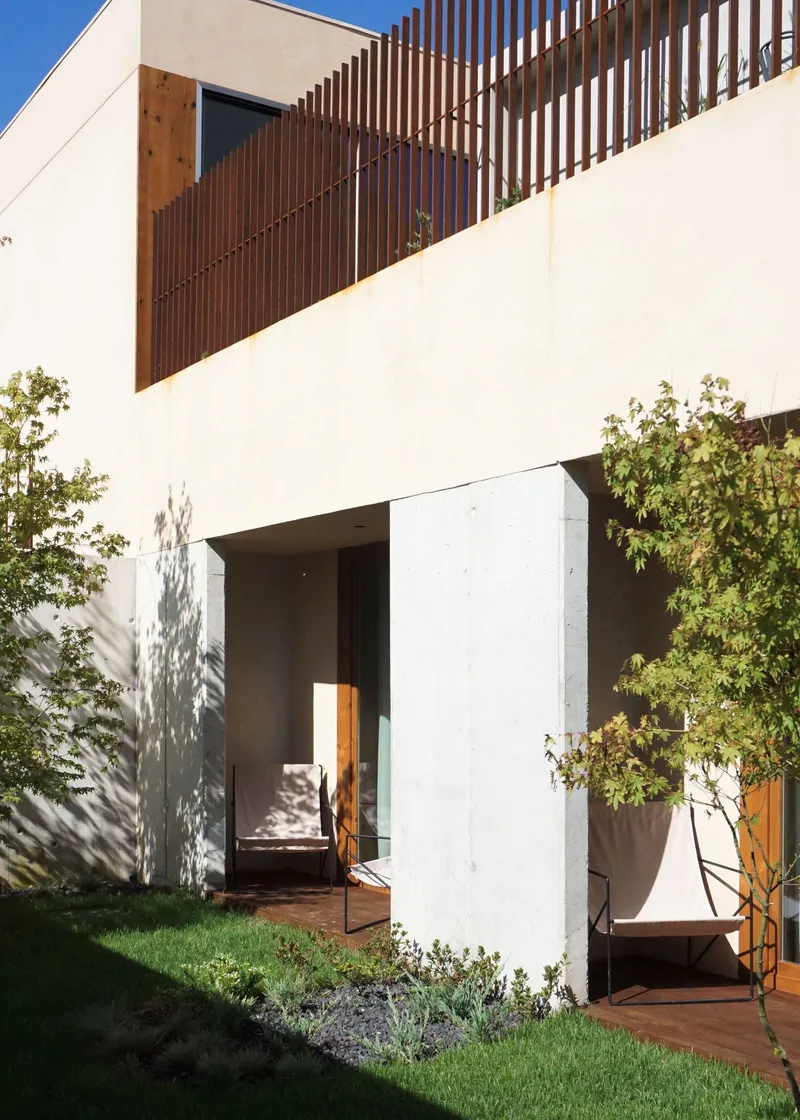
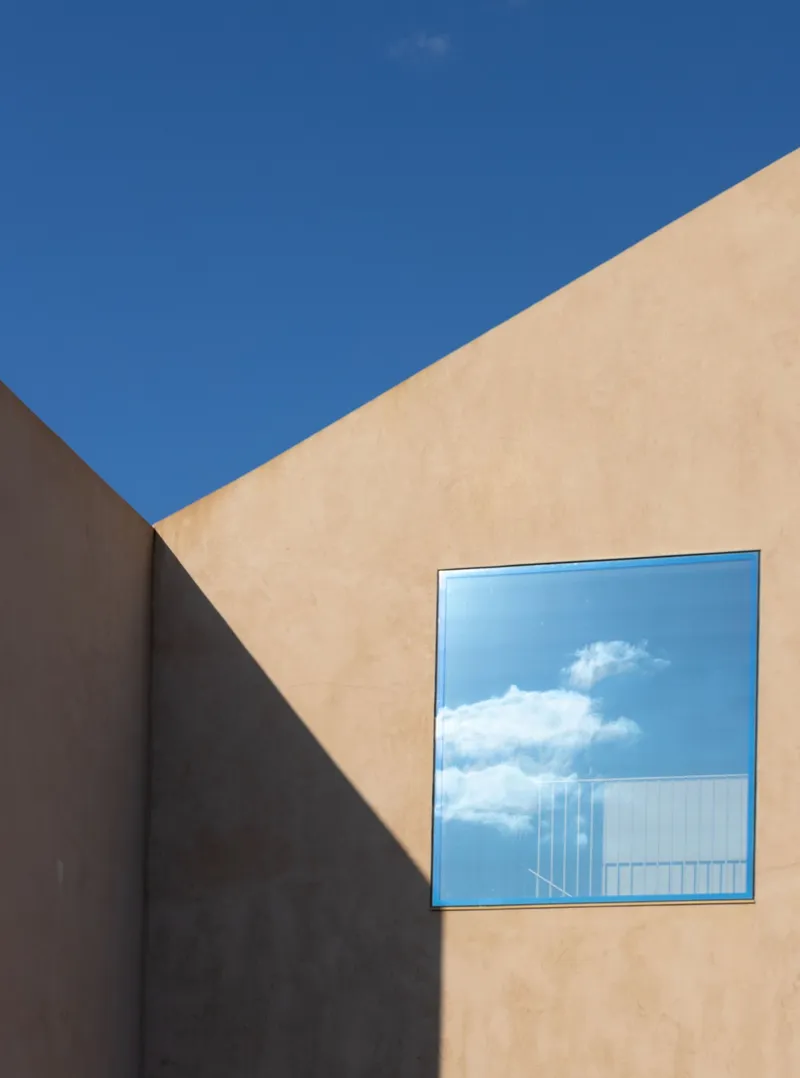
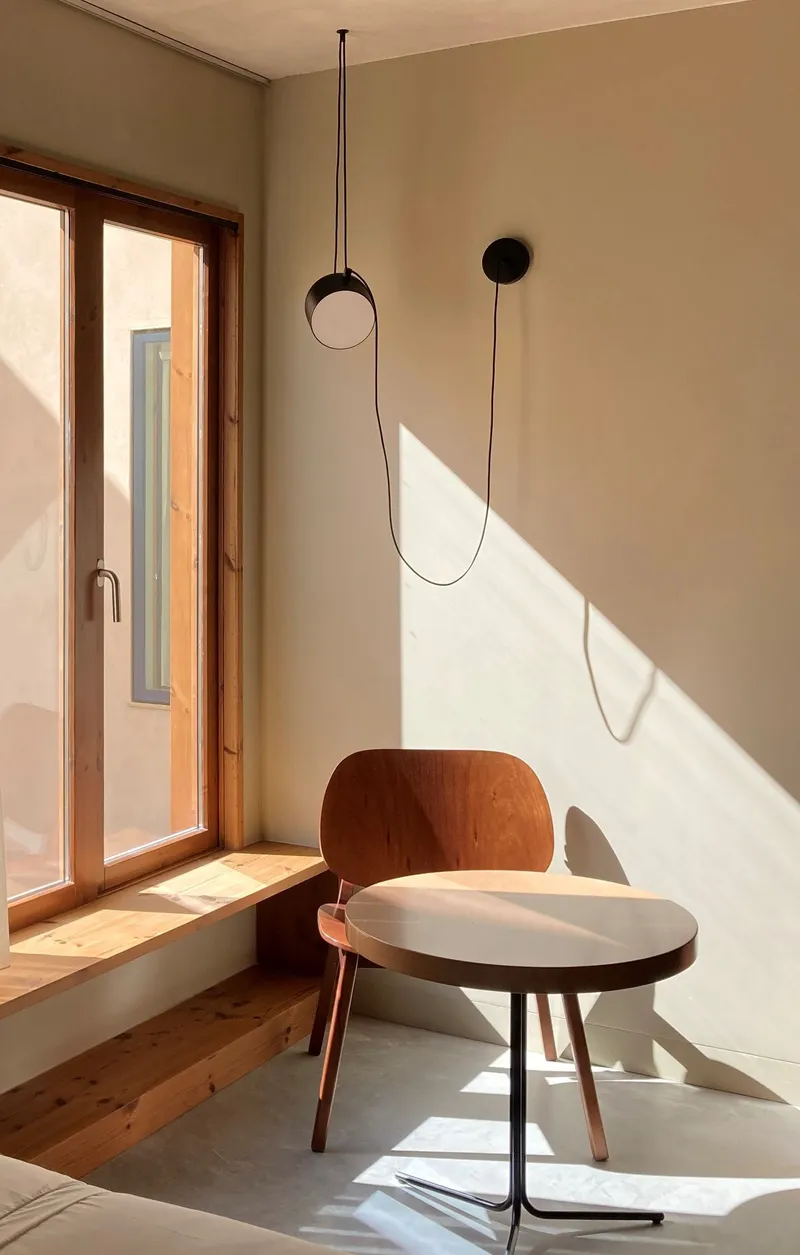
Facade details reinforce the material logic. A timber screen balcony catches dappled tree shadows. A square window punched into peach-toned stucco frames clouds and a distant facade like a painting. A corner seating nook with a pendant light casts diagonal shadows across plaster walls in the afternoon. These moments are quiet, almost incidental, but they accumulate into an experience that feels considered at every turn.
The Pool and Outdoor Life
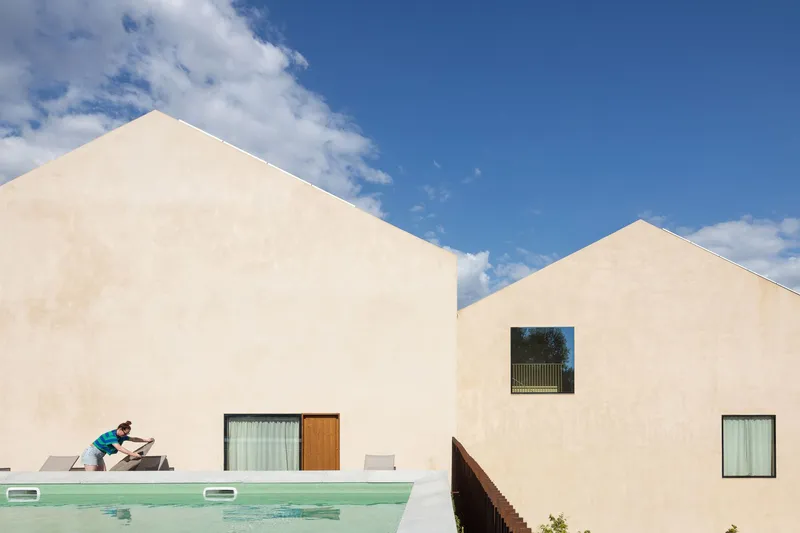
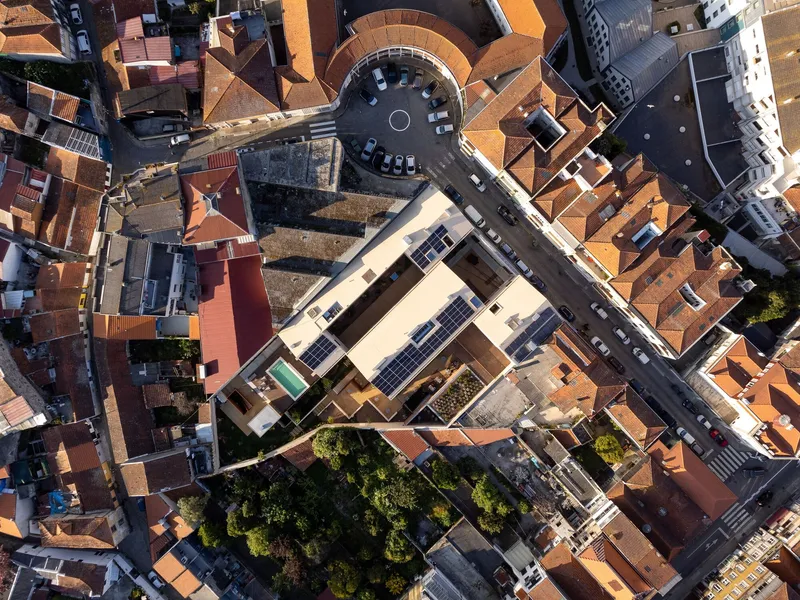
The outdoor swimming pool sits between two gabled volumes, positioned so that the pitched rooflines frame the sky. It is a striking image: a cyclist passes in the foreground, afternoon clouds build above, and the pool's water catches light between what could easily be mistaken for village houses. The aerial view reveals how tightly organized the complex is, with solar panels on the main roof and terracotta tiles crowning the residential volumes. A living space with timber-clad glazing opens to a brick courtyard in afternoon sunlight, collapsing the boundary between private room and shared garden.
Plans and Drawings
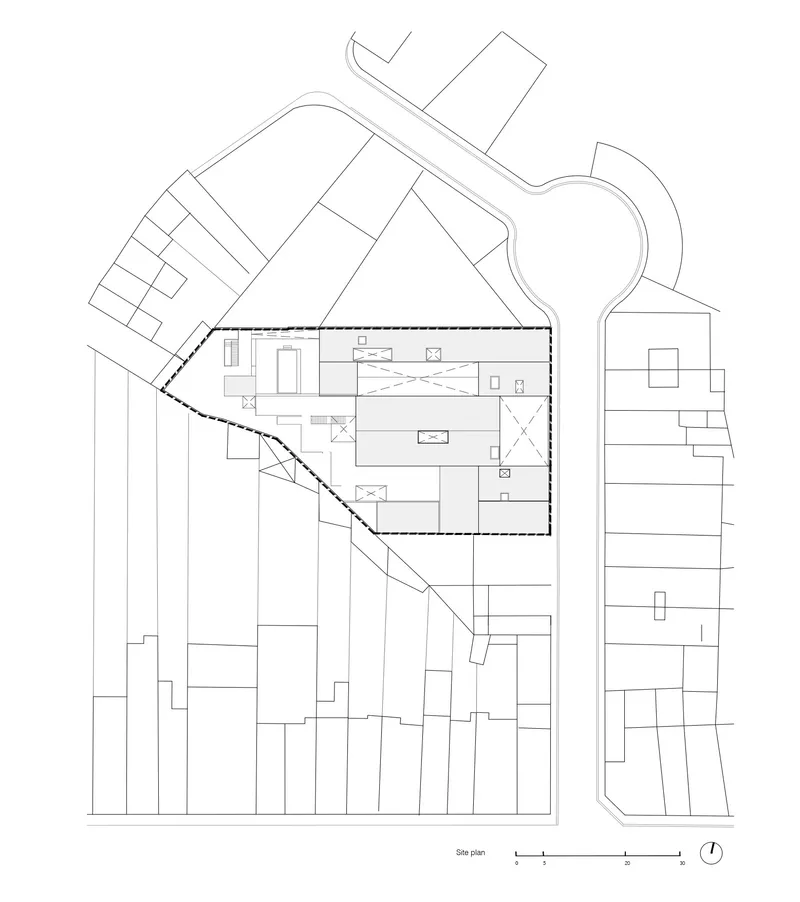
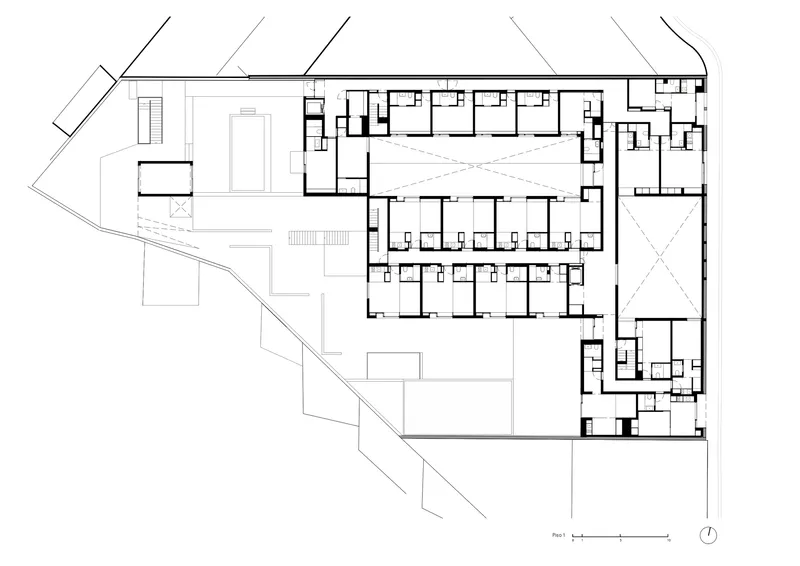

The site plan reveals the project's insertion logic: a rectangular footprint wedged among adjacent buildings and parcels, its edges negotiating angular site boundaries. The floor plan shows residential units arranged around a central courtyard, a configuration that maximizes natural light and cross-ventilation while minimizing corridor length. The section drawing is the most revealing: multi-story residential volumes with pitched roofs share a basement level, and the variation in ridge heights across the gabled forms produces the village-like silhouette visible from the street.

The elevation drawing displays the sequence of gabled units with varied window openings and ground floor transparency, confirming that the architects treated each volume as a semi-independent element rather than a continuous block. The interplay between solid wall and glass at the base allows the public program to spill outward, while the upper residential floors maintain privacy through smaller, more deliberately placed openings.
Why This Project Matters
M.OU.CO matters because it offers a model for adaptive reuse that is neither nostalgic nor amnesiac. Keeping the factory's structural bones and street facade preserves the neighborhood's memory, while introducing a radically different program, from concert hall to swimming pool, ensures the building has a viable future. The decision to open large portions of the formerly covered site as permeable garden returns something tangible to the city, rather than simply extracting value from it. And the material palette, limited to four honest materials deployed with discipline, demonstrates that restraint and richness are not opposites.
The real lesson, though, is programmatic. Using music as the binding agent between hospitality and public culture gives the project a social function that outlasts any individual guest's stay. The concert hall draws the neighborhood in. The courtyards and gardens give the neighborhood something it did not have before. The hotel finances the whole operation. It is a virtuous loop, and it was made possible by an architecture firm willing to subordinate formal ambition to the logic of a place and a program. Porto has gained not just a hotel, but a small piece of functioning city.
M.OU.CO Hotel Apartments by Arquitectos Aliados. Located in Porto, Portugal. 4,890 m². Completed in 2022. Photography by Alexander Bogorodskiy.
About the Studio
Share Your Own Work on uni.xyz
If projects like this are the kind of work you want to make, uni.xyz is a place to publish your own, find collaborators, and enter design competitions.


Popular Articles
Popular articles from the community


Cloaked Colonization: A Mobile Underwater Habitat That Moves Like a Fish
Micah Abaya's shortlisted EHC Pacific entry reimagines ocean settlement as a dispersed network of self-sustaining architectural organisms.

Faces of the Soviet Avant-Garde: Turning Moscow's Street Names into an Open-Air Museum
A network of sculptural installations across a Moscow residential district transforms forgotten architect names into spatial encounters with cultural memor

Tsunami Convergenics: Turning Catastrophic Ocean Forces into Underwater Housing Infrastructure
A speculative underwater settlement off the coast of Onagawa, Japan, treats tsunamis and typhoons as energy sources rather than threats.

The Amber Palace Opera: A Geological Fiction Surfaces on Tallinn's Baltic Waterfront
Pierre Brillard reimagines a Baltic legend as a public landscape, opera house, and waterfront promenade rooted in Tallinn's coastal identity.

Similar Reads
You might also enjoy these articles

Pixel Gardens: One Repeated Module Stacked Into a Terraced Social Housing Tower for Famagusta
Salem Bader's shortlisted housing tower builds a vertical neighbourhood from one repeated module, offsetting units to carve terraces, light and air.

Bao Huynh Watercolor Atelier: A Serene Art Retreat in Hội An
Bao Huynh Watercolor Atelier in Hội An blends multifunctional art spaces, sustainable design, local materials, and family-friendly living in a serene environment.

Atelier Macri Concept Store Interior Design by CASE-REAL
Atelier Macri store features a "ko" counter, walnut wood details, cork displays, blending retail, gallery, and seamless customer experiences.

Manuel Vargas Izquierdo Stadium and High-Performance Sports Center: Architectural Excellence in Jalpa de Méndez
The Manuel Vargas Izquierdo Stadium blends sustainable design, inclusive sports facilities, and cultural-inspired architecture, revitalizing Jalpa de Méndez’s public spaces.


Comments (0)
Please login or sign up to add comments
No comments yet. Be the first to comment!