

Bez and Kock Architekten Nest a Timber Daycare Pavilion Inside a 17th-Century Monastery Garden
In Miltenberg's historic center, silver fir and red sandstone merge to create a sensory world for children within ancient walls.


There are few sites in Germany where a new public building arrives with this much inherited grace. The monastery garden of a former Franciscan complex, enclosed by weathered red sandstone walls just steps from Miltenberg's Engelplatz, is not the kind of plot that invites architectural ego. Bez+Kock Architekten understood the assignment: they designed a single-story timber pavilion that slots precisely between those existing walls, low enough to disappear from the street yet generous enough to hold a full daycare and family center program across 2,133 square meters.
What makes the project worth studying is not restraint for its own sake but the calibration between deference and delight. The building divides the monastery garden into two distinct zones, a protected play area for the daycare and a publicly accessible open space designed in the spirit of the original monastic landscape, while its own interior life is tactile, bright, and thoroughly calibrated for small bodies. Climbing elements puncture through green roofs. Brightly colored felt markers orient children through corridors of silver fir. The whole thing reads as both civic repair and a piece of very specific child-centered design.
A Pavilion Between Walls


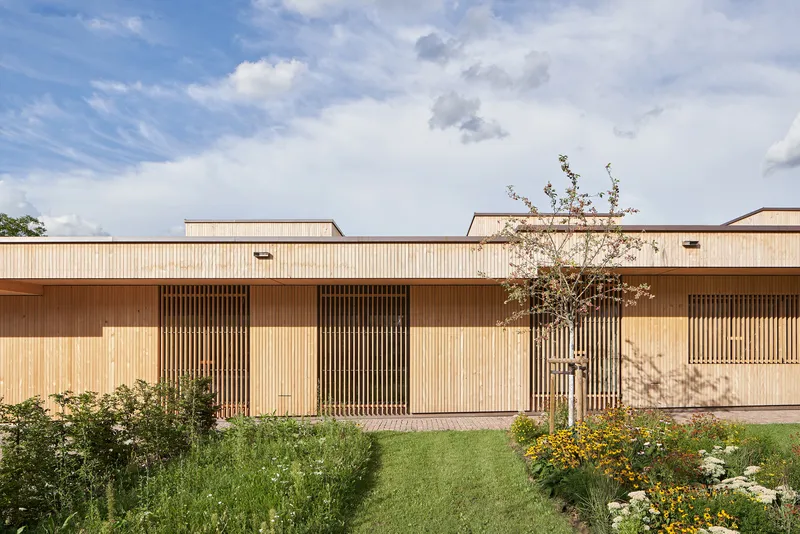
The decision to build in one story was not merely pragmatic. It is an act of landscape continuity. From the aerial view, the flat timber roof barely registers against the surrounding town's steep gables and church towers. The building's long elevations run parallel to the monastery walls, creating a layered reading: red sandstone perimeter, planted beds of flowering perennials, then a repeated rhythm of slender timber columns holding up a continuous pergola. That pergola is critical. It mediates between inside and outside along both long sides, creating a weather-protected front zone that keeps the facade from becoming a hard boundary.
The courtyard elevation reveals how gentle the staggering is. Volumes step across the site's natural topography in a terracing gesture that avoids any sense of a monolithic block. Each bay reads as its own pavilion, linked under the shared roof canopy, which reinforces the sense of a cluster rather than a single institutional mass.
The Pergola as Architecture
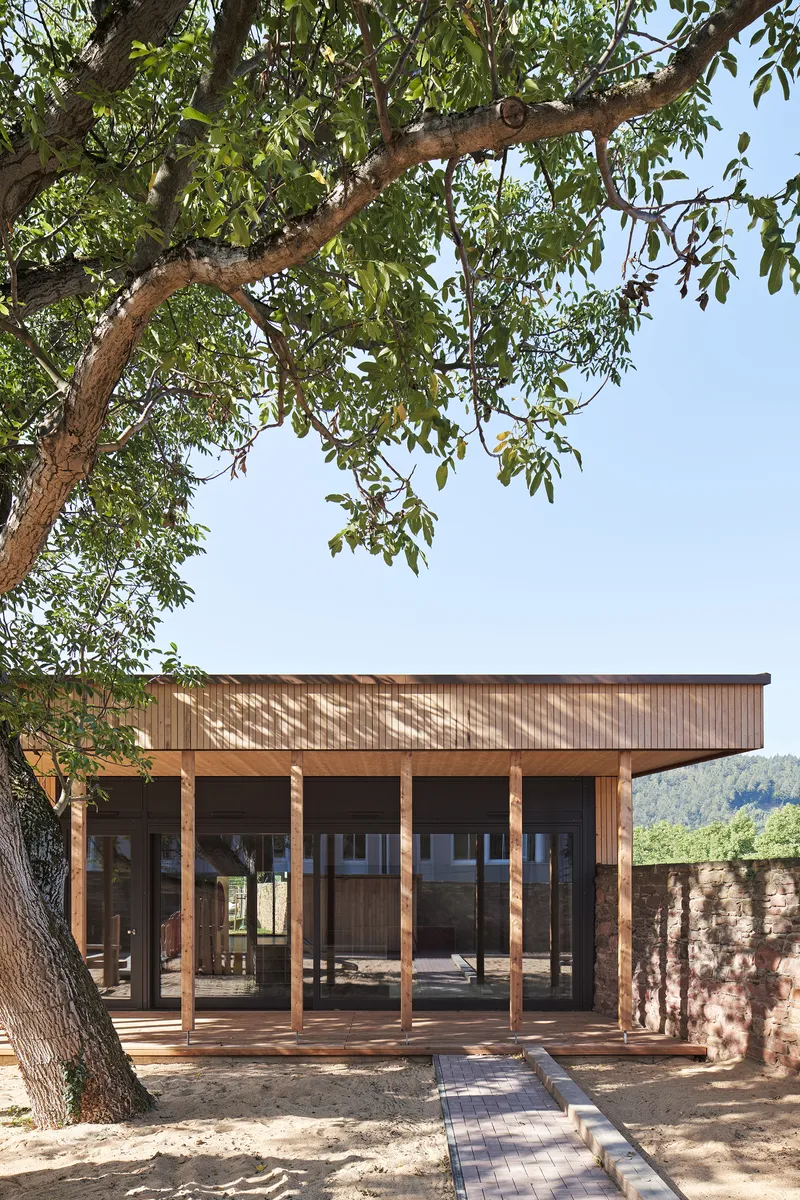


If there is a single move that defines the project's character, it is the covered walkway. The timber columns, exposed plank ceiling, and slatted screen walls create a zone that is simultaneously corridor, playground, and threshold. Dappled shadows shift across the decking as the sun moves. Children play with toy cars in a space that is sheltered but not sealed, warm but not enclosed. The slatted screens filter views to the garden while casting rhythmic shadow patterns that change by the hour.
This is the kind of architectural generosity that rarely survives value engineering. The pergola is not strictly necessary for program, but it transforms the entire experience of arriving, moving through, and inhabiting the building. It gives the institution its social life.
Silver Fir and Red Sandstone
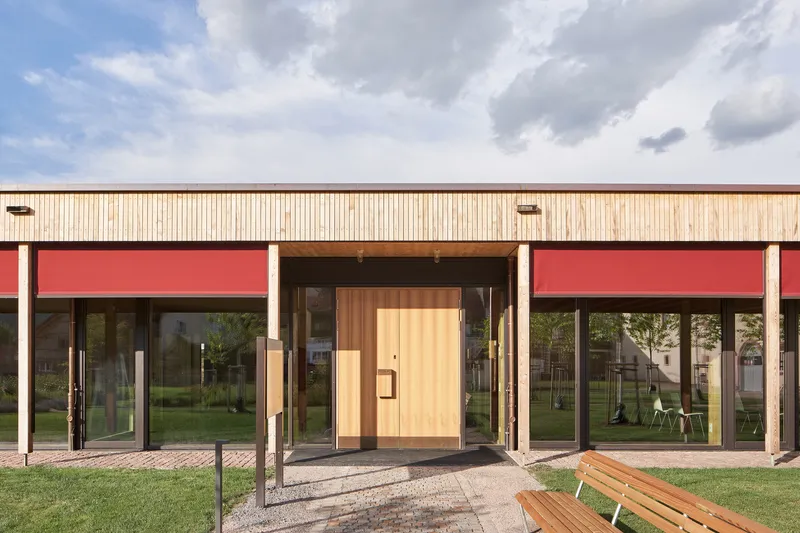

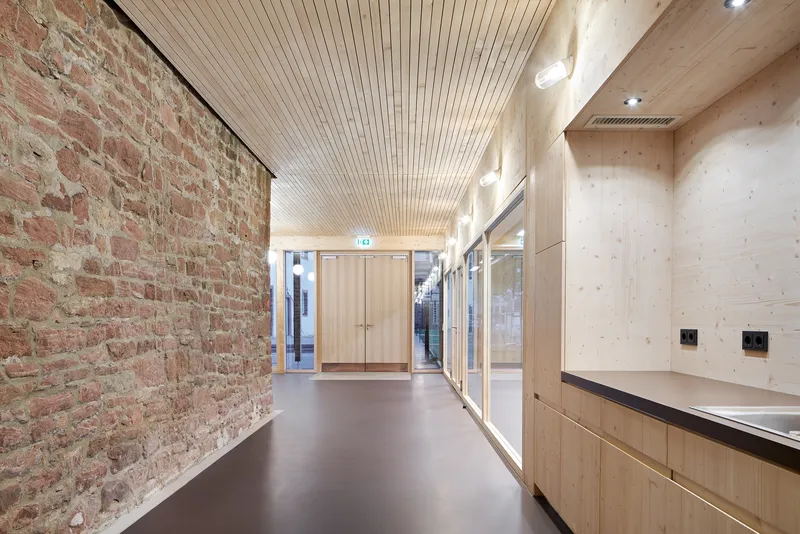
The material palette is deliberately regional. The primary structure is constructive timber with visible surfaces throughout, and the facade cladding is silver fir cut into vertical slats. Against the backdrop of the monastery's original red sandstone, the pale timber reads as a respectful counterpoint: lighter, newer, clearly of its own time but drawn from the same landscape. Inside, where the old walls are revealed, exposed brick sits alongside timber cabinetry and slatted ceilings in a dialogue that avoids pastiche.
The entrance facade plays the most explicit game with this material contrast. Red fabric awnings recall the sandstone tones overhead while the glazed openings below let light flood into the entry sequence. It is a small gesture, almost domestic in scale, but it signals that this building knows where it is.
Interior Corridors as Learning Landscapes

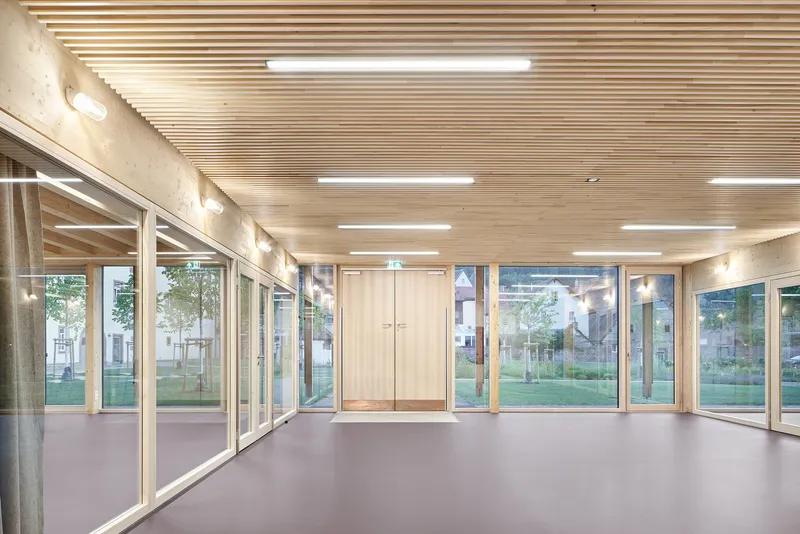
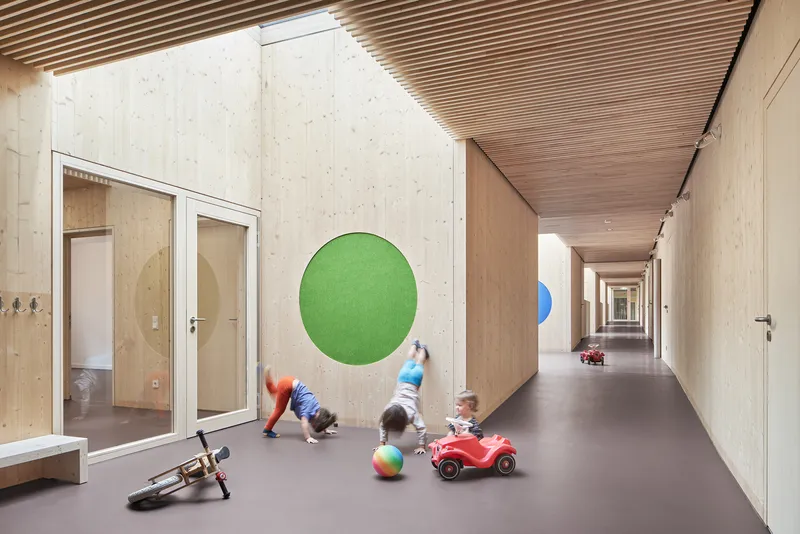
The corridors here do more work than circulation demands. Large-format skylights wash the access areas with daylight, reaching into checkrooms that are built into widened niches rather than left as dead-end closets. Slatted timber ceilings run continuously, giving the hallways a directional grain that helps children navigate intuitively. Circular green wall graphics appear at key junctions, functioning as wayfinding markers that speak a visual language young children can read before they can read text.
The floor surface shifts from grey resin in circulation zones to warmer treatments in group rooms, reinforcing spatial identity through material change rather than signage. Glass walls between rooms maintain sightlines for staff while giving children a sense of the building's social ecosystem beyond their own group.
Group Rooms and the Rooftop Climb

Each group room comes with its own integrated climbing element, a vertical play structure that rises above the green roof. It is the most inventive programmatic detail in the building. Rather than isolating play in a dedicated gymnasium, the architects embedded physical challenge directly into the daily room. The group rooms themselves are lined in exposed timber with horizontal windows carefully framed to capture Miltenberg's roofscape, connecting children visually to the town beyond the monastery walls.
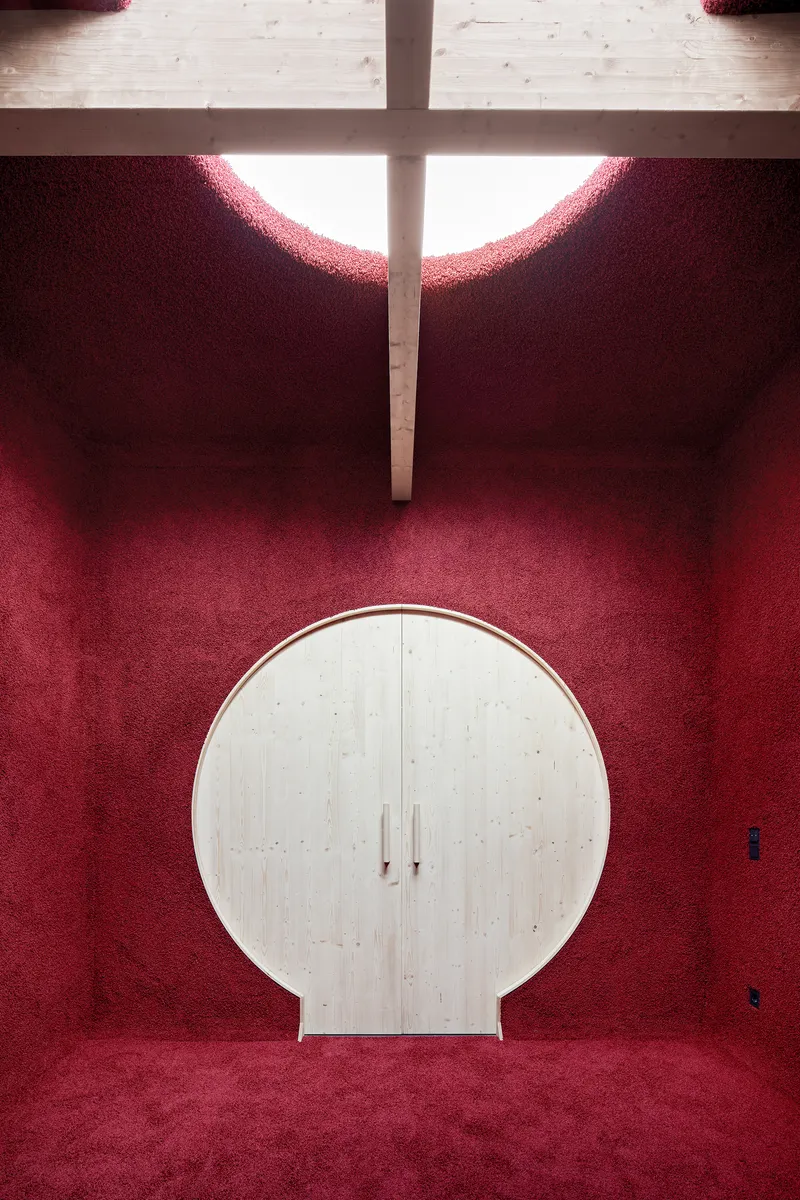
One of the more unexpected spaces is a room with deep red carpeted walls and a circular plywood cabinet positioned beneath a clerestory cross. It reads almost as a meditation room, recalling the monastic past of the site in a completely contemporary material language. Whether intentional or not, this spatial quality gives the building a depth that goes beyond functional daycare provision.
The Courtyard as Shared Ground

From above, the building's strategy becomes fully legible. A landscaped inner courtyard sits at the interface between the daycare and the family center, shared by both user groups and oriented around a geometric garden that echoes the monastic tradition of enclosed green space. The large multi-purpose room faces the entrance and serves both populations, a pragmatic doubling of use that reduces the building's footprint without sacrificing program.
Landscape architects Koeber Landschaftsarchitektur from Stuttgart shaped the public open space in the spirit of the former monastery garden, while the protected daycare play zone features wooden play elements consistent with the building's material language. The courtyard is not leftover space. It is the organizational spine.
Plans and Drawings

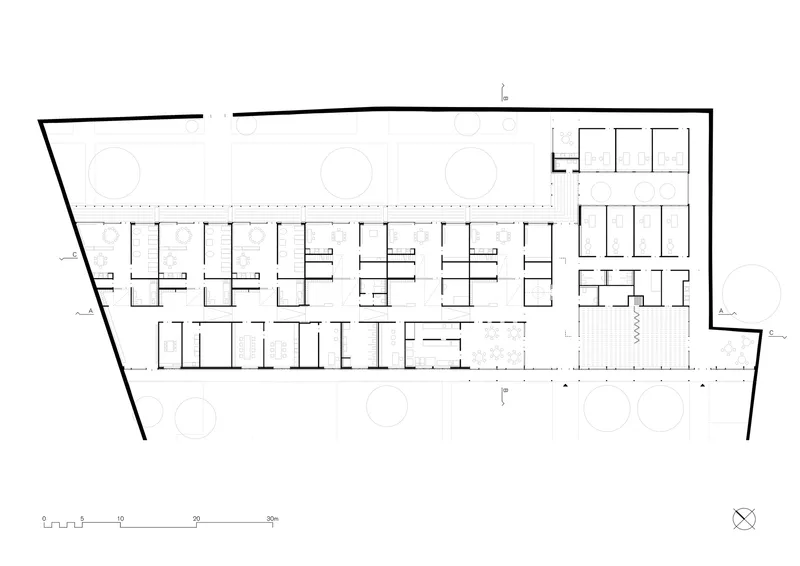
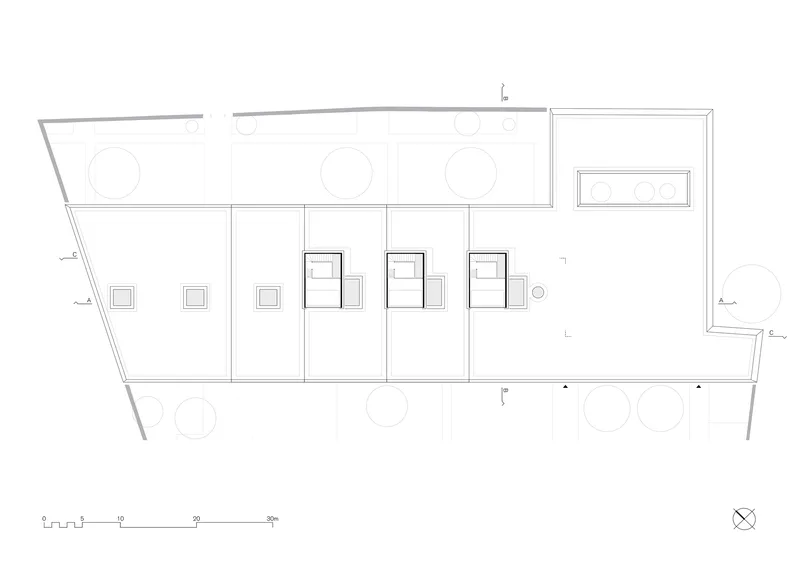

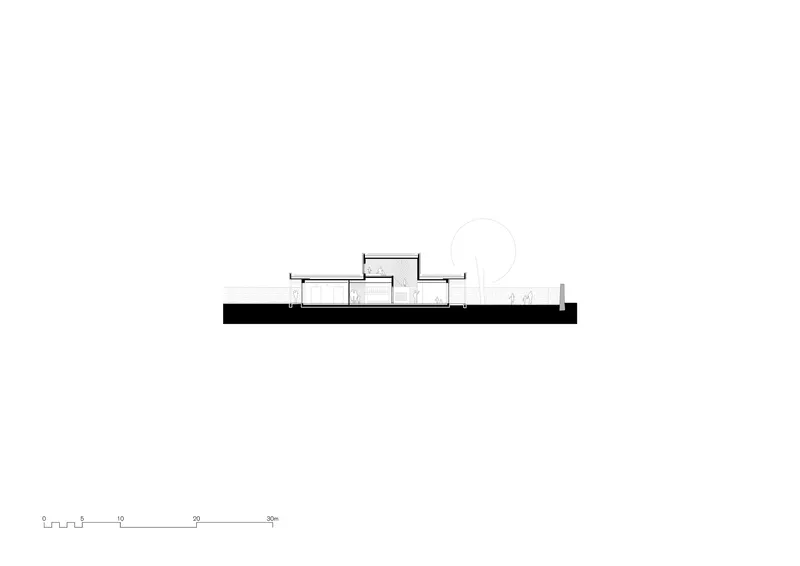
The site plan confirms how tightly the pavilion is fitted into its urban block, with the building occupying almost the exact footprint available between the monastery walls and the surrounding streets. The floor plans reveal a clear organizational logic: repeated linear classroom units flank a central corridor, with the family center rooms wrapping the courtyard garden. The sections are perhaps the most revealing drawings. A sawtooth profile steps three taller volumes down the slope, each crowned with clerestory glazing that explains the quality of light in the interior photographs. The transverse section shows how a central clerestory volume sits between lower wings on a dark plinth, an in-situ concrete floor slab that grounds the timber structure against the earth.
Why This Project Matters
Building for children inside a heritage site is a minefield of competing demands: conservation officers, safety codes, acoustic standards, the desire to make something that doesn't look institutional. Bez and Kock Architekten navigated all of that without resorting to either mimicry or provocation. The building is legibly modern, structurally honest in its timber construction, and completely at home among 17th-century sandstone walls. That balance is harder to achieve than any formal gesture.
What stays with you is the commitment to sensory richness. The slatted shadows along the pergola, the skylights washing corridor walls, the climbing elements that break through the green roof, the horizontal windows that frame a Bavarian roofscape for three-year-olds who will remember it for decades. This is civic architecture at its most careful and its most generous, a building that gives a small town something it will not outgrow.
Daycare and Family Center in Miltenberg, designed by Bez and Kock Architekten, Miltenberg, Germany. 2,133 m². Completed 2022. Photography by Stephan Baumann, bild_raum.
About the Studio
Share Your Own Work on uni.xyz
If projects like this are the kind of work you want to make, uni.xyz is a place to publish your own, find collaborators, and enter design competitions.


Popular Articles
Popular articles from the community


The Amber Palace Opera: A Geological Fiction Surfaces on Tallinn's Baltic Waterfront
Pierre Brillard reimagines a Baltic legend as a public landscape, opera house, and waterfront promenade rooted in Tallinn's coastal identity.

Singing Woman: Contemporary Architecture Inspired by Estonia’s Voice and the Sea
Singing Woman turns Estonia’s song culture into flowing opera house architecture, blending public life, landscape, sea, and national memory.

Cloaked Colonization: A Mobile Underwater Habitat That Moves Like a Fish
Micah Abaya's shortlisted EHC Pacific entry reimagines ocean settlement as a dispersed network of self-sustaining architectural organisms.

Opera on the Sea: Driftwood Logic Shapes a Timber Opera House on Estonia's Coast
Trevor Orgill's opera house translates the entangled drift of floating timber into a civic building where wood, water, and music converge.

Similar Reads
You might also enjoy these articles

Bao Huynh Watercolor Atelier: A Serene Art Retreat in Hội An
Bao Huynh Watercolor Atelier in Hội An blends multifunctional art spaces, sustainable design, local materials, and family-friendly living in a serene environment.

Atelier Macri Concept Store Interior Design by CASE-REAL
Atelier Macri store features a "ko" counter, walnut wood details, cork displays, blending retail, gallery, and seamless customer experiences.

Manuel Vargas Izquierdo Stadium and High-Performance Sports Center: Architectural Excellence in Jalpa de Méndez
The Manuel Vargas Izquierdo Stadium blends sustainable design, inclusive sports facilities, and cultural-inspired architecture, revitalizing Jalpa de Méndez’s public spaces.

KAKR Buluh Awar Hall: Revitalizing Community and Ecology Through Bamboo Architecture
Community built bamboo hall revitalizes Buluh Awar village, empowering youth, restoring ecology, celebrating vernacular craftsmanship through sustainable architecture and culture.

Explore Childcare Center Competitions
Discover active competitions in this discipline

Challenge to reimagine the Iron Throne

Photograph architecture without architects

Illustrate the lost glory of Angkor Wat - Render Challenge

Design challenge to reuse E-waste
Comments (0)
Please login or sign up to add comments
No comments yet. Be the first to comment!