
Tying Up the Nature: A Biophilic Sanctuary for Oslo's Low-Light Winters
A runner-up Solarium entry uses adjustable louvers, a central garden house, and continuous ramp circulation to fuse wellness with Nordic daylight.


Oslo gets roughly six hours of daylight in winter. For a city where seasonal depression is a public health concern, architecture that chases light is not a luxury but a necessity. "Tying Up the Nature with the Human" takes that premise seriously, wrapping a triangular site in curved concrete, double-skin glass, and adjustable aluminum louvers that treat sunlight as both material and medicine. At the core of the building sits a garden house, a transparent atrium anchored by a mature tree, visible from nearly every interior zone. The effect is less "building with plants" and more a spatial argument that wellness and architecture are the same discipline.
Designed by Mahsa Abdkarimi, Ali Torabi, and Elnaz Ghorbani, this project earned runner-up in the Solarium competition. The programme is ambitious: meditation rooms, a library, spa facilities, communal lounges, a café, and garden paths all coexist within a single multi-level volume. Rather than compartmentalizing these functions behind corridors and fire doors, the designers link them through a continuous ramp system that encourages fluid movement and unplanned encounters between users.
Undulating Concrete and Vertical Fins Against an Overcast Sky
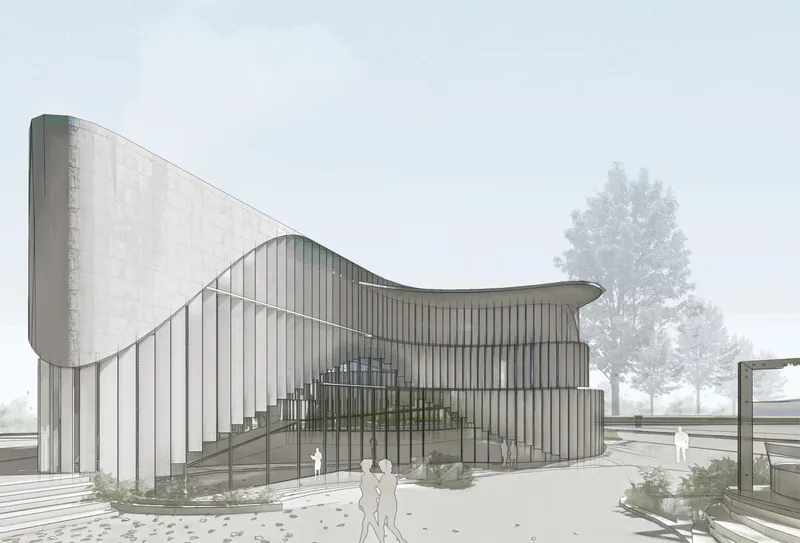
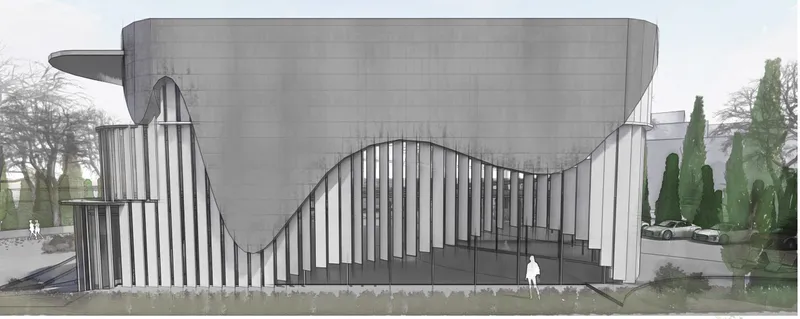
The exterior readings tell you immediately that this is not a conventional glass box chasing maximum transparency. The building presents an undulating concrete facade punctuated by vertical metal fins, a rhythm that modulates views and daylight without sealing the interior off from the city. Exterior stairs wrap the curved volume, creating thresholds between indoor and outdoor life. The mist in the rendering is deliberate context: Oslo's overcast conditions are not obstacles here but atmospheric partners. The solid concrete mass provides thermal inertia, while the aluminum louvers embedded in the facade contain insulation layers that block cold Nordic drafts without sacrificing light regulation.
The triangular plot, often a nightmare for spatial planning, was resolved through a geometric strategy of mirroring and offsetting the site boundaries into a more functional rectangular footprint. By softening acute corners rather than fighting them, the designers maximized usable floor area and improved daylight penetration to interior zones that would otherwise sit in shadow. It is a pragmatic move that happens to reinforce the biophilic agenda.
Multi-Level Interiors Organized Around Circular Openings
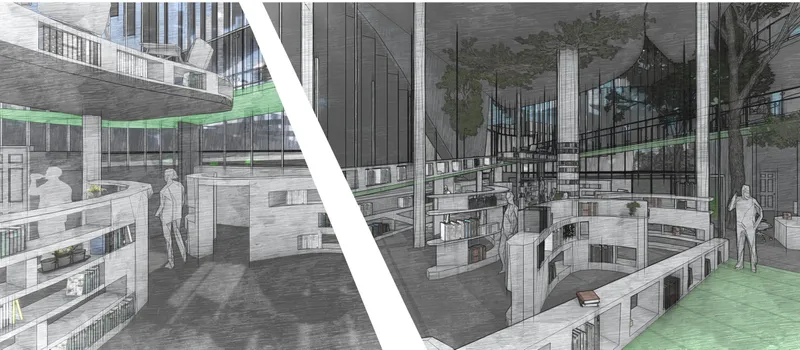
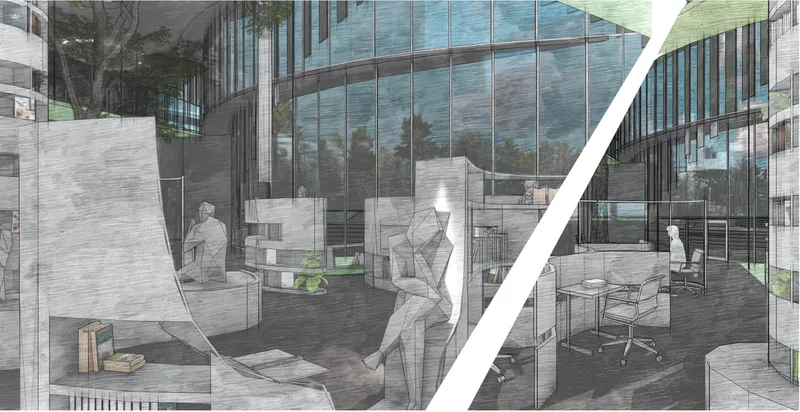
Step inside and the vertical dimension takes over. Circular floor openings connect multiple levels visually, letting light drop through the building while giving occupants sightlines to activity above and below. The reading areas shown here seat figures at various heights, reinforcing the open-plan philosophy. Fixed partitions are minimal. Instead, spatial identity comes from changes in level, material shifts between brick and glass, and the varying proximity to the central garden atrium. The glass-enclosed reading spaces with brick walls provide acoustic separation without visual isolation, a critical balance in a building that houses both meditative quiet and communal gathering.
A Ring of Light for Pause and Reflection

One of the most compelling moments in the project is this circular seating area beneath a ring light, wrapped in glass walls. It functions as one of the ramp's "multifunctional stop points," designed to break the monotony of circulation and offer opportunities for informal interaction or meditative pause. The geometry is deliberately soft, almost womb-like, and the overhead light ring ensures the space remains inviting even during Oslo's darkest months. The glass walls maintain the visual connection to adjacent zones, so users in this quiet pocket still feel part of the building's larger social ecosystem.
The Garden House as Spatial and Emotional Anchor
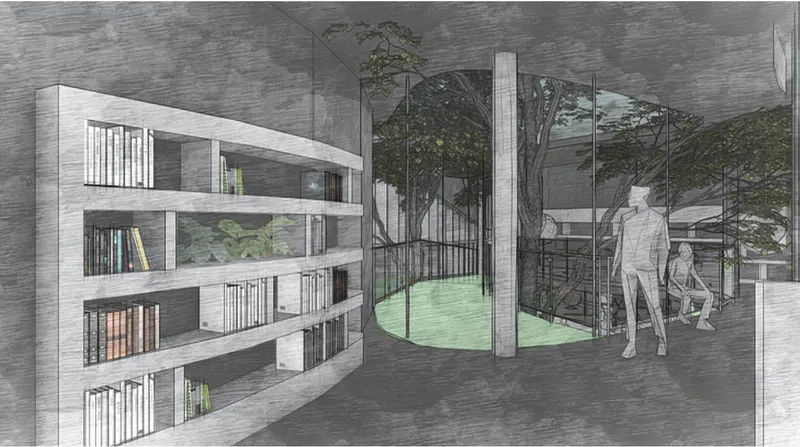
Library shelving runs along a wall adjacent to the glass-enclosed courtyard, where a mature tree stands as the building's most literal piece of biophilic infrastructure. The garden house is not decorative. Its transparent canopy allows sunlight to cascade into the surrounding atrium, distributing natural light to private zones (the library, spa, yoga spaces) and public ones (lounges, café, garden paths) alike. From most interior positions, the tree and its enclosure are visible, a constant reminder of the seasonal cycles happening outside. In a building designed to combat the psychological toll of Nordic winters, this persistent visual connection to living greenery is arguably the most powerful therapeutic tool in the entire programme.
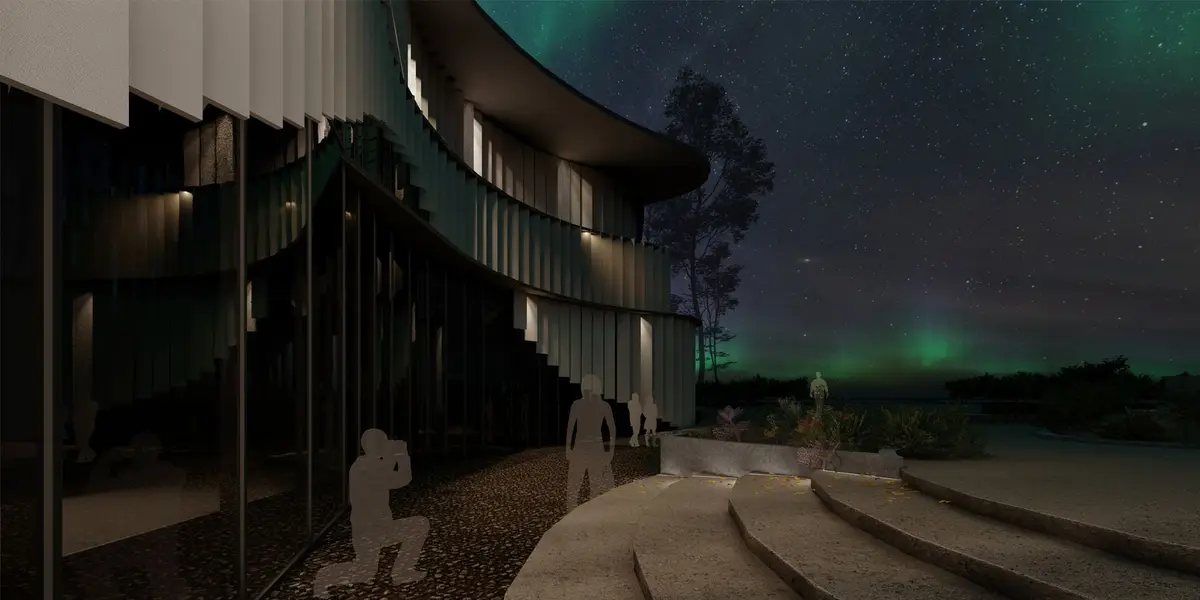
The designers also programmed outdoor areas with seating oriented toward open sky, specifically to allow viewing of phenomena like the aurora borealis through the fully glazed facade. It is a small detail that reveals the project's deeper ambition: not just to bring nature inside, but to frame the extraordinary natural events that already define Oslo's identity.
Why This Project Matters
Biophilic design risks becoming a checklist: add a green wall, specify timber cladding, claim wellness credentials. What Abdkarimi, Torabi, and Ghorbani have done here is more rigorous. Every design decision, from the louver insulation layers to the ramp stop points to the triangular site manipulation, feeds back into a coherent argument about how architecture can regulate light, climate, and social interaction to support human health. The central garden house is not a feature; it is the organizational logic of the entire building.
As a Solarium runner-up, the project demonstrates that biophilic architecture in extreme climates demands more than transparency and planting. It demands an understanding of thermal mass, facade engineering, and programmatic flexibility. The continuous ramp, the circular openings between floors, and the deliberate blurring of public and private zones create a building that resists static occupation. Users are invited to drift, pause, read, meditate, and watch the sky change color. In a city where winter can feel like a siege, that spatial generosity is itself a form of care.
View the Full Project
About the Designers
Designers: Mahsa Abdkarimi, Ali Torabi, Elnaz Ghorbani
Enter a Design Competition on uni.xyz
uni.xyz runs architecture and design competitions year-round that reward proposals with spatial conviction and real site intelligence.
Project credits: Tying up the nature with the human by Mahsa Abdkarimi, Ali Torabi, Elnaz Ghorbani Solarium (uni.xyz).


Popular Articles
Popular articles from the community


Manzana Morphosis: Stretching Barcelona's Grid into a Living Landscape for 2050
A radical reworking of the Eixample manzana turns density into a tool for generous public space, vertical ecology, and environmental performance.

Tsunami Convergenics: Turning Catastrophic Ocean Forces into Underwater Housing Infrastructure
A speculative underwater settlement off the coast of Onagawa, Japan, treats tsunamis and typhoons as energy sources rather than threats.

Singing Woman: An Opera House That Performs Before the Curtain Rises
Ovidiu Cristian Pavel's conceptual opera house translates Estonia's choral identity into a sculpted waterfront landmark facing the Baltic Sea.

Opera by the Sea Estonia: Three Shells Dissolving Architecture into Tallinn's Coastline
A winning opera house proposal replaces monumental form with interconnected shells that blur the boundary between building, park and Baltic Sea.

Similar Reads
You might also enjoy these articles

Shakur's House: Exposed Brick as an Interior Organiser in a 168 m² Mashhad Residence
Brick moves indoors in this Mashhad residence, where masonry walls, glass partitions and teal planes sequence a compact home without closing it off.

Day and Night Park: A Time-Based Urban Newsstand in Beijing
A temporary urban newsstand in Beijing blending travel, light, and reading through poetic colors, compact form, and community-focused design.

Modernist Patio Renovation in El Masnou, Barcelona by Oliver Segura Arquitectura + Cebrià Arquitectura
Modernist patio renovation blending tradition and innovation with a movable pool, leveled floors, and Catalan materials in El Masnou.

Alto Residencial Coop: Cooperative Housing Development in Santiago de Compostela by Carbajo Barrios Arquitectos
A linear cooperative housing complex blending white volumes and perforated metal façades, enhancing community living, natural light, privacy, and urban integration.


Comments (0)
Please login or sign up to add comments
No comments yet. Be the first to comment!