

CASE-REAL Designs a Minimal Landscape to Let 1.6-Million-Year-Old Basalt Speak for Itself
At Genbudo Park in Toyooka, Japan, sandblasted concrete and restrained interventions defer to volcanic columnar joints formed in the Pleistocene.


A landscape architect's hardest job is sometimes knowing when to step back. At Genbudo Park in Toyooka, Hyogo Prefecture, CASE-REAL was tasked with redeveloping a well-known scenic park whose star attractions are columnar basalt joints formed roughly 1.6 million years ago, when magma cooled and fractured into hexagonal columns. The park, which served as a quarry during the Edo Period, already had the infrastructure of a tourist site: paths, signage, handrails, display panels. What it lacked was coherence and the kind of spatial generosity that would let visitors feel the geological power of the place rather than simply look at it.
The strategy CASE-REAL adopted is one of selective subtraction and calibrated addition. Rather than a comprehensive overhaul, the team made targeted moves: concrete platforms pushed close to cave mouths, sandblasted surfaces that rhyme with the rough basalt, safety barriers dissolved into thin steel bars, and a color palette reset from yellow and orange to gray. The result is a 14,700 square meter park that feels less designed than revealed, as if the landscape itself dictated where people should stand and what they should see.
Staging the Geological Encounter


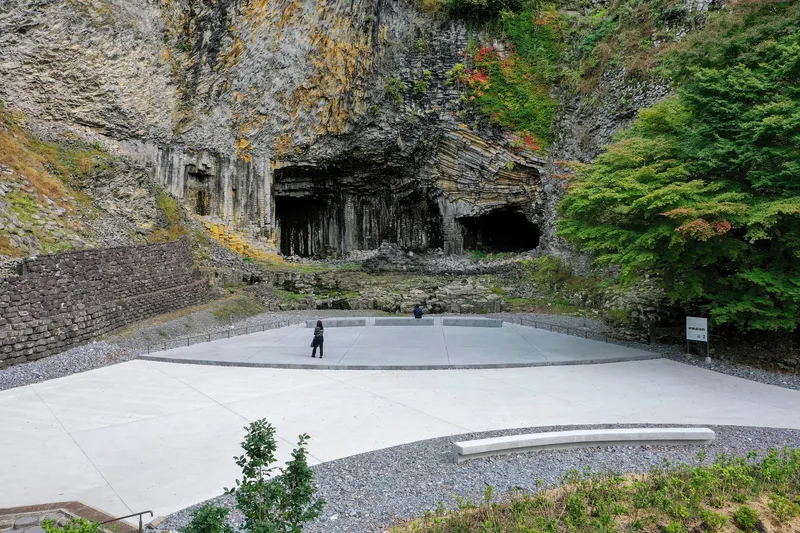
The most decisive move in the project is the series of concrete platforms, or "stages," positioned directly in front of the Genbu-do and Seiryu-do caves. These are not observation decks in the usual sense. They are broad, low planes that reduce the spatial gap between the visitor and the rock face, collapsing the distance that older infrastructure had maintained. Benches face the caves head-on, treating the geological formations as something between a performance and a shrine.
The curved and linear geometries of the platforms create a deliberate contrast with the organic fracture patterns of the basalt. Where the rock splinters into hexagons and prisms, the concrete sweeps in clean arcs. The tension between these two geometries is the park's real design argument: human order placed against deep-time disorder, each making the other more legible.
Concrete as a Geological Companion
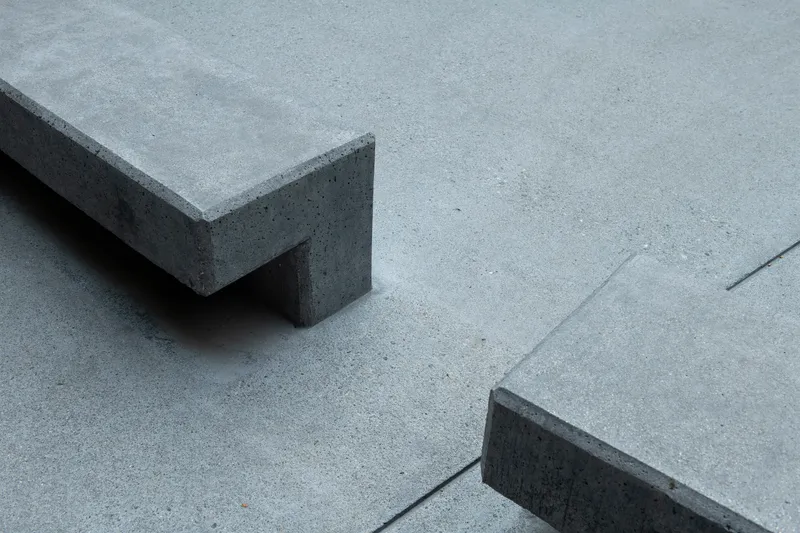


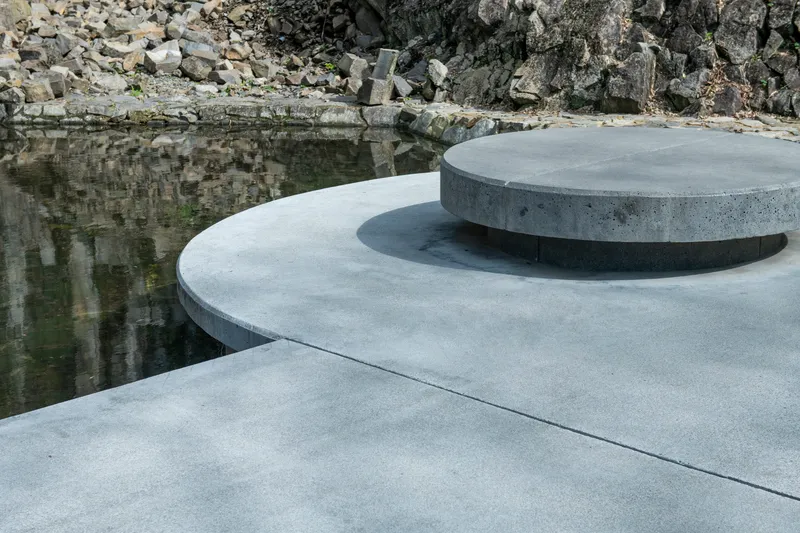
CASE-REAL's choice of sandblasted concrete is the quiet hero of the material palette. The rough, pitted surface that sandblasting produces bears a textural resemblance to the weathered basalt it sits beside. Over time, these surfaces will stain, moss over, and darken, further dissolving the boundary between built and geological. It is a material strategy rooted in patience: the park is designed to look better in twenty years than it does today.
Detailing reinforces the same logic. Bench corners are notched with clean joints, steel railing posts emerge from the concrete with minimal hardware, and the phosphate-treated metal of the ticket booth and signage carries a matte, industrial gray that recedes against the cliff faces. Nothing shines. Nothing competes.
Water, Reflection, and the Quarry Edge
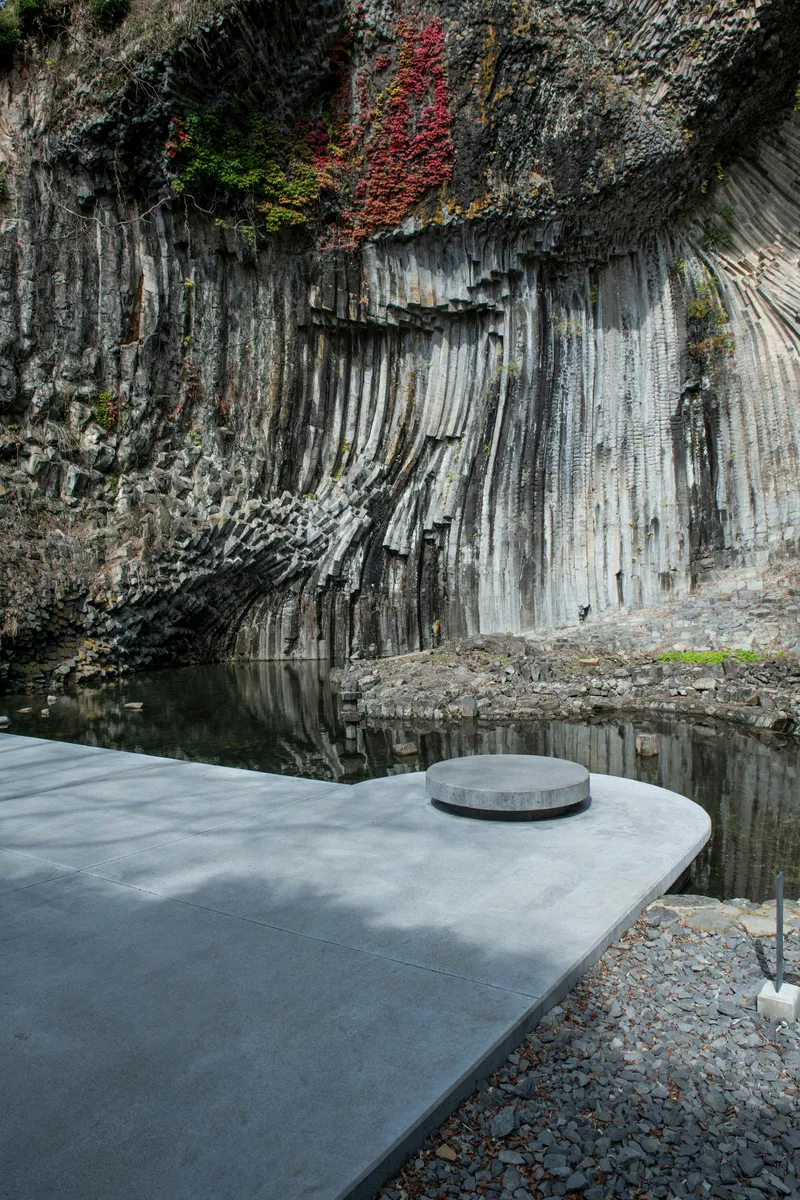

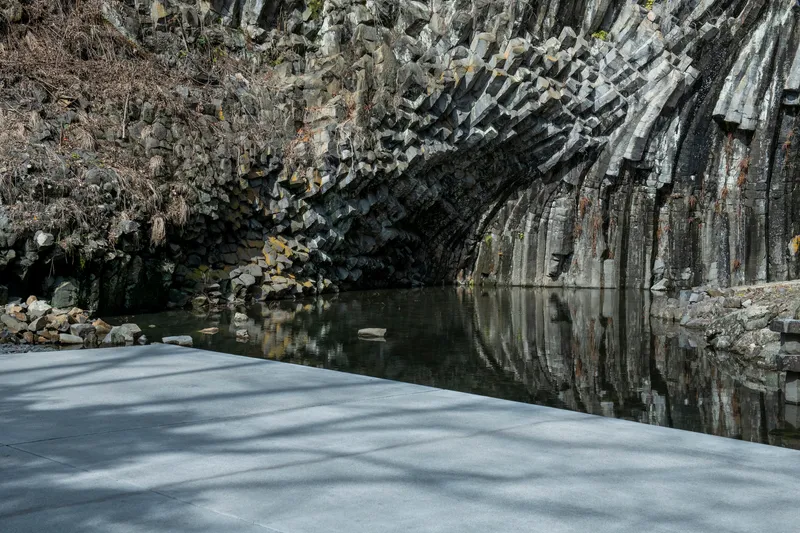
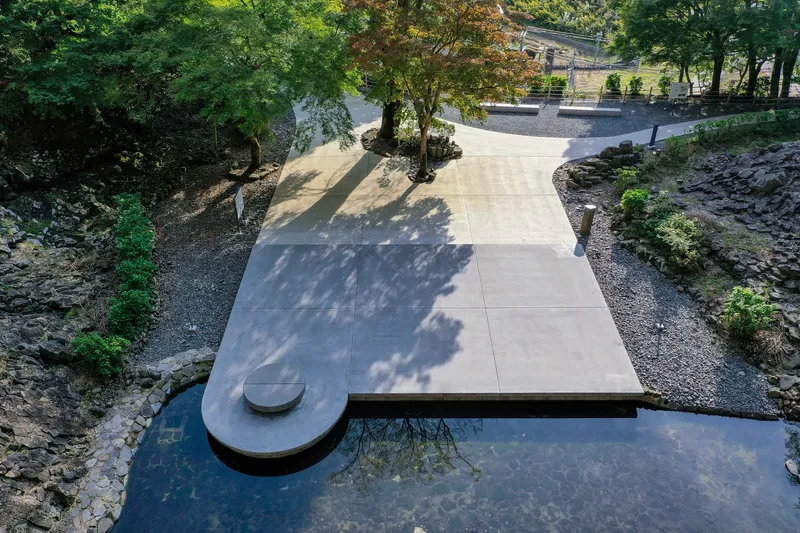
The former quarry pools are among the park's most atmospheric zones. Still, dark water at the base of columnar cliffs produces reflections that double the height of the rock face and blur the line between solid and liquid. CASE-REAL capitalized on this condition by cantilevering concrete platforms over the water's edge, complete with circular openings that punctuate the surface and introduce a surreal scale reference.
These waterside platforms are the moments where the design is most assertive, and they work precisely because they are so spare. A curved terrace, a single circular vent, the flat plane of water: the composition is almost abstract, borrowing more from land art than conventional park design. The restraint makes the basalt columns behind feel monumental rather than merely tall.
Entering the Caves


The caves themselves are untouched, and that is the point. The Genbu-do grotto, with its hexagonal basalt columns framing a vaulted ceiling and cobblestone floor, is a space no architect could improve upon. CASE-REAL's contribution here is purely sequential: the approach paths, the framing of the entrance, the moment of transition from manufactured surface to raw rock. The cobblestones inside are the same basalt that was historically quarried and used as building material throughout the region, closing a material loop that connects the park to its broader geography.
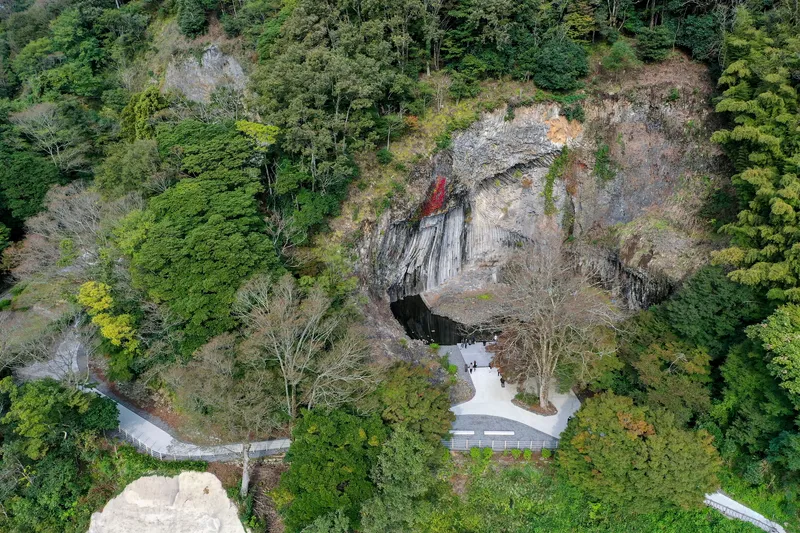
Aerial views of the columnar formations reveal the angular, almost crystalline patterning that makes this geology so extraordinary. These are not smooth, river-polished surfaces but sharp-edged fractures, each column a record of the thermal stresses that shaped it. Seeing them from above, as the drone images allow, underscores the scale of the formation and the modesty of the human interventions below.
Circulation and the Color Reset


The park's path system is a network of concrete boardwalks and gravel beds that thread through rocky shorelines and forested hillsides. Timber post railings and metal barriers are kept low and thin, prioritizing sightlines over safety theater. The curving paths create a pacing that slows visitors down, encouraging lateral glances into the forest canopy or down toward the river.
One of the less visible but significant interventions was the wholesale color correction of existing infrastructure. Yellow walls became gray. Orange handrails became gray. It sounds simple, and it is, but the cumulative effect is enormous. The park now reads as a single tonal field against which the green of vegetation and the dark gray of basalt stand out with clarity. CASE-REAL understood that visual noise was the old park's main problem, and the solution was chromatic discipline rather than demolition.
Support Buildings and Interpretation


The entry pavilion, clad in phosphate-treated dark metal with a timber screen, is built at what CASE-REAL describes as the minimum necessary size. It serves as a ticket booth and orientation point, and its compact footprint ensures that the first thing visitors register is not a building but the landscape beyond it. The three-lobed roof form of the rest building, visible from drone views, tucks into the canopy like a large leaf.
Inside the rest building, restructured display panels explain the geological history of the columnar joints, developed in consultation with scientific experts. The gallery space is bright, simple, and deliberately un-architectural: white walls, white benches, exposed timber columns. It is a room designed to be left behind quickly, a brief pause before the real experience outside.
Terraces, Lawns, and the Broader Site
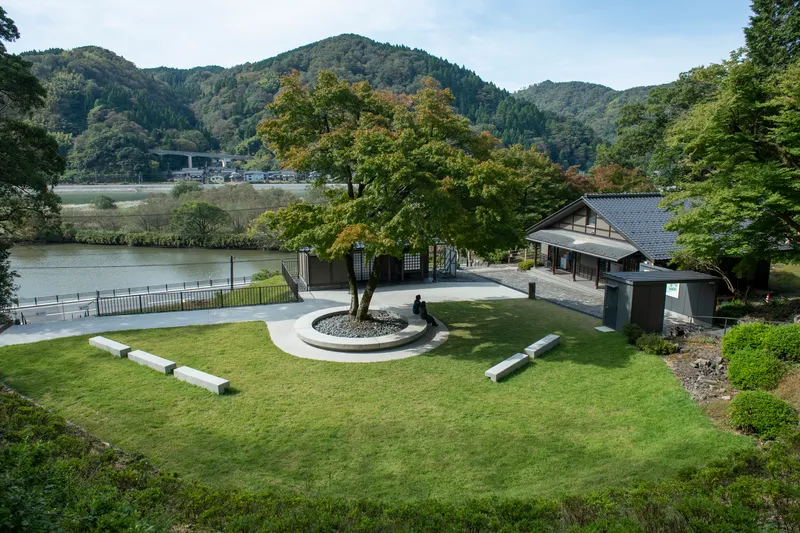

Beyond the cave-front stages, the park includes open lawns with circular tree plantings, elevated terraces with gravel borders, and raised viewing platforms that orient visitors toward the river valley. These are the social spaces of the park, places where geology recedes and the landscape operates as a more conventional public ground. Concrete benches with the same sandblasted finish anchor these areas, providing consistency across the site.
The aerial views reveal how carefully the new concrete geometries have been stitched into the existing topography. Paths intersect roadways at clean angles. Planted circles punch through paved surfaces. Gravel bands separate zones without walls or fences. The overall composition reads as a series of precise incisions in a wild body, each one calculated to do just enough.
Plans and Drawings

The watercolor site plan communicates the project's priorities at a glance. The forested hillside dominates; the numbered zones of intervention appear as small clearings within it. Parking and access roads are pushed to the periphery, and the cave areas sit deep in the site, requiring a walk that builds anticipation. The drawing technique itself, loose and painterly, suggests a design attitude that values atmosphere over precision, experience over specification.
Why This Project Matters


Genbudo Park is a case study in what landscape architecture can achieve when it commits to deference. CASE-REAL did not build a destination; they refined one that already existed. Every decision, from the sandblasted concrete to the gray color palette to the thin steel railings, serves a single goal: to remove the friction between visitors and a geological phenomenon that is genuinely extraordinary. In an era when parks are often over-programmed and over-branded, this project argues for the opposite: do less, and what remains will carry more weight.
The project also offers a model for how to handle the transition from free public access to paid admission, a change that coincided with the redevelopment. By investing in the quality of the spatial experience rather than in spectacle, the park justifies its entry fee not with novelty but with clarity. Visitors pay to see something they could not see properly before: basalt columns that have been waiting 1.6 million years for an audience willing to stand still and look.
Genbudo Park by CASE-REAL. Toyooka, Hyogo Prefecture, Japan. 14,700 m². Completed 2022. Photography by Hiroshi Mizusaki.
About the Studio
Share Your Own Work on uni.xyz
If projects like this are the kind of work you want to make, uni.xyz is a place to publish your own, find collaborators, and enter design competitions.


Popular Articles
Popular articles from the community


Opera by the Sea Estonia: Three Shells Dissolving Architecture into Tallinn's Coastline
A winning opera house proposal replaces monumental form with interconnected shells that blur the boundary between building, park and Baltic Sea.
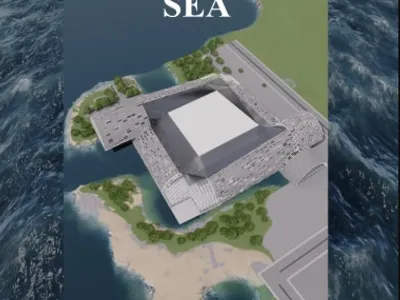
Opera on the Sea: Driftwood Logic Shapes a Timber Opera House on Estonia's Coast
Trevor Orgill's opera house translates the entangled drift of floating timber into a civic building where wood, water, and music converge.
Cloaked Colonization: A Mobile Underwater Habitat That Moves Like a Fish
Micah Abaya's shortlisted EHC Pacific entry reimagines ocean settlement as a dispersed network of self-sustaining architectural organisms.
Tsunami Convergenics: Turning Catastrophic Ocean Forces into Underwater Housing Infrastructure
A speculative underwater settlement off the coast of Onagawa, Japan, treats tsunamis and typhoons as energy sources rather than threats.

Similar Reads
You might also enjoy these articles

Bao Huynh Watercolor Atelier: A Serene Art Retreat in Hội An
Bao Huynh Watercolor Atelier in Hội An blends multifunctional art spaces, sustainable design, local materials, and family-friendly living in a serene environment.

Atelier Macri Concept Store Interior Design by CASE-REAL
Atelier Macri store features a "ko" counter, walnut wood details, cork displays, blending retail, gallery, and seamless customer experiences.

Manuel Vargas Izquierdo Stadium and High-Performance Sports Center: Architectural Excellence in Jalpa de Méndez
The Manuel Vargas Izquierdo Stadium blends sustainable design, inclusive sports facilities, and cultural-inspired architecture, revitalizing Jalpa de Méndez’s public spaces.

KAKR Buluh Awar Hall: Revitalizing Community and Ecology Through Bamboo Architecture
Community built bamboo hall revitalizes Buluh Awar village, empowering youth, restoring ecology, celebrating vernacular craftsmanship through sustainable architecture and culture.

Explore Public Park Competitions
Discover active competitions in this discipline

Challenge to reimagine the Iron Throne

Photograph architecture without architects

Illustrate the lost glory of Angkor Wat - Render Challenge

Design challenge to reuse E-waste
Comments (0)
Please login or sign up to add comments
No comments yet. Be the first to comment!