

A Ceramics Workshop Built Like a Kiln for Ideas
Pianca Arquitetura designs a ground-up ceramics school in São Paulo using green steel, glass block, and fabric to create a space as tactile as the craft it


Most craft studios are afterthoughts: a garage lease, a subdivided warehouse, a corner of someone else's building. The Ceramics Workshop in São Paulo is none of those things. Designed by Pianca Arquitetura and completed in 2025, it is a 245 square meter building conceived from scratch as a place to teach and practice ceramics. That distinction matters. When a building is purpose-built for a manual discipline, every surface, every joint, every partition carries an argument about how making should feel.
What makes the project genuinely interesting is its refusal to treat "workshop" as a synonym for "raw." Lead architect Guilherme Pianca assembled a material palette of powder-coated green steel, translucent glass block, corrugated metal ceilings, and linen curtains that is simultaneously industrial and warm. The building doesn't romanticize mess. It creates a controlled atmosphere where dust, water, and clay can coexist with natural light and spatial clarity. The result is closer to a well-organized laboratory than a bohemian atelier, and it's better for it.
A Facade That Glows

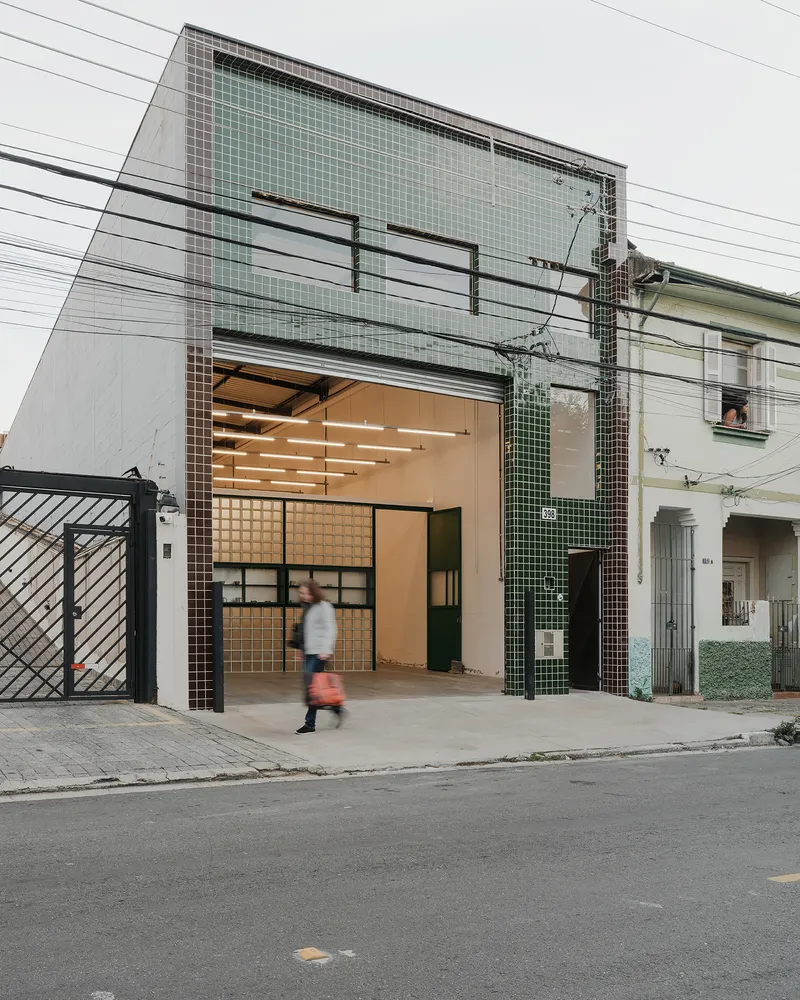
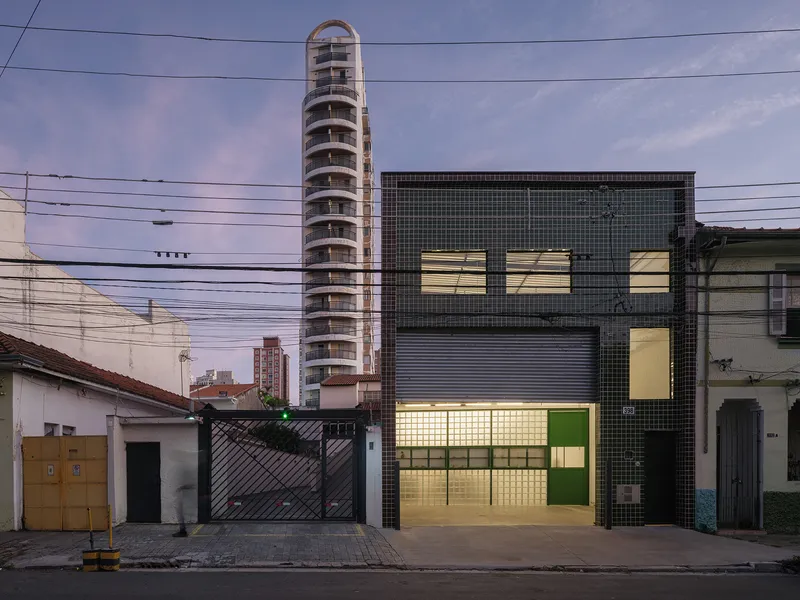
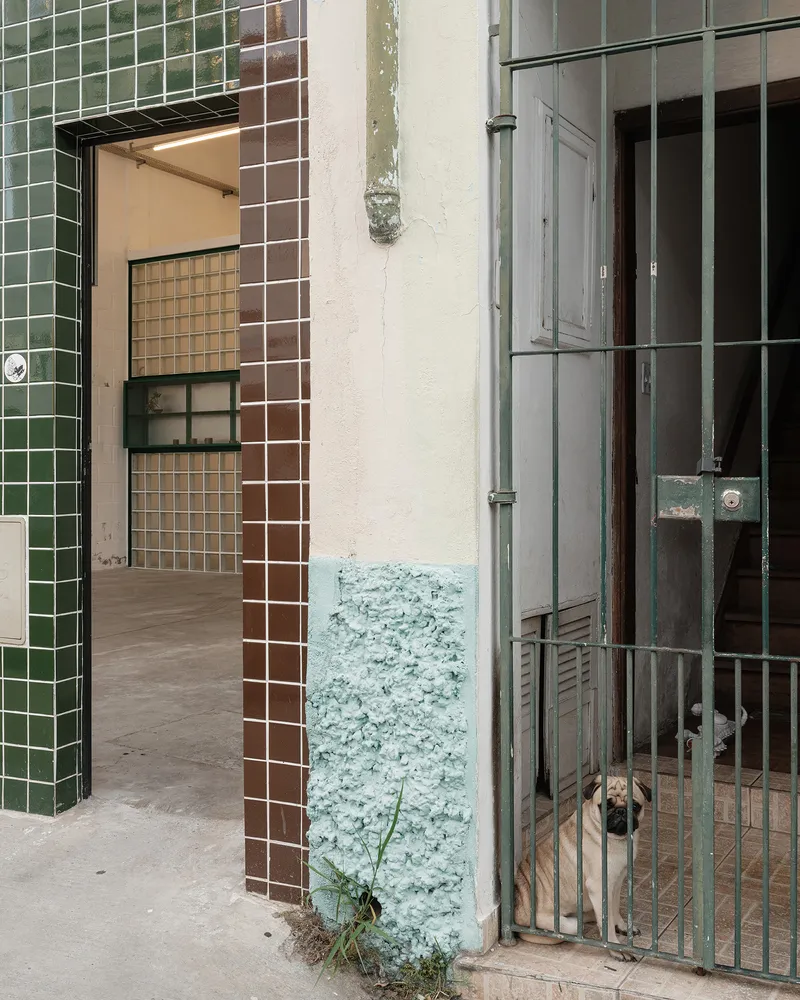
From the street, the building announces itself through a two-story composition of green and brown tile cladding punctuated by a large glass block wall. At dusk, the facade becomes a lantern. The translucent blocks diffuse interior light into a soft, even glow that pulls pedestrians' attention without shouting. It's an understated piece of urban signage: you know something is happening inside without needing a logo.
The choice of glass block is strategic rather than nostalgic. It admits daylight to the workspaces while screening the interior from direct views, giving students a sense of enclosure without claustrophobia. The green steel framing that organizes the blocks reads as a grid, reinforcing the building's tectonic logic right at its public face.
Glass Block as Spatial Device


Inside, the glass block wall becomes more than a facade element. It functions as a thick, luminous boundary that organizes the main corridor and the primary workspaces. Viewed from within, the blocks filter São Paulo's harsh sunlight into a diffuse, almost aqueous wash. Linear fluorescent fixtures mounted to the corrugated metal ceiling supplement this with an even, shadowless layer, essential for the close handwork ceramics demands.
The green steel frames that hold the glass blocks continue into the interior as a unified structural and organizational system. Shelves, partitions, door frames, and the staircase all share the same powder-coated finish. The consistency is disciplined without being monotonous, a single material language spoken fluently across different scales.
The Workshop Floor

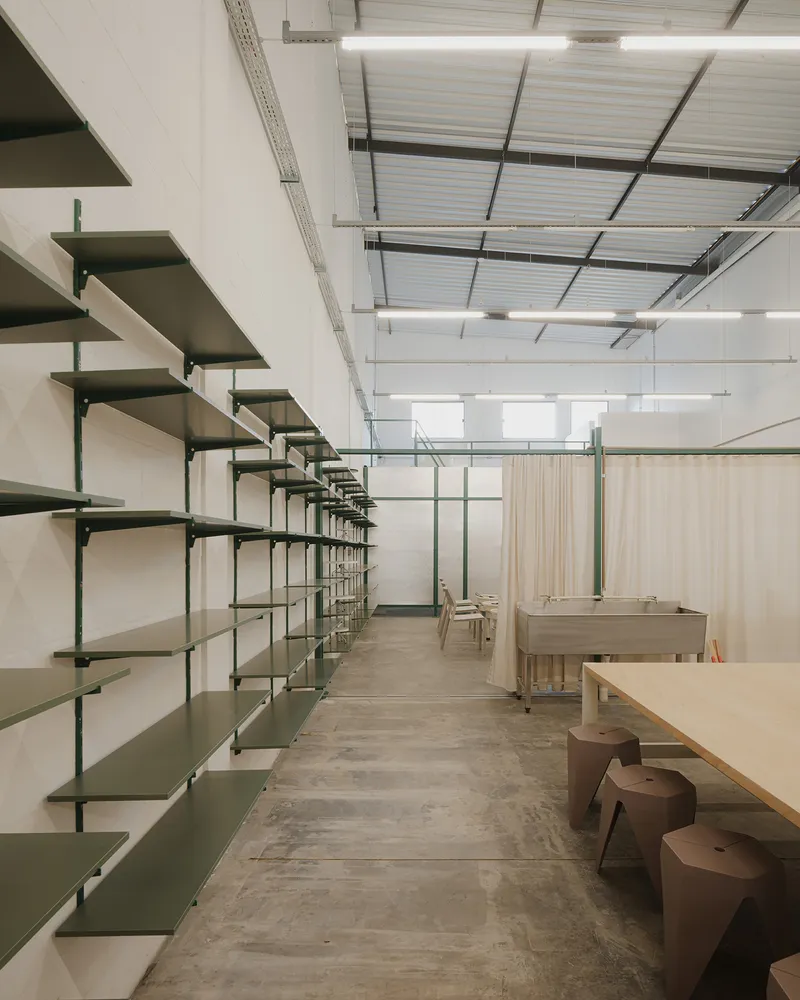
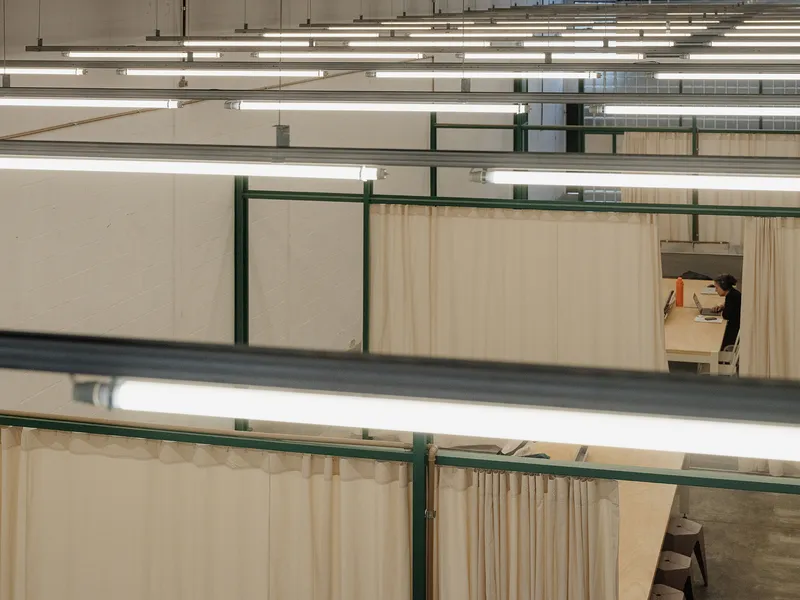
The main working level is a long, open floor organized by plywood worktables, adjustable metal stools, and the omnipresent green shelving. Polished concrete underfoot is practical: easy to clean, resistant to the constant drip and splash of slip and glaze. The proportions feel generous for a 245 square meter building, an effect Pianca achieves through the unbroken sightlines and the rhythmic repetition of structural bays.
An elevated vantage point reveals the intelligence of the layout. Fabric-partitioned zones create semi-private work areas that can be reconfigured as class sizes shift. The partitions absorb sound without killing it, allowing the ambient clatter and conversation that make a workshop feel alive.
Fabric Partitions and Soft Boundaries
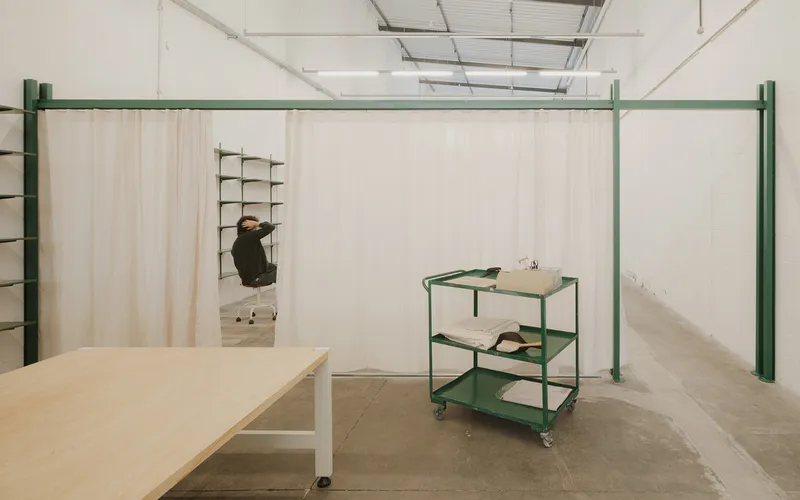
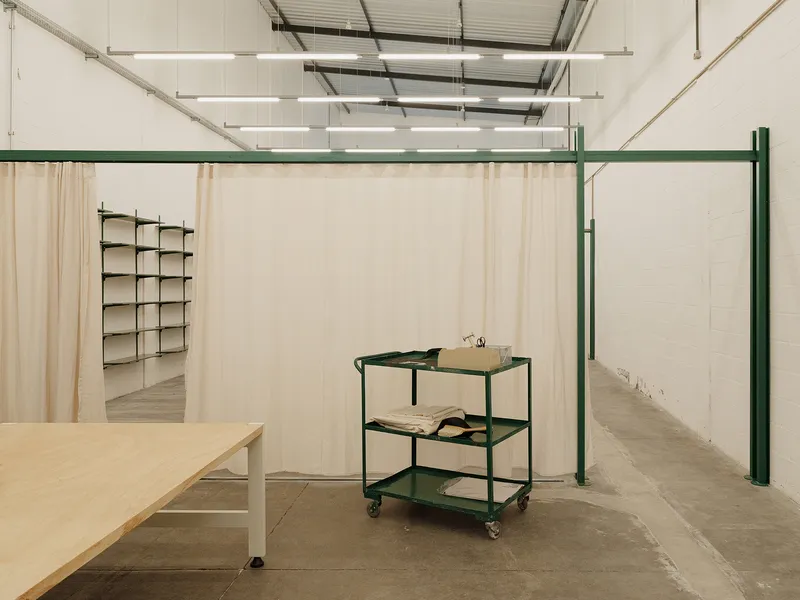
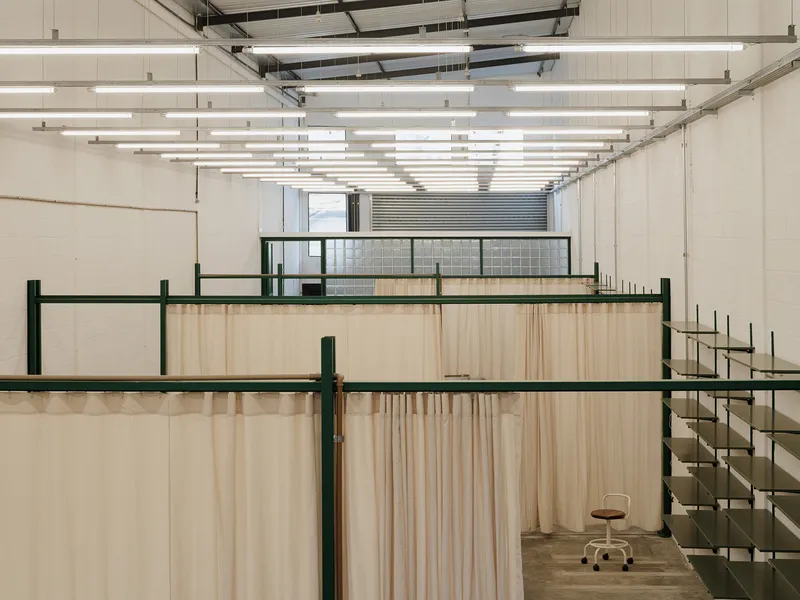
The linen and canvas curtains deserve their own discussion. Hung from the green steel frames, they transform rigid geometry into something pliable. A curtain pulled aside opens two zones into one. A curtain drawn creates a moment of focused solitude. In a building dedicated to working with your hands, the ability to reshape your environment with a simple gesture feels exactly right.
The curtains also soften the industrial palette. Against corrugated metal, fluorescent tubes, and concrete, their pleated weight introduces a textile warmth that registers almost subconsciously. They manage light, too: sheer panels glow when backlit, adding depth to the layered spatial sequence visible from one end of the building to the other.
Displaying the Work

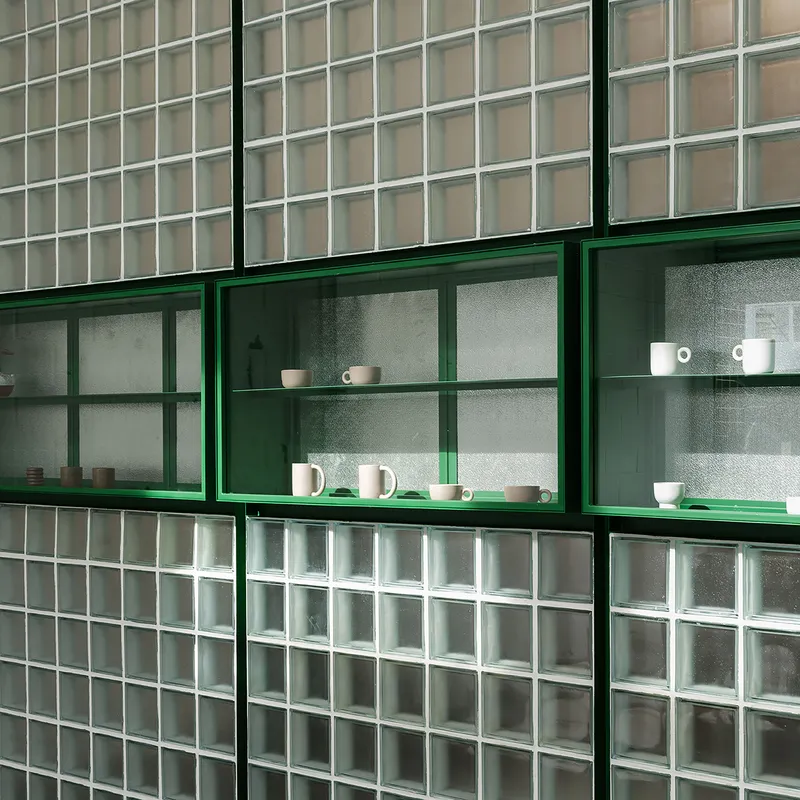
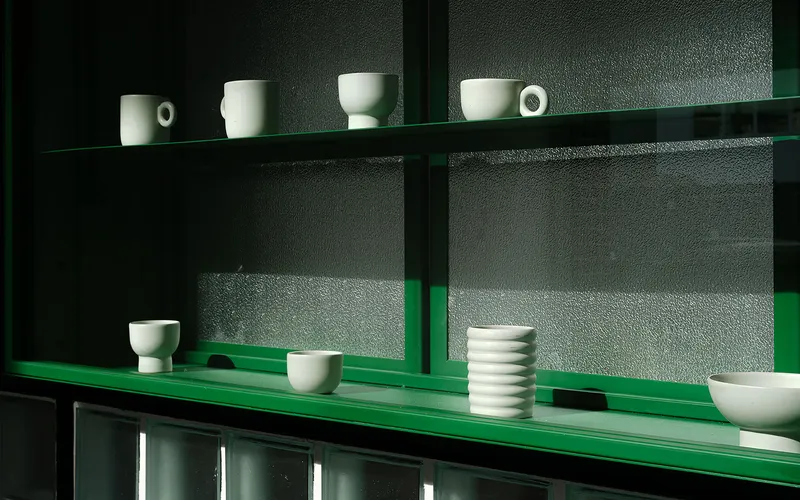
A ceramics school lives and dies by its display infrastructure. Pianca integrates shelving directly into the building's structural logic. Green steel brackets mounted on white tile walls hold finished and in-progress pieces at eye level, turning every corridor into an informal gallery. Some shelving units are set into the glass block wall itself, their frosted glass backing creating a luminous vitrine effect.
The detail at the shelf corners is worth noting. The powder-coated steel is precisely welded and finished, a level of craft that mirrors the ceramics on display. When a building asks its users to care about surface quality, it had better demonstrate that care in its own construction. Here, it does.
Staircase and Double Height
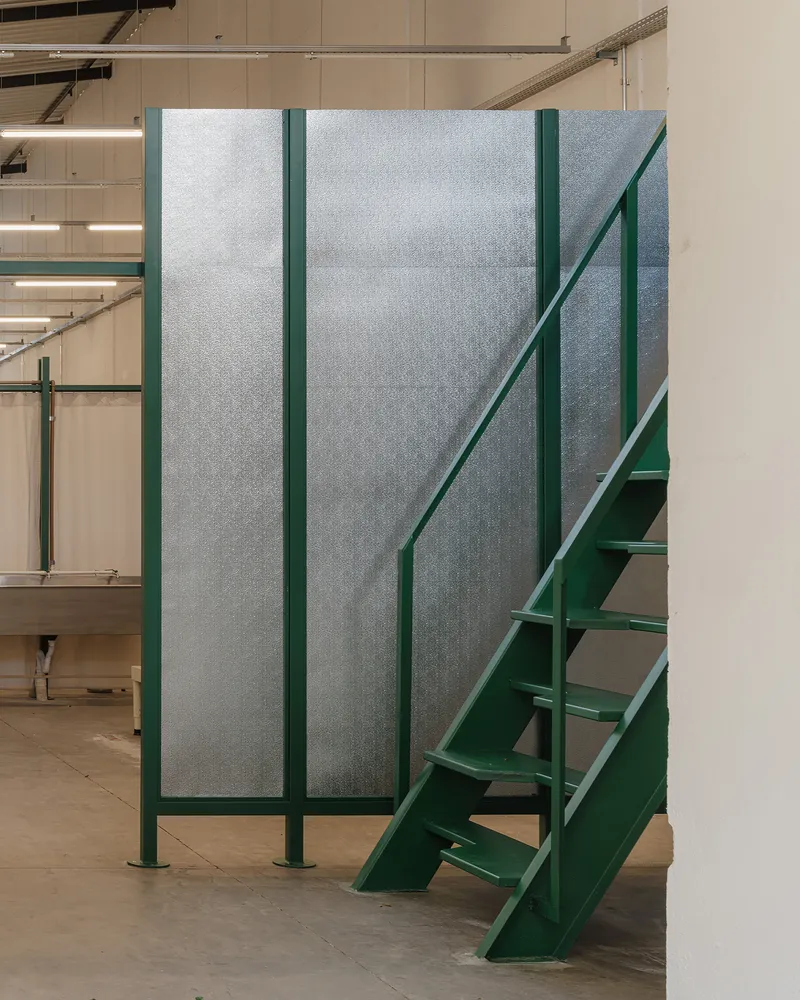

A green steel staircase ascends beside a translucent partition to a mezzanine level that overlooks the main workshop. The double-height volume it cuts through is the building's most dramatic moment, a vertical release in an otherwise deliberately horizontal plan. Glass railings at the upper level maintain visual continuity, letting instructors and students on the mezzanine stay connected to the activity below.
The staircase itself is lean and angular, its diagonal line contrasting with the orthogonal grid of the steel framing system. It's the one place where the architecture permits itself a dynamic gesture, and the restraint makes it more effective.
The Enclosed Courtyard


Tucked into the building's linear plan is an enclosed courtyard floored in gravel and planted with banana leaves and grasses. It serves as a decompression space, a place to step away from the wheel without leaving the building. The planting is tropical and unfussy, requiring little maintenance while providing a genuinely different sensory register from the hard surfaces of the workshop.
Glimpsed through the green-trimmed hallway, the courtyard also functions compositionally. It draws your eye along the building's depth and rewards the journey with a pocket of green calm. In a dense São Paulo neighborhood, access to even a modest outdoor room is a luxury that significantly elevates the day-to-day experience of the space.
Utility and Detail


The stainless steel wash basin mounted on a green frame with open shelving beneath it is a small detail that reveals a lot about the project's priorities. Everything is visible, accessible, and cleanable. There are no cabinet doors to get clay-caked. The rolling carts, the adjustable stools, the plywood tables: all of it is chosen for durability and ease of rearrangement rather than decorative effect.
This pragmatism extends to the ceiling, where corrugated metal panels and exposed conduit accept their utilitarian role without apology. The building is honest about being a workshop. Its aesthetic ambitions are achieved through proportion, color consistency, and material care, not through concealment.
Plans and Drawings


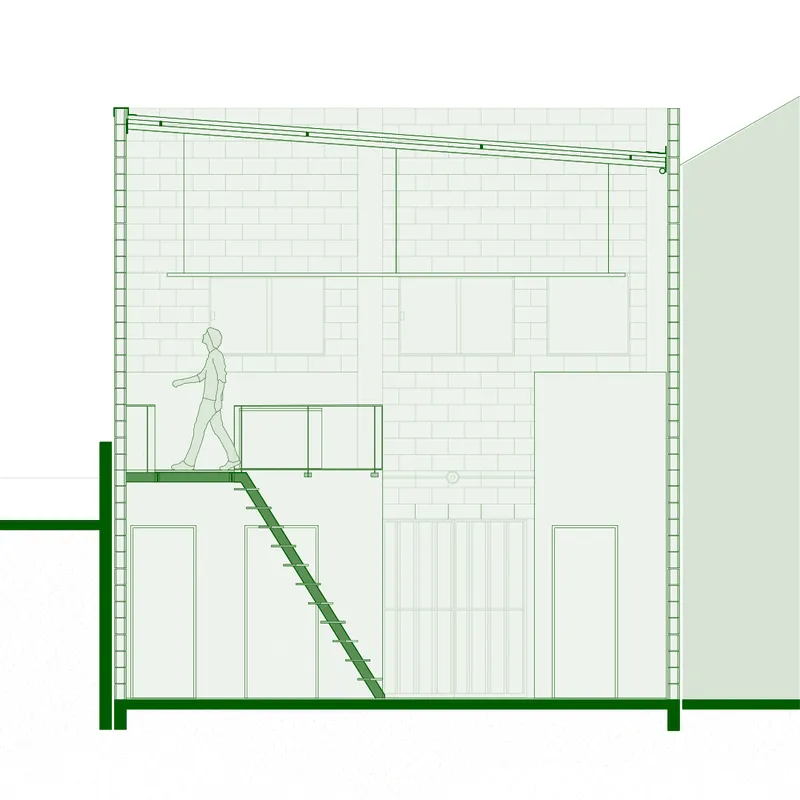


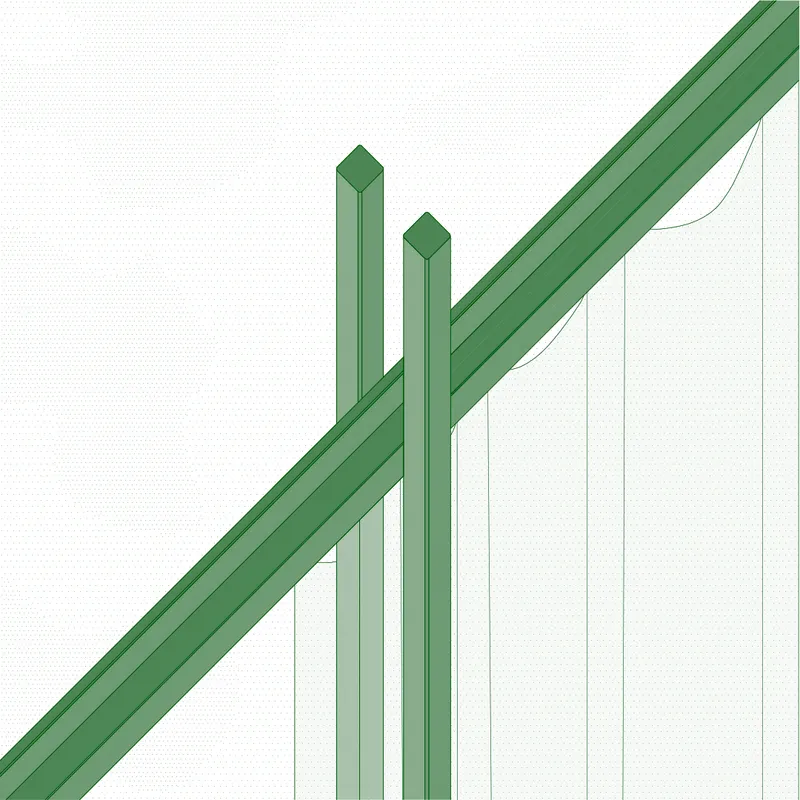

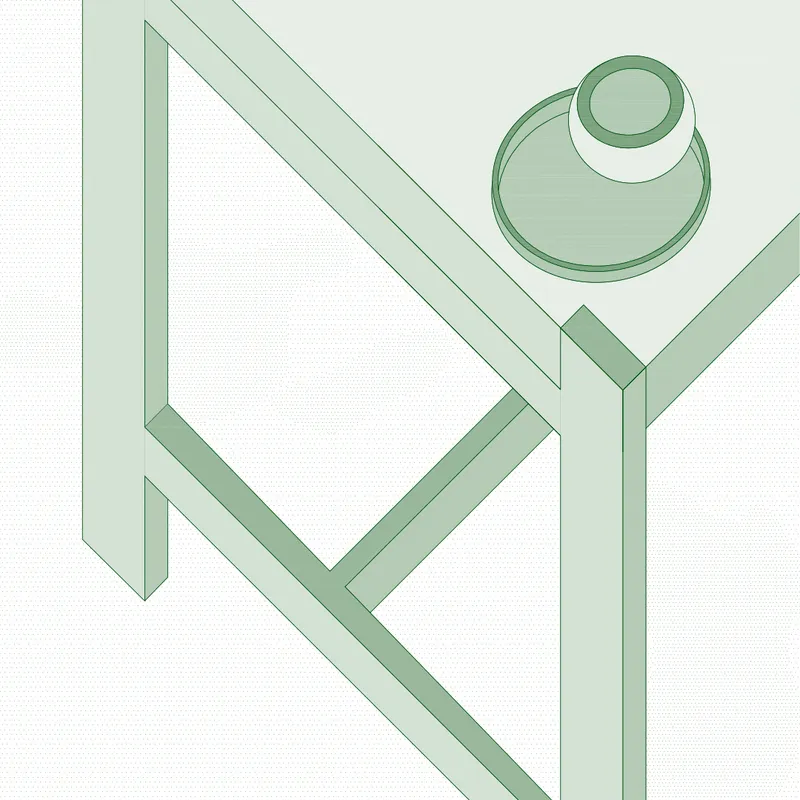


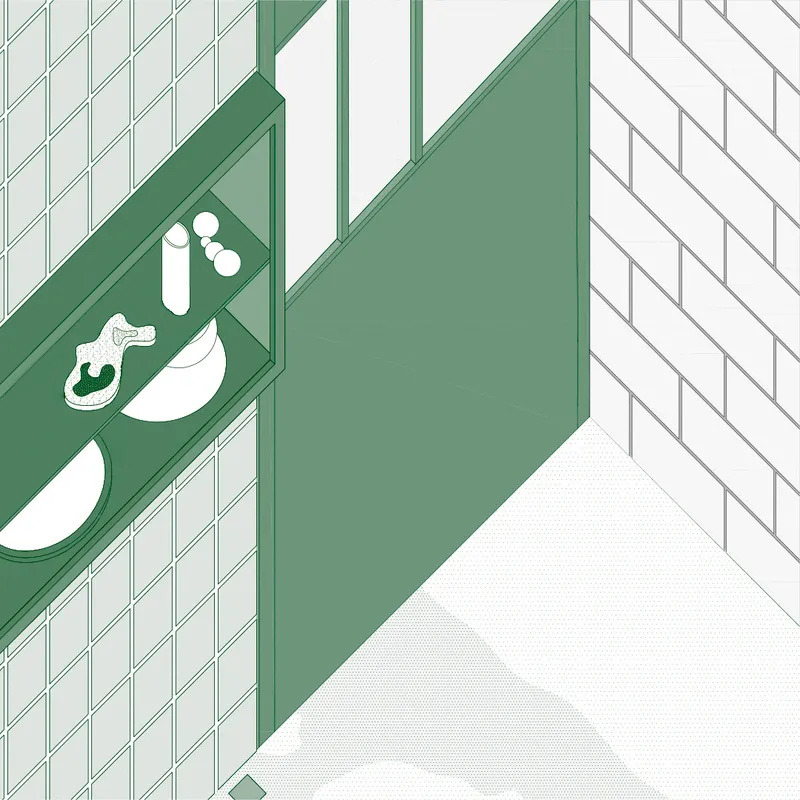
The floor plan and elevation confirm the building's straightforward linear organization: workspaces strung along a central axis with the courtyard providing a break in the sequence. Section drawings reveal the mezzanine's relationship to the double-height volume and show how the glass block facade extends the full height of the street elevation. The axonometric details are particularly instructive, isolating the steel column bases, diagonal bracing connections, skylight intersections, and raised platform structures that give the building its structural specificity.
What the drawings collectively demonstrate is that the building's visual coherence is not accidental. Every connection, from anchor bolt to signage panel, participates in a consistent tectonic system. The detail drawings read like a manual for the green steel vocabulary that Pianca developed for the project.
Why This Project Matters
The Ceramics Workshop matters because it takes a building type that is almost always improvised and treats it as worthy of genuine architectural invention. Purpose-built craft spaces are rare. Purpose-built craft spaces that develop a coherent material language from foundation to signage are rarer still. Pianca Arquitetura has produced a building where the architecture and the activity inside it share a commitment to precision, tactility, and care.
It also offers a quiet lesson about economy. At 245 square meters, the building is compact. Its power comes not from scale but from consistency: one color, one framing system, one logic applied everywhere. The green steel, the glass block, the linen curtains, and the polished concrete form a vocabulary tight enough to be memorable and flexible enough to accommodate the messy, unpredictable reality of a working studio. That balance is harder to achieve than it looks, and it is the thing that elevates this project from a nice renovation to a reference point for anyone designing spaces where things get made.
The Ceramics Workshop by Pianca Arquitetura (lead architect: Guilherme Pianca). São Paulo, Brazil. 245 m². Completed 2025. Photography by Pedro Kok.
About the Studio
Share Your Own Work on uni.xyz
If projects like this are the kind of work you want to make, uni.xyz is a place to publish your own, find collaborators, and enter design competitions.


Popular Articles
Popular articles from the community


LT2A and OPEN Architectes Thread a Brick and Glass High School Through a Wooded Belgian Campus
In Braine-l'Alleud, a 3,000 m² wing for Collège Cardinal Mercier pairs pale brick with a glazed colonnade, deferring to a small chapel and a dense wood.

Cube Design Draws an Ecological Corridor Between Two Shenzhen Hills with the Nankai Building
Beside Shenzhen's container docks, the Nankai Building pairs stacked balconies with a climbing green screen to connect two hillsides across its height.

Architekt Andreas Gruber Scatters 23 Dark Timber Chalets Across a South Tyrolean Forest Edge
In Molini di Tures, Amonti Chalets breaks a resort into a hamlet of gabled timber houses, with parking, storage and services pushed into the slope.

U.GA Architects Wraps an Oval Rooftop Pool in Curved Board-Formed Concrete on Busan's Jeollidan-gil
In Busan's Jeonpo-dong, a 454 m² mixed-use block stacks a neighborhood facility, guest rooms and an oval rooftop pool inside spiraling concrete walls.

Similar Reads
You might also enjoy these articles


LAVA Architecten Gives Vocational Education a Sawtooth-Roofed Face on a Mechelen School Campus
In Mechelen, Belgium, a 2,053 m² STEM school on a 6×6 m grid turns workshops and classrooms into rooms that can be rearranged as teaching changes.

KEMA Studio Turns a Derelict Marvila Attic into a 60 m² Lighthouse Apartment Above Lisbon
In Lisbon's Marvila district, a rebuilt roof, four skylights and two plywood volumes turn an unlivable attic into a bright home facing the Tagus.

Pixel Gardens: One Repeated Module Stacked Into a Terraced Social Housing Tower for Famagusta
Salem Bader's shortlisted housing tower builds a vertical neighbourhood from one repeated module, offsetting units to carve terraces, light and air.

Bao Huynh Watercolor Atelier: A Serene Art Retreat in Hội An
Bao Huynh Watercolor Atelier in Hội An blends multifunctional art spaces, sustainable design, local materials, and family-friendly living in a serene environment.

Explore Workshop Hall Competitions
Discover active competitions in this discipline

Challenge to reimagine the Iron Throne

Photograph architecture without architects

Illustrate the lost glory of Angkor Wat - Render Challenge

Design challenge to reuse E-waste
Comments (0)
Please login or sign up to add comments
No comments yet. Be the first to comment!