

MaMo Architects Wraps a Concrete Barn House in Charred Wood in the Rolling Hills of Chester County, Pennsylvania
A West Chester, Pennsylvania family home where ICF concrete, shou sugi ban and a stair-tower heat chimney rework the local barn for low upkeep.


Chester County has no shortage of barns, and no shortage of houses pretending to be barns. The Charred Barn by MaMo Architects takes the familiar gable seriously. It also refuses to treat that gable as a costume. Completed in 2019 on a 10-acre parcel of meadow and mature trees outside West Chester, Pennsylvania, the roughly 2,800 sq ft house keeps the silhouette you expect from the hills around it. Underneath that silhouette, nearly everything is different: an insulated concrete form (ICF) shell, a LiteDeck floor system, steel, and a skin of charred timber and corrugated metal.
The real story is not the barn reference. What interests us is how lead architect Matthew Moger turned the brief into a building-science problem. The owners wanted low maintenance and high efficiency, and they run a small business from home. MaMo answered with a durable, thermally broken envelope and a central stair that doubles as a heat chimney. The skylight above it works the way a cupola works on a historic barn. Here the vernacular reference does real work. It is not just there to look good.
A Barn You Read from the Meadow
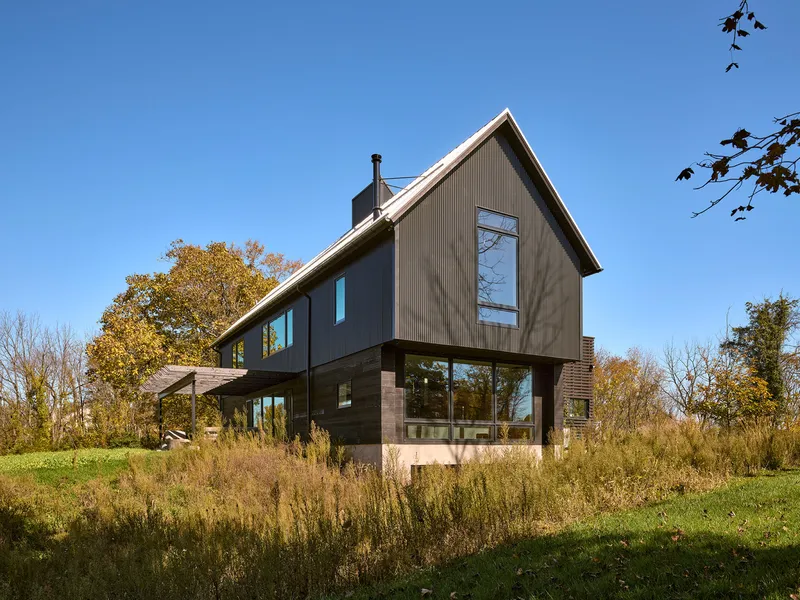
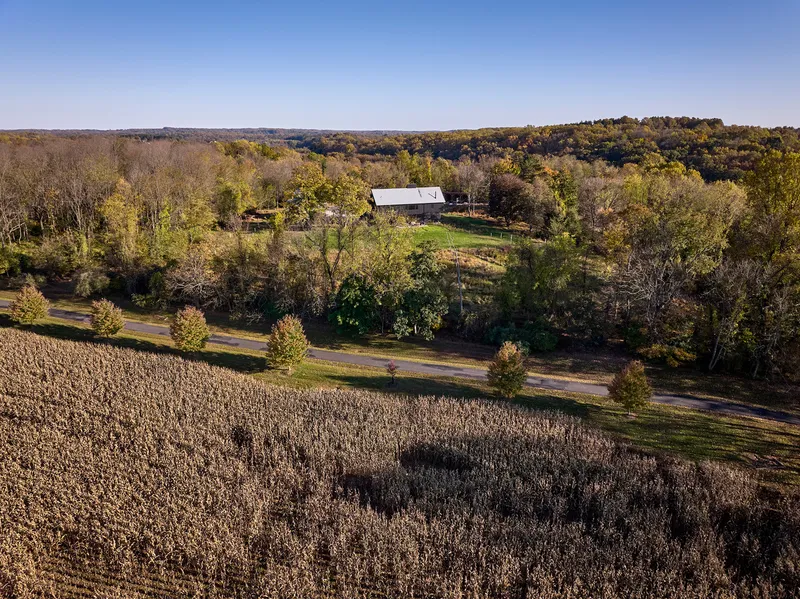
From the dry grasses of the meadow, the house reads first as a single dark gable with one tall window slicing up its face. That window marks the stair, and it gives the elevation away before you step inside. From the air, the building sits low among autumn trees beyond a cornfield and a curving lane. It is one more agricultural shape in a working landscape, not a statement house parked on a hilltop.
The site's undulating ground and its meadow planting, by Donald Pell Gardens, carry much of that restraint. Moger reportedly camped on the property before designing. You can see the result in how quietly the house takes its place: it is oriented for energy performance and set into the terrain, not posed against it.
A Skin Built to Be Left Alone
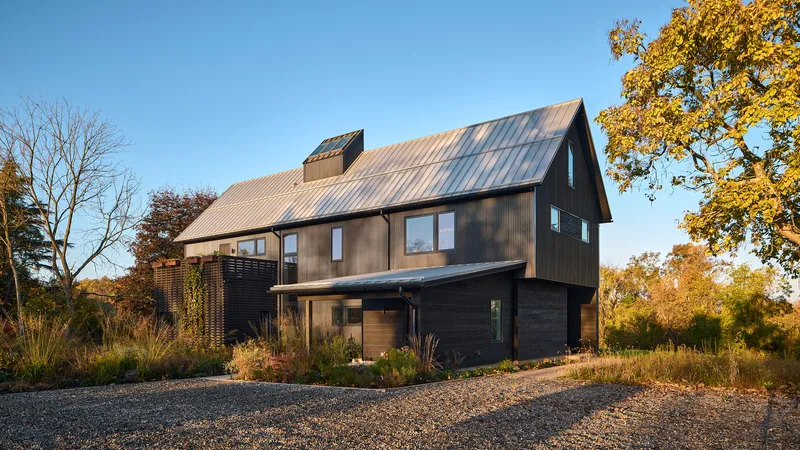
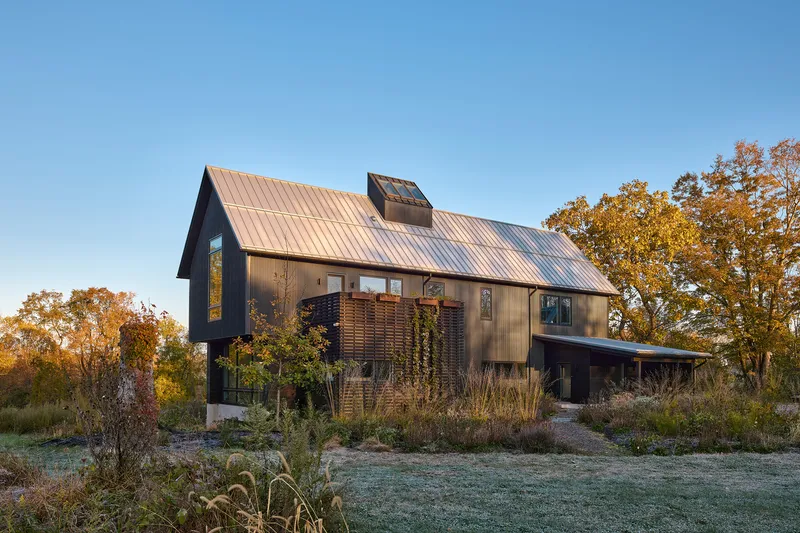
The exterior pairs shou sugi ban, the Japanese charring technique, with metal siding and a standing-seam metal roof. Charring timber makes it more resistant to weather, rot and insects. Over a concrete shell, that gives you a facade that should need very little attention for a long time. Seen across the gravel drive in low sun, the black boards absorb light while the roof catches it. The result is a sharper two-tone reading than any painted barn could manage.
Note the honesty of the borrowing. The charring is a Japanese tradition, not a Pennsylvanian one, and MaMo does not pretend otherwise. The skylight dormer above the slatted timber screen is where the regional reference returns. It reads as a cupola, the vent every old barn used to dump hot air. The firm calls this familiar forms with unfamiliar materials, and here the phrase holds up.
The Stair as Heat Chimney
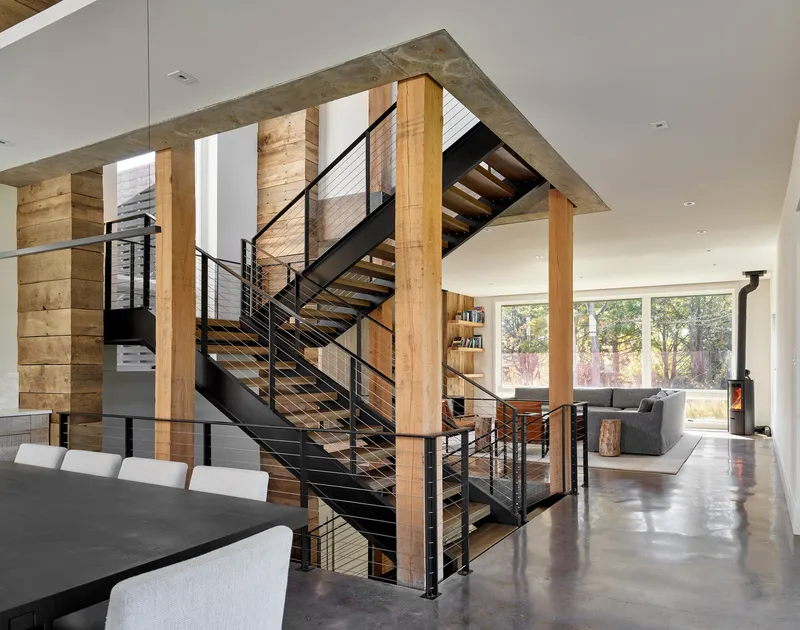
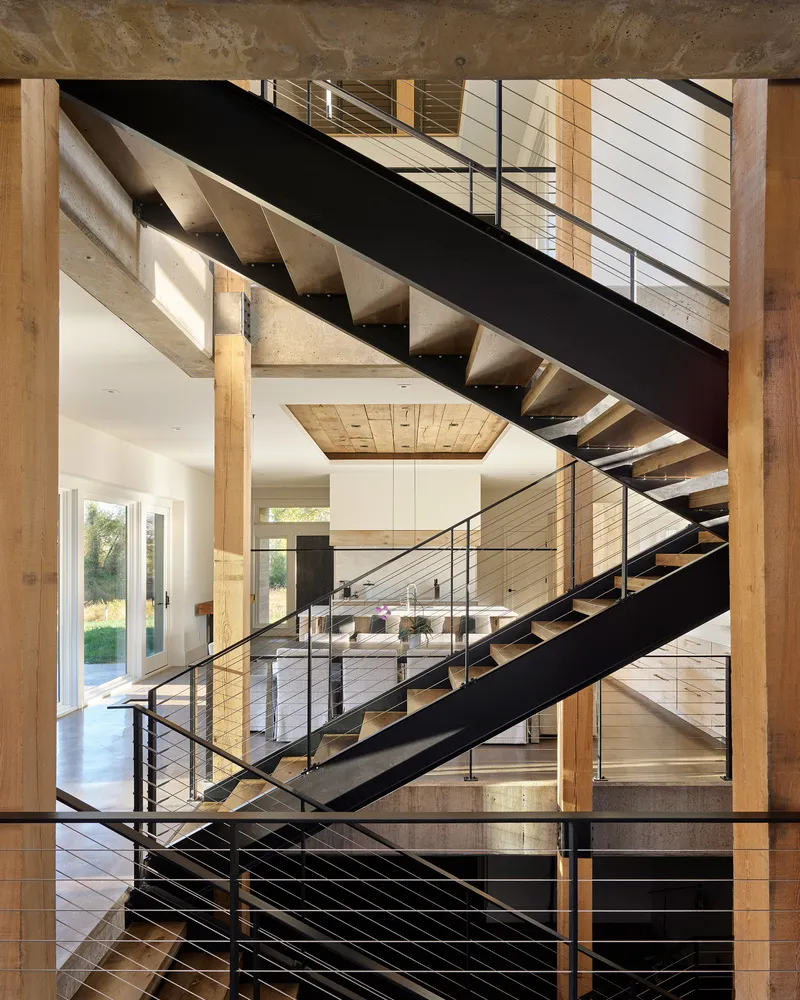
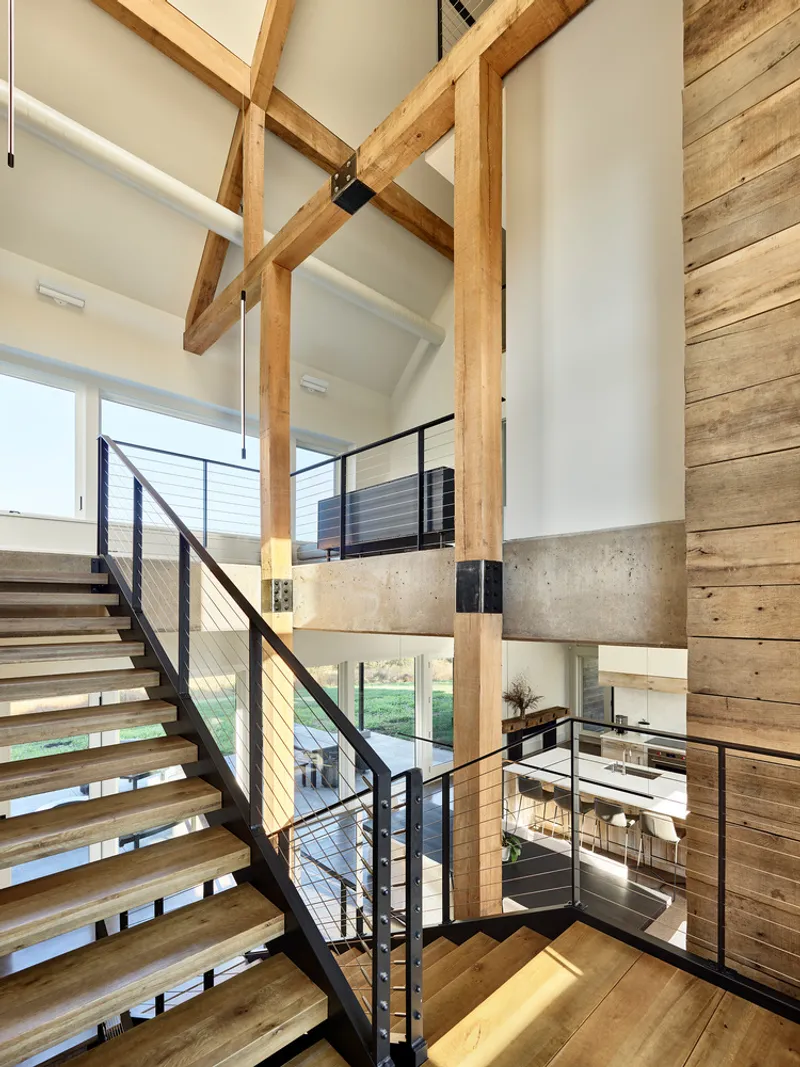
The centrally placed stair carries the house's climate strategy. Built from black steel with open timber treads and cable rails, it rises between square oak posts through a tower capped by a light shaft that pushes past the roofline. Warm air climbs the shaft and leaves through the venting skylight, which pulls cooler air in at lower levels. It is passive ventilation you can see, and climbing toward the sky is a pleasure on its own terms.
The landing shows how the structure combines systems. Heavy timber posts and trusses meet black steel brackets against a reclaimed plank wall, with daylight pouring through the tall windows. Concrete, steel and wood each do a clear job, and the connections stay exposed. MaMo describes the interior as showing how the building was made, and this is where that claim is most convincing.
Kitchen and Living Inside a Concrete Shell
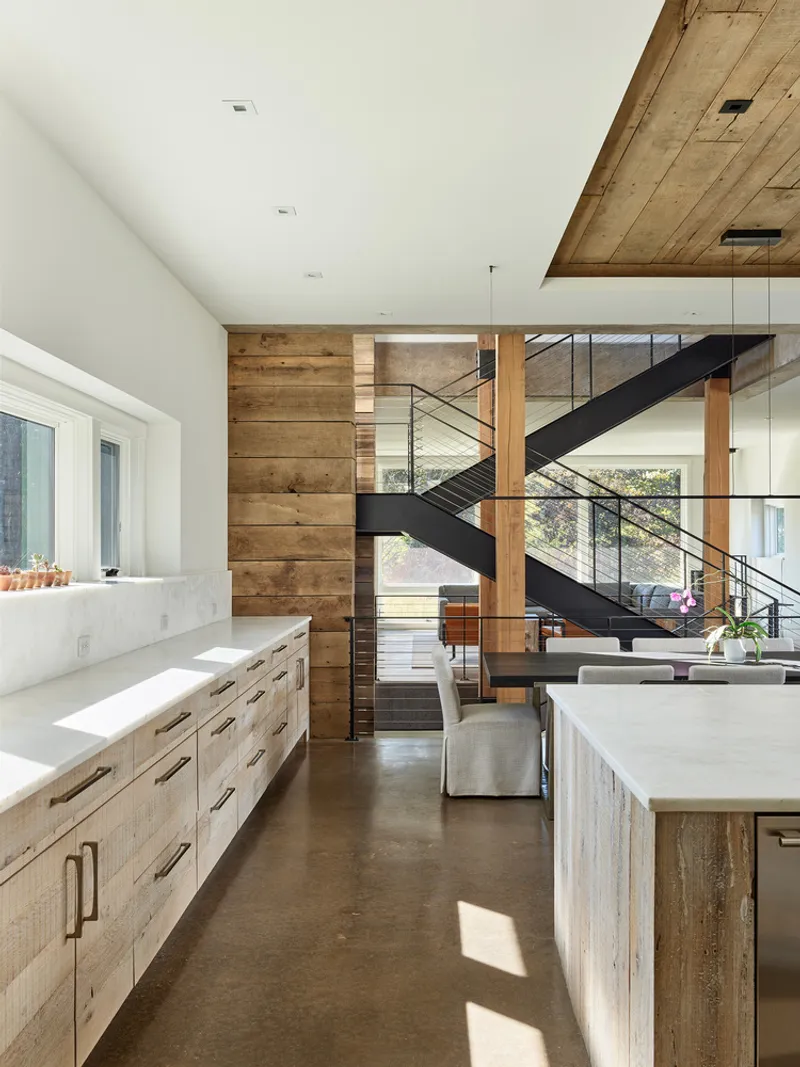
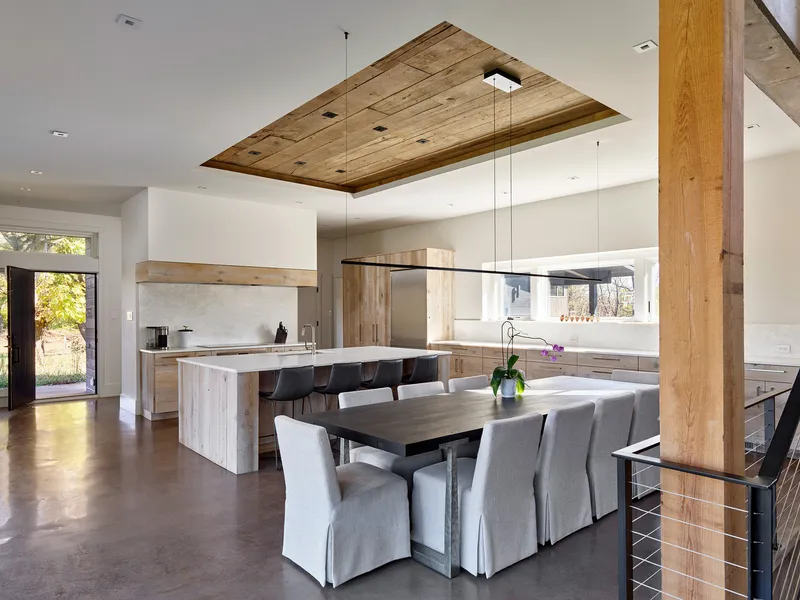
The concrete pays off downstairs. Polished floors over radiant heating store warmth, and the thermal mass smooths out daily temperature swings. A pale wood cabinet run with a marble counter leads the eye straight to the steel stair. The plan stays open, but the stair gives it a spine. The flexibility serves the work-from-home brief: there is room to spread out without the house losing its center.
Reclaimed wood keeps the concrete from turning clinical. A timber ceiling inset hovers over the dining area, the island is clad in planks, and a single timber column stands among slipcovered chairs. These are modest moves, and they matter. A house built on parking-garage logic, with a contractor reportedly experienced in that kind of concrete work, still needs to feel like somewhere a family eats dinner.
Raw and Reclaimed in the Private Rooms
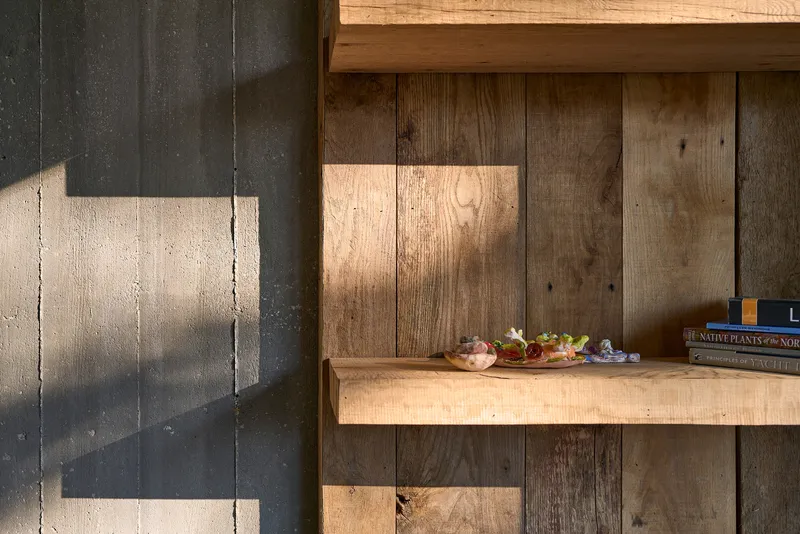

Board-formed concrete next to reclaimed oak shelving is the house's core material argument, shown at the scale of a plate and a stack of books. The formwork grain prints the timber into the concrete, so the two materials end up sharing a texture. It is a small detail, and it does more to reconcile the hybrid construction than any amount of explanation.
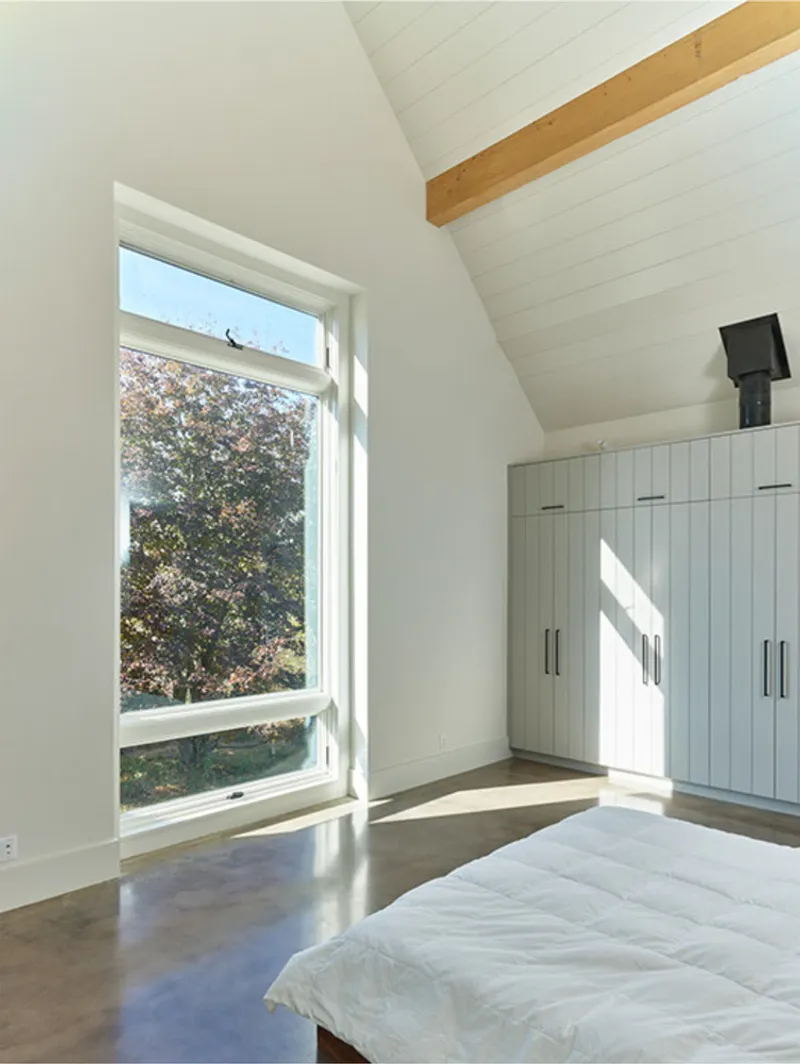
The bathroom and bedroom move toward calm. A black stone trough sink sits on a reclaimed wood vanity, and a freestanding tub faces a ribbon window of autumn trees. In the bedroom, a vaulted shiplap ceiling and an exposed beam frame a tall window, with built-in wardrobes keeping the room uncluttered. The triple-pane Andersen units let these rooms open generously to the landscape without undercutting the envelope.
Why This Project Matters
Rural residential design in the American Northeast often gets stuck between nostalgic reproduction and generic modernism. The Charred Barn suggests a third path: keep the regional form, then rebuild everything behind it around performance. ICF walls, thermal mass, radiant floors, solar PV and a stack-effect stair add up to a house whose barn identity is backed by how it actually works.
The cupola-as-heat-chimney is the lesson to take away. It shows that vernacular forms often encode climate knowledge worth recovering, and that a contemporary house can borrow the function instead of just the profile. For clients asking for low maintenance and high efficiency, the case is persuasive. Durability and comfort here come from choices the architecture makes visible, not from equipment hidden in a basement.
Charred Barn by MaMo Architects (lead architect Matthew Moger), West Chester, Pennsylvania, USA. Area: approximately 2,800 sq ft. Year: 2019. Landscape: Donald Pell Gardens. Builder: T3 Construction. Photography: Jeffrey Totaro.
About the Studio
Share Your Own Work on uni.xyz
If projects like this are the kind of work you want to make, uni.xyz is a place to publish your own, find collaborators, and enter design competitions.


Popular Articles
Popular articles from the community


FCC Arquitectura Expands a Portuguese Granite House with a Board-Marked Concrete Wing
In Portugal, JV House pairs a cleaned-up whitewashed and granite dwelling with a timber-shuttered concrete extension, courtyards and a garden pool.


The Amber Palace Opera: A Geological Fiction Surfaces on Tallinn's Baltic Waterfront
Pierre Brillard reimagines a Baltic legend as a public landscape, opera house, and waterfront promenade rooted in Tallinn's coastal identity.

ETEH Reworks the Shared Spaces of São Domingos School in Brazil Around Timber, Color and Hanging Plants
At São Domingos School in Brazil, 436 m² of hall, refectory and library are recast with timber joinery, a yellow and blue code and trailing greenery.

Aquadapt: An Underwater Habitat That Rewrites Its Rooms by the Hour
Curved modules ring the seabed while one shell shifts from breakfast room to cinema, farm and football pitch as residents' needs change.

Similar Reads
You might also enjoy these articles

Cube Design Draws an Ecological Corridor Between Two Shenzhen Hills with the Nankai Building
Beside Shenzhen's container docks, the Nankai Building pairs stacked balconies with a climbing green screen to connect two hillsides across its height.

Praksis A and Studio Sted Bend a Red Timber Cabin Across the Granite of Norway's Southern Coast
On the southern Norwegian coast, a 105 m² cabin follows the rock on slender posts, pairing red cladding outside with pine, brick and plywood within.

David Ortega Stacks a Two-Story Mexico City Penthouse Around a Steel Stair and a Pergola-Shaded Roof Terrace
In Colonia Roma, a 300 m² penthouse uses oak joinery, a planted steel stair and a slatted roof pergola to make a new-build apartment feel like a house.

PARALELA and LB2 Thread a Public Walkway Through the Base of a Las Condes Residential Tower
In Las Condes, Santiago, the Hamlet Building gives its fenceless ground floor to a 70-metre wooded passage linking two streets and the metro.

Explore Architecture Competitions
Discover active competitions in this discipline

Challenge to reimagine the Iron Throne

Photograph architecture without architects

Illustrate the lost glory of Angkor Wat - Render Challenge

Design challenge to reuse E-waste
Comments (0)
Please login or sign up to add comments
No comments yet. Be the first to comment!