

The Shire Kindergarten: Earth-Integrated Learning Shaped by Climate in Mainz
A semi-buried kindergarten for one hundred children dissolves into the urban landscape, letting solar geometry and wind corridors define its form.


Bury a kindergarten under a hill and let the children play on its roof. That is the essential proposition of The Shire, a project for approximately one hundred children in Mainz, Germany, that takes the principle of "form follows climate" literally. The building does not sit on its site so much as it grows out of it: a gently raised landform with partially buried volumes beneath, where the thermal mass of the soil provides year-round insulation and the roofscape doubles as an active play surface. Named after the Hobbit homeland, the project embraces a low-profile, earth-integrated architecture that prioritizes shelter, warmth, and human scale over formal spectacle.
Designed by Jannik Pöstges, The Shire sits in a gap between high-rise buildings, a condition that most designers would treat as a constraint but that here becomes an asset. Rather than inserting another vertical object into the urban fabric, the project extends a continuous green corridor connecting an adjacent park to the surrounding infrastructure, bridging a fragmented neighborhood at ground level. The result is a kindergarten that reads as landscape first, architecture second.
Spherical Logic Flattened into a Hillock


The physical model reveals the project's formal DNA: layered, curving roof profiles that rise gently above a tree-planted base, each laminated layer registering a different zone of programme or structure beneath. The starting point is the sphere, the geometry offering the most efficient ratio of volume to surface area. Pöstges translates that spherical logic into a semi-circular form that demands grounding, producing a series of hillocks rather than domes. The slotted openings visible in the close-up model view are not decorative; they correspond to daylight apertures and ventilation channels that thread through the earth-covered roof.
What makes this approach compelling for a kindergarten is the collapse of building and playground into a single surface. Children do not merely occupy the interior spaces; they climb, run across, and inhabit the building's form itself. The earth covering cools interior spaces in summer and retains heat in winter, turning the roof into a working thermal envelope rather than a passive green blanket.
Four Volumes Along a Curved Landscape Path

The angled model view, with miniature trees positioned around the layered roof structure, shows how the kindergarten fragments into distinct volumes rather than consolidating under a single mass. The main building serves as the shared entrance and common-use area, housing meeting rooms, a sports hall, and communal spaces. Two additional buildings are dedicated to children aged four to seven, while a fourth, more secluded structure at the rear of the site is designed specifically for children from birth to three years old. This age-based separation ensures that the youngest children occupy the quietest, most protected zone of the campus.
Outdoor areas are woven between the buildings, enabling seamless transitions from interior to exterior while maintaining supervision lines and environmental comfort. The fragmented layout also means that each volume can respond independently to its immediate microclimate, orienting windows and openings toward optimal solar and wind conditions rather than conforming to a single facade logic.
A Solar Facade That Tracks the Sun

The section drawing makes the energy strategy legible. Because the vegetated roofs cannot host photovoltaic panels, the main building deploys a movable photovoltaic slat facade on its south-facing elevation. These slats rotate in response to the sun's position: shading the glazing during peak solar exposure to prevent overheating, then opening to admit controlled daylight and natural ventilation when conditions allow. The drawing annotates a "solar isolation window" and a "heat-cushion" detail within the grassed berm, illustrating how the facade and the landscape work as complementary thermal systems.
South orientation ensures maximum daylight penetration into the interior, a critical requirement for spaces occupied by young children. Curved glazing extends toward the east and west to capture sunlight during sunrise and sunset, further optimizing passive solar gains. The design draws explicitly from the framework outlined in "Das Klima als Entwurfsfaktor," reinforcing climate as the primary generative force rather than an afterthought resolved through mechanical systems.
Wind Corridors Between Towers as a Ventilation Engine

The site plan and section drawings depict the four vaulted-roof buildings arranged along the curved landscaped path, but they also reveal the project's relationship to the surrounding high-rises. Positioned between tall buildings, The Shire exploits the wind suction effect created by the urban fabric to drive cross-ventilation and passive cooling through its interior spaces. In a building type occupied by active children who generate significant internal heat, this is not a luxury; it is a functional necessity. Window openings and facade articulation are calibrated to channel these wind corridors through the programme zones where cooling demand is highest.
Why This Project Matters
Kindergarten design often defaults to one of two modes: the brightly colored pavilion or the generic institutional box. The Shire sidesteps both by asking a more fundamental question: what happens when you let climate data, not aesthetic preference, generate form? The answer, in this case, is a landscape building whose geometry derives from thermal efficiency, whose facade tracks the sun, and whose ventilation strategy leverages the very urban density that surrounds it. Every design decision traces back to a measurable environmental condition.
What elevates Pöstges's work beyond a technical exercise is the recognition that climate-responsive architecture and child-centered design are not competing agendas. The earth-covered roof that provides insulation also provides a hill to climb. The fragmented plan that optimizes microclimate response also creates age-appropriate spatial zones with clear supervision lines. The project demonstrates that when climate is treated as a genuine design driver from the first sketch, the resulting architecture can be simultaneously rigorous and generous.
View the Full Project
About the Designers
Designer: Jannik Pöstges
Enter a Design Competition on uni.xyz
uni.xyz runs architecture and design competitions year-round that reward proposals with spatial conviction and real site intelligence.
Project credits: The Shire by Jannik Pöstges.


Popular Articles
Popular articles from the community


Cube Design Draws an Ecological Corridor Between Two Shenzhen Hills with the Nankai Building
Beside Shenzhen's container docks, the Nankai Building pairs stacked balconies with a climbing green screen to connect two hillsides across its height.

GROUP A Strips a 1969 Rotterdam Harbor Headquarters to Its Frame and Wraps It in Timber Louvers
In Rotterdam's M4H harbor district, Ferro Offices reuses a 1969 frame, adds one timber storey and reaches BREEAM-NL Outstanding.

David Ortega Stacks a Two-Story Mexico City Penthouse Around a Steel Stair and a Pergola-Shaded Roof Terrace
In Colonia Roma, a 300 m² penthouse uses oak joinery, a planted steel stair and a slatted roof pergola to make a new-build apartment feel like a house.

U.GA Architects Wraps an Oval Rooftop Pool in Curved Board-Formed Concrete on Busan's Jeollidan-gil
In Busan's Jeonpo-dong, a 454 m² mixed-use block stacks a neighborhood facility, guest rooms and an oval rooftop pool inside spiraling concrete walls.

Similar Reads
You might also enjoy these articles

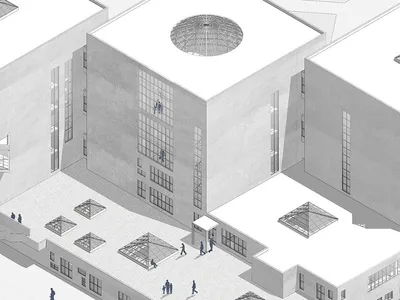
Yenisei Monitoring Center: A Sun-and-Moon Sphere Anchors a Research Campus on Siberia's Great River
In Krasnoyarsk, shifting square blocks, a glazed central sphere and descending window rhythms turn river science into a public spectacle on the Yenisei.
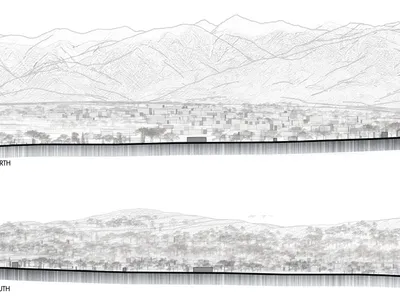
Andretta Artist's Village: A Node-Based Masterplan That Lets the Hills Write the Plan
A cultural landscape strategy for Palampur's artist colony threads studios, residences and stages along a porous spine shaped by the Dhauladhar terrain.
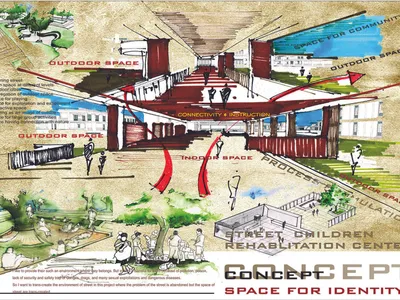
Street Children Rehabilitation Center: A Brick Campus That Eases Children From Street to Safety
A low-rise courtyard campus where learning streets, uthans and shaded verandahs stage a gradual passage from street into protective, family-scale life.

The NEON Culture: A Field of Pavilions Built for the 24-Hour City
Smaran Alva spreads galleries, stages, clubs and markets across a varied site, treating light, sound and ramped movement as the real building materials.


Comments (0)
Please login or sign up to add comments
No comments yet. Be the first to comment!