
J. Mayer H. Revives a Bomb-Damaged Berlin Coach House with Monochrome Color Blocks and Salvaged Character
A postwar patchwork residence in a hidden Berlin courtyard gains a cohesive new identity without losing its layered past.


Somewhere inside a dense Berlin city block, behind street-facing buildings and past a narrow passage, sits a coach house that was never really finished. Bombed during the war, rebuilt piecemeal between the 1960s and 1980s from salvaged materials, the structure accumulated split levels, mismatched rooms, and a quietly wild garden where foxes still den. J. Mayer H. was handed this layered, eccentric inheritance and asked to make it work as a family home for a couple with three children, without steamrolling the idiosyncrasy that made the place worth saving.
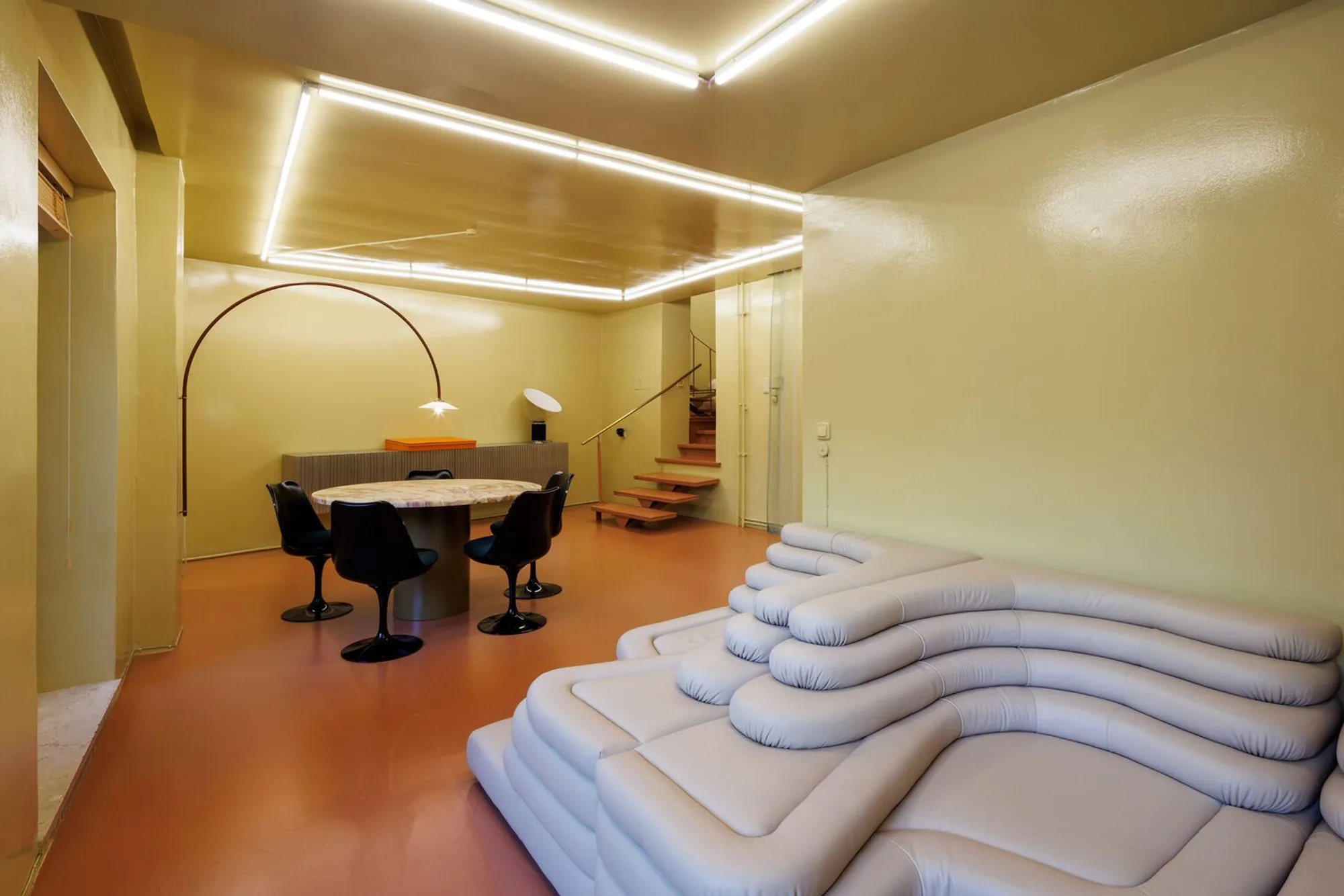
What makes the renovation genuinely interesting is its refusal to choose sides. Rather than stripping everything back to a neutral shell or treating the building as a museum of postwar improvisation, the studio introduced a bold monochrome color-block system that absorbs the existing quirks. Original banisters, vintage tiles, mid-century light switches, and wooden doors all remain, but a continuous field of orange resin flooring and recessed cove lighting pulls the fragmented plan into something that reads as intentional. The result is a house that feels both curated and slightly feral, a combination Berlin does better than almost any other city.
Courtyard and Facade: Rough Concrete, Soft Edges
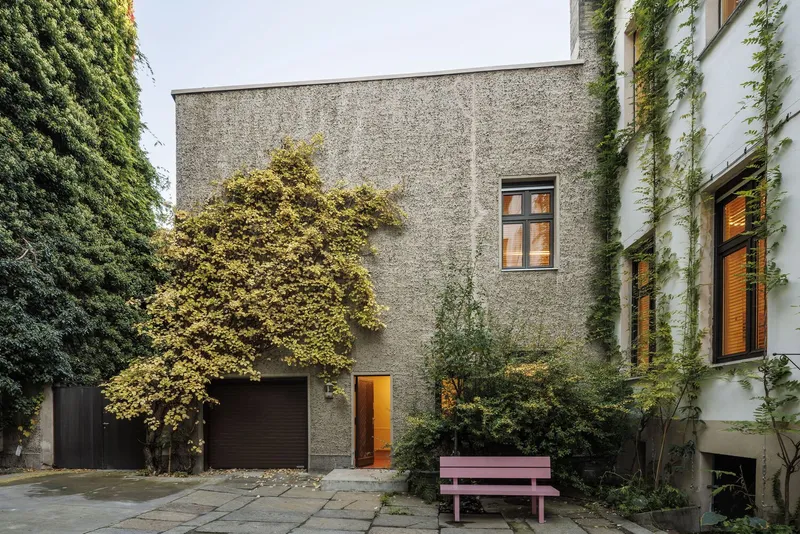
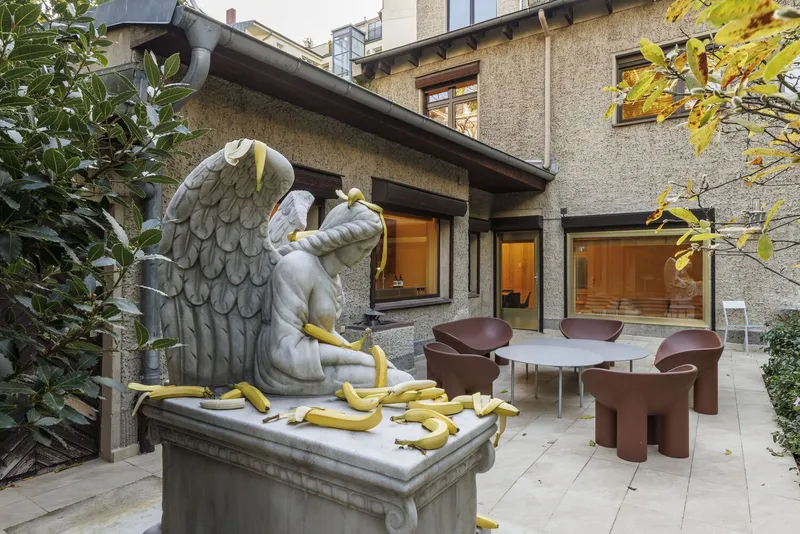
The exterior reads as something between a garden folly and a bunker. Textured concrete walls carry the patina of decades, their surfaces animated by climbing vines and the seasonal drift of autumn foliage. A pink bench parked beside the garage door and a bronze eagle sculpture on a pedestal inject deliberate absurdity, signaling that the occupants are not interested in blending in. These found objects and sculptural insertions populate the courtyard like characters in a play, transforming a utilitarian pass-through into a genuine outdoor room.
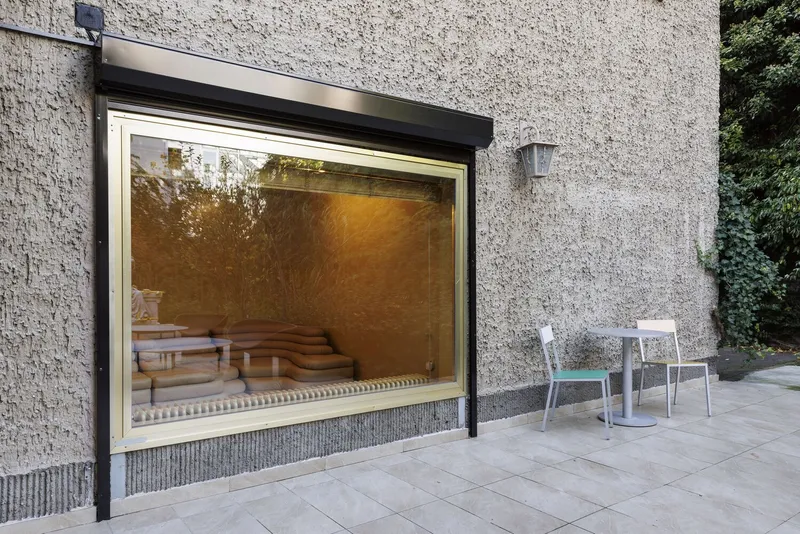
Large window openings punched into the concrete walls collapse the boundary between inside and out. From the paved terrace you look straight through to interior seating; from the dining table you watch light shift across the garden. The strategy is low-tech but effective: big voids, no curtains, and enough planting to filter the gaze of neighboring buildings.
The Orange Floor: A Unifying Surface
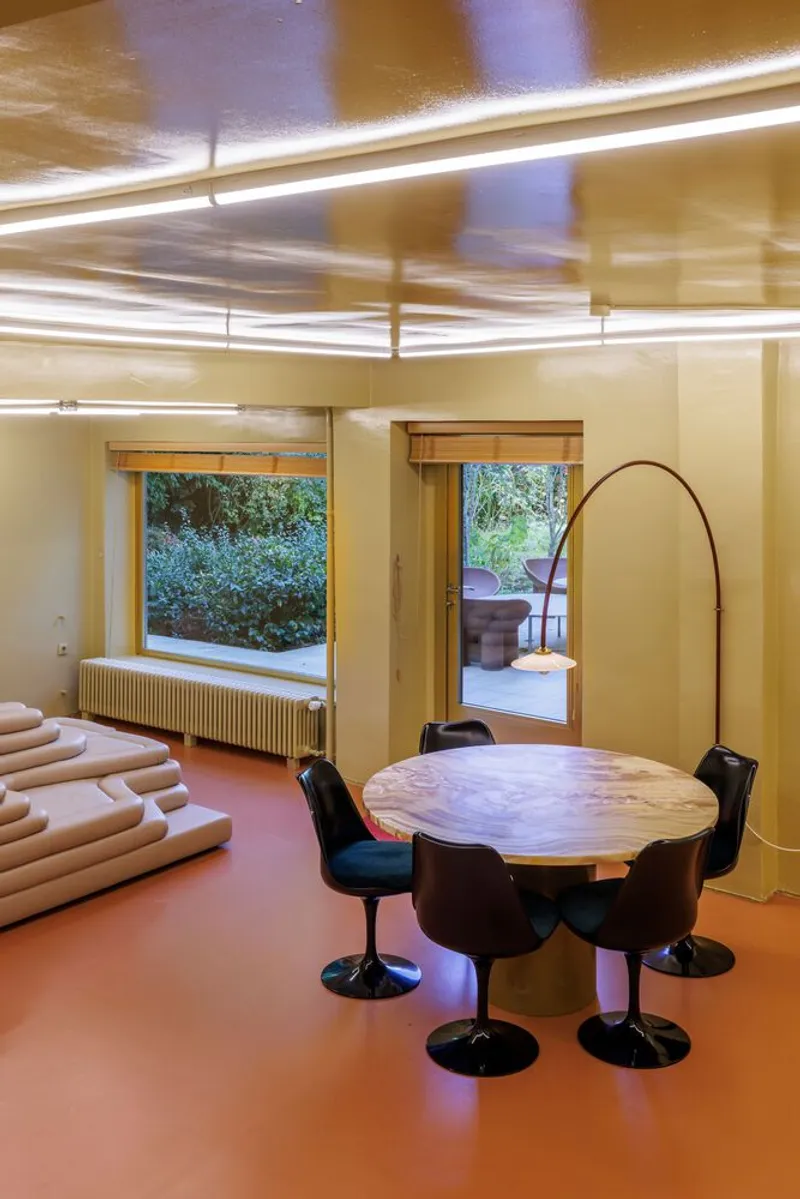
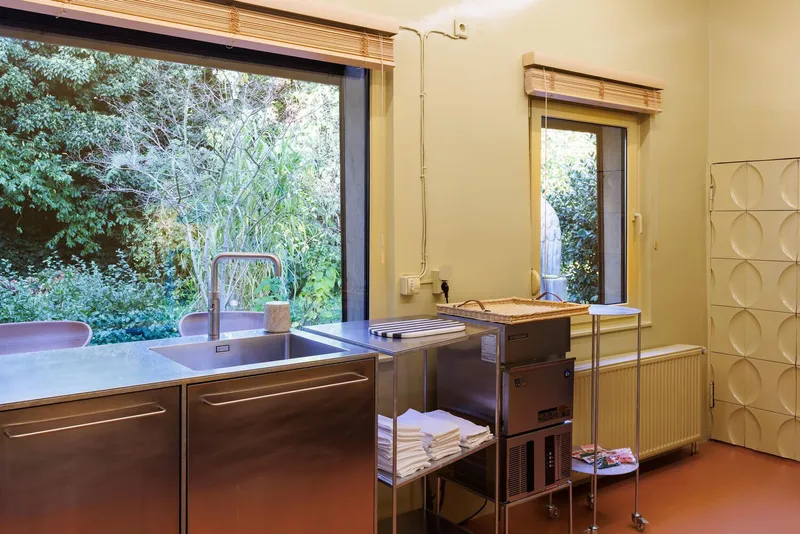
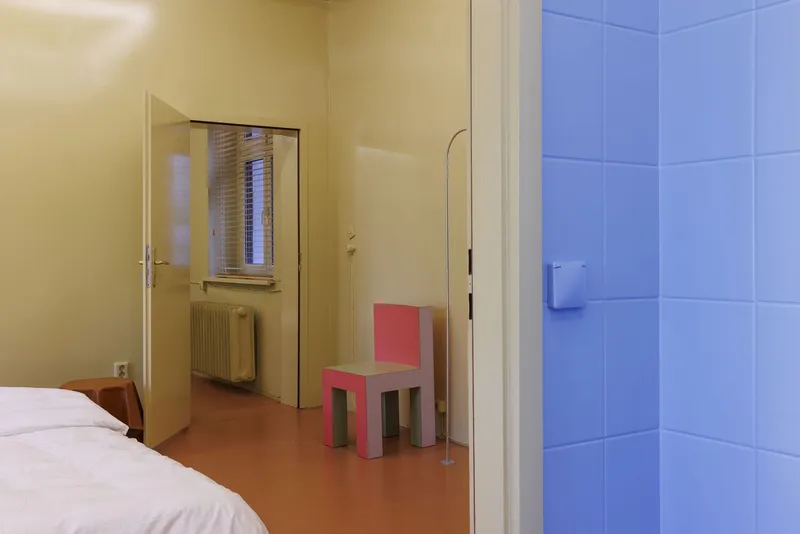
If one move defines the renovation, it is the orange resin floor that runs continuously through kitchens, bedrooms, dining areas, and circulation spaces. On paper this sounds aggressive. In practice, the warm amber tone absorbs the cream walls and timber accents, functioning less like a statement and more like a ground plane that gives the fragmented plan a shared datum. Every room, regardless of ceiling height or orientation, belongs to the same house.
The floor also does practical work. Resin is seamless, easy to clean, and tolerant of the kind of wear three children produce. In the kitchen it meets stainless steel counters and a garden view; in the bedroom it slides under glass partitions into a tiled bathroom. The material's slight sheen picks up natural light and amplifies it, which matters in a courtyard building where direct sun is not always guaranteed.
Split Levels and Staircases: Navigating the Patchwork
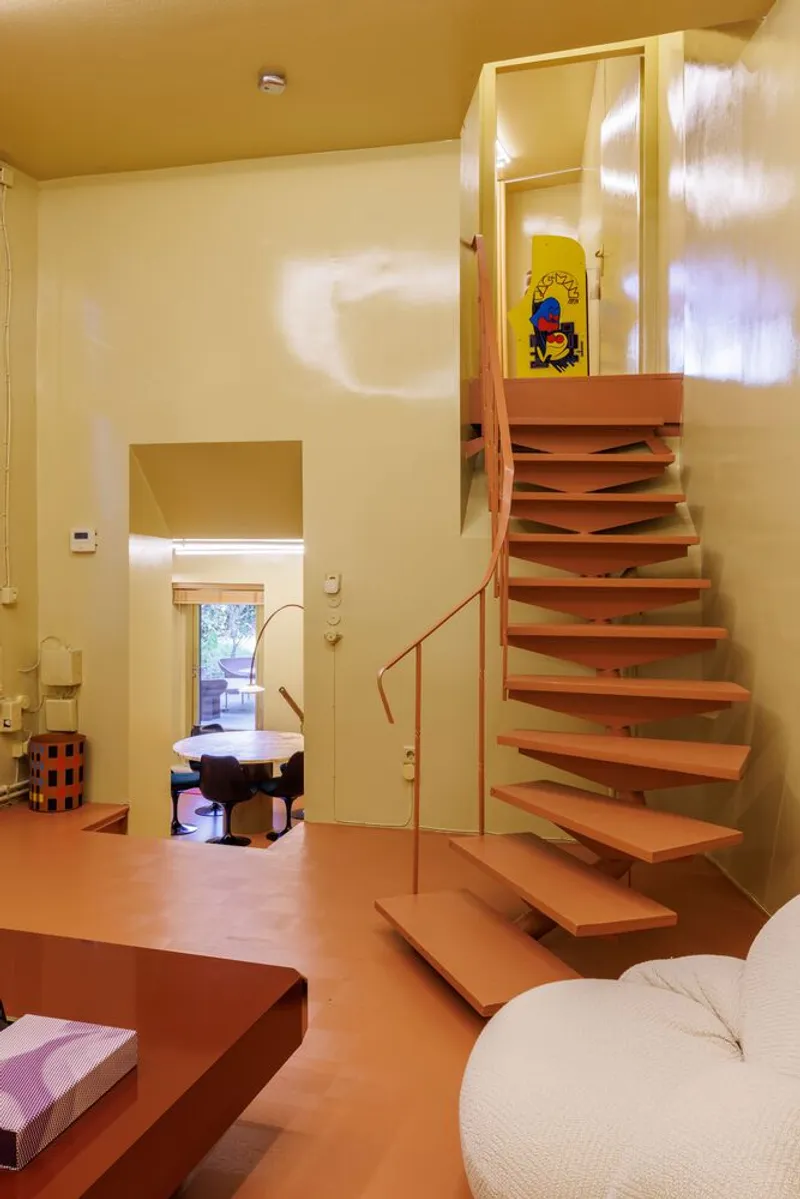
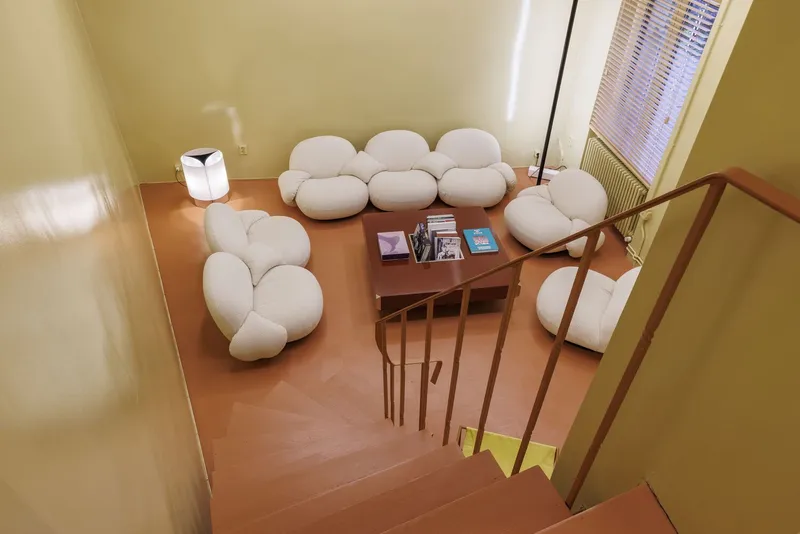
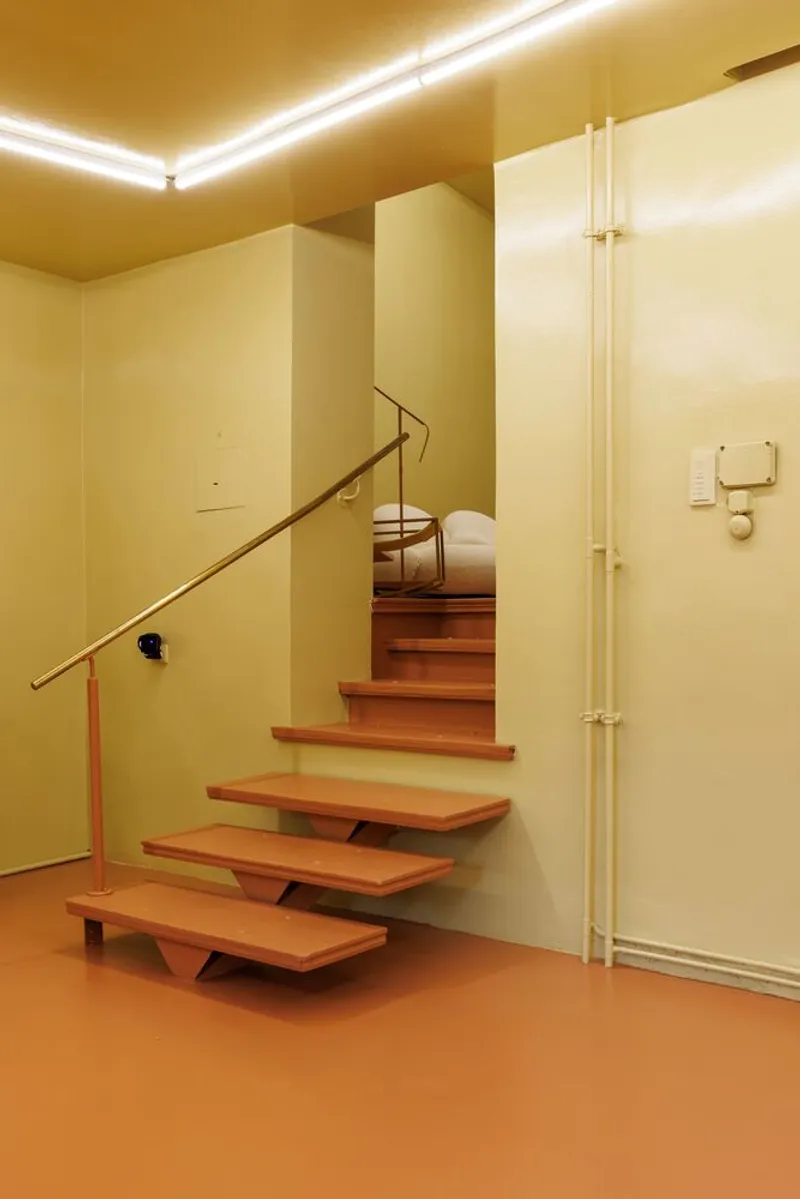
The postwar reconstruction created a building with no single consistent floor level. Rather than pouring new slabs to flatten everything out, the renovation celebrates the height differences. Open-tread staircases in orange-painted steel connect half-levels with a directness that turns vertical circulation into a spatial event. You are always ascending or descending slightly, peering over a railing into a lounge below or glancing up toward a landing above. The house never lets you forget its third dimension.
A cantilevered timber stair with a brass handrail occupies a quieter register, ascending through cream walls lit by recessed ceiling coves. The contrast between this stair and the exposed orange-steel version captures the project's tonal range: refined when it wants to be, blunt when that serves the moment better. Brass, timber, steel, and resin rotate through the palette without competing.
Living Spaces: Mid-Century Fragments in a Contemporary Frame
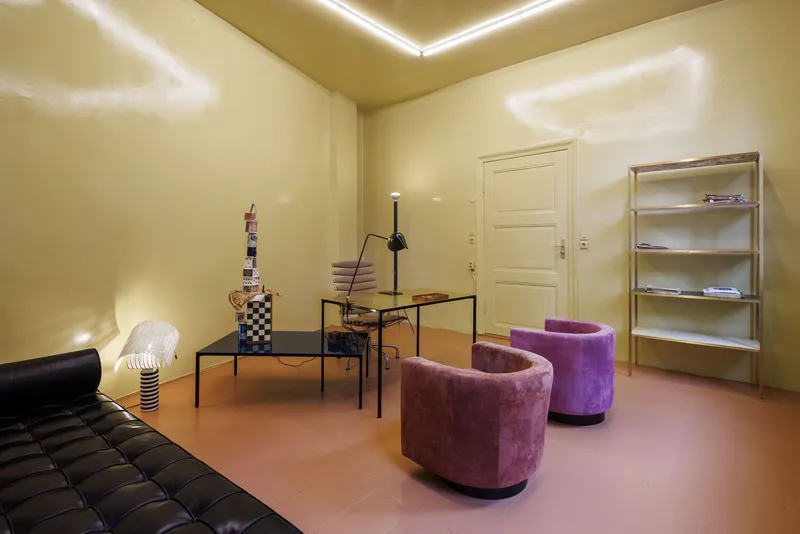
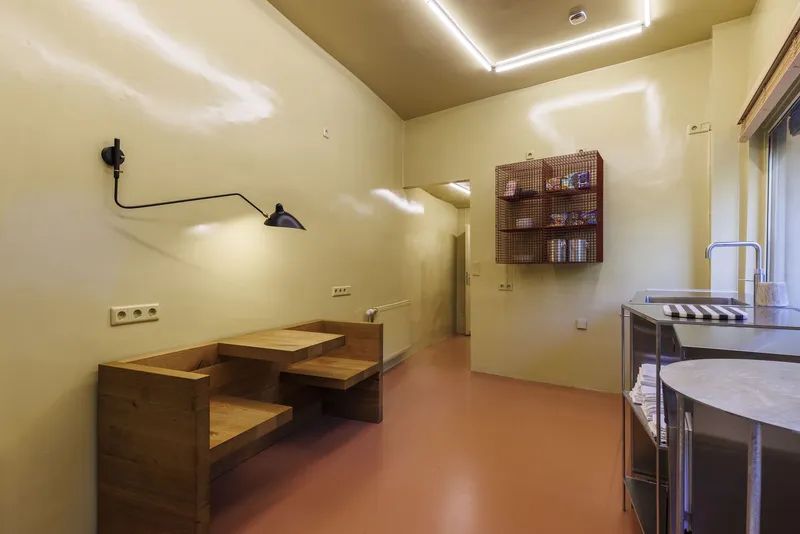
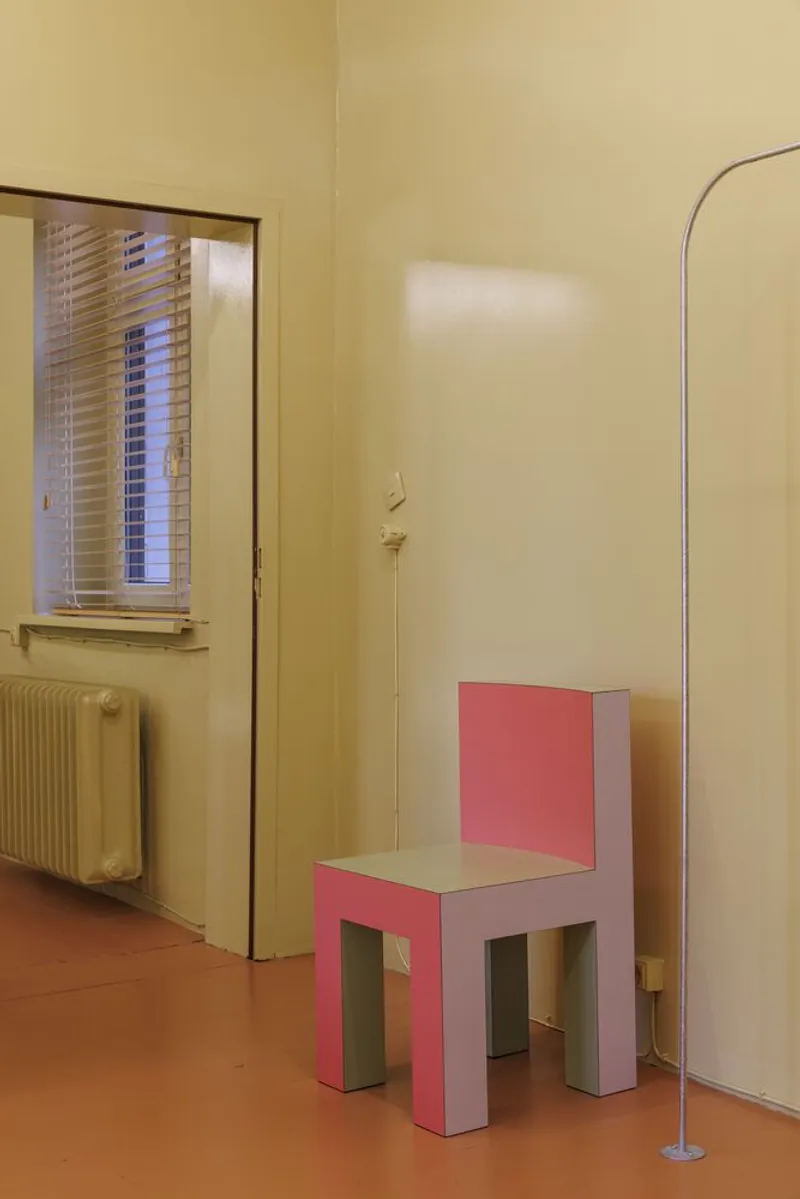
The interiors walk a fine line between nostalgia and discipline. Purple barrel chairs sit alongside open shelving and a black desk; a built-in timber banquette with an articulated wall lamp occupies a dining nook that could have existed in the 1970s original. A pink cubist chair against a pale yellow wall feels like a wink at the Memphis Group, yet the arched floor lamp beside it is more Scandinavian restraint. None of this is accidental. The monochrome color-block concept assigns each zone a limited tonal range, preventing the eclectic furniture from reading as clutter.
Preserved details anchor the rooms in history. Vintage tiles, original banisters, and mid-century light switches remain in place, lightly restored rather than replaced. These small artifacts accumulate into a texture you cannot replicate with new materials, and the renovation is smart enough to know that.
Furniture and Objects as Architecture
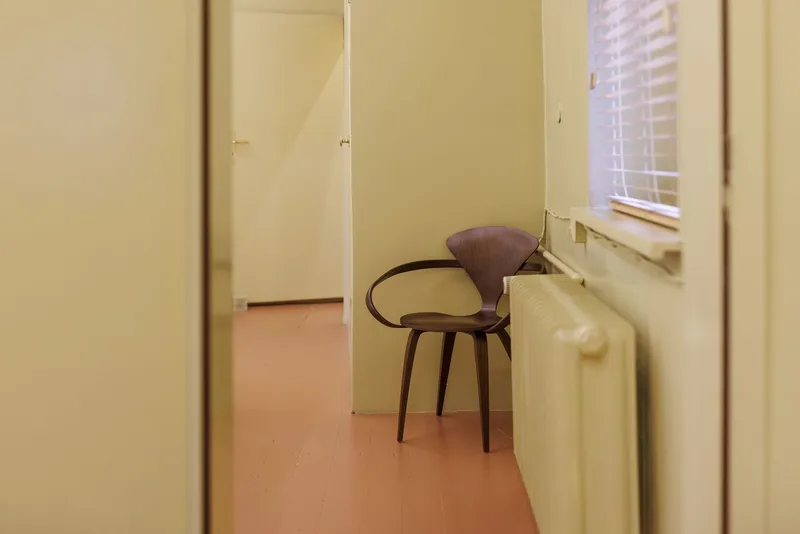
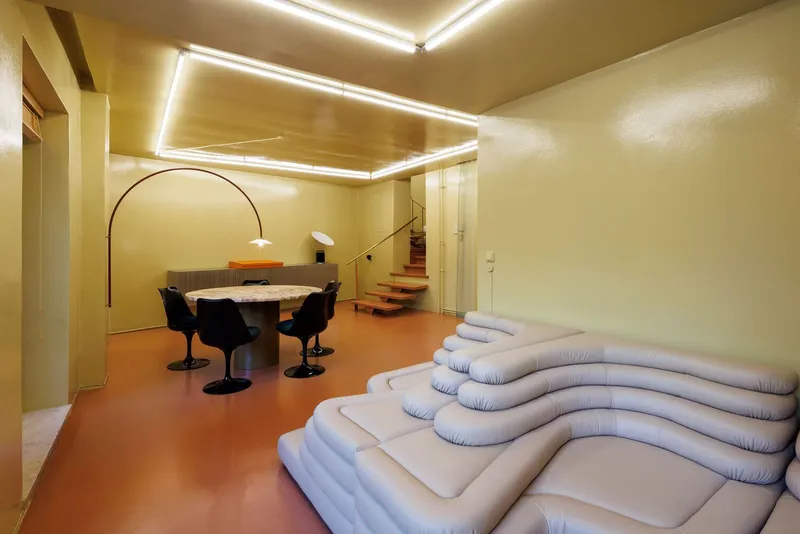
A wooden curved-back chair beside a radiator, venetian blinds filtering afternoon light: these are not decorating choices, they are spatial decisions. Throughout the house, furniture and found objects occupy the role that partition walls might serve in a more conventional renovation. Curved lounge seating defines the boundary of the living area; a timber side table marks a pause between stair and sofa. The approach recalls the postwar scarcity ethic that built the house in the first place, where every object had to justify its presence.
Recessed ceiling light panels and cove lighting run overhead, providing even illumination that avoids the pendant-fixture forest common in renovated Berlin apartments. The light quality is warm and diffuse, reinforcing the sense that the house is a single continuous environment rather than a collection of separate rooms.
Why This Project Matters
Berlin is full of buildings that were improvised back into existence after the war, structures whose irregularities are not design failures but records of survival. Most renovations iron those irregularities out. What J. Mayer H. demonstrates here is that you can introduce a strong contemporary identity, a continuous floor surface, a coherent color system, recessed lighting, without erasing the evidence of how a building got to where it is. The split levels stay. The salvaged doors stay. The foxes in the garden stay.
The project also offers a quiet argument for density. Hidden inside a city block, surrounded by party walls and neighboring rooflines, this house and its wild garden sustain a surprising level of domestic comfort and even biodiversity. It suggests that the most interesting sites for architecture are not empty lots but the overlooked, half-forgotten spaces that cities have already produced. The coach house was always there. It just needed someone willing to look at it closely enough.
Coach House and Garden Renovation by J. Mayer H. Architects, Berlin, Germany. Photography by Frank Sperling.
About the Studio
Share Your Own Work on uni.xyz
If projects like this are the kind of work you want to make, uni.xyz is a place to publish your own, find collaborators, and enter design competitions.




Popular Articles
Popular articles from the community


Riyadh For All: Intergenerational Urban Design for Active Aging in Rabat
Riyadh For All reimagines urban design in Rabat with intergenerational co-living, adaptive courtyards, and Moroccan cultural exchange today.

Conexión: Biophilic Design Reimagines High-Rise Living in Hong Kong
Conexión reimagines high-rise living in Hong Kong through biophilic design, green facades, shared spaces, daylight, water and nature within.

The Ocean Hive: Sustainable Architecture for a Self-Sufficient Civilization at Sea
The Ocean Hive imagines sustainable architecture at sea, where modular habitats, algae, wave power and ocean waste sustain a growing colony.

Lunar Spiral: Space Architecture Shaped by the Mathematics of the Universe
Lunar Spiral reimagines space architecture through Fibonacci geometry, lunar regolith, levitating habitats, and self-sustaining Moon living.

Similar Reads
You might also enjoy these articles


Hodi-Mandai Geram
Project Function: Preservation and revitalization of the Intangible heritage and socio-spatial identity of the Hodi by Housing, Cultural Memory Center, Sacred Grove, landscape, local tourism economy


Olio Towers: A Mid-Rise for Performers That Fuses Housing, Rehearsal, and Stage
Located blocks from Houston's Theater District, this modular tower stacks living units around a central performance atrium.

Oasis: Modular Green Housing Carved into Dhaka's Urban Fabric
A shortlisted Plugin Housing entry reclaims unauthorized settlements in Dhaka with stepped concrete volumes, green roofs, and ventilation-driven design.

Black Hole: A Floating Megastructure for the Post-Physical Era
Emiliano Mazzarotto envisions a spherical, self-scaling arena where e-sports, digital hotels, and holographic stadiums replace traditional public space.


Explore B19 Architekten Bda – Weimar Competitions
Discover active competitions in this discipline



Challenge to reimagine the Iron Throne


Photograph architecture without architects


Illustrate the lost glory of Angkor Wat - Render Challenge


Design challenge to reuse E-waste
Comments (0)
Please login or sign up to add comments
No comments yet. Be the first to comment!