
Common Woods: Housing That Lives Inside a Forest
Space&Matter's circular housing cluster in Amersfoort dissolves the boundary between neighborhood and nature with radical material honesty.


There is a particular tension in building housing at the edge of a forest. The forest is already complete. It doesn't need you. The question is whether you can insert domestic life without turning trees into scenery, without reducing a functioning ecosystem to a backdrop for real estate photography. At Nimmerdor in Amersfoort, Space&Matter has attempted something genuinely difficult: a 10,850 square meter residential cluster that treats the surrounding woodland not as a amenity to be consumed but as a co-inhabitant to be accommodated.
Common Woods, completed in 2026, is a collection of low-rise volumes threaded through the existing tree canopy. The buildings are compact, flat-roofed, and clad in a rotating palette of corrugated metal, ribbed panels, and timber. What makes the project worth serious attention is not any single formal gesture but the accumulation of decisions: the way circulation paths double as ecological corridors, the way cladding materials weather at different rates to match the forest's own tonal shifts, and the way interior finishes are left deliberately raw. It reads less like a finished product and more like an opening move in a longer conversation with the site.
A Cluster, Not a Block

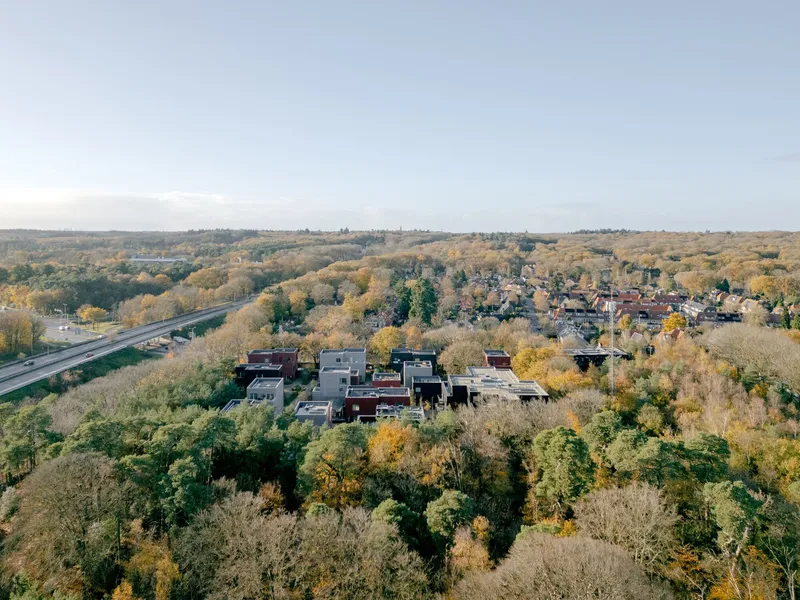
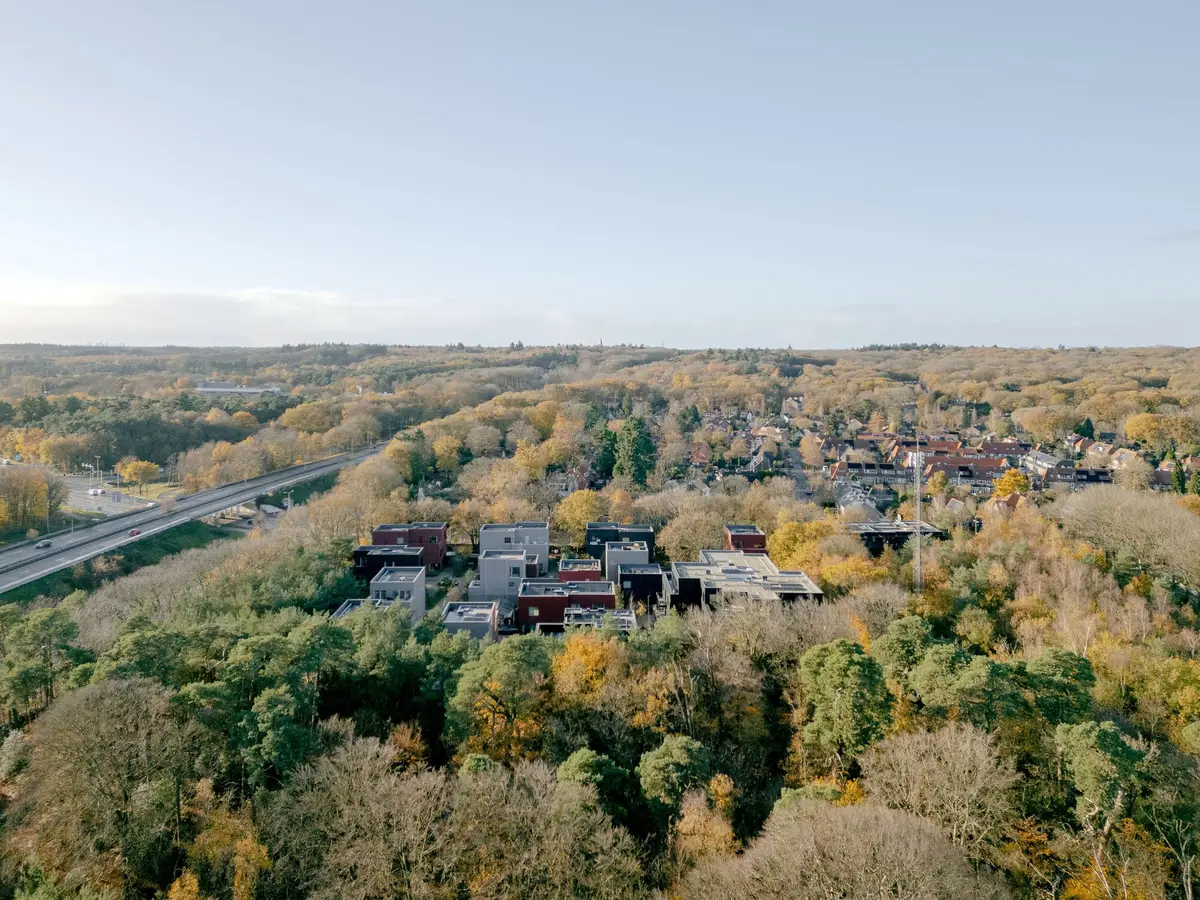
From above, the logic is immediately legible. Common Woods is not organized as a street or a perimeter block. It is a cluster of discrete volumes, rotated and offset so that no two facades share the same orientation. The result is a series of interstitial spaces, some intimate, some generous, that flow between buildings the way clearings open and close in a forest. This is not a casual metaphor. The site plan directly references the irregular spacing of tree stands, and the aerial views confirm that the buildings sit within the canopy rather than displacing it.
The flat roofs keep the profiles low, never competing with the treeline. From the nearby highway, you can barely distinguish the settlement from the surrounding woodland. That kind of visual modesty is rare in Dutch housing, where developers tend to announce their presence with tall volumes and signage. Here, the ambition is the opposite: to be absorbed.
Material Palette as Camouflage
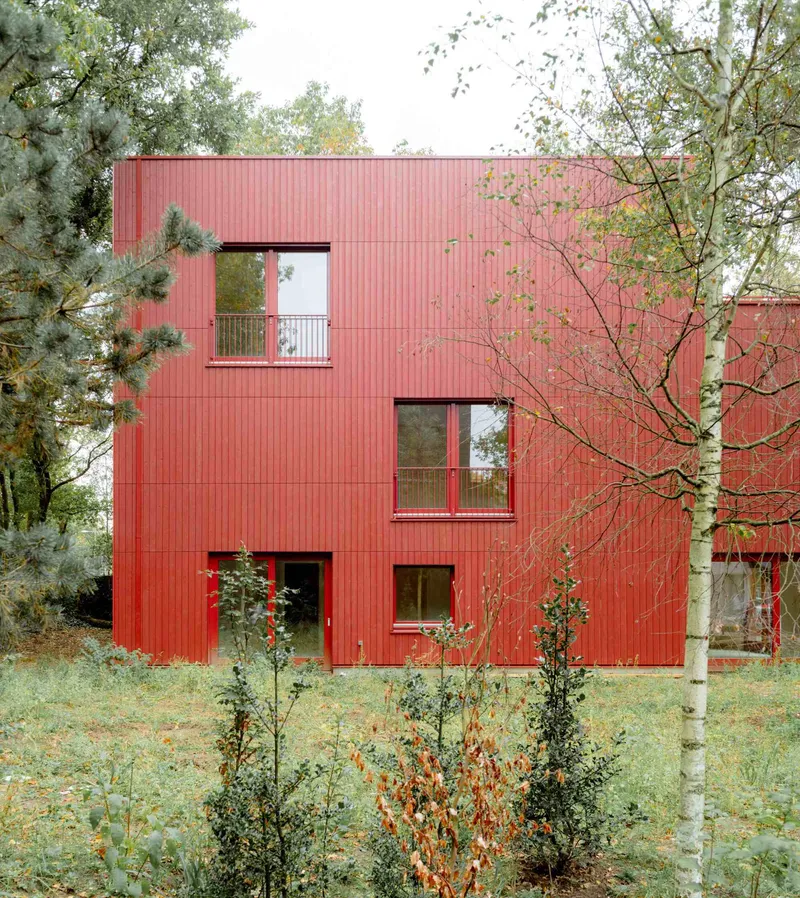
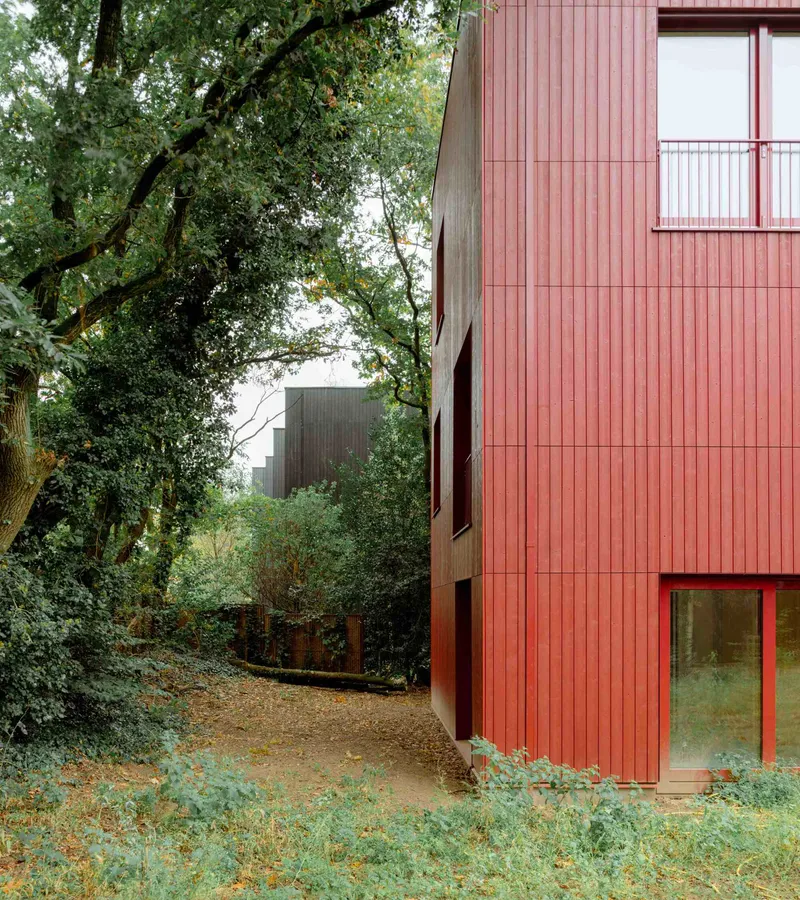
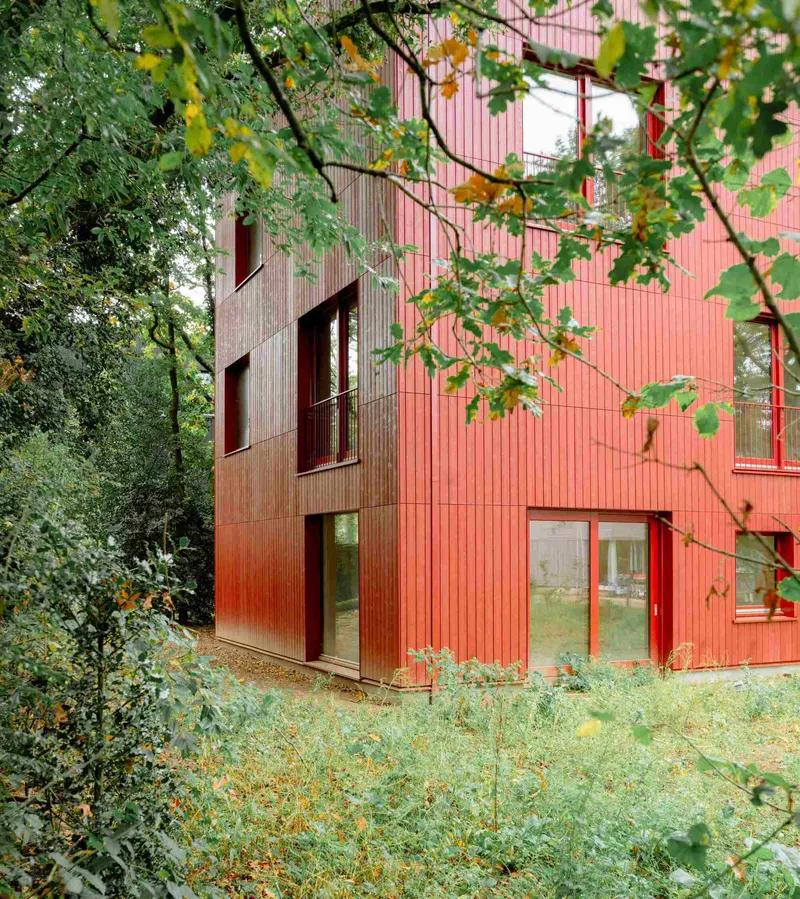
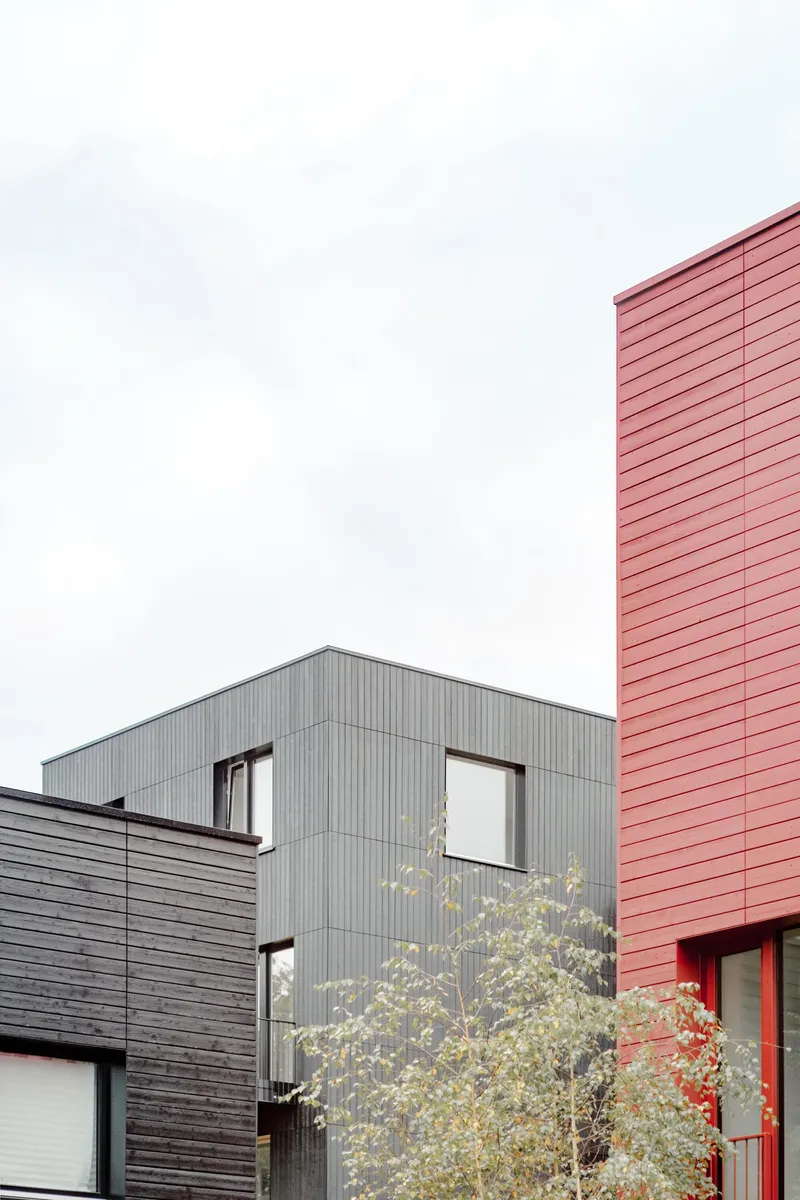
The cladding strategy deserves close reading. Space&Matter deploys at least four distinct facade treatments across the cluster: grey horizontal timber, dark vertical timber, red and pink ribbed panels, and corrugated metal in several tones. Rather than creating visual chaos, this variety mimics the heterogeneity of a natural landscape. A birch trunk, an oak canopy, a patch of dead leaves, and a granite boulder all coexist without matching. The buildings operate the same way.
The pink ribbed facades are the most surprising, almost playful against the autumn foliage. Paired with red-framed windows, they introduce a warmth that reads as autumnal rather than artificial. The corrugated metal volumes, by contrast, recede into grey sky and bare branches. Over time, as the timber greys and the metal weathers, these distinctions will soften further. The project is designed to age, not to be maintained in a state of factory-fresh perfection.
Courtyards as Commons
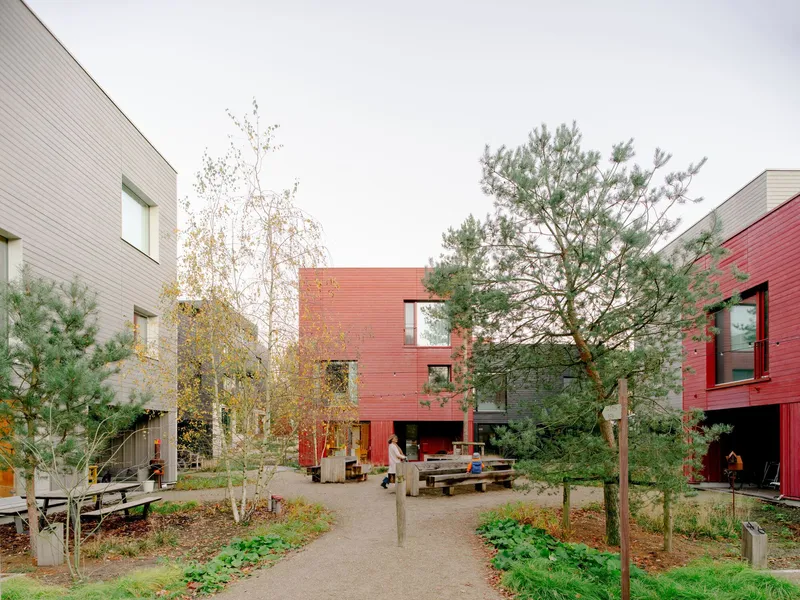
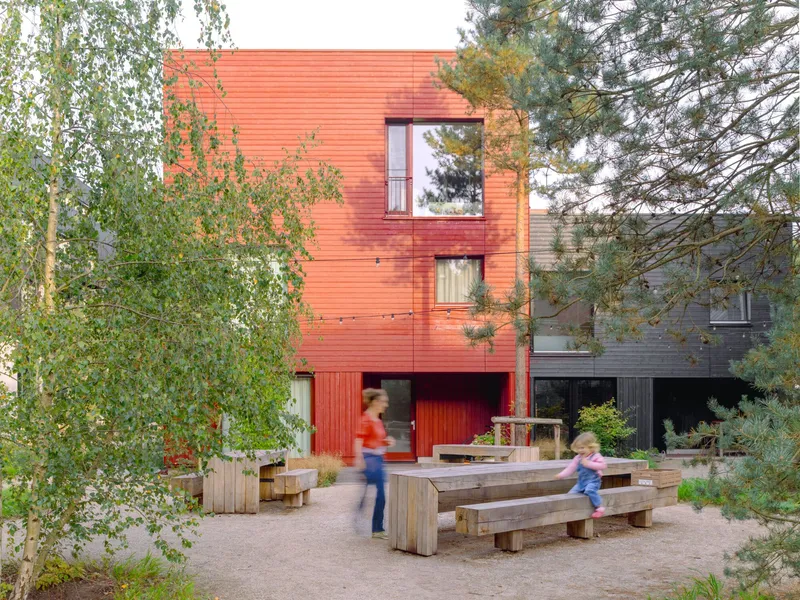

The shared outdoor spaces are where the project's social proposition becomes tangible. Brick-paved paths wind between planted beds, timber seating platforms, and young trees. The courtyards are clearly communal, not residual. They have been designed with the same care as the interiors, with specific materials and planting choices that suggest a landscape architecture practice was deeply involved from the start.
What works particularly well is the scale. These are not grand public plazas. They are pocket-sized outdoor rooms, scaled for a handful of neighbors rather than a crowd. A person walking through one of the courtyard paths feels enclosed but not trapped, observed but not surveilled. The combination of young trees, varied cladding, and low building heights creates a sense of shelter without claustrophobia.
Forest Edge and Street Face
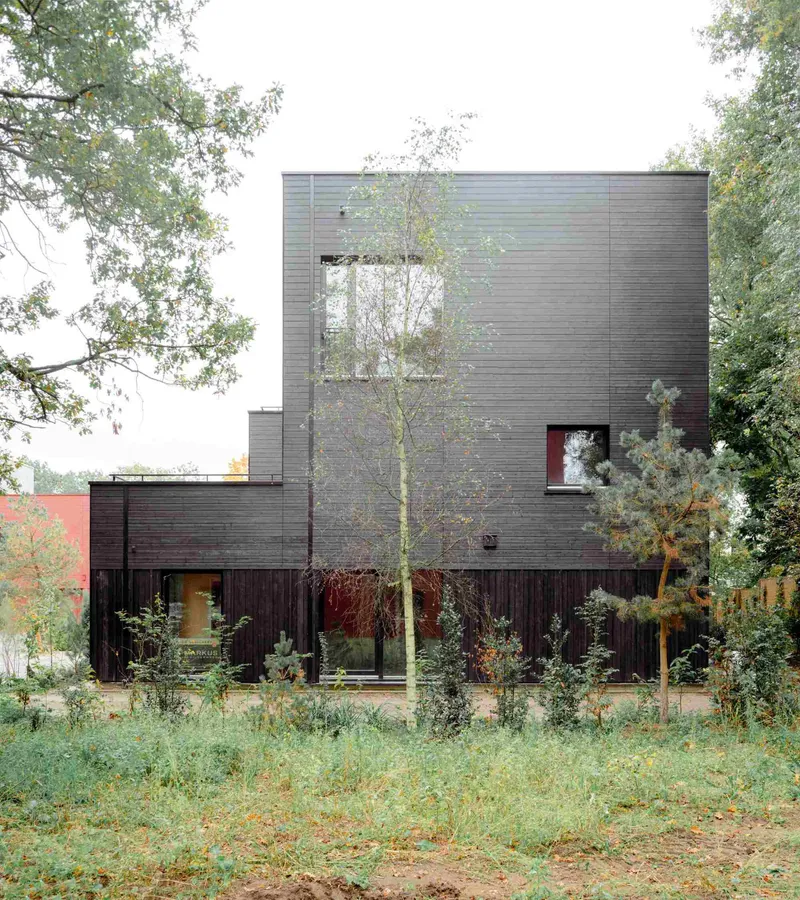
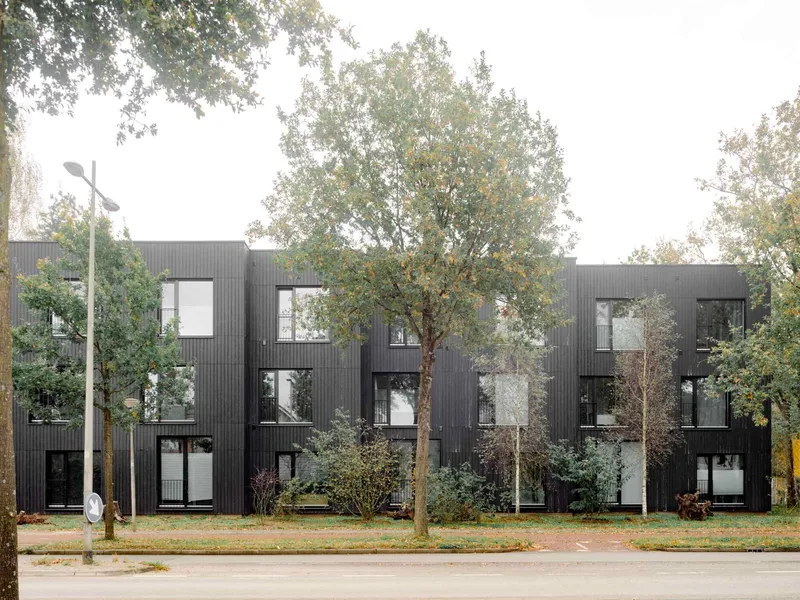
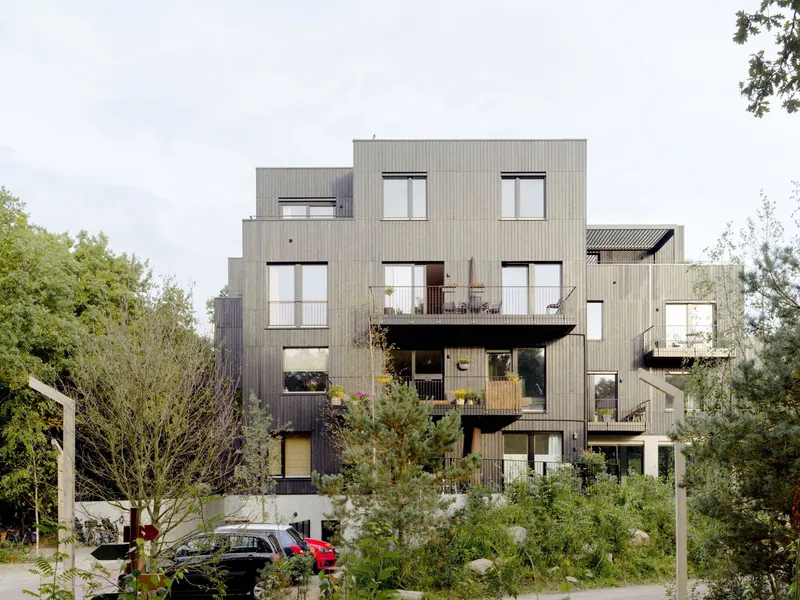
The street-facing facades tell a different story from the forest-facing ones. From the road, the buildings present a composed, almost reticent face: punched windows, minimal ornament, muted color. The grey horizontal timber of image_0 sits above a dark wood base with wildflowers in the foreground, a deliberate layering that softens the building's footprint at ground level. The dark vertical timber in image_2 is even more restrained, almost disappearing behind roadside trees.
The staggered facades and projecting balconies on the landscaped side are more assertive, more varied. This is where residents engage with the outdoors, where private life opens up to the forest. The asymmetry between public restraint and private expressiveness feels intentional and mature. Too many housing projects try to be everything on every side. Common Woods is selective about where it performs.
The Unfinished Interior

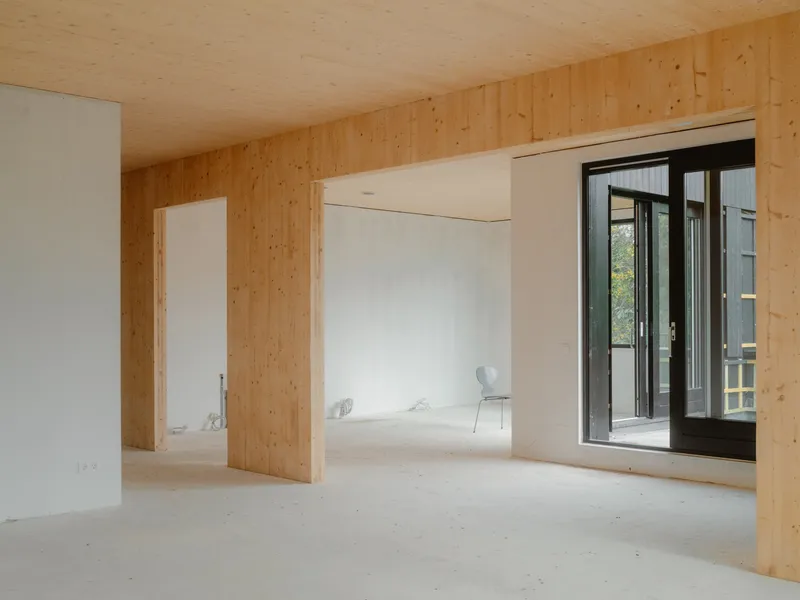
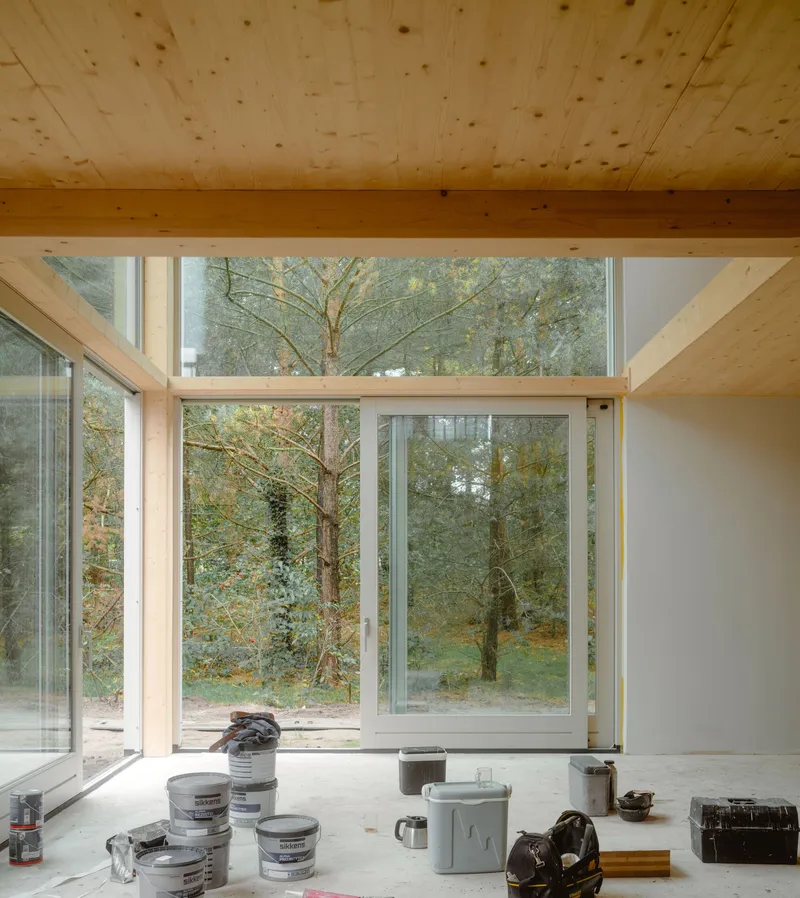
Inside, the approach is one of deliberate restraint. Exposed plywood walls and ceilings dominate. There is no plasterboard, no paint (yet), no decorative molding. The material is the finish. This is a circular construction strategy: plywood is renewable, recyclable, and legible. You can see what the building is made of, which is increasingly rare in residential architecture where layers of gypsum and acrylic latex conspire to hide every structural truth.
The large timber-framed windows are generous, pulling autumn light and tree shadows deep into the rooms. The effect is warm without being precious. Paint buckets visible on the floor in one shot suggest these images were captured just before or during move-in, which only reinforces the point: these spaces are designed to be completed by their inhabitants, not delivered as a sealed package.
Living Among Trees
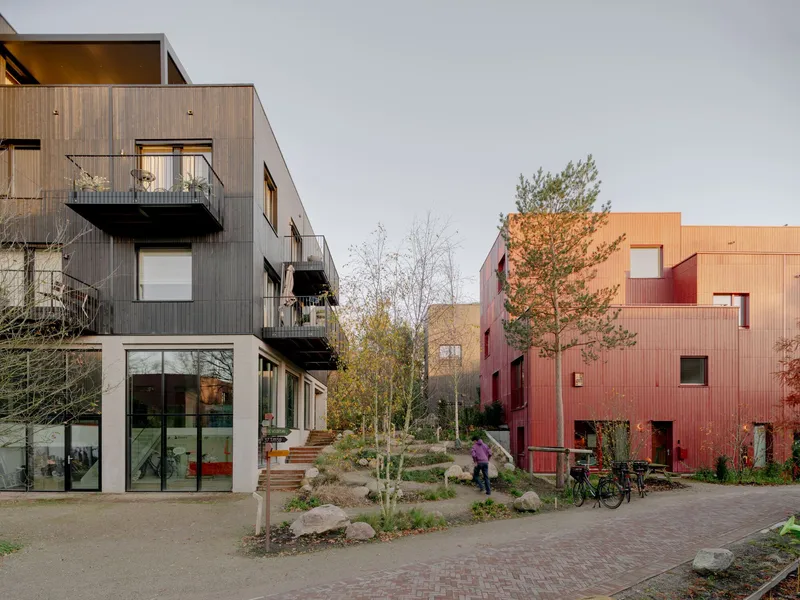


The relationship between building and vegetation is the project's most compelling quality. Views through wooded yards reveal glazed corners and timber facades of neighboring units filtered through layers of foliage. The young trees planted in the courtyards will eventually close the gap between the settlement and the surrounding forest, creating a continuous canopy overhead. In twenty years, the distinction between what was planted and what was preserved will be invisible.
This is nature-inclusive design taken seriously, not as a marketing label but as a spatial strategy. The buildings don't merely sit next to trees. They are organized around them, deforming their plans and shifting their volumes to preserve root zones and sight lines. The result is a housing development that feels inhabited rather than imposed.
Plans and Drawings

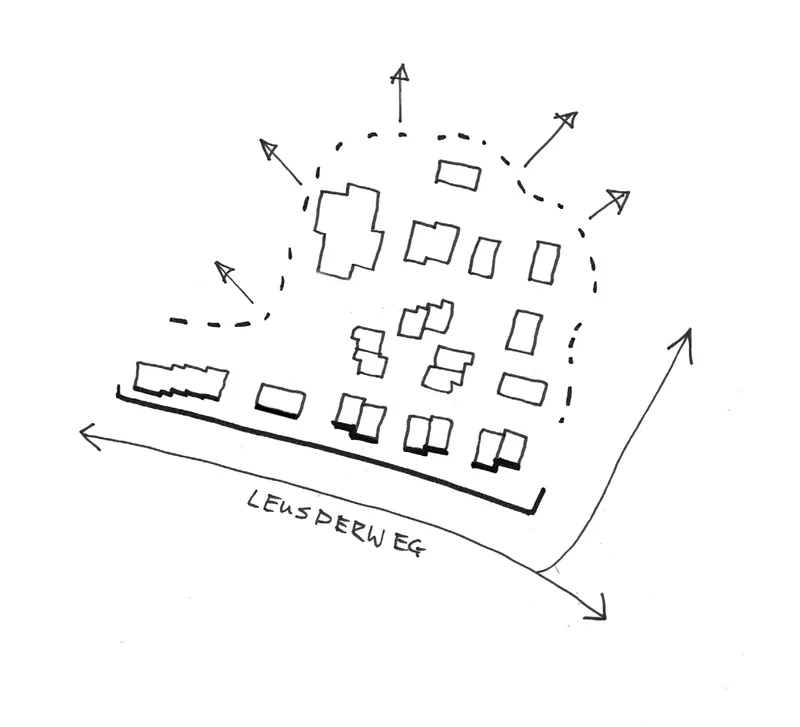
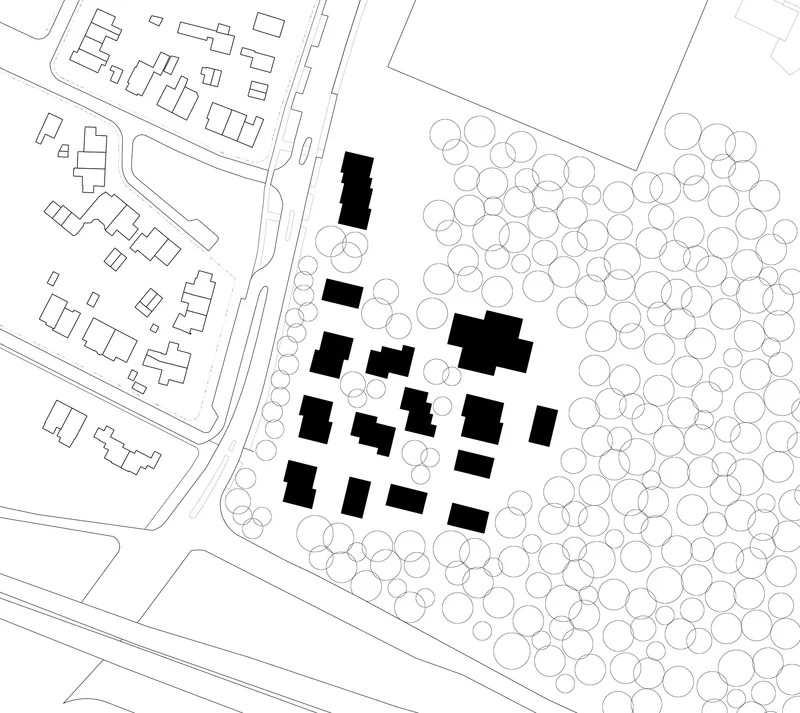
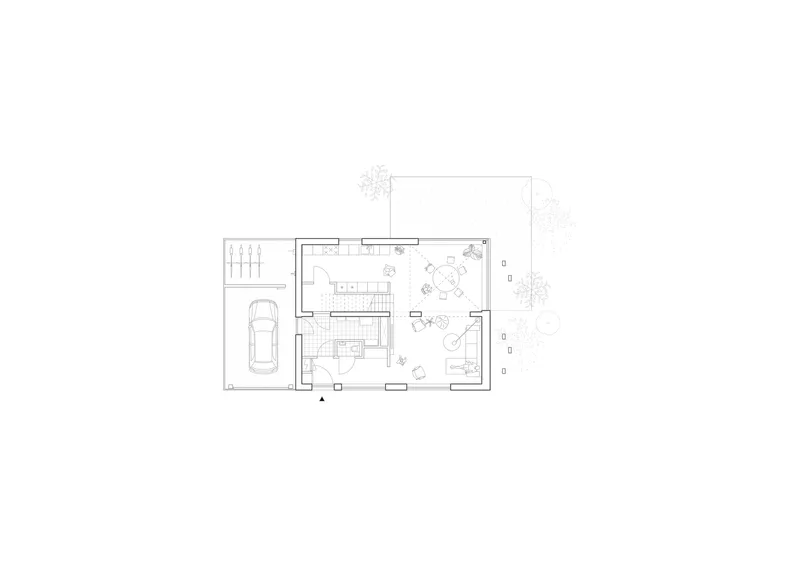

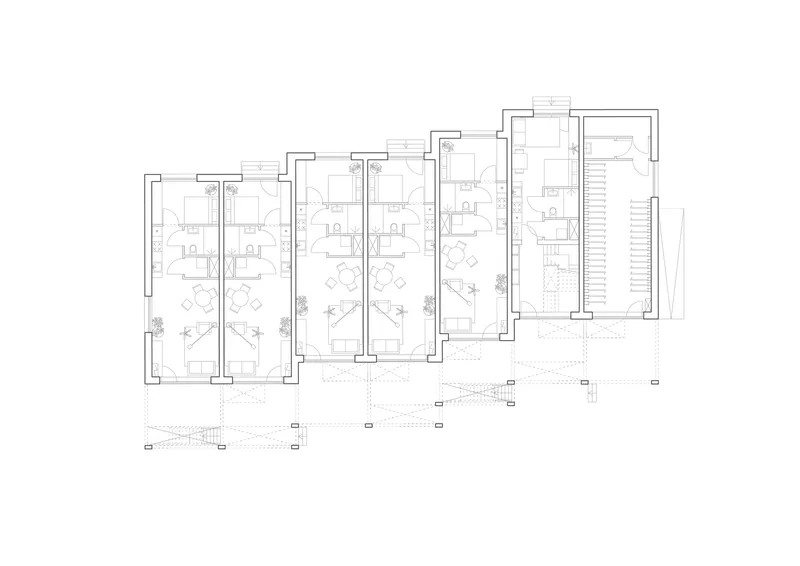
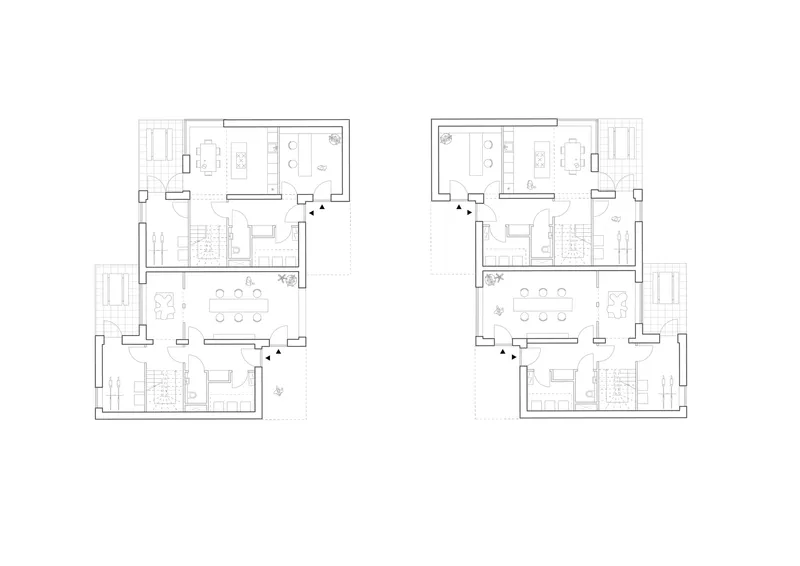
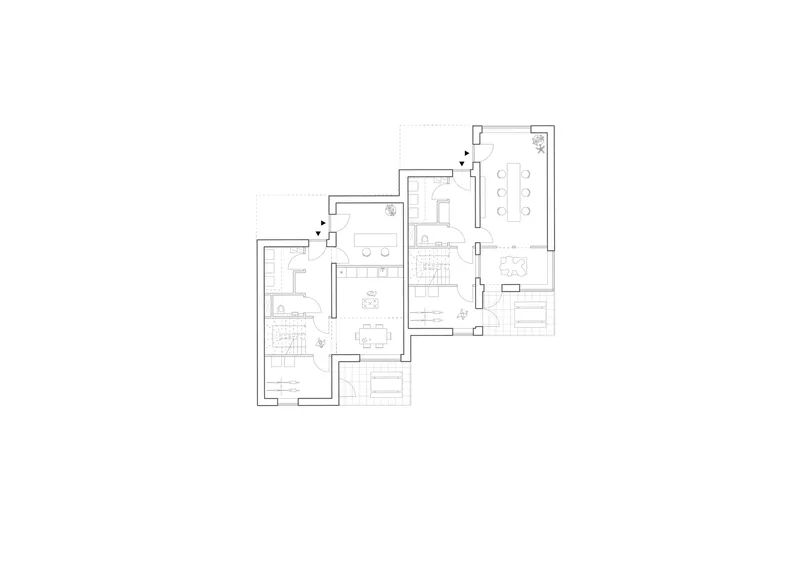
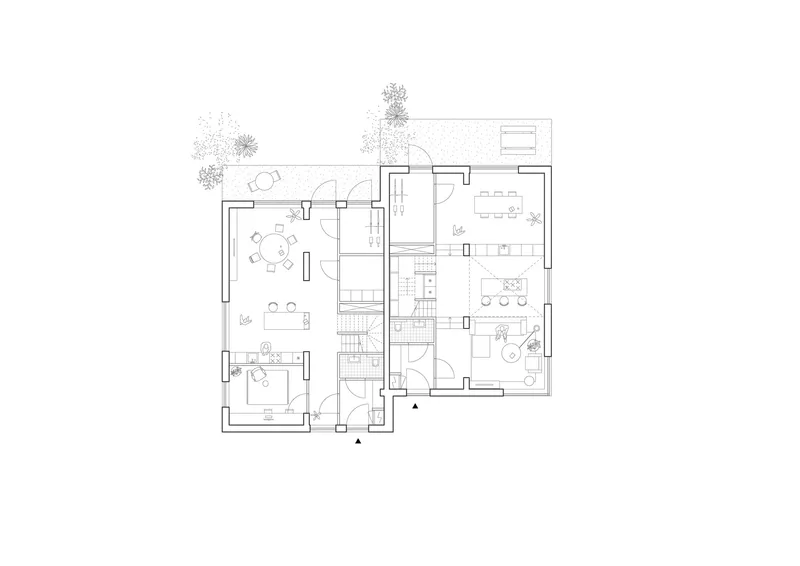
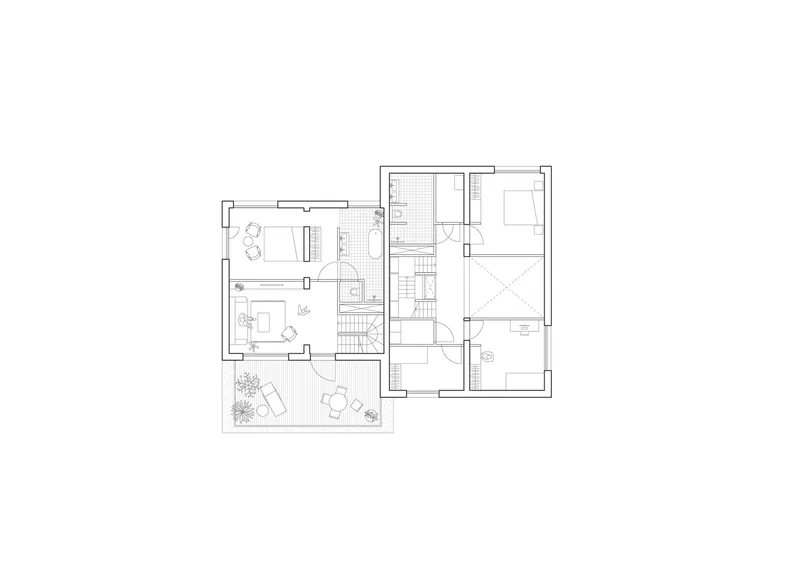


The drawings reveal the precision behind the apparent informality. The site plan shows how carefully the building footprints are calibrated to preserve existing trees and create meaningful gaps between volumes. Circulation diagrams indicate that wind patterns and pedestrian desire lines were studied early, shaping the orientation of each cluster. The concept sketch with arrows reads almost like a weather map, translating environmental forces into architectural form.
At the unit scale, the floor plans show compact, efficient layouts with central staircases, open living spaces at ground level, and bedroom suites above. Balconies and terraces are positioned to engage with the courtyard or the forest, depending on the unit's location in the cluster. Several plans show mirrored pairs or stepped triplets, suggesting a modular logic that allowed for repetition without monotony. The planted elements drawn into the plans, potted trees on terraces, small gardens at entrances, reinforce the idea that nature is not external to the architecture but woven into it at every scale.
Why This Project Matters
Common Woods matters because it demonstrates that density and ecological sensitivity are not opposing forces. The Netherlands, one of the most densely populated countries in Europe, faces relentless pressure to build housing. The standard response is to consolidate, to stack units higher and fill plots edge to edge. Space&Matter has shown that a scattered cluster embedded in a forest can achieve meaningful density while preserving the very thing that makes the site worth living on. The approach requires more design effort, more negotiation with existing conditions, and more willingness to let go of the clean rectangle. But the payoff is a neighborhood that feels genuinely alive.
The project also makes a quiet argument for material honesty in housing. Plywood interiors, weathering facades, and circular construction principles are not new ideas, but they remain uncommon in market-rate residential work. Common Woods puts them into practice at a scale that proves they are viable, not as luxury gestures or experimental pavilions but as the default condition for everyday domestic life. If this is the standard for Dutch forest-edge housing going forward, the country's expanding suburbs will be better places for it.
Common Woods by Space&Matter, Amersfoort, The Netherlands. Completed 2026. 10,850 m². Photography by Riccardo De Vecchi.
About the Studio
Share Your Own Work on uni.xyz
If projects like this are the kind of work you want to make, uni.xyz is a place to publish your own, find collaborators, and enter design competitions.


Popular Articles
Popular articles from the community


David Ortega Stacks a Two-Story Mexico City Penthouse Around a Steel Stair and a Pergola-Shaded Roof Terrace
In Colonia Roma, a 300 m² penthouse uses oak joinery, a planted steel stair and a slatted roof pergola to make a new-build apartment feel like a house.


Manzana Morphosis: Stretching Barcelona's Grid into a Living Landscape for 2050
A radical reworking of the Eixample manzana turns density into a tool for generous public space, vertical ecology, and environmental performance.

Singing Woman: An Opera House That Performs Before the Curtain Rises
Ovidiu Cristian Pavel's conceptual opera house translates Estonia's choral identity into a sculpted waterfront landmark facing the Baltic Sea.

Aquadapt: An Underwater Habitat That Rewrites Its Rooms by the Hour
Curved modules ring the seabed while one shell shifts from breakfast room to cinema, farm and football pitch as residents' needs change.

Similar Reads
You might also enjoy these articles

LAVA Architecten Gives Vocational Education a Sawtooth-Roofed Face on a Mechelen School Campus
In Mechelen, Belgium, a 2,053 m² STEM school on a 6×6 m grid turns workshops and classrooms into rooms that can be rearranged as teaching changes.

KEMA Studio Turns a Derelict Marvila Attic into a 60 m² Lighthouse Apartment Above Lisbon
In Lisbon's Marvila district, a rebuilt roof, four skylights and two plywood volumes turn an unlivable attic into a bright home facing the Tagus.

Pixel Gardens: One Repeated Module Stacked Into a Terraced Social Housing Tower for Famagusta
Salem Bader's shortlisted housing tower builds a vertical neighbourhood from one repeated module, offsetting units to carve terraces, light and air.

Bao Huynh Watercolor Atelier: A Serene Art Retreat in Hội An
Bao Huynh Watercolor Atelier in Hội An blends multifunctional art spaces, sustainable design, local materials, and family-friendly living in a serene environment.

Explore Co-Housing Competitions
Discover active competitions in this discipline

Challenge to reimagine the Iron Throne

Photograph architecture without architects

Illustrate the lost glory of Angkor Wat - Render Challenge

Design challenge to reuse E-waste
Comments (0)
Please login or sign up to add comments
No comments yet. Be the first to comment!