

Compartment S4 Builds a Himalayan Market Plaza Where Local Craft Is the Architecture
A 250-square-meter timber and stone plaza on the Champawat highway gives self-help groups a place to make, sell, and teach regional crafts.


The standard playbook for promoting local craft through architecture goes something like this: build a clean white gallery, hang some baskets on the wall, and call it cultural preservation. Compartment S4 has done something fundamentally different in Champawat, a small Himalayan town along the Champawat–Pithoragarh highway where youth migration and unplanned concrete growth have been steadily eroding both public space and traditional livelihoods. Their 250-square-meter market plaza does not exhibit craft. It is made of it. Bamboo weaving, Likhai woodwork, stone carving, and Aipan painting are not decorative afterthoughts but the literal substance of the building's walls, screens, and surfaces.
Commissioned by the Kumaon Mandal Vikas Nigam and the District Tourism Office of Champawat, the project refuses the separation between production and display that defines most craft markets. Self-help groups can weave bamboo panels for the building's facade in the same spaces where they sell finished goods and teach techniques to visitors. The plaza is civic infrastructure in the truest sense: not a monument to community, but a working framework that earns its keep every day.
Reading the Town Before Building In It

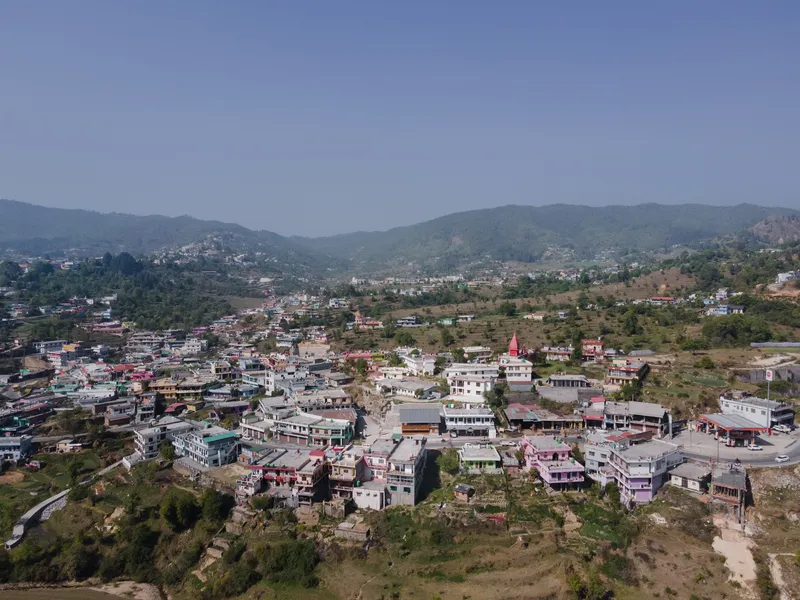

Champawat sits on a series of steep ridges where winding roads thread between agricultural terraces and clustered houses. Concrete has become the default material, but older timber and stone buildings still punctuate the hillside, their pitched roofs and hand-carved details offering a material vocabulary that the town is slowly forgetting. A red temple tower anchors the skyline, a reminder of a built culture that once had its own logic.
Compartment S4 clearly read the town before intervening. Rather than importing an alien aesthetic, they extracted a structural language already present in Champawat's surviving traditional houses: load-bearing stone bases, timber-framed upper levels, pitched metal roofs. The difference is that where most new construction in town has abandoned those methods, the market plaza doubles down on them, making a case for their relevance by demonstrating their performance.
A Stone Base, a Timber Frame, and Everything Between
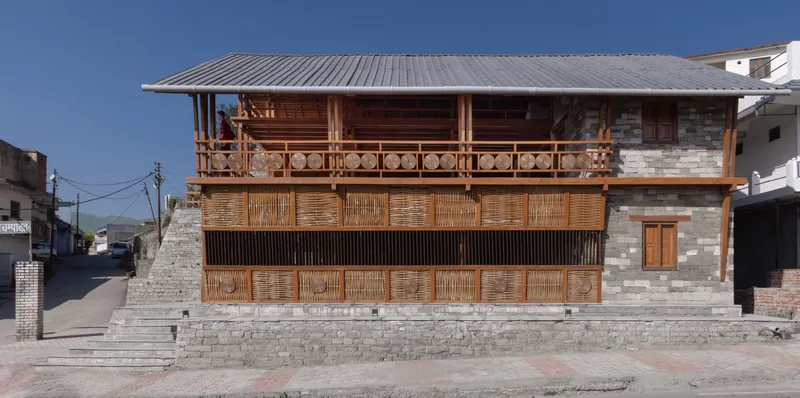

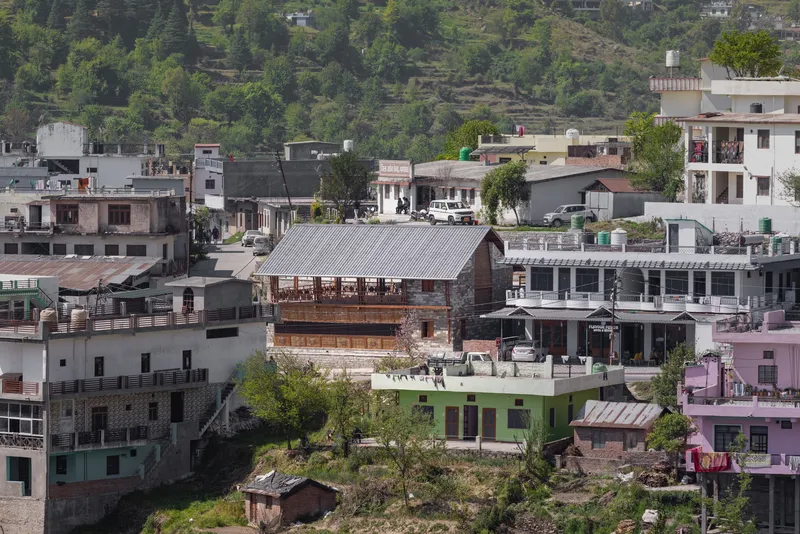
The building's section is easy to describe: a heavy stone plinth meets a lighter timber frame above, capped by a corrugated metal gable. It is a construction logic shared with the best surviving houses in the region, and it makes seismic sense. Stone handles compression and grounds the structure to the hillside. Timber absorbs lateral forces. The metal roof sheds monsoon water without the maintenance burden of thatch. Nothing about this assembly is sentimental; it is the most rational way to build on a steep Himalayan site with locally available materials.
What elevates the project beyond pragmatism is the infill. The bays between timber posts are filled with woven bamboo screen panels, each one a piece of craft produced by the same self-help groups who will use the building. These panels are not cladding applied over a finished structure. They are the enclosure itself, filtering light, providing ventilation, and defining the boundary between inside and outside with a softness that solid walls could never achieve.
The Screens as Living Surface


Look closely at the woven bamboo panels and the carved wooden medallions set among them. These are not mass-produced components. Each screen has a slightly different weave density and pattern, a natural consequence of being handmade. Circular carved motifs punctuate the facade at irregular intervals, their geometric precision contrasting with the organic texture of the bamboo. At twilight the whole facade glows from within, the woven surfaces transforming from solid planes into luminous membranes.
The critical insight here is replaceability. Bamboo panels wear out. They can also be re-woven, upgraded, or repatterned without altering the structural frame. The building's skin is designed to be maintained by the same community that made it, which means the architecture never reaches a fixed "finished" state. It remains, in a real sense, a craft in progress.
Interior: Shadow, Stone, and Occupation
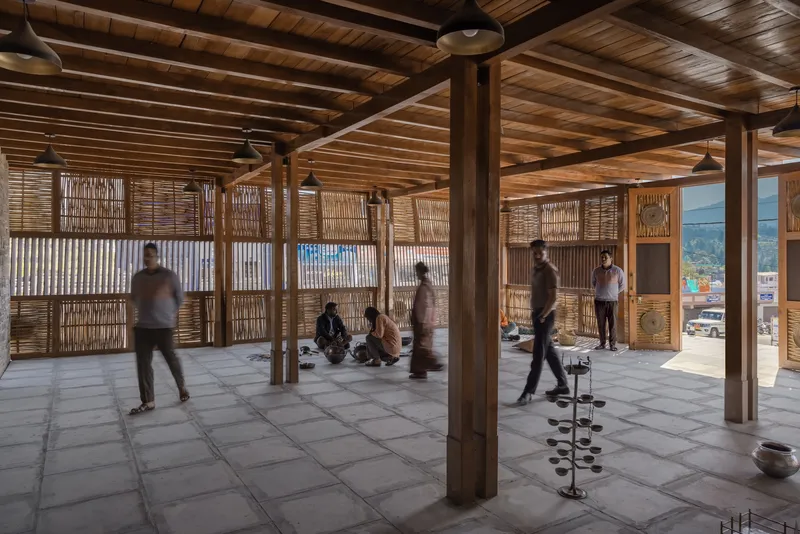


Inside, exposed timber columns rise to a beam-and-plank ceiling. Stone flooring absorbs the coolness of the ground and radiates it back through the day, a passive climate move that needs no mechanical support. Light enters through the bamboo screens in shifting patterns, drawing parallel lines across the floor that rotate with the sun. The effect is less like being inside a building and more like sitting under a large, very well-made basket.
The images of occupation tell the real story. An artisan sits among rows of metal cookware and hand tools, working beneath the slatted screen wall. Blurred figures arrange ceramic vessels on the floor of a workshop bay. These are not staged tableaux; they are the building doing its job. The absence of glass partitions, display vitrines, or any white-walled gallery apparatus is deliberate. Making and selling happen on the same stone floor, separated by nothing more than a column or a change in shadow.
The Stone Staircase and the Section That Connects
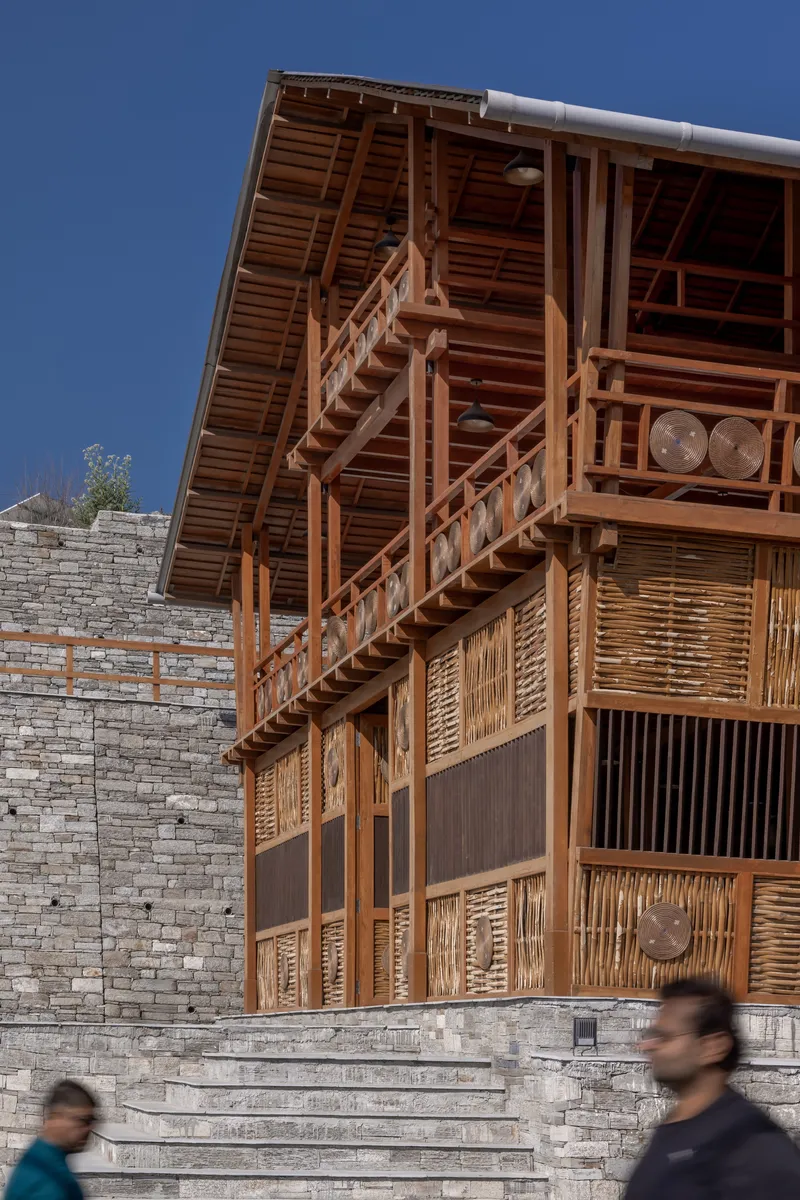


The section is activated by a diagonal timber staircase that connects the upper balcony to the stone base, creating a continuous circuit between the street level and the elevated terrace. Stone steps carved into the retaining wall run alongside the slatted facade, their roughness underfoot a tactile reminder that this is a building made by hand. The staircase is generous enough that it doubles as informal seating, which matters enormously in a town with limited public gathering space.
Cantilevered timber treads rise between stone walls under the exposed beam ceiling, a construction detail that would be perfectly at home in a traditional Kumaoni house. That continuity is the point. The market plaza does not invent a new architectural language. It takes an existing one seriously enough to use it structurally, not just decoratively.
The Pavilion and the Mountain View

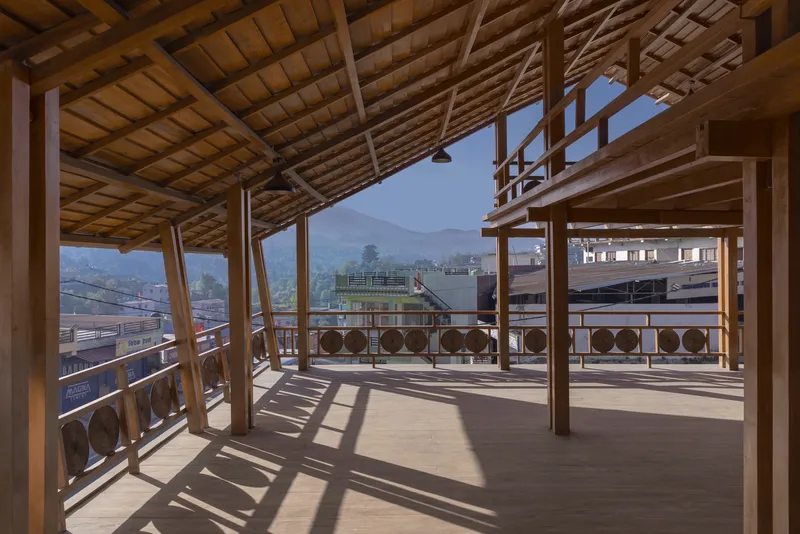

At the upper level, the building opens into a timber-framed pavilion with a wooden deck and circular balustrade that frames the distant Himalayan ranges. Columns cast long shadows across the floor while people gather, sit, and look out. The space functions as a covered terrace, a meeting point, a vantage, and on market days, presumably, a sales floor. Its openness to the landscape is a quiet assertion: Champawat's setting is its greatest asset, and any civic building worth its stone should make that asset legible.
The tiered stone seating built into the wall beside the slatted facade extends this logic of casual occupation. People lean, perch, and recline without needing furniture. The architecture provides posture rather than prescription, which is exactly what a market needs.
Light, Texture, Material Honesty
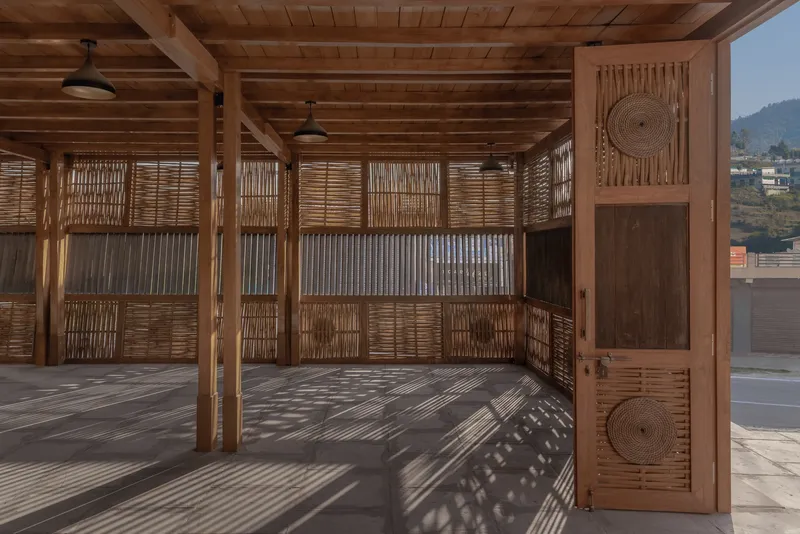


Afternoon light through slatted timber screens produces a dappled shadow pattern on the concrete floor that would cost a fortune to replicate with mechanical lighting. The perforated screening panels in the open pavilion spaces create a moire effect when viewed at an angle, each panel's weave interacting with its neighbor's to produce visual depth. These are not designed effects in the conventional sense; they are consequences of choosing handmade materials and letting sunlight do what sunlight does.
The textured stone block walls, the rough-sawn timber beams, the hand-woven bamboo: nothing in this building pretends to be something it is not. Material honesty is a cliché in architectural criticism, but here it carries economic meaning. Every surface was made with skills that exist in Champawat, using materials sourced from the surrounding landscape. The building's aesthetic is, quite literally, a by-product of its supply chain.
Why This Project Matters
The Champawat Market Plaza matters because it refuses the false choice between heritage conservation and new construction. It does not freeze traditional craft in amber. It puts craft to work, structurally and economically, inside a building that serves a contemporary civic need. In a context where poorly constructed concrete buildings are vulnerable to natural disasters and traditional skills are vanishing with each generation that migrates to the plains, that refusal carries real weight.
Compartment S4 has demonstrated that a 250-square-meter public building on a highway in a small Himalayan town can be simultaneously a marketplace, a workshop, a gathering place, and an argument for a different way of building. The architecture does not romanticize rural life. It creates the economic and spatial conditions under which rural life might actually sustain itself. That is a harder and more useful achievement than any number of beautiful pavilions could ever be.
Champawat Market Plaza by Compartment S4, Champawat, India. 250 m². Completed 2025. Photography by The Space Tracing Company.
About the Studio
Share Your Own Work on uni.xyz
If projects like this are the kind of work you want to make, uni.xyz is a place to publish your own, find collaborators, and enter design competitions.


Popular Articles
Popular articles from the community


Faces of the Soviet Avant-Garde: Turning Moscow's Street Names into an Open-Air Museum
A network of sculptural installations across a Moscow residential district transforms forgotten architect names into spatial encounters with cultural memor
Temporary Home for Dogs: A Reversed Zoo Rethinks Animal Shelter Architecture
In Bucharest, a sinuous corridor and freed landscape flip the logic of containment, designing a shelter that works to make itself unnecessary.

Extended Shell: Retrofitting Kolkata's Balconies as Living Urban Thresholds
A modular retrofit system recovers the social and environmental intelligence of Kolkata's historic verandas for contemporary Park Street residents.

Singing Woman: Contemporary Architecture Inspired by Estonia’s Voice and the Sea
Singing Woman turns Estonia’s song culture into flowing opera house architecture, blending public life, landscape, sea, and national memory.

Similar Reads
You might also enjoy these articles

Bao Huynh Watercolor Atelier: A Serene Art Retreat in Hội An
Bao Huynh Watercolor Atelier in Hội An blends multifunctional art spaces, sustainable design, local materials, and family-friendly living in a serene environment.

Atelier Macri Concept Store Interior Design by CASE-REAL
Atelier Macri store features a "ko" counter, walnut wood details, cork displays, blending retail, gallery, and seamless customer experiences.

Manuel Vargas Izquierdo Stadium and High-Performance Sports Center: Architectural Excellence in Jalpa de Méndez
The Manuel Vargas Izquierdo Stadium blends sustainable design, inclusive sports facilities, and cultural-inspired architecture, revitalizing Jalpa de Méndez’s public spaces.
KAKR Buluh Awar Hall: Revitalizing Community and Ecology Through Bamboo Architecture
Community built bamboo hall revitalizes Buluh Awar village, empowering youth, restoring ecology, celebrating vernacular craftsmanship through sustainable architecture and culture.


Comments (0)
Please login or sign up to add comments
No comments yet. Be the first to comment!