

Cosmic Odyssey: A Sculptural Space Museum That Bridges Earth and the Universe
A sequential architectural journey from Earth to the Moon and beyond, blending interactive exhibits with futuristic design in a unified civic landmark.


What if a building could compress the entire trajectory of human space exploration into a single walk-through experience? Cosmic Odyssey proposes exactly that: a sculptural museum sequenced from ground-level terrestrial galleries up through lunar and Martian exhibits, culminating on a rooftop terrace where fire, wind, and water reassert Earth's elemental presence. The architecture does not merely house exhibits about space; it performs the sensation of leaving the planet, moving visitors through escalating scales of cosmic awareness until they arrive back at the fragile familiarity of home.
Designed by Zayra Susana Rico, this shortlisted entry for the Moontrip 2019 competition positions a riverfront building as both civic landmark and immersive narrative device. The oval footprint sits adjacent to a river, its domed volumes and curvilinear plan radiating outward from a central core. Three levels of exhibition and public spaces are organized so that visitors experience a strict sequence, from planetary sustainability through rocket launch simulations and celestial navigation, never losing the thread of a story that connects our world to the cosmos.
An Atrium Anchored by Light and Circulation
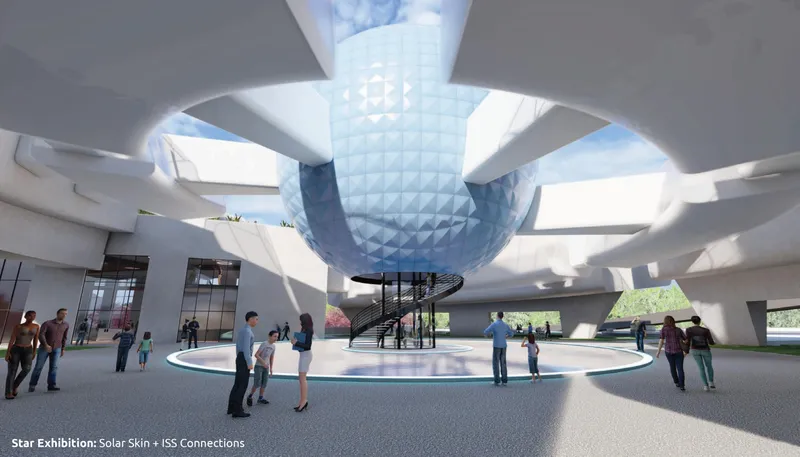
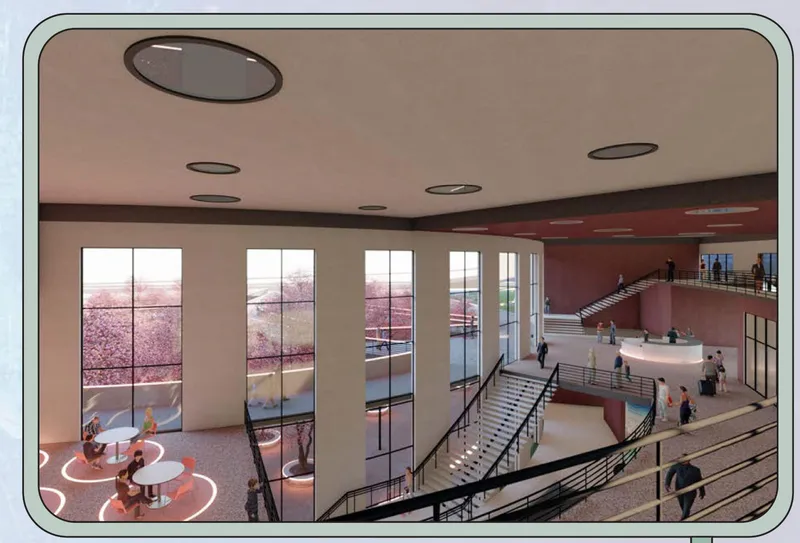
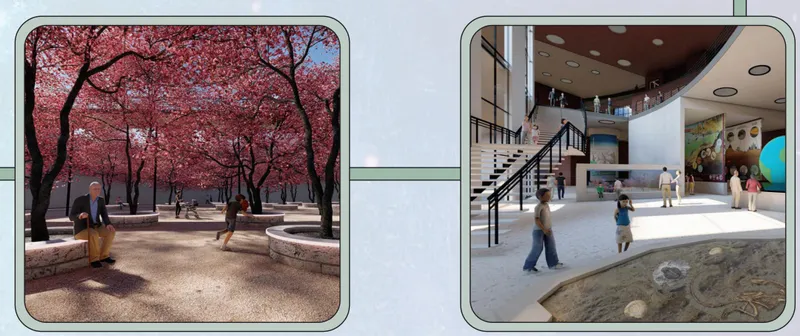
The interior atrium establishes the building's spatial logic from the moment of entry. A circular skylight punches through the ceiling, pulling daylight down onto a terrazzo floor where visitors gather at the base of a spiral staircase. The geometry is deliberate: the oculus overhead echoes planetary forms while the spiral below initiates the vertical ascent that structures the entire visit. Pink terrazzo surfaces, tall gridded windows, and a multi-level lobby give the ground floor a warmth that feels civic rather than clinical, grounding visitors in a recognizable architectural language before the exhibits transport them elsewhere.
Central staircases connect the lobby levels visually and physically, keeping sightlines open across floors. The effect is that of a launchpad: you can see where you are headed, and the building's vertical energy pulls you upward toward increasingly immersive environments.
From Blue LEDs to Starfields: Exhibit Spaces as Environments
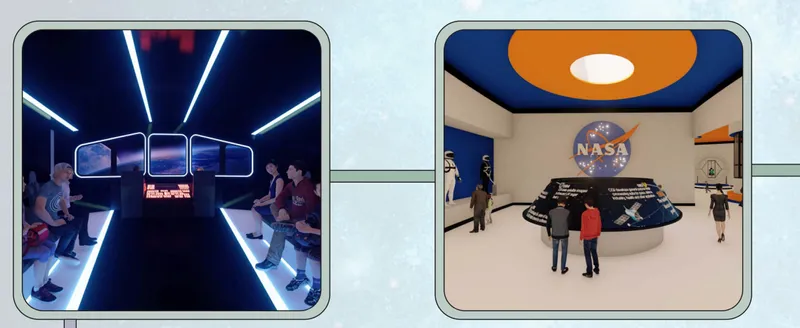
The exhibition galleries abandon conventional white-box display in favor of total environmental control. One gallery bathes visitors in blue LED light, wrapping them in a curved monitor array that projects space imagery at an enveloping scale. The transition is immediate: you leave the daylit lobby and enter a space where architecture recedes and media takes over, simulating the disorientation of departure from Earth.
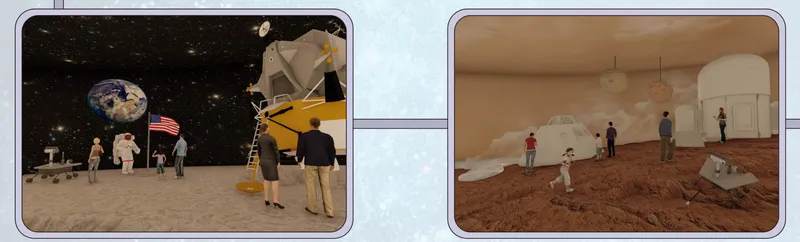
Deeper into the sequence, a lunar landing diorama places a spacecraft model within a constructed starfield, with a projected Earth hovering in the background. Visitors observe from a darkened viewing platform, their position mimicking the perspective of astronauts looking back at their planet. The design here relies on careful lighting calibration and spatial compression to sell the illusion, and the result is a gallery that operates more like a theatrical set than a museum room.
The Planetarium as Central Landmark
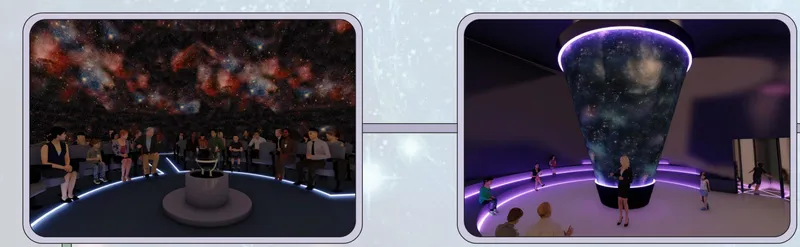
At the heart of the building, the planetarium dome serves as both the spatial and symbolic core. Galaxy imagery floods the interior dome surface while visitors gather around a circular platform washed in purple light. Rico describes this element as a revolving structure that forms a direct architectural connection with the International Space Station, a bold conceptual gesture that positions the building as a terrestrial counterpart to orbital infrastructure. The dome's geometry organizes the surrounding plan, with galleries radiating outward like orbits from a gravitational center.
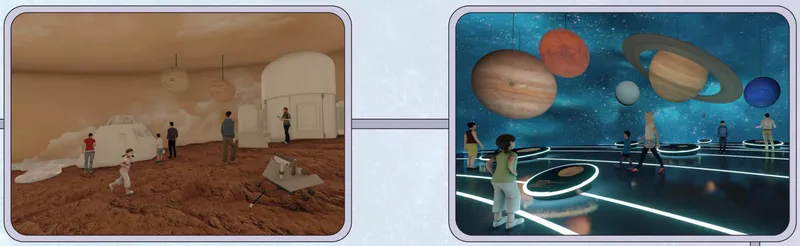
An adjacent interactive solar system gallery suspends illuminated planet models overhead, scaled and spaced to give visitors a tangible sense of relative distance. The patterned floor below maps orbital paths, turning circulation itself into a lesson in celestial mechanics. Cantilevered and elevated spaces throughout this zone create the sensation of weightlessness, reinforcing the building's ambition to make visitors feel as though they are floating in space rather than walking through a museum.
Domed Volumes and a Riverfront Plaza
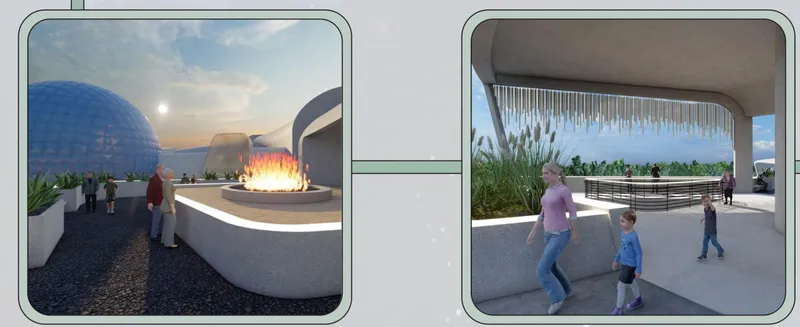
Externally, the building reads as a cluster of domed volumes gathered around a curved plaza. At dusk, an illuminated fountain anchors the public space, drawing the surrounding urban fabric toward the museum's entrance. The massing avoids monolithic presence in favor of a constellation of forms, each dome corresponding to a major programmatic element inside. The analogy to celestial bodies is clear without being literal.
A paved courtyard lined with pink flowering trees offers a softer counterpoint to the building's futuristic language, providing a transitional zone between the city and the immersive interior. Visitors walking beneath the canopy experience a moment of terrestrial beauty before entering a building devoted to the cosmos, a sequencing choice that sharpens the contrast and makes the journey inside feel all the more extraordinary.
Three Levels Radiating from a Central Core
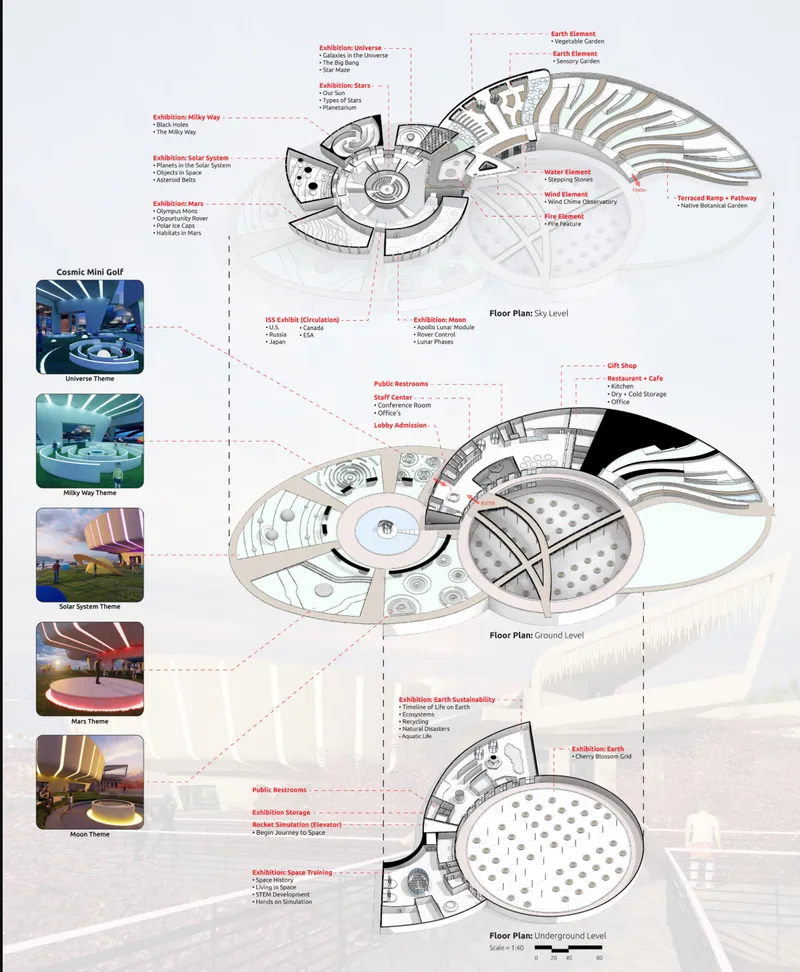
The annotated floor plan reveals how three levels of exhibition and public spaces radiate from the central planetarium core, with circulation routes enforcing the sequential narrative. The plan's radial organization ensures that visitors cannot shortcut the experience: each gallery leads to the next in a prescribed order, building knowledge and emotional intensity as the journey progresses from Earth-focused sustainability exhibits through space mission simulations to the rooftop terrace.
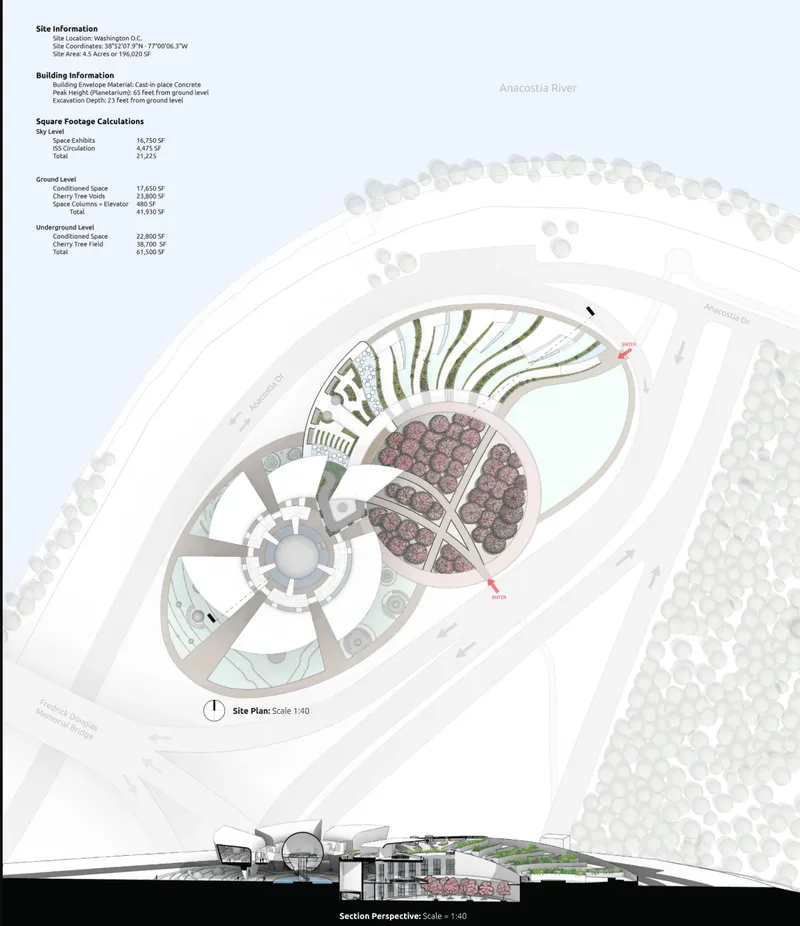
The site plan confirms the building's oval footprint and its relationship to the adjacent river, with a section view showing how floor levels step upward toward the domed planetarium. The riverfront siting is not incidental; it gives the building a reflective horizon that extends its presence into the landscape, and it provides the rooftop terrace with open sky views unobstructed by surrounding development. The section also clarifies how cantilevered volumes project outward from the core, creating the elevated, floating spaces that define the visitor experience at upper levels.
Why This Project Matters
Cosmic Odyssey succeeds because it treats architecture as narrative infrastructure. Rather than designing a neutral container for exhibits about space, Rico builds the story into the circulation, the lighting, the massing, and the material palette. The sequential logic means the building teaches through movement: you learn about Earth before you leave it, you experience disorientation before you reach the planetarium, and you return to the elements on the rooftop only after understanding what lies beyond them. That is a spatial argument, not just an exhibition strategy.
For a competition centered on imagining architecture's relationship to space travel, the project offers a grounded and buildable proposition. It does not rely on speculative lunar construction or zero-gravity fantasies. Instead, it asks what a civic building on Earth could do to make the cosmos feel real, accessible, and urgent. The answer, according to this design, is to make the building itself a vehicle for the journey.
View the Full Project
About the Designers
Designer: Zayra Susana Rico
Enter a Design Competition on uni.xyz
uni.xyz runs architecture and design competitions year-round that reward proposals with spatial conviction and real site intelligence.
Project credits: COSMIC ODYSSEY by Zayra Susana Rico Moontrip 2019 (uni.xyz).


Popular Articles
Popular articles from the community


Faces of the Soviet Avant-Garde: Turning Moscow's Street Names into an Open-Air Museum
A network of sculptural installations across a Moscow residential district transforms forgotten architect names into spatial encounters with cultural memor

Manzana Morphosis: Stretching Barcelona's Grid into a Living Landscape for 2050
A radical reworking of the Eixample manzana turns density into a tool for generous public space, vertical ecology, and environmental performance.

Cloaked Colonization: A Mobile Underwater Habitat That Moves Like a Fish
Micah Abaya's shortlisted EHC Pacific entry reimagines ocean settlement as a dispersed network of self-sustaining architectural organisms.

The Amber Palace Opera: A Geological Fiction Surfaces on Tallinn's Baltic Waterfront
Pierre Brillard reimagines a Baltic legend as a public landscape, opera house, and waterfront promenade rooted in Tallinn's coastal identity.

Similar Reads
You might also enjoy these articles

Day and Night Park: A Time-Based Urban Newsstand in Beijing
A temporary urban newsstand in Beijing blending travel, light, and reading through poetic colors, compact form, and community-focused design.

Modernist Patio Renovation in El Masnou, Barcelona by Oliver Segura Arquitectura + Cebrià Arquitectura
Modernist patio renovation blending tradition and innovation with a movable pool, leveled floors, and Catalan materials in El Masnou.

Alto Residencial Coop: Cooperative Housing Development in Santiago de Compostela by Carbajo Barrios Arquitectos
A linear cooperative housing complex blending white volumes and perforated metal façades, enhancing community living, natural light, privacy, and urban integration.

Vil Genis School by BPA ARCHITECTURE – Massy, France
Vil Genis School in Massy, France, features sustainable design, south-facing classrooms, community integration, accessible spaces, and modern educational architecture.

Explore Cosmic Architecture Competitions
Discover active competitions in this discipline

Challenge to design luxury tourism on rails

VR headsets Storefront design competition

Designing a staircase for a client
Comments (0)
Please login or sign up to add comments
No comments yet. Be the first to comment!