
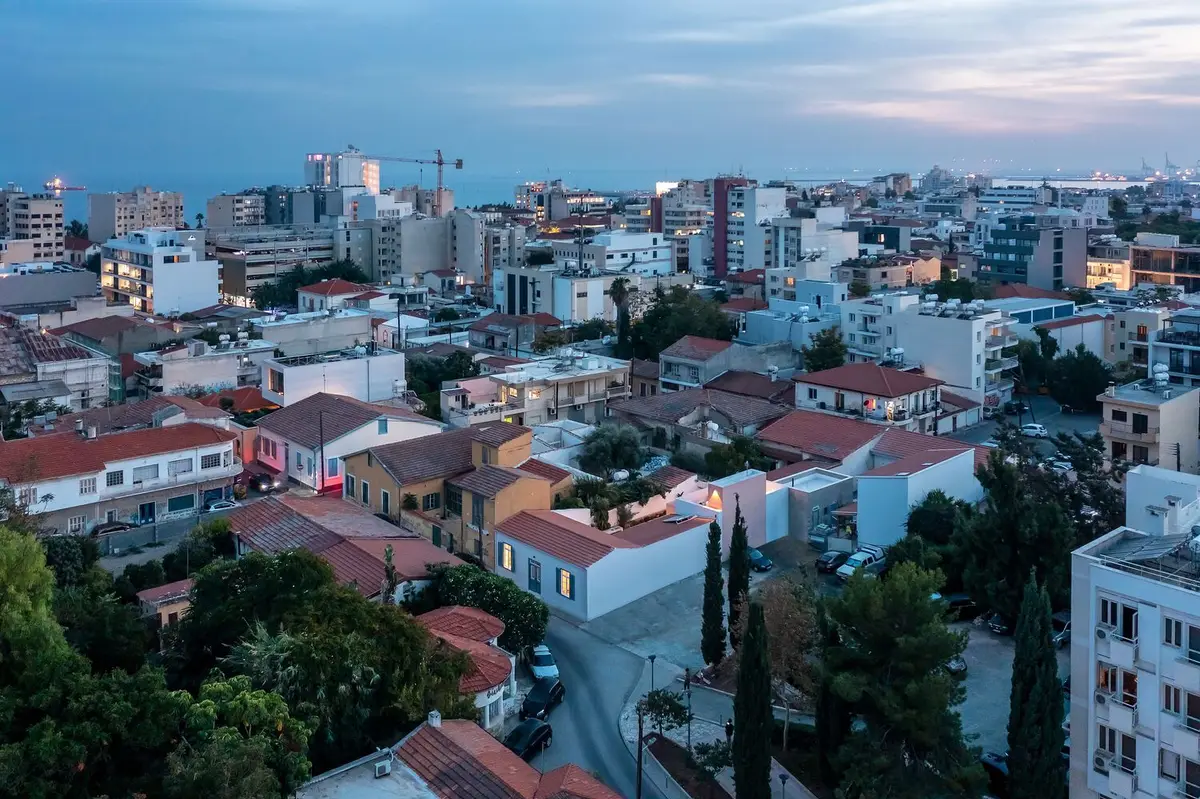
Courtyard-Centered Living: A Contemporary Restoration in Limassol
Restored Limassol house blending traditional courtyard living with modern extensions, bioclimatic design, flexible interiors, vibrant colors, and sustainable, light-filled spaces.


Adaptive restoration centered around a bioclimatic courtyard
Located in the historic urban fabric of Limassol, Cyprus, The Yard House is a sensitive restoration and extension of a listed residence by Alexis Papadopoulos Architectural Practice. Completed in 2023, the 160-square-meter project reinterprets traditional Cypriot domestic architecture through contemporary spatial strategies, climate responsiveness, and a renewed relationship between indoor life and the courtyard.


Restoring the original spatial logic
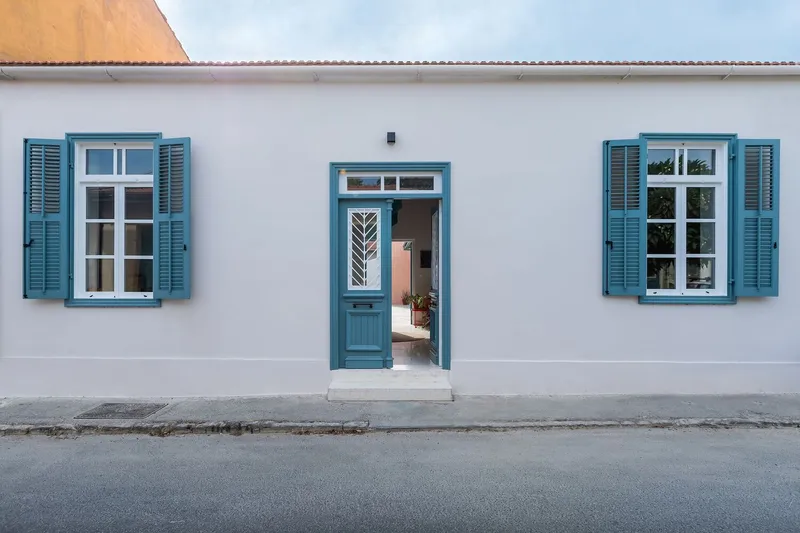
The design process began with a careful study of the existing listed building, prioritizing preservation while accommodating the evolving needs of a contemporary family. Selective demolitions were carried out to return the house to its original configuration, revealing and expanding the inner courtyard, historically the heart of the home. This intervention restores direct access from the street through the foyer, or heliakos, allowing daylight to once again penetrate the central threshold and the adjacent rooms on either side.
By reopening these spatial connections, the architects reestablish the courtyard as both a climatic moderator and a social nucleus, reinforcing traditional patterns of living that had been compromised over time.
Linear expansion and bioclimatic performance
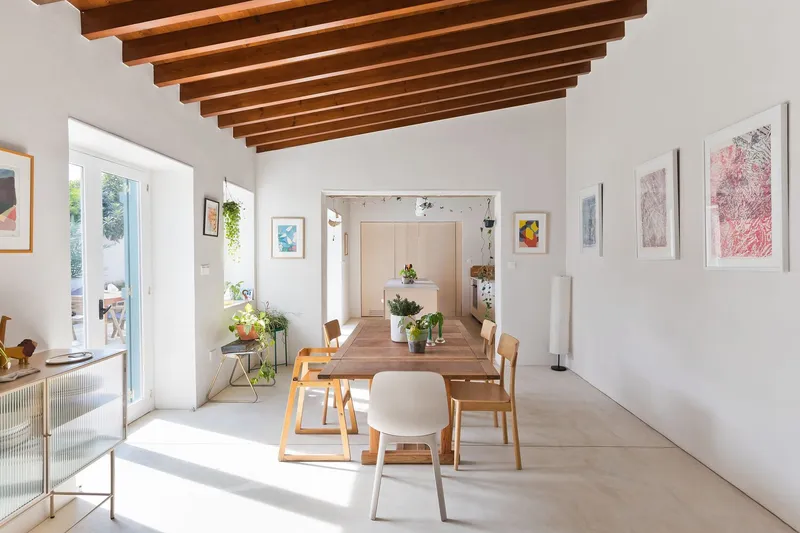
New additions extend linearly along the edge of the courtyard, following the customary method of house expansion in Limassol. Orientation plays a crucial role in the project’s bioclimatic strategy: during winter months, sunlight reaches deep into all primary rooms, providing passive heating, while in summer, modest canopies protect openings from direct solar gain.
The courtyard’s microclimate is enhanced through a combination of planted trees, uncovered soil, and water. Vegetation and permeable ground absorb rainwater in winter and prevent heat accumulation during summer, while the swimming pool contributes to evaporative cooling. Together, these elements naturally regulate indoor temperatures and reduce reliance on mechanical systems.

Courtyard as protagonist
Rather than serving as a backdrop, the yard becomes the main organizing element of the house. All interior spaces maintain a direct visual and physical relationship with the outdoors, and circulation frequently passes through the courtyard itself. This spatial arrangement encourages constant interaction with light, air, and greenery throughout the day, transforming everyday movement into an outdoor experience.

Old and new: a clear yet respectful dialogue
At the junction between the restored structure and the new extension, a carefully detailed expansion joint allows the two volumes to move independently in response to thermal variation and seismic activity. Thermally insulated and waterproofed, this joint is deliberately expressed through a recessed niche that interrupts the continuity of the walls, marking the transition between old and new.
Formal and chromatic contrasts further articulate this relationship. The extension is composed of simple, robust rectangular volumes without traditional frames, finished in vivid color. Drawing from Limassol’s historical palette, the architects selected a deep reddish tone, an abstract reference to the tiled roofs that characterize the city center, reintroducing color as a contemporary architectural tool.
Flexible living and sensory interiors
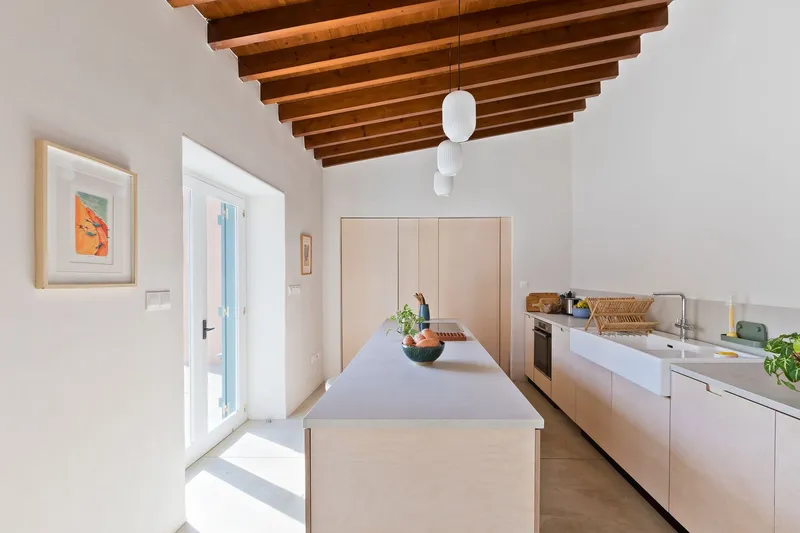
Entry to the house occurs through the heliakos, reinforcing its role as a spatial mediator. To one side, a semi-autonomous room opens both to the foyer and directly to the courtyard, allowing it to function flexibly as a home office, workshop, or guest room. On the opposite side, the main living spaces unfold sequentially in a linear plan, maintaining clarity and ease of movement.
Interior design receives particular attention in the bathrooms, where materiality and form blur the boundary between inside and outside. An excavated bathtub enveloped in green surfaces: floor, walls, and ceiling, creates an immersive environment that evokes the sensation of bathing within the courtyard landscape, as if the yard continues inward.


Contemporary restoration rooted in place
Through restrained interventions, climatic intelligence, and a strong respect for local architectural traditions, The Yard House demonstrates how heritage buildings can be adapted for modern living without losing their identity. The project stands as a refined example of residential restoration in Cyprus, where courtyard-centered living, color, and environmental responsiveness are reimagined for contemporary life.
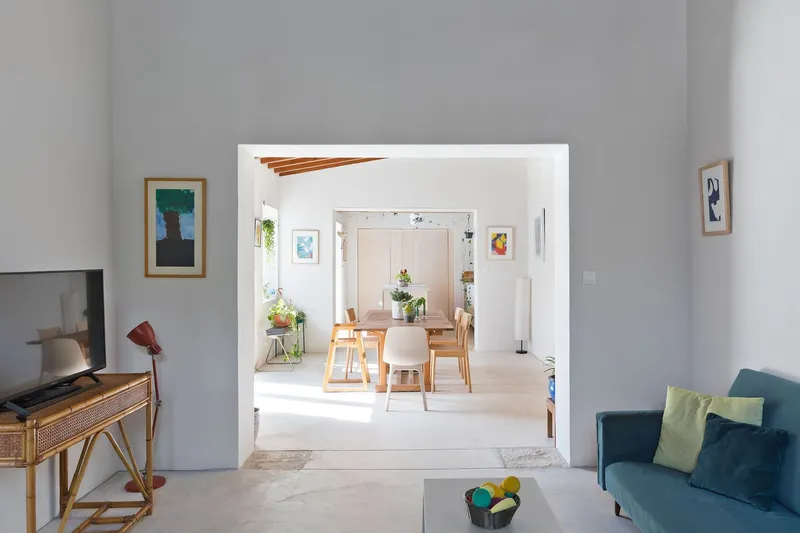

All photographs are works of
Mariana Bisti


Popular Articles
Popular articles from the community


Singing Woman: An Opera House That Performs Before the Curtain Rises
Ovidiu Cristian Pavel's conceptual opera house translates Estonia's choral identity into a sculpted waterfront landmark facing the Baltic Sea.

Opera on the Sea: Driftwood Logic Shapes a Timber Opera House on Estonia's Coast
Trevor Orgill's opera house translates the entangled drift of floating timber into a civic building where wood, water, and music converge.
Tsunami Convergenics: Turning Catastrophic Ocean Forces into Underwater Housing Infrastructure
A speculative underwater settlement off the coast of Onagawa, Japan, treats tsunamis and typhoons as energy sources rather than threats.

Opera by the Sea Estonia: Three Shells Dissolving Architecture into Tallinn's Coastline
A winning opera house proposal replaces monumental form with interconnected shells that blur the boundary between building, park and Baltic Sea.

Similar Reads
You might also enjoy these articles

FAMM Arquitectura Organizes Ten Villas Around Courtyards and Jungle in Nosara, Costa Rica
El Molino pairs two elongated volumes with deep overhangs and timber louvers to build a compact coastal community five minutes from the beach.
Oscar Niemeyer's Ibirapuera Park Pavilions Define São Paulo's Cultural Identity in Concrete and Curve
A constellation of modernist volumes set within São Paulo's most important urban park, conceived for the city's 400th anniversary in 1954.
Sanjay Puri Architects Wraps a Jaipur Office Tower in Capsule-Shaped Green Buffers
A nine-level climate-responsive workplace near Jaipur Airport uses stacked planter terraces and aluminium screens to fight 40°C heat.
RHO Converts a Berlin Spree-Side Industrial Courtyard into Enkime's 1,000 m² Agency Headquarters
A social media agency's new home in Charlottenburg trades glossy branding for concrete waffle ceilings, glazed tile, and sheer curtains.

Explore Courtyard Competitions
Discover active competitions in this discipline

Challenge to design mud housing for contemporary communities

Challenge to reimagine the Iron Throne

Photograph architecture without architects

Illustrate the lost glory of Angkor Wat - Render Challenge
Comments (0)
Please login or sign up to add comments
No comments yet. Be the first to comment!