
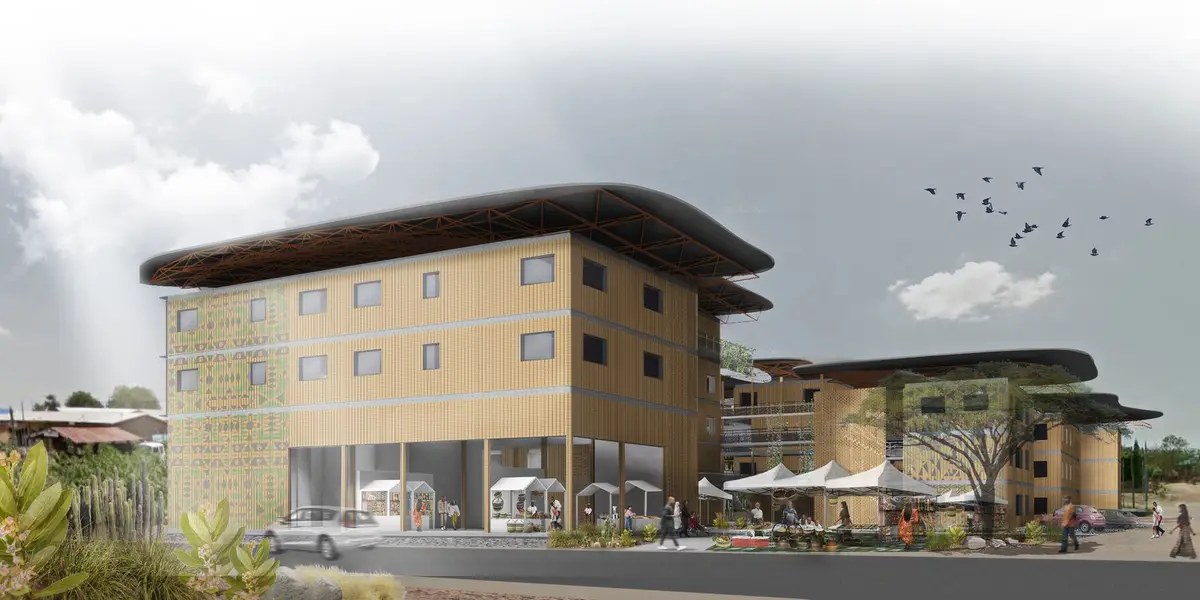
Courtyard Living: Earth Block Housing Rooted in Ghanaian Compound Traditions
A winning Earth Made entry uses courtyard typologies and locally sourced earth blocks to address Ghana's 5.7 million unit housing deficit.


In Bolgatanga, a compact city in Ghana's Upper East Region, households of up to ten people share a single room, often without electricity or running water. The national housing deficit exceeded 5.7 million units in 2020, yet only 35,000 to 40,000 homes are built annually against a need for over 100,000. Those numbers frame a crisis, but they also frame an opportunity: to rethink housing not as an imported commodity but as something that grows from the ground underfoot, shaped by the social rituals that have organized northern Ghanaian life for generations.
Courtyard Living, a winner of the Earth Made competition, takes that opportunity seriously. Designed by Robert Holton, Thu Nguyen, Clara Jimenez, and JouChuch Lee, the project proposes a sustainable community housing model for Bolgatanga that draws on the compound house typology common across the region. Courtyards are not decorative gestures here; they are the primary organizational logic, connecting residences, markets, playgrounds, community gardens, and craft studios into a single coherent settlement. The buildings themselves are constructed from earth blocks fabricated on site, a material strategy that keeps costs low, embodied carbon minimal, and construction skills local.
Stacked Earth: How Varying Porosity Defines Public and Private Space
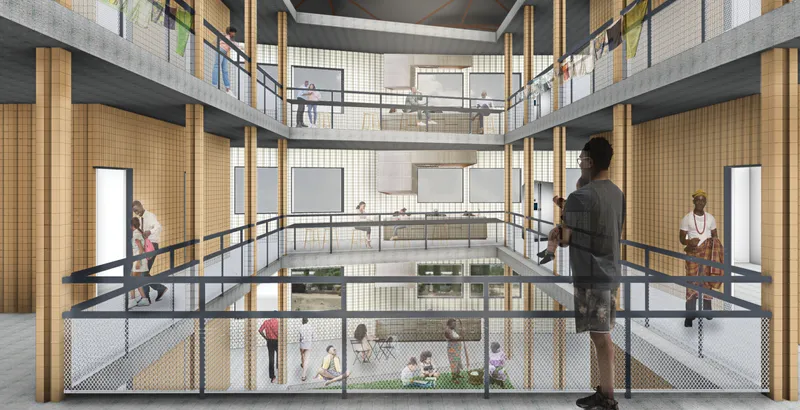
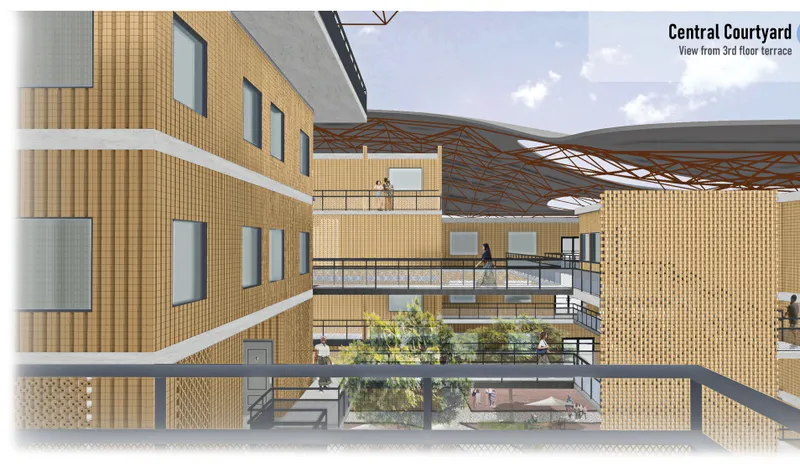
The section views reveal the project's core material argument. Earth blocks, created from site-excavated soil mixed with additives and finished with a limestone-cement coating for durability, are the singular modular unit from which the entire settlement is assembled. What makes the system spatially rich rather than monotonous is the variation in stacking configuration. High-porosity arrangements open up walls into chequered screens for markets and communal zones, admitting breeze and dappled light. Low-porosity configurations close down for privacy in residential units. The multi-story atrium section shows mesh-paneled bridges threading between chequered brick walls, creating an inhabited thickness where structure, ventilation, and social encounter overlap. Adjacent to this, the central courtyard section features planted terraces beneath a latticed timber roof canopy, demonstrating how the courtyard is not simply an absence of building but a carefully constructed microclimate.
Steel-reinforced columns embedded within the earth block walls provide the structural backbone, allowing the modular units to rise multiple stories without sacrificing the handmade quality of the surface. The freeform steel-trussed roof that unifies the building cluster acts as both a rain collector and a passive cooling device, channeling airflow over and through the residences below. In Bolgatanga's hot savannah climate, with its alternating wet and dry seasons, this layering of material porosity and roof geometry replaces mechanical systems with architectural intelligence.
From Soil to Wall: A Construction Logic Designed for Community Participation
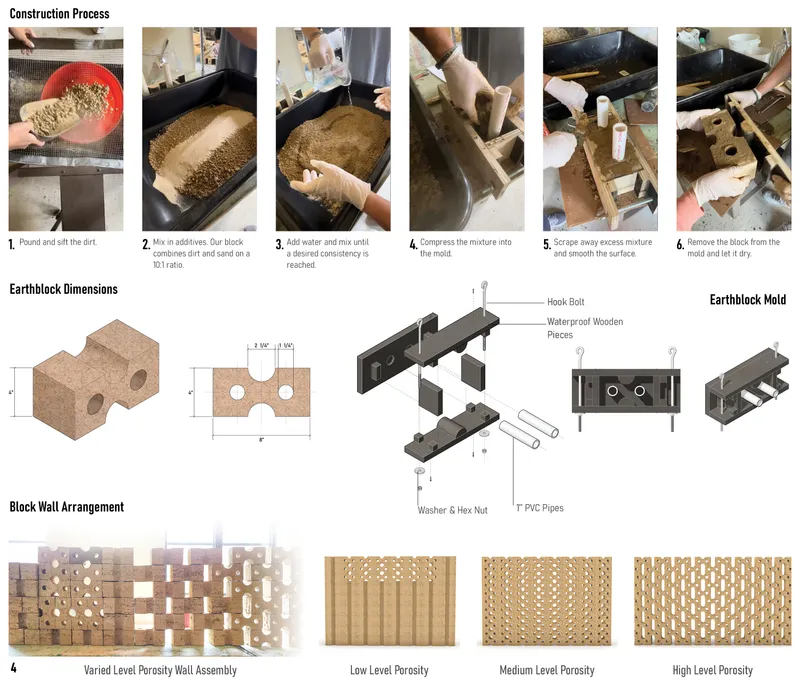
The construction process diagrams lay out the fabrication sequence with clarity: soil is excavated on site, mixed with stabilizing additives, pressed into blocks, and assembled into wall patterns of varying porosity. Each step is low-tech enough to be executed by local labor, which matters enormously when the goal is not just to build housing but to build a construction economy. The diagrams show how the same modular block, rotated or spaced differently, produces walls that range from nearly solid enclosures to open lattice screens. It is a simple idea with significant consequences, because it means the entire palette of spatial conditions, from an intimate bedroom to a breezy market hall, emerges from a single production line.
Life on the Terrace: Semi-Private Space Between Dwelling and Community
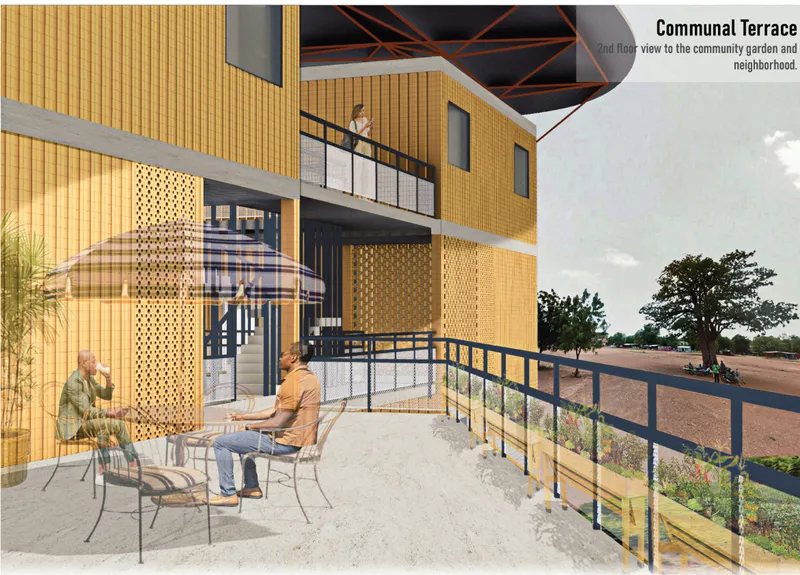
The terrace view captures the social texture the designers are after. Residents sit at a table beside perforated brick screens while planted beds line the edge of the balcony. These semi-private zones are critical to the project's argument. In traditional compound housing, life does not divide neatly into public and private; there are gradients. The balconies and terraces here perform that gradient work, offering a place to cook, dry clothes, weave baskets, or simply watch neighbors without the full exposure of the courtyard below. The perforated screens filter harsh sunlight on the sun-exposed facades while maintaining visual connection, a detail that is simultaneously environmental and social.
Below these terraces, the program unfolds through a series of courtyards calibrated to different scales of community life. A front courtyard doubles as a flexible market area linked to the main road, connecting commerce directly to the settlement. A playground sits adjacent to a daycare, supporting working parents. A communal courtyard anchors events and links to an enclosed hall. At the settlement's edge, a community garden transitions into Bolgatanga's broader agricultural landscape, reinforcing the courtyard-based farming traditions that support both nutrition and income across the region.
Structural and Environmental Detail at the Building Scale
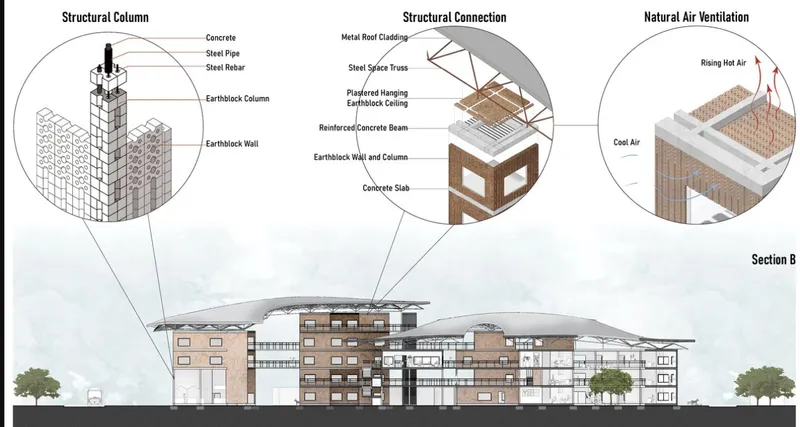
The detailed building section drawing annotates the technical systems that make the passive design work. Callouts identify structural column connections, the junction between earth block walls and the steel-trussed roof, and the natural ventilation pathways that move air through and over the building envelope. Louvers and bamboo screens appear on sun-exposed facades, adding a second layer of shading beyond the perforated block walls. A stormwater harvesting system channels rainwater from the roof structure for irrigation and greywater use, a direct response to Bolgatanga's dry-season water scarcity. Every technical decision is legible here: the architecture does not hide its environmental strategies behind finished surfaces but expresses them as part of the building's visual and spatial identity.
Why This Project Matters
Housing crises in rapidly urbanizing African cities are too often met with imported typologies and industrial materials that ignore local climate, local craft, and local social structures. Courtyard Living resists that pattern by starting from what already works: the compound house, the courtyard as communal living room, the earth block as construction unit, and the artisanal economy as livelihood. The designers did not romanticize tradition; they studied it closely enough to extract operational principles, then recombined those principles into a contemporary settlement that addresses density, infrastructure, and economic activity at a community scale.
What distinguishes this entry is its refusal to separate environmental performance from cultural relevance. The same perforated earth block wall that enables cross-ventilation also enables the visual porosity that defines compound living. The same courtyard that creates a microclimate also creates a marketplace. The same roof that shades the interior also harvests rainwater. When material, climate, program, and culture converge this tightly, the result is not a housing prototype but a model for how architecture can participate in building resilient communities from the ground up.
View the Full Project
About the Designers
Designers: Robert Holton, Thu Nguyen, Clara Jimenez, JouChuch Lee
Enter a Design Competition on uni.xyz
uni.xyz runs architecture and design competitions year-round that reward proposals with spatial conviction and real site intelligence.
Project credits: Courtyard Living by Robert Holton, Thu Nguyen, Clara Jimenez, JouChuch Lee Earth Made (uni.xyz).


Popular Articles
Popular articles from the community


longwave studio Reorganizes a 112 m² Tainan Apartment Around the Daily Routines of a Family and Two Cats
In Tainan, Taiwan, birch plywood, rust-red furniture and a freestanding plaster wall link arrival, storage, work and family life in one apartment.

David Ortega Stacks a Two-Story Mexico City Penthouse Around a Steel Stair and a Pergola-Shaded Roof Terrace
In Colonia Roma, a 300 m² penthouse uses oak joinery, a planted steel stair and a slatted roof pergola to make a new-build apartment feel like a house.

Juan García Correa, John González and Claudia Rueda Sink a Circular Amphitheater into a Manizales Engineering Building
On the La Nubia campus in Manizales, Colombia, the S1 Building folds labs and offices into a hillside of ramped lawns that double as a campus route.

Architekt Andreas Gruber Scatters 23 Dark Timber Chalets Across a South Tyrolean Forest Edge
In Molini di Tures, Amonti Chalets breaks a resort into a hamlet of gabled timber houses, with parking, storage and services pushed into the slope.

Similar Reads
You might also enjoy these articles


Vereda Arquitetos Renovates a 40-Square-Meter Apartment Inside Niemeyer's Copan Building
A compact unit in São Paulo's most iconic residential tower gets a material overhaul that pairs exposed concrete with bold blue Formica.

Shakur's House: Exposed Brick as an Interior Organiser in a 168 m² Mashhad Residence
Brick moves indoors in this Mashhad residence, where masonry walls, glass partitions and teal planes sequence a compact home without closing it off.

Day and Night Park: A Time-Based Urban Newsstand in Beijing
A temporary urban newsstand in Beijing blending travel, light, and reading through poetic colors, compact form, and community-focused design.

Modernist Patio Renovation in El Masnou, Barcelona by Oliver Segura Arquitectura + Cebrià Arquitectura
Modernist patio renovation blending tradition and innovation with a movable pool, leveled floors, and Catalan materials in El Masnou.


Comments (0)
Please login or sign up to add comments
No comments yet. Be the first to comment!