

Léopold Banchini Architects Channels Ancient Irrigation Systems into a Self-Sustaining Desert House in Morocco
Dar El Farina uses rammed earth walls, zellige skylights, and thousand-year-old water networks to carve a cool retreat from the arid plains of Al Haouz.


The name means "House of Flour" in Arabic, a nod to the wheat and barley that communities have coaxed from this seemingly barren ground for millennia. Dar El Farina, completed in 2024 by Léopold Banchini Architects in collaboration with local architect Sana Nabaha, sits on an arid plot outside Marrakech at the foot of the High Atlas Mountains. It is fully off-grid, built almost entirely from the soil beneath it, and sustained by the same water that has irrigated this plain since the Almoravid dynasty dug its underground galleries a thousand years ago. The building is not simply located on this land; it is made of it.
What makes the project genuinely compelling is its refusal to treat vernacular technique as mere aesthetic citation. Two parallel rammed earth walls, spanning just four metres, define a linear sequence of rooms, courtyards, and water basins that traces the path of the mesref (an open irrigation channel) and khetara (a subterranean draining gallery) crossing the site. The house literally follows the water. On one side, the desert is left untouched. On the other, a garden of indigenous plants grows thanks to ancestral irrigation that the design deliberately keeps active, allowing small openings for water to continue its seasonal flow. The architecture does not interrupt the landscape's hydrology; it instrumentalizes it.
A Line Drawn Between Desert and Garden


Approached from the desert side, Dar El Farina reads as an almost geological event: a low, horizontal concrete and rammed earth volume emerging from the rocky terrain, flanked by prickly pear and agave. There is no conventional front door, no welcoming portico. The building presents itself as a wall, which is precisely the point. For thousands of years, communities here have divided fields using endless rammed earth walls running in straight lines. Léopold Banchini takes that territorial logic and makes it domestic.
Walk around to the other side and the experience inverts completely. Native grasses and shrubs crowd a planted pathway leading toward a cylindrical tower element. The contrast between the two faces of the house is radical and intentional: the building is not a pavilion in the landscape but a boundary that creates two entirely different ecosystems. The garden side benefits from the khetara and mesref that cross the plot, irrigation infrastructure so effective it remains in use despite being medieval.
The Enfilade: Rooms, Patios, and Water in Series
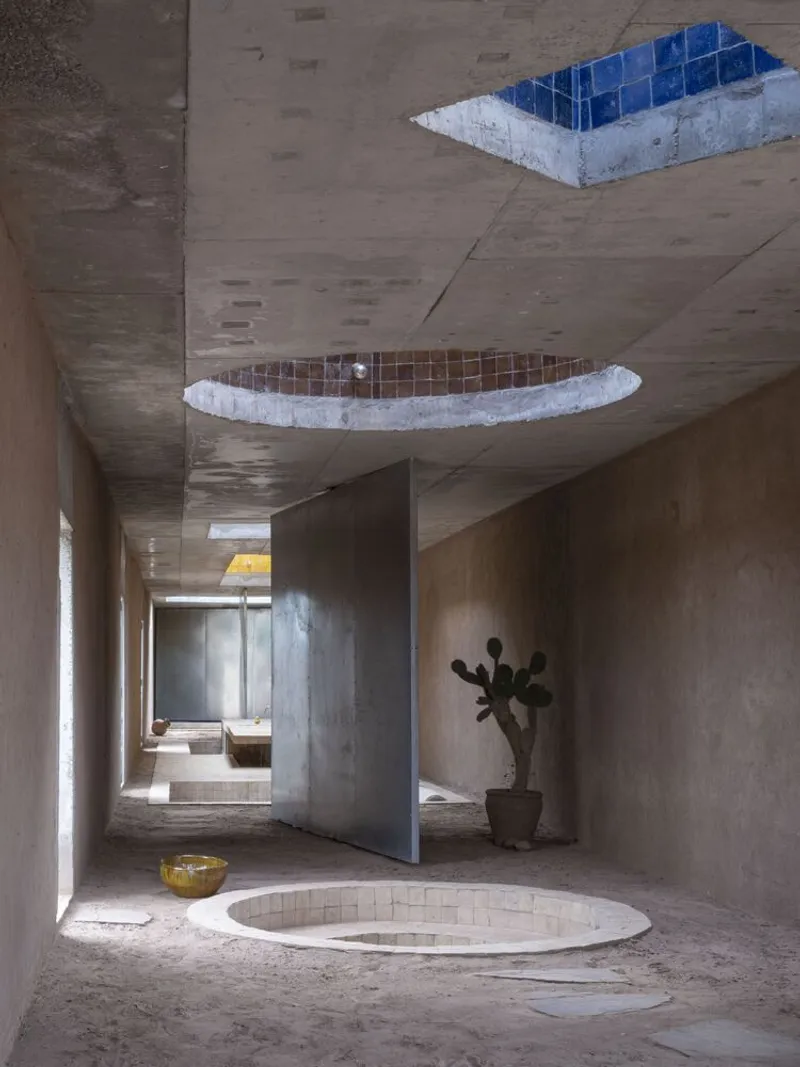
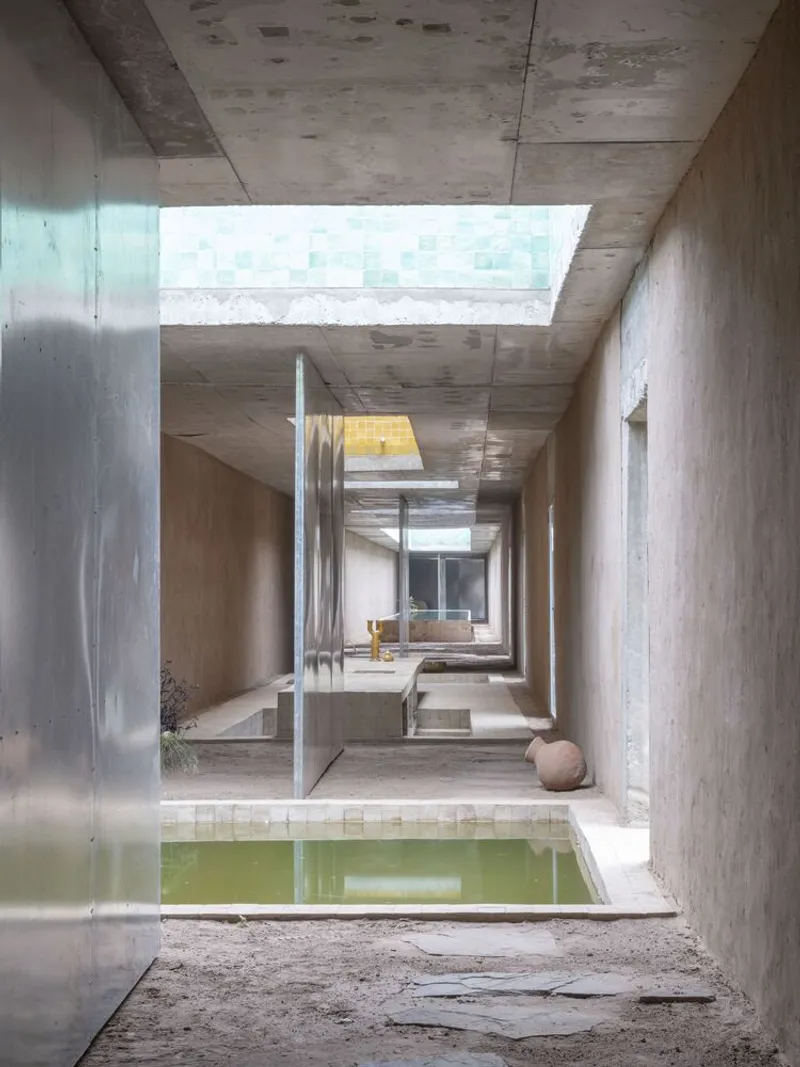
The interior organization abandons the traditional Moroccan patio house, which wraps rooms around a central courtyard, in favor of an enfilade: a succession of interconnected spaces arranged in a single line. Two bedrooms and a kitchen/living area are threaded together with open-air patios and reflecting pools, each space flowing into the next. Board-formed concrete walls and ceilings give the corridors a monastic severity, while floor-level water channels and pools introduce a softness that is both visual and thermal.
Large metal pivot doors can be swung open to unify the entire sequence or closed to create discrete rooms. The result is a house that can be as communal or as private as its inhabitants need. Translucent glass panels between rooms allow light to pass through without sacrificing enclosure. There is a discipline to the plan that keeps a four-metre span from ever feeling constricted: every room has a skylight, a water surface, or a view through to the next space.
Zellige Skylights and the Choreography of Light
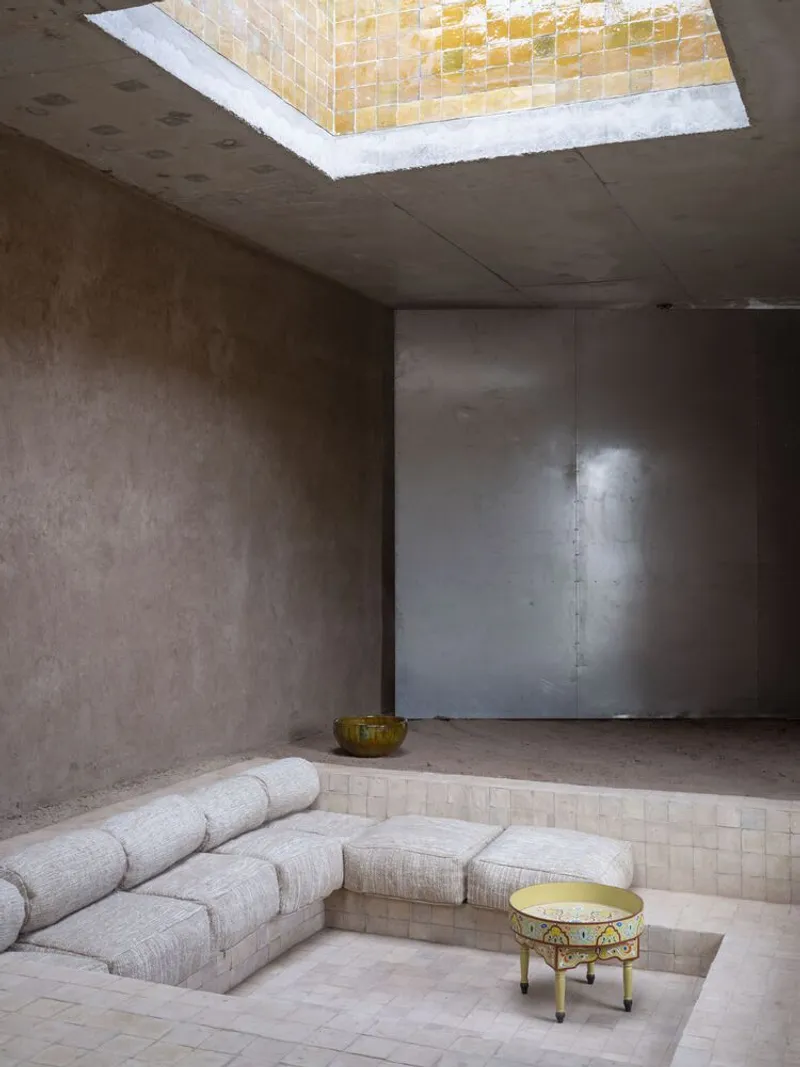


The most visually arresting detail in the house is the treatment of its zenithal openings. Rather than clear glazing, the skylights are lined with zellige tiles in red, blue, yellow, and gold, produced in a neighboring village using techniques that predate the building by centuries. Sunlight passes through the glazed ceramic surfaces and is tinted before it lands on the rammed earth walls and water basins below. The effect is somewhere between a hammam and a chapel: colored light bouncing off still water, filling the space with warmth that is chromatic rather than thermal.
In the sunken seating area, a golden mosaic tile skylight turns the ceiling into a lantern, casting a honeyed glow over cream upholstered cushions. Elsewhere, a large rectangular opening above a mosaic-tiled pool brings in a sharp column of daylight that the water surface fractures into moving reflections. These are not decorative flourishes. They are the house's primary lighting strategy, tuned to modulate the brutal Moroccan sun into something inhabitable.
Water as Cooling System, Material, and Memory
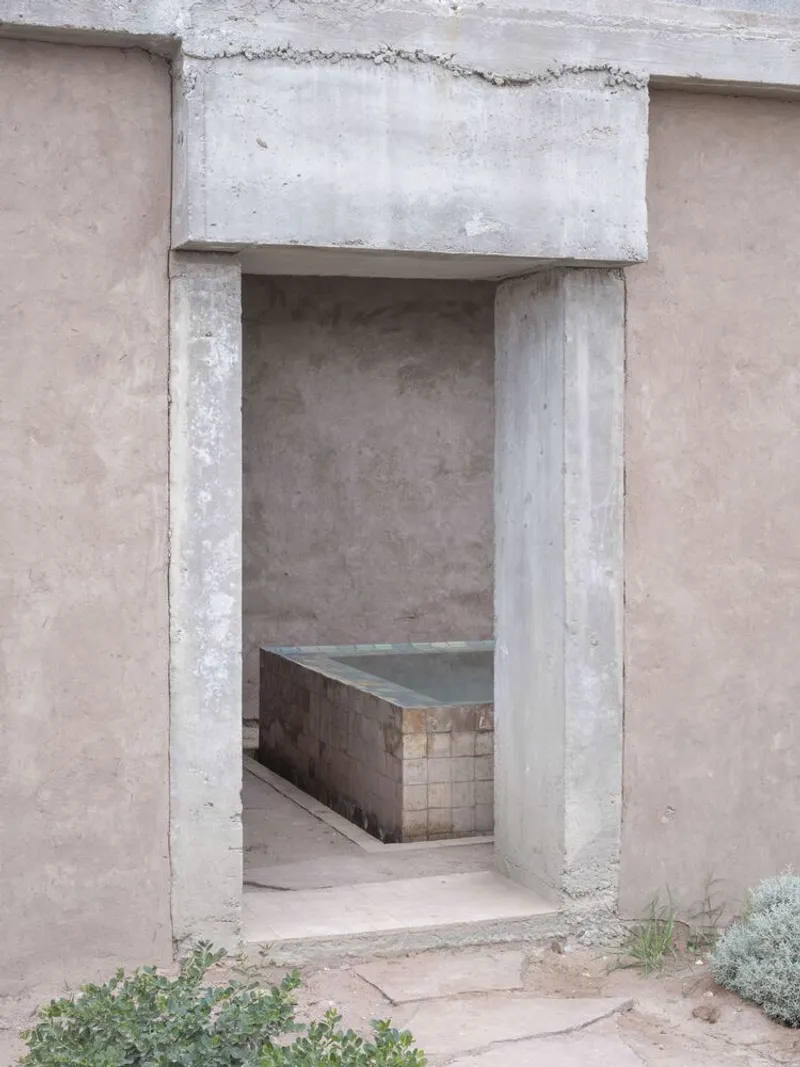
Water runs through Dar El Farina as both subject and system. The floor pools and tiled bathing basins are not ornamental. Water cools the air through evaporation, working in concert with the thick rammed earth walls and controlled ventilation to produce a microclimate that rarely requires mechanical assistance. A concrete doorway framing a sunken bathing basin could be a detail from a Roman villa or an Almoravid palace; the functional logic is identical in all three cases.
The design allows the mesref to continue operating, preserving the seasonal flooding that feeds the garden. Solar panels handle the modest electrical load. The house proves that "off-grid" need not mean high-tech survivalism. Here it means plugging into a grid that is a thousand years old and works perfectly well.
Sleeping and Living in Compression

The bedrooms are spare, almost ascetic. A concrete sleeping platform with rolled bedding sits beneath a board-formed ceiling, separated from adjacent spaces by glass partitions that maintain visual continuity while providing acoustic privacy. There is no furniture beyond the essentials. The architecture itself is the furnishing: the platform, the niche, the opening. This is a house that asks its occupants to live closer to the ground and closer to the rhythms of light and temperature that the building mediates.
In the living area, a sunken floor drops the seating below grade, wrapping inhabitants in the thermal mass of the earth. Overhead, the golden zellige skylight warms the palette. The combination of compression, colored light, and the sound of water nearby produces an environment that is both stimulating and deeply calm. It is a sensory strategy borrowed from traditional Moroccan architecture but executed with a contemporary restraint that strips away everything non-essential.
Why This Project Matters
Dar El Farina is significant because it treats sustainability not as a technological overlay but as a cultural inheritance. The rammed earth is not a fashionable material choice; it is what people in the Haouz plain have built with for centuries because it works better than anything else in this climate. The zellige tiles are not a nostalgic gesture; they solve a real problem of solar gain control while supporting a local craft economy. The irrigation system is not a landscape feature; it is working infrastructure that predates the building by a millennium. Léopold Banchini and Sana Nabaha had the intelligence to recognize that the most advanced technology available on this site was already there.
The project also reframes what an off-grid house can be. So much contemporary discourse around self-sufficiency fixates on batteries, insulation ratings, and photovoltaic arrays. Dar El Farina uses solar panels, but they are the least interesting part. The real energy strategy is the thick wall, the water basin, the skylight orientation, and the thousand-year-old underground gallery feeding the garden. In a moment when architecture is scrambling to invent new solutions to the climate crisis, this house suggests that some of the best solutions were invented long ago and simply need to be taken seriously.
Dar El Farina by Léopold Banchini Architects with Sana Nabaha. Al Haouz, Morocco. Completed 2024. Photography by Rory Gardiner.
About the Studio
Share Your Own Work on uni.xyz
If projects like this are the kind of work you want to make, uni.xyz is a place to publish your own, find collaborators, and enter design competitions.


Popular Articles
Popular articles from the community


Hill & Cross Opera: Sculptural Opera House Architecture Shaped by Tallinn’s Landscape and Identity
Hill & Cross Opera reimagines opera house architecture in Tallinn through its sculptural hill, civic plaza, glass wave and a luminous cross.

The Ocean Hive: Sustainable Architecture for a Self-Sufficient Civilization at Sea
The Ocean Hive imagines sustainable architecture at sea, where modular habitats, algae, wave power and ocean waste sustain a growing colony.

The Musturak Paradise: Senior Living Architecture for a Connected Future in Temara, Morocco
The Musturak Paradise reimagines senior living architecture in Temara via private homes, social spaces, culture, community, and shared care.

Conexión: Biophilic Design Reimagines High-Rise Living in Hong Kong
Conexión reimagines high-rise living in Hong Kong through biophilic design, green facades, shared spaces, daylight, water and nature within.


Similar Reads
You might also enjoy these articles


Hodi-Mandai Geram
Project Function: Preservation and revitalization of the Intangible heritage and socio-spatial identity of the Hodi by Housing, Cultural Memory Center, Sacred Grove, landscape, local tourism economy


Olio Towers: A Mid-Rise for Performers That Fuses Housing, Rehearsal, and Stage
Located blocks from Houston's Theater District, this modular tower stacks living units around a central performance atrium.

Oasis: Modular Green Housing Carved into Dhaka's Urban Fabric
A shortlisted Plugin Housing entry reclaims unauthorized settlements in Dhaka with stepped concrete volumes, green roofs, and ventilation-driven design.

Black Hole: A Floating Megastructure for the Post-Physical Era
Emiliano Mazzarotto envisions a spherical, self-scaling arena where e-sports, digital hotels, and holographic stadiums replace traditional public space.
Explore Desert Architecture Competitions
Discover active competitions in this discipline



Challenge to reimagine the Iron Throne


Photograph architecture without architects


Illustrate the lost glory of Angkor Wat - Render Challenge


Design challenge to reuse E-waste
Comments (0)
Please login or sign up to add comments
No comments yet. Be the first to comment!