

DOT Designs a Surat Apartment Around the Woman Who Holds It Together
A 3,400-square-foot interior in Surat, India uses concrete, terrazzo, and a rotated plan geometry to rethink domestic life for an Indian family.


A house is often a portrait of the people who live in it, but in India, where the woman of the house frequently spends her time looking after everyone else, that portrait tends to flatten her into a supporting role. DOT, the Surat-based practice led by Krishna Mistry and Anand Jariwala, set out to change that equation in a 3,400-square-foot apartment they call Kaleidoscopic House. The brief was deceptively simple: create enough opportunities for the family matriarch to actually sit down with her family rather than orbit it.
The result is an interior organized around a rotated-square geometry that creates diagonal sight lines, layered thresholds, and a series of shared zones where gathering is almost unavoidable. Concrete, terrazzo, and timber slats do the heavy lifting materially, while a careful arrangement of split levels, sunken platforms, and circular ceiling voids gives each zone its own gravity. It is, in the best sense, an apartment that refuses to let anyone retreat fully into their own corner.
Rotated Geometry, Diagonal Living


The plan's defining move is a rotated square inscribed within the apartment's orthogonal shell. Where the two grids collide, diagonal walls and angled ceiling planes generate triangular leftover spaces that DOT converts into alcoves, storage, and display niches. The effect is disorienting in the best way: you never quite face a dead wall, and the eye is always drawn through to another room or a filtered view of daylight.
Round concrete columns punctuate the open living zone, acting less as structural necessities and more as spatial markers that gently separate the lounge from the terrazzo platform seating area. Globe pendant lights hang from circular recesses cut into the ceiling, echoing the column geometry and drawing the eye upward. The whole composition reads as a calibrated tension between the circle and the square, the soft and the hard.
Concrete as Canvas
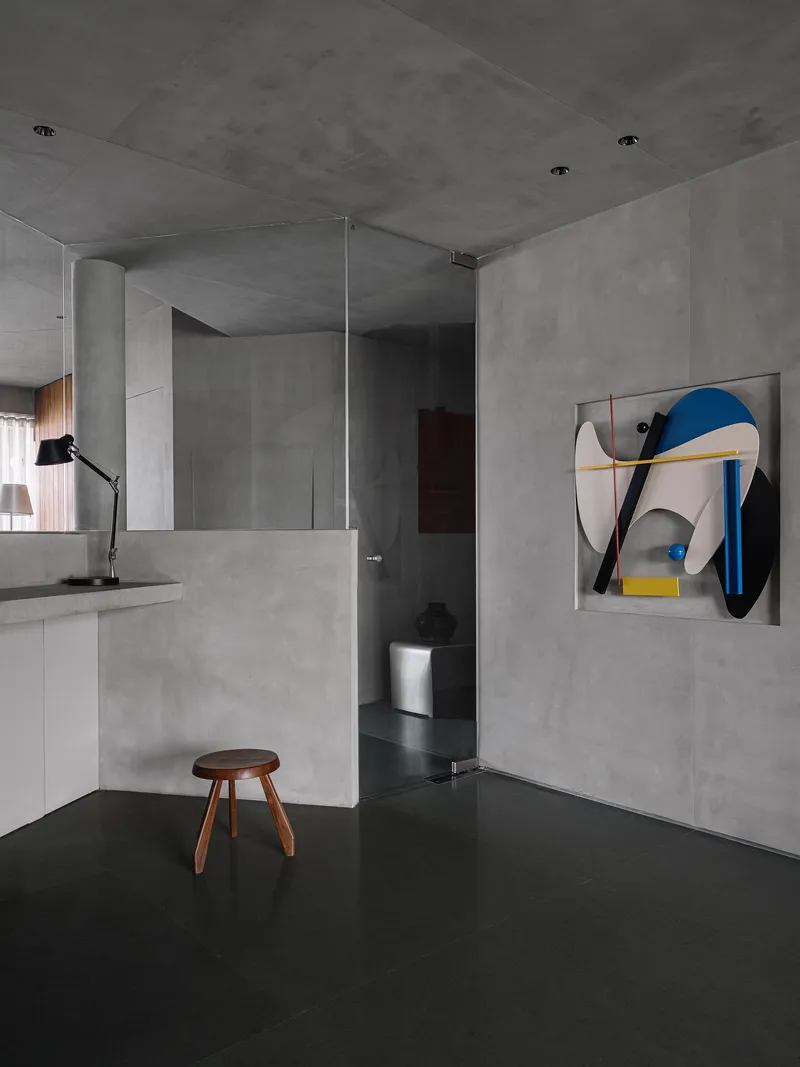

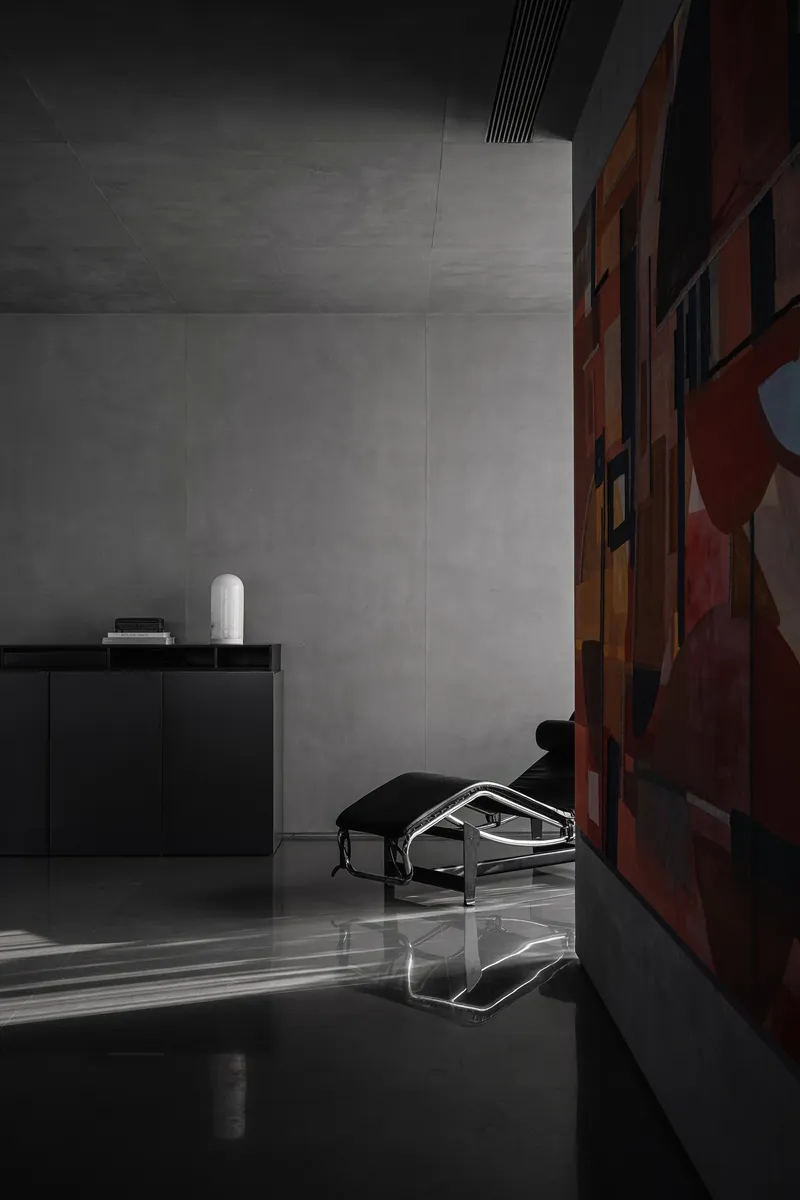
Raw concrete walls serve double duty here: they define the apartment's spatial hierarchy and provide a deliberately neutral backdrop for the family's art collection. Abstract geometric paintings, mounted without fuss on the grey surfaces, introduce the "kaleidoscopic" color that gives the project its name. A deep red sculptural wall piece above an upholstered bench, a colorful canvas beside a low armchair: each artwork feels like it chose its own spot.
This is a smart move. Rather than embedding color into the architecture through tiles or paint, DOT keeps the shell monochromatic and lets the inhabitants bring the vibrancy. The apartment can evolve as the family's taste changes, and no wall finish has to fight for attention against a carefully selected painting. It also means the architecture recedes just enough to feel lived in, not exhibited.
Timber Screens and Filtered Light
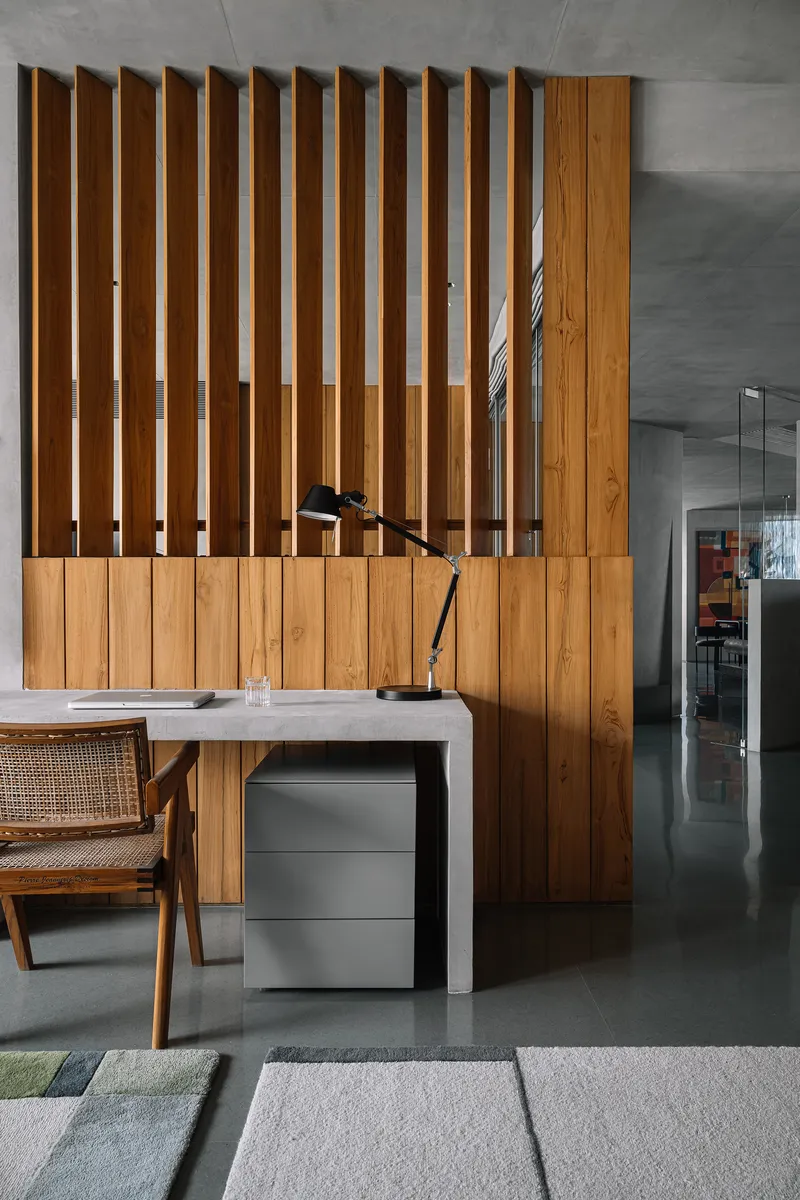

Vertical timber slat screens appear throughout the apartment, operating as partitions, door surrounds, and privacy filters. In the workspace, a slat divider separates the desk from the living zone without sealing it off, maintaining the acoustic intimacy that DOT clearly values. Reflected in a full-height mirror beside a built-in closet, the slats multiply themselves into a moiré pattern that changes as you walk past.
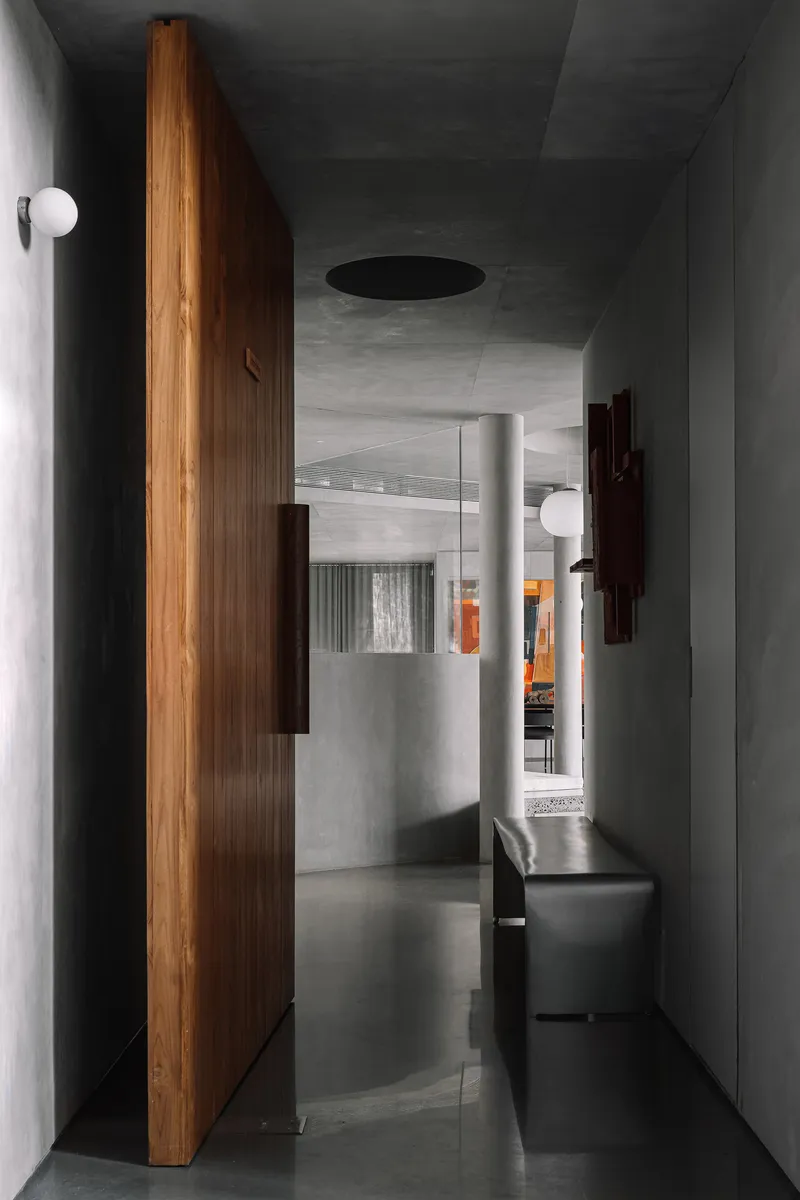
A corridor lined with vertical timber panels leads to a circular ceiling void that opens to an upper level, pulling borrowed light down into what would otherwise be the apartment's darkest spine. The strategy is consistent: no room is allowed to feel sealed. Every threshold offers a glimpse of the next zone, and every screen invites you to look through rather than at it.
Light, Shadow, and the Sheer Curtain
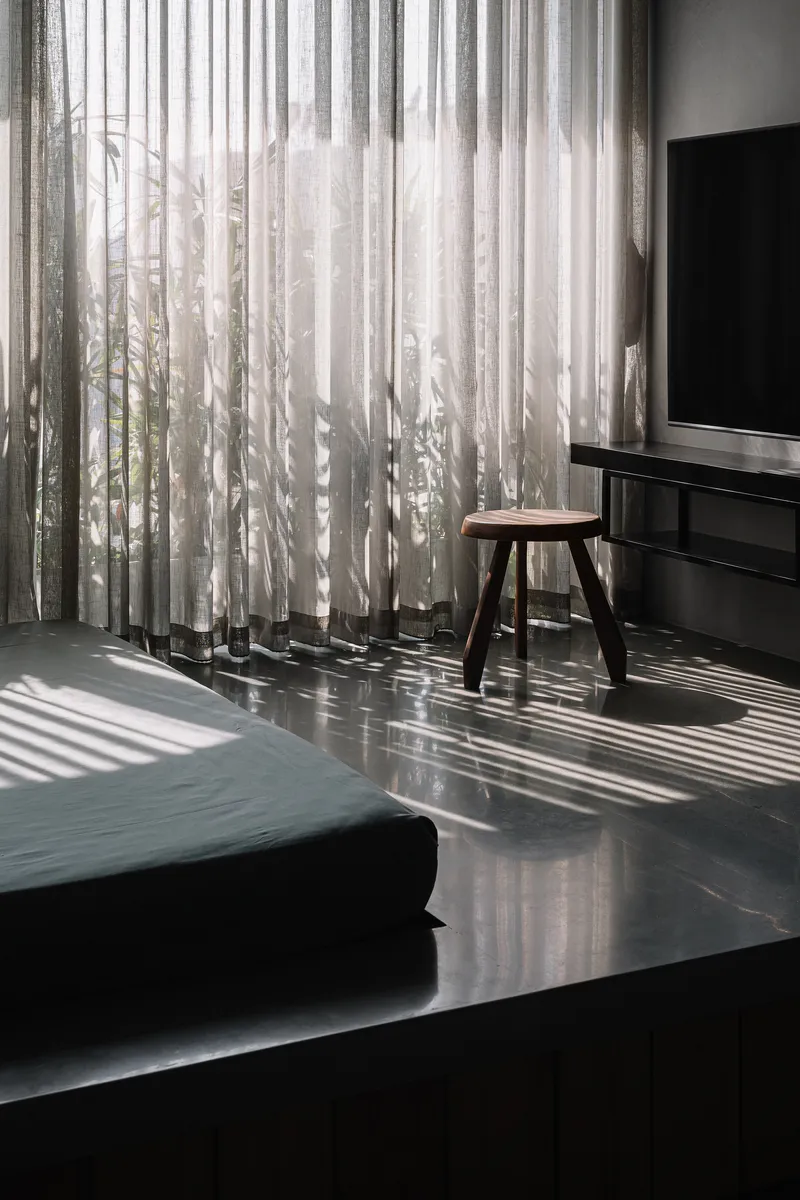


Some of the apartment's most arresting moments come from the simplest gesture: sheer curtains filtering Surat's intense afternoon sun into striped shadow patterns across polished dark floors. The reflections double the effect, turning the floor plane into a luminous field. In the powder room, slatted shadows and translucent fabric create a layered screen that makes a small space feel deep.
DOT clearly understands that in the Indian context, managing light is as important as admitting it. The apartment's windows are generous, but every one is mediated by at least one layer of translucency. The result is an interior that feels bright without ever feeling exposed, warm without ever feeling harsh.
Private Rooms and Hidden Respites

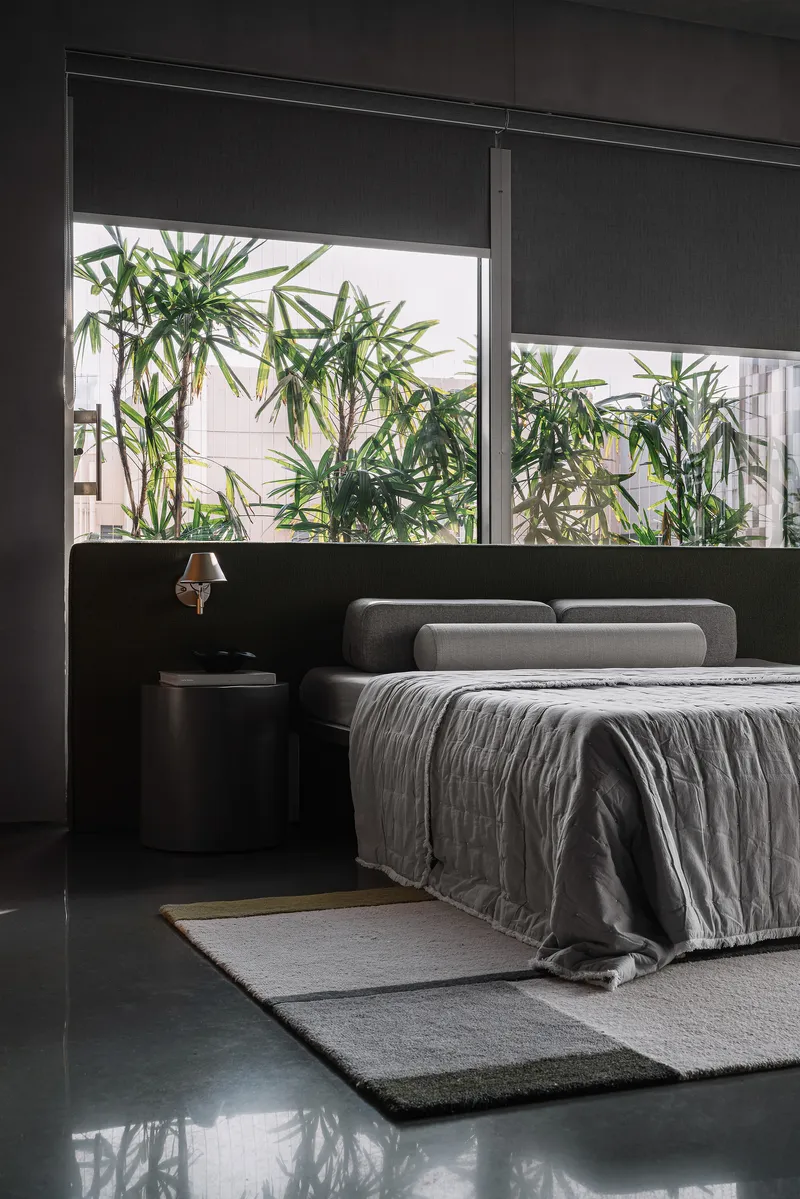

The bedrooms dial down the drama. Grey concrete ledges serve as headboards, cylindrical bolster cushions add a quiet domesticity, and pendant lights provide focused illumination. One bedroom frames a horizontal window that looks onto a courtyard planted with bamboo, a green pause in an otherwise mineral palette. It is a small luxury, but an effective one: the eye rests on living foliage rather than a neighboring balcony.
The bathroom continues the material logic with a floating concrete vanity and a glass-enclosed shower lined in small mosaic tiles. The tile shift is deliberate; in a home dominated by large unbroken surfaces, the fine grain of the mosaic signals that you have crossed into a different register of intimacy. Nothing about these rooms is showy, but everything is considered.
Kitchen and Courtyard as Social Anchors
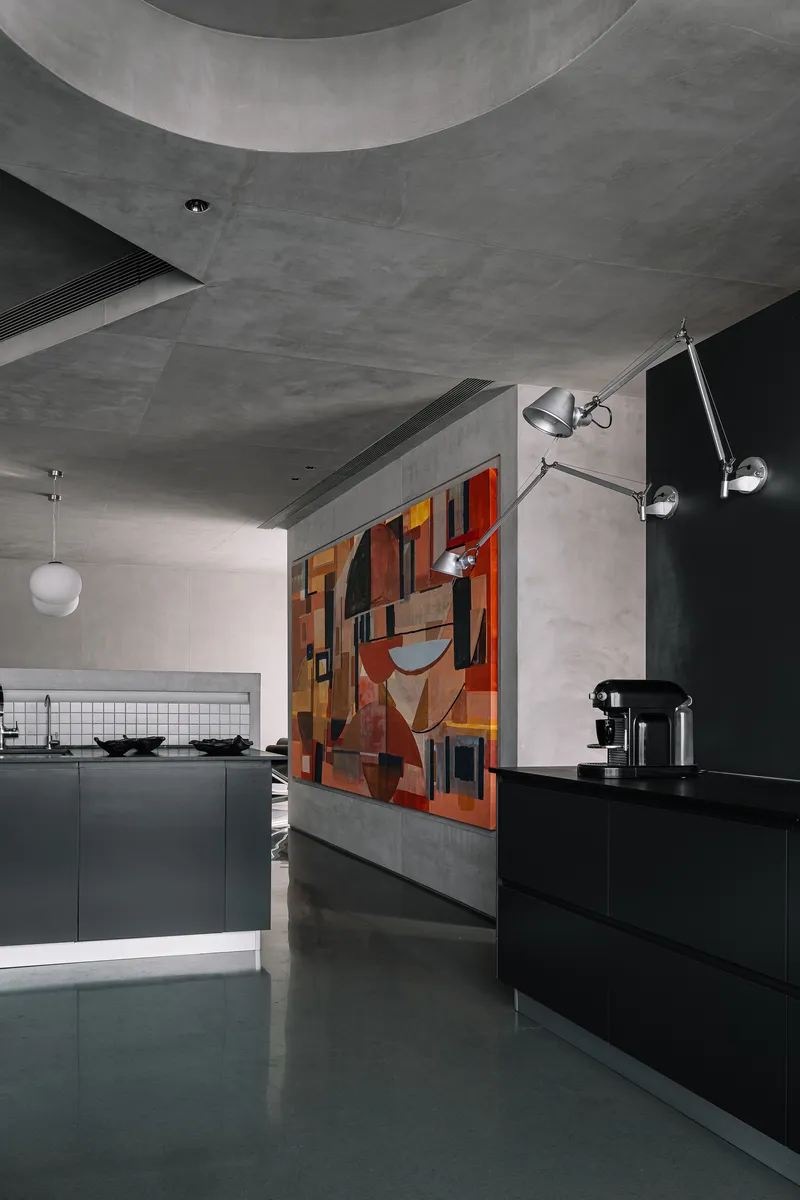

The kitchen breaks the apartment's monochromatic restraint with a colorful geometric mural behind black cabinetry, a move that positions cooking as a celebratory act rather than a service task. A grey concrete partition separates the kitchen from the living zone but keeps the two in visual conversation, a decision that directly supports the project's central thesis: the woman of the house should never be architecturally isolated from the family she is feeding.
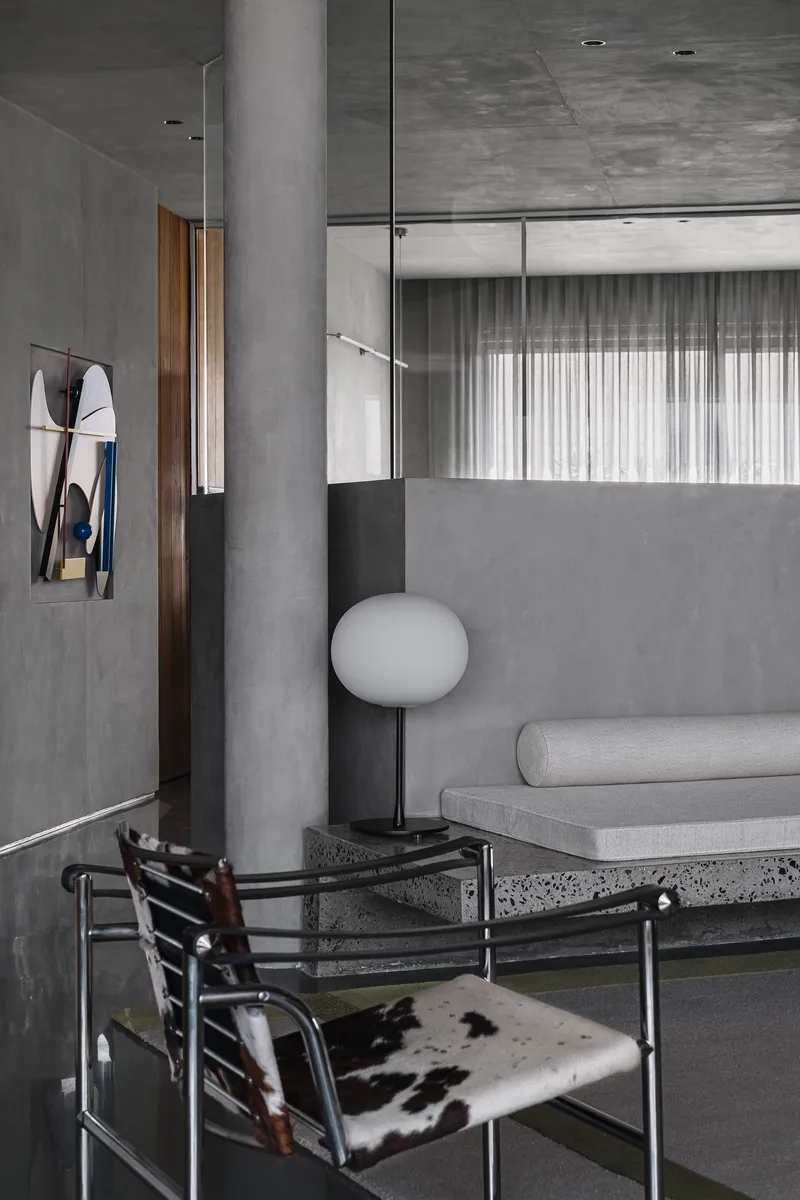
Through a doorway, a sunken pool with a timber-edged bench and tiled base introduces water as a cooling element and a gathering point. The seating nook nearby, with its terrazzo bench and cowhide chair overlooking frosted glass partitions, is the kind of corner that earns its keep on a slow Sunday. These are not spectacular rooms. They are rooms designed to make people stay.
Thresholds and Split Levels


DOT uses level changes with surgical precision. A terrazzo platform rises a few inches to define the seating area; a polished dark floor drops to mark the hallway. These shifts are subtle, never exceeding a step, but they do the work of walls without the visual weight. The hallway, with its circular ceiling recess and reflected timber cabinetry, becomes a room in its own right rather than a leftover corridor.
The vertical timber wall panels in the living space reach from floor to the exposed concrete ceiling, framing spherical pendant lights that glow like captured moons. The whole interior reads as a sequence of frames within frames, a spatial kaleidoscope where each vantage point recomposes the arrangement of surfaces, materials, and light. It earns its name.
Plans and Drawings



The floor plan reveals how the apartment's four bedrooms, five bathrooms, and service spaces wrap around central living zones that resist easy subdivision. An axonometric drawing makes the rotated-square strategy explicit: a diamond plan sits inside the rectangular envelope, with a central stair anchoring the composition and scattered yellow storage volumes popping out of the grey matrix like puzzle pieces. A concept diagram strips the idea to its essence: a red rotated square inscribed within a larger square defined by grey and black zones. It is a simple geometric rule, but in execution it generates the complex spatial experience that makes this apartment worth studying.
Why This Project Matters
The Kaleidoscopic House is not a luxury apartment in the conventional sense. Its furnishings come from names like Cassina, Living Divani, and Artemide, and its finishes are impeccable, but the real ambition is social rather than material. DOT has designed an apartment that makes togetherness the path of least resistance. Every threshold is porous, every sightline connects two zones of activity, and the woman for whom the home was conceived is never architecturally sidelined. That is a quietly radical proposition in a domestic culture where the kitchen is still too often a room with its back turned.
At 3,400 square feet, the apartment is generous by Indian urban standards, and DOT uses every inch of that generosity to create a spatial complexity that belies the plan's simple geometric premise. The rotated square is a formal trick, yes, but it works because it serves a human agenda. Architecture at this scale often defaults to decoration. Here, it defaults to connection, and that makes all the difference.
Kaleidoscopic House by DOT (Lead Architects: Krishna Mistry and Anand Jariwala). Surat, India. 3,400 sq ft. Completed 2025. Photography by Ishita Sitwala | The Fishy Project.
About the Studio
Share Your Own Work on uni.xyz
If projects like this are the kind of work you want to make, uni.xyz is a place to publish your own, find collaborators, and enter design competitions.


Popular Articles
Popular articles from the community


LT2A and OPEN Architectes Thread a Brick and Glass High School Through a Wooded Belgian Campus
In Braine-l'Alleud, a 3,000 m² wing for Collège Cardinal Mercier pairs pale brick with a glazed colonnade, deferring to a small chapel and a dense wood.

Architekt Andreas Gruber Scatters 23 Dark Timber Chalets Across a South Tyrolean Forest Edge
In Molini di Tures, Amonti Chalets breaks a resort into a hamlet of gabled timber houses, with parking, storage and services pushed into the slope.

U.GA Architects Wraps an Oval Rooftop Pool in Curved Board-Formed Concrete on Busan's Jeollidan-gil
In Busan's Jeonpo-dong, a 454 m² mixed-use block stacks a neighborhood facility, guest rooms and an oval rooftop pool inside spiraling concrete walls.

Jaramillo Van Sluys Arquitectura and Urbanismo Turn a Demolished Registry Lot in Quito into an Orchard Plaza
In Quito's Centro Histórico, a 2,800 m² plaza exposes the San Agustín convent wall and redraws its lost Augustinian orchard in volcanic stone.

Similar Reads
You might also enjoy these articles


LAVA Architecten Gives Vocational Education a Sawtooth-Roofed Face on a Mechelen School Campus
In Mechelen, Belgium, a 2,053 m² STEM school on a 6×6 m grid turns workshops and classrooms into rooms that can be rearranged as teaching changes.

KEMA Studio Turns a Derelict Marvila Attic into a 60 m² Lighthouse Apartment Above Lisbon
In Lisbon's Marvila district, a rebuilt roof, four skylights and two plywood volumes turn an unlivable attic into a bright home facing the Tagus.

Pixel Gardens: One Repeated Module Stacked Into a Terraced Social Housing Tower for Famagusta
Salem Bader's shortlisted housing tower builds a vertical neighbourhood from one repeated module, offsetting units to carve terraces, light and air.

Bao Huynh Watercolor Atelier: A Serene Art Retreat in Hội An
Bao Huynh Watercolor Atelier in Hội An blends multifunctional art spaces, sustainable design, local materials, and family-friendly living in a serene environment.

Explore Samira Rathod Design Atelier Competitions
Discover active competitions in this discipline

Comments (0)
Please login or sign up to add comments
No comments yet. Be the first to comment!