
Enhancing the self-learning experience - Juror's opinion
A discussion on libraries of future


As the system of acquiring knowledge does not remain conventional anymore, it is now being transferred into digital media. Self-learning is also explored in all dimensions and mediums, grasped by anyone who has access to the same. The mere presence of digital media and the web has made this absorption simpler by dissipating information-based knowledge to everyone. Yet, such a learning place that is open to all is still finding its physical space in the urbanscape.
Libraries, that acted as the public centre for storing information, and knowledge in the form of books are no more updated with the new age requirements and spaces. With digitization, the internet and modern-day learning, the public’s interest in Libraries is diminishing. In the wake of this issue, “Unyt” has launched Libgen challenge that aims to rewrite the definition of public libraries through refreshing spatial ideas. The Lead Jurors from the Jury panel of this challenge have shared their perspectives on the same.
1. How can architecture and spatial planning contribute to an individual’s self-learning experience in a library (public space)?
First, it is important that architecture provides space for learning without reservations - that is, for all, and possibly at any time.
Secondly, it is important that very different spaces are designed. That means the classical, quiet reading places but also - and that is missing in many libraries today - places for communication, so the common learning in pairs or in groups.
And third, the atmosphere of the learning location is important: how do I sit? what do I see? How is the light?
-Kurrle Volker
2. How can the libraries of today receive an update at a considerable scale to regain the diminishing interest as a public space?
I think the interest in libraries as social places of public exchange is very big today. Among other things, the challenge is to reconcile this new (loud) program with the traditional (quiet) program of a library.
-Kurrle Volker
3. How can the libraries of today democratize education and learning through architecture?
Libraries that have successfully reinvented themselves have created environments that promote social interaction and incubation. Traditional room definitions have generally given way to larger spaces that support active, contemporary programs. Patrons are no longer requested to be quiet. In addition to real-time interactions, so too making digital tools accessible across a broad spectrum of society becomes critical in any discussion of democratization. Ways of learning now vary broadly and the new library is inclusive, exciting, often instagrammable and uniquely contingent upon the community it serves.
-Willis Pember
4. What can be some of the evolutionary ideas that are explored in the designing of a Library for the next generation?
One way Libraries have successfully reinvented their mission is to utilize the concept of mixed uses: film screening rooms, cafes, public terraces, play areas for the very young and performance spaces. These uses have effectively transformed Libraries into ‘community centres’ or ‘community colleges’. We see spaces that deliver on the notion of ‘content creation’ – music composition, 3D printing, textile arts – all employing sophisticated digital tools not readily accessible to individuals. Further, in these libraries, we see program spaces that encourage collaboration–spaces for business development and student work supported by small conference rooms and lounges.
-Willis Pember
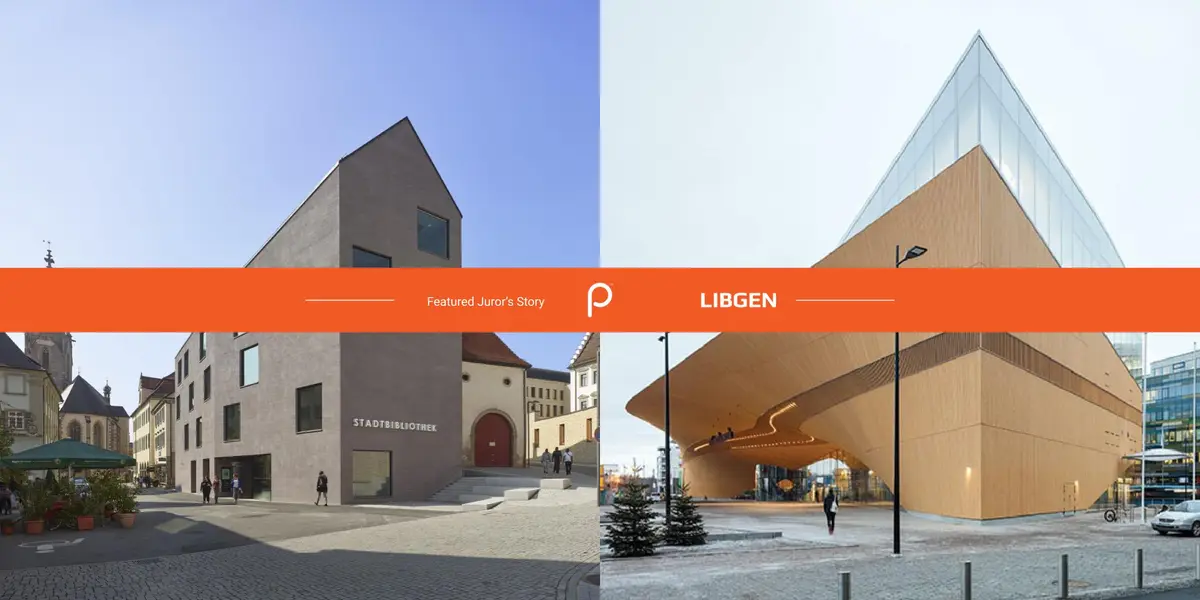
The following is an example of two libraries designed by a team of architects from Willis Pember Architects and by harris + kurrle architekten bda and his team, which can be observed as a point of inspiration and case study for the participants of this challenge.
Title of the Project: Oodi Helsinki Central Library
Project Location: Helsinki, Finland
Project Category: Public Architecture
Project Area/Builtup Area: 17250. m2
Project Duration: 2012 (competition) -2018
Project Budget: 107 million USD
Project Team
ALA Architects | Ramboll - Structural engineering
Project Description :
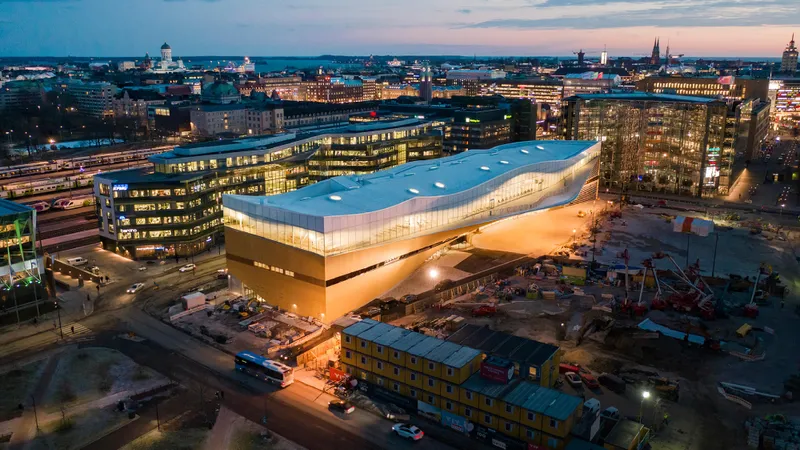
Oodi occupies a significant site in central Helsinki: facing the steps of the Finnish parliament building, the Eduskuntatalo across the Kansalaistori square, a public space flanked by major civic institutions.
The siting of Oodi opposite the Eduskuntatalo was chosen to be symbolic of the relationship between the government and the populace, and act as a reminder of the Finnish Library Act’s mandate for libraries to promote lifelong learning, active citizenship, democracy and freedom of expression. It also places the new library in the heart of Helsinki’s cultural district, close to many of the capital’s great institutions.
Oodi has a peaceful open-plan reading room on the upper floor that has been nicknamed “book heaven”, but books only fill one-third of the space within the library. By reducing on-site storage and consulting library users on how they access to culture, the designers and librarians of Oodi have been able to introduce facilities including a café, restaurant, public balcony, movie theatre, audio-visual recording studios and a maker space. This is representative of broader experimentation within Finnish libraries to offer new services in addition to loaning books.
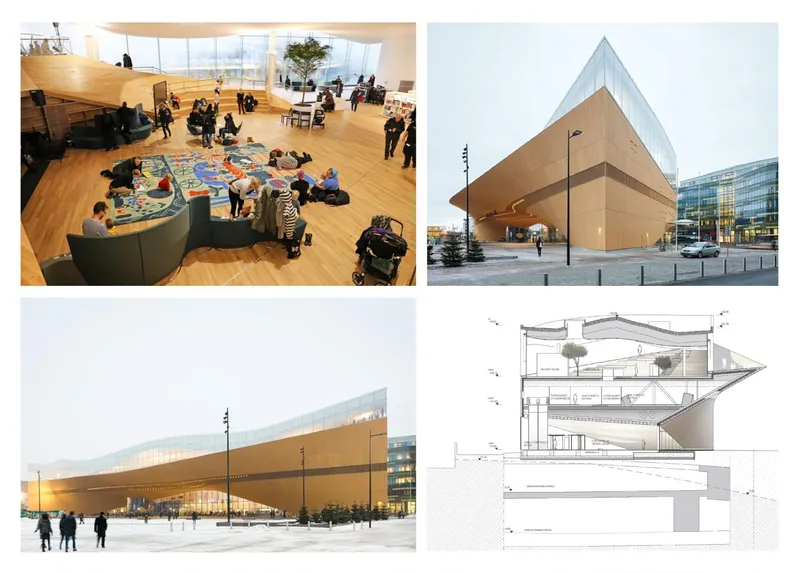
The design divides the functions of the library into three distinct levels: an active ground floor that extends the town square into an interior space; “book heaven” on the upper level; and an enclosed in-between volume containing rooms to accommodate additional services and facilities within the library. This spatial concept has been realized by building the library as an inhabited bridge, with two massive steel arches that span over 100 meters to create a fully enclosed, column-free public entrance space, clusters of rooms grouped around the structure, and the open-plan reading room carried above.
Oodi has been built using local materials and with local climate conditions in mind. The timber façade is clad with 33-millimetre-thick Finnish spruce planks that conform to the sweeping curve that extends the building outwards to create a canopy above the Kansalaistori square, blending the interior and exterior spaces and creating shelter for public events in front of the library.
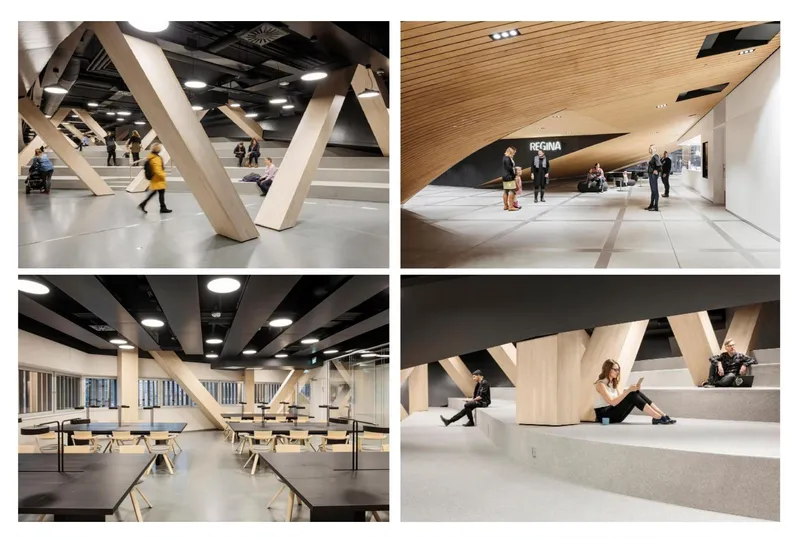
The ground floor of Oodi extends the Kansalaistori square into an interior public space. The purpose of the ground floor is to make each of the facilities of the library apparent and accessible and provide a non-commercial interior space open to all, every day of the week. Kino Regina, the National Audiovisual Institute’s movie theatre will occupy a space on the ground floor, together with a cafe-restaurant with seating that will spill out onto the square in the summer months.
The middle floor, known as the “Attic”, consists of flexible rooms arranged around the intimate nooks and corners that inhabit the spaces between the trusses of the bridge structure. The multi-function rooms are designed to accommodate both noisy and quiet activities and it is on this floor that Oodi will offer facilities such as its maker space and recording studios.
“Book Heaven” on the top floor, is a vast open landscape topped with an undulating cloud-like white ceiling punctured by circular roof lights. Here the best characteristics of the modernist library meet the possibilities provided by 21st Century technologies. The serene atmosphere invites visitors to read, learn, think and enjoy themselves. From this level, visitors can enjoy an unobstructed 360-degree panorama view of the city centre, or step out onto the terrace overlooking Kansalaistori square.
---------------------------------
Title of the Project: City Library Rottenburg
Project Location: Rottenburg am Neckar, Germany
Project Category: Public Architecture
Project Duration: 2013 - 2017
Project Team
Lead Architects: Vojtech Bast, Bertram Wruck, Florian Foetsch, Kristina Herberg, Mirko Schaab
Other participants:
Client: Stadt Rottenburg am Neckar, represented by Hochbauamt, Rottenburg am Neckar
Construction management: Göppel Strittmatter Hallig, Gesellschaft von Architekten mbH, Ludwigsburg
Landscape architect: Schmid | Treiber | Partner Freie Landschaftsarchitekten, BDLA, IFLA, Leonberg
Structural Engineer: Engelsmann Peters GmbH Beratende Ingenieure, Stuttgart
Building services planning: Heimann Ingenieure GmbH, Lorsch
Building physics planning: TEB GmbH, Vaihingen/Enz
Fire protection planning: Planungsgruppe Kuhn GmbH & Co.KG, Sindelfingen
Kitchen planning: Edgar Fuchs GmbH, Kirchentellinsfurt
Photo credits: Roland Halbe, Stuttgart
Project Description :
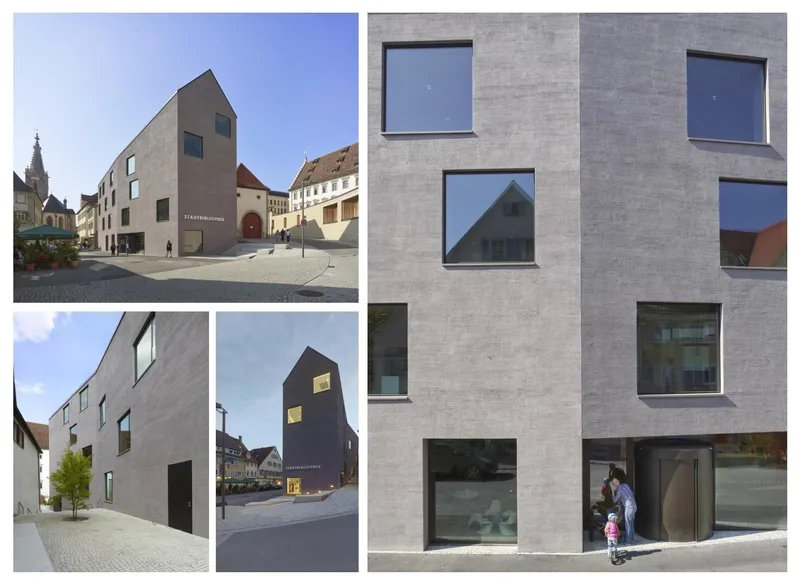
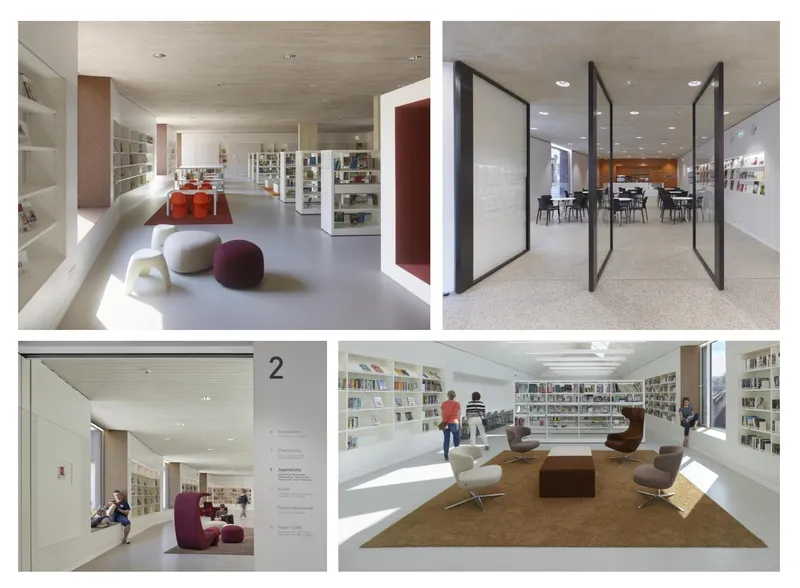
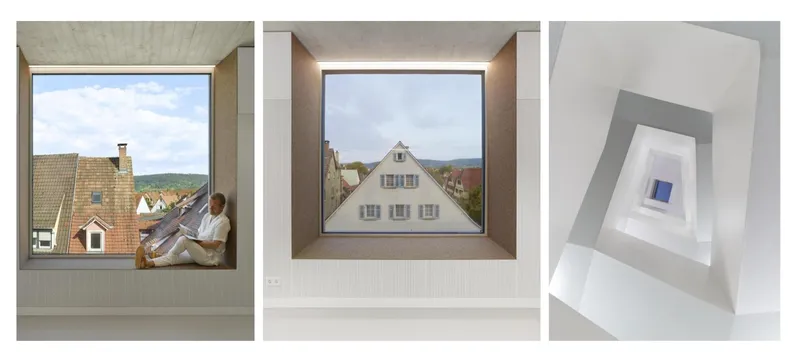
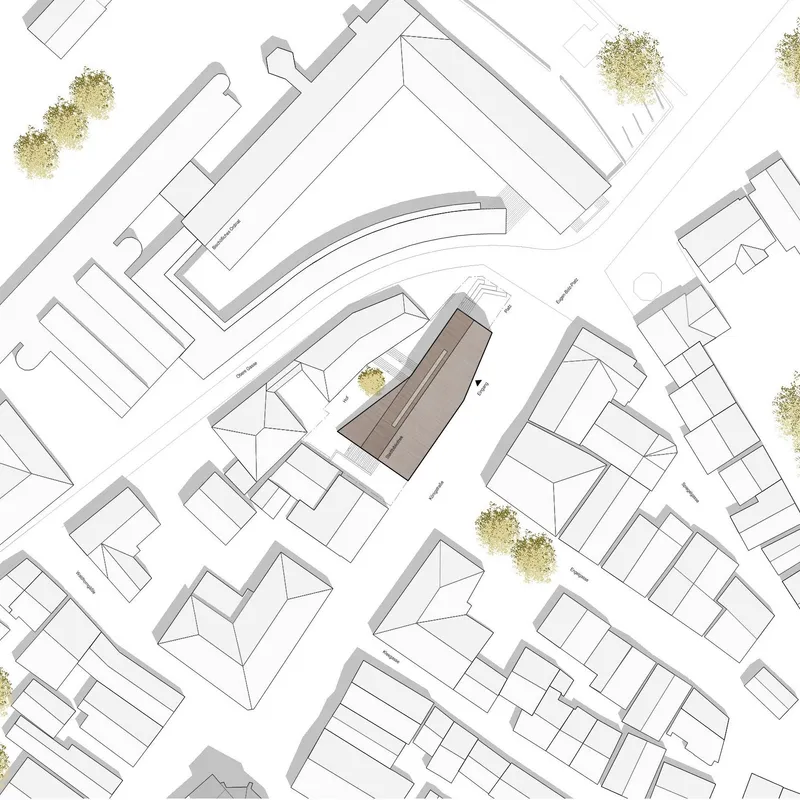
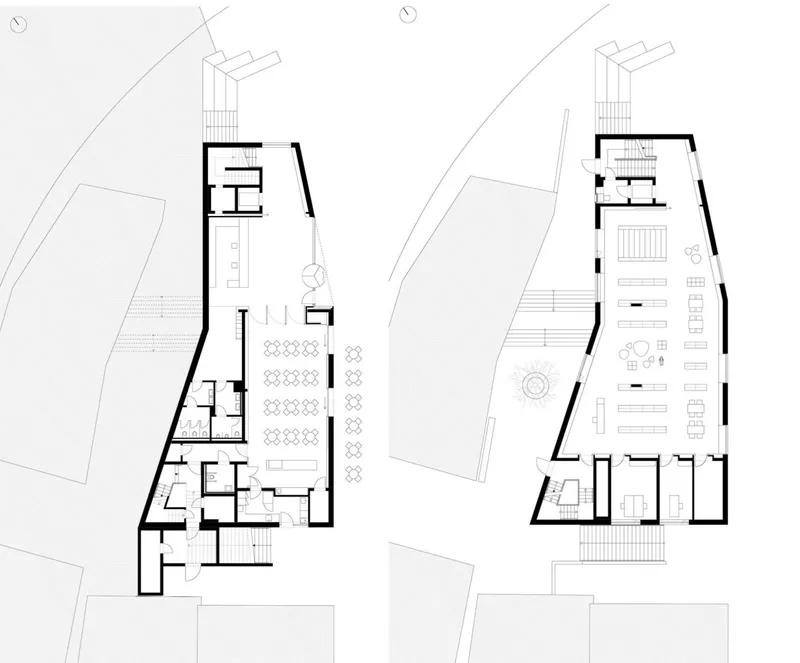
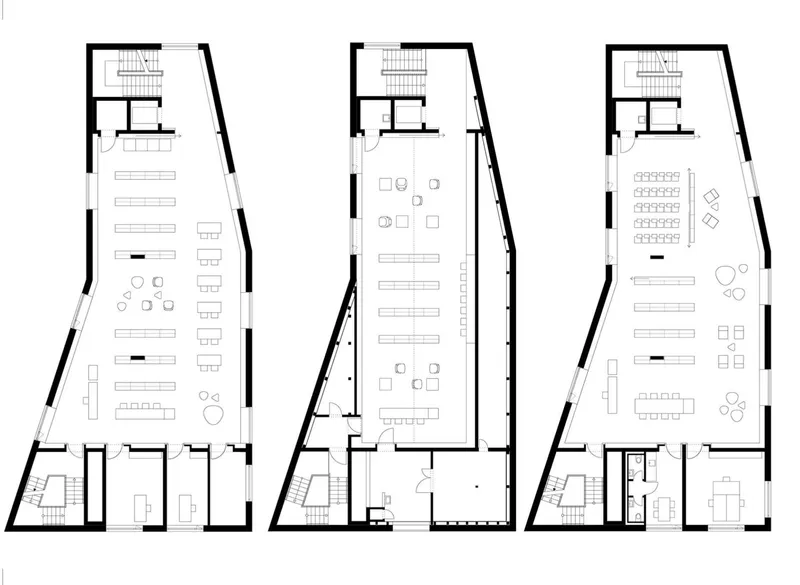
The new town library is built in the town centre, between the medieval town centre and the Episcopal palace, serving on this prominent site as a new public meeting place. The result is a communicative building in the urban fabric. Communication means, on this urban-spatial level, that topics of the environment are recorded, interpreted and re-rendered. So something new emerges whose “genetic code” is drawn from the environment. The building form for the city library was developed from the cranked form of the neighbouring buildings. This creates a spatial dialogue. The library is located at the interface of very different scales. The varying eaves heights of the new building - due to the straight pitched roof on the cranked building plan transfers between the grandeur of the Episcopal Palace and lower buildings of the old town. The entrance level, with a generous reception desk, is about public communication and is characterized by its maximum openness. An open house for the citizens of the city with a cafe that can also be used for events in the evening. The upper floors are available to the public for reading and learning. The extensive walls are largely covered with library shelves. These are interrupted by large windows with deep reveals, which are suitable for sitting and reading. The readers in the windows become visible from the outside, proclaiming the function of the building into the public space
Discover the full results here: https://uni.xyz/competitions/libgen/entries
Discover the design brief here: https://uni.xyz/competitions/libgen/info/about
Follow us on social media: Facebook | Instagram | LinkedIn | Twitter | Youtube
Discover other design competitions to participate here: https://uni.xyz/competitions


Popular Articles
Popular articles from the community


LT2A and OPEN Architectes Thread a Brick and Glass High School Through a Wooded Belgian Campus
In Braine-l'Alleud, a 3,000 m² wing for Collège Cardinal Mercier pairs pale brick with a glazed colonnade, deferring to a small chapel and a dense wood.

Architekt Andreas Gruber Scatters 23 Dark Timber Chalets Across a South Tyrolean Forest Edge
In Molini di Tures, Amonti Chalets breaks a resort into a hamlet of gabled timber houses, with parking, storage and services pushed into the slope.

longwave studio Reorganizes a 112 m² Tainan Apartment Around the Daily Routines of a Family and Two Cats
In Tainan, Taiwan, birch plywood, rust-red furniture and a freestanding plaster wall link arrival, storage, work and family life in one apartment.

David Macias Steps a Doorless Stone and Plaster House Down a Tropical Colombian Hillside
In the humid hills of Colombia, Threshold House replaces the front door with an open void and terraces its 850 m² down the slope instead of fighting it.

Similar Reads
You might also enjoy these articles

Gil Mello Arquitetura Tilts a Single Roof Toward the Waterfalls on a Plateau Above Aiuruoca, Brazil
In Aiuruoca, Minas Gerais, a 200 m² house of local labor and reclaimed poles pairs a low valley veranda with a tall mountain one.

U.GA Architects Wraps an Oval Rooftop Pool in Curved Board-Formed Concrete on Busan's Jeollidan-gil
In Busan's Jeonpo-dong, a 454 m² mixed-use block stacks a neighborhood facility, guest rooms and an oval rooftop pool inside spiraling concrete walls.

Felipe Hess Arquitetos Turns a Blind Stone Wall to the Street and Opens a Brazilian House onto a Courtyard and Canal
A canal-front house in Brazil hides behind painted stone and planting, then opens to an olive-tree courtyard, a reed-ceilinged porch and a curving pool.
David Macias Steps a Doorless Stone and Plaster House Down a Tropical Colombian Hillside
In the humid hills of Colombia, Threshold House replaces the front door with an open void and terraces its 850 m² down the slope instead of fighting it.

Comments (0)
Please login or sign up to add comments
No comments yet. Be the first to comment!