
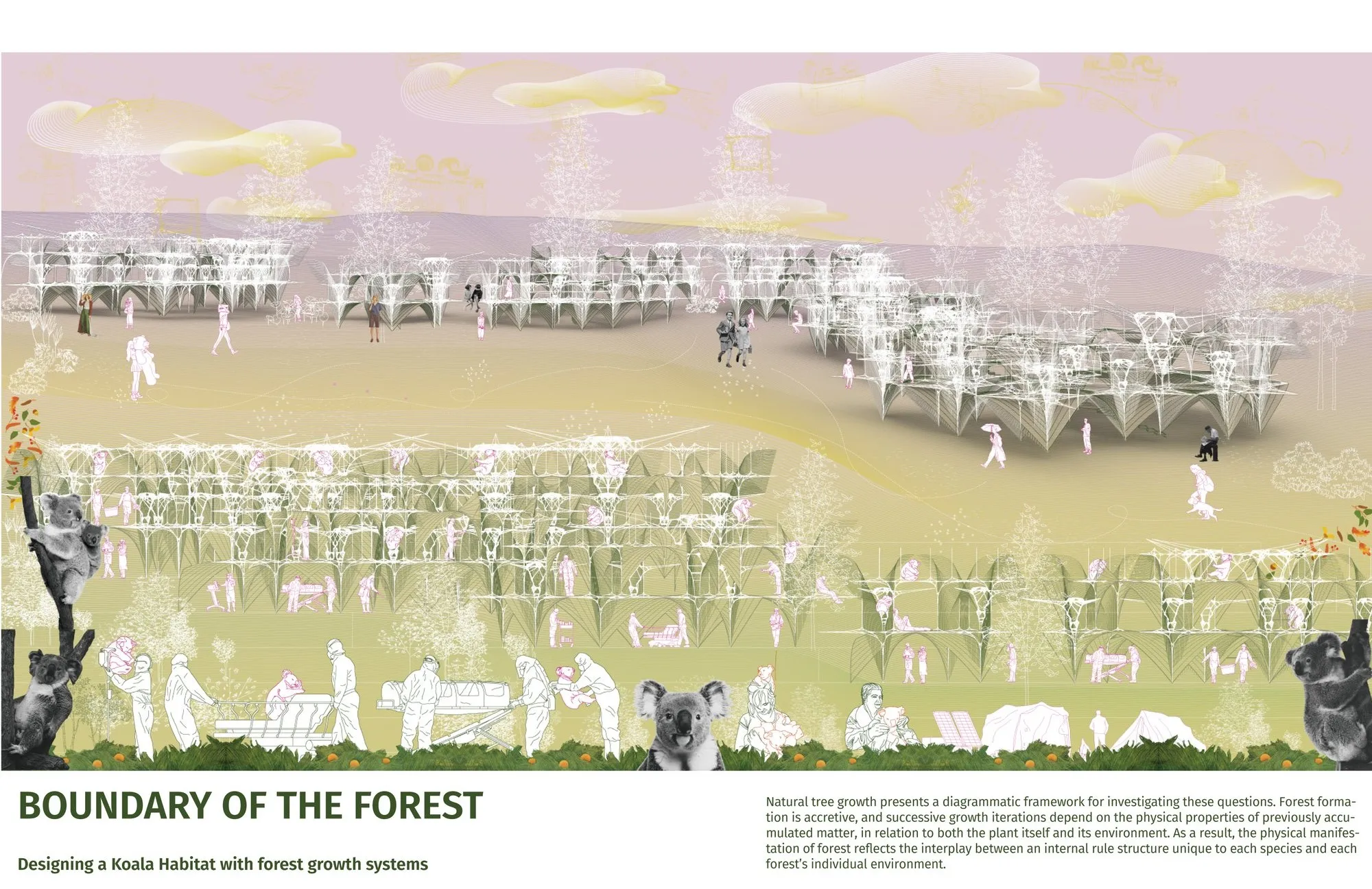
Boundary of Forest: A Biophilic Architecture Proposal for Koala Habitat Conservation
Boundary of Forest transforms eucalyptus ecosystems into biophilic architecture that reconnects koalas, humans, and nature.


Reimagining Wildlife Conservation Through Biophilic Architecture
As climate change, deforestation, and rapid urbanization continue to threaten wildlife ecosystems across Australia, architecture is increasingly being challenged to move beyond human-centered design. Contemporary sustainable architecture is now expected to engage with ecological restoration, biodiversity protection, and environmental coexistence. “Boundary of Forest,” designed by YuHan Gu, explores these concerns through an experimental biophilic architecture proposal focused on koala habitat rehabilitation.
Recognized as an Editor’s Choice entry in Haven 2020, the project investigates how forest systems can become architectural systems. Rather than imposing built structures onto nature, the proposal studies the growth logic, branching patterns, spatial relationships, and environmental conditions of eucalyptus forests to generate an adaptive architectural language rooted in ecological behavior.
The result is an immersive wildlife architecture concept that creates a sensitive relationship between humans, koalas, and the surrounding environment while promoting rehabilitation, education, conservation, and environmental awareness.
Translating Forest Systems into Architectural Language
At the core of Boundary of Forest is the idea that forests are not static landscapes but living, evolving systems. The project approaches the eucalyptus forest as a computational and spatial framework capable of informing architecture at multiple scales.
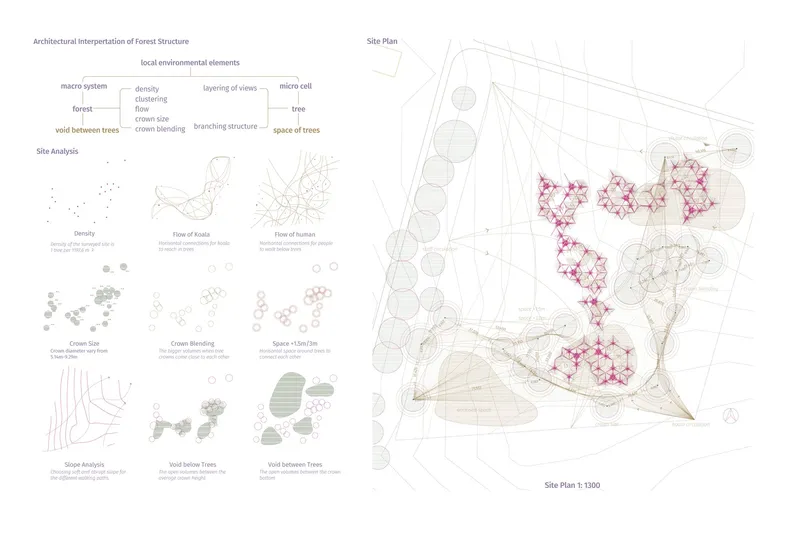
The design studies forest density, branching structures, crown blending, circulation paths, spatial voids, and growth formations to create an architectural environment inspired directly by ecological organization. Instead of relying on conventional building typologies, the proposal develops structures that emulate the layered complexity of forest canopies and branching networks.
The architectural diagrams reveal an extensive investigation into koala behavior, sleeping positions, human interaction, and environmental flow. These biological and spatial observations become generators for the structural logic of the project. Through this process, architecture becomes less of a singular object and more of an ecosystem itself.
This approach strongly aligns with contemporary biophilic architecture principles, where built environments are designed to strengthen human relationships with nature while minimizing ecological disruption.
Designing a Habitat Around Koala Behavior
Unlike traditional conservation facilities that separate wildlife from human occupation, Boundary of Forest proposes a coexistence model. The project creates interconnected spatial systems that allow both koalas and visitors to inhabit the same environmental framework while maintaining appropriate boundaries.
The design carefully studies koala movement patterns and sleeping behaviors within eucalyptus forests. Elevated structures emerge from the ground like branching trunks, allowing koalas to occupy upper layers while human circulation remains integrated within lower and transitional levels.
This layered circulation strategy creates distinct environmental territories without disconnecting users from the natural experience. Visitors move through pathways and observation zones that encourage awareness and empathy toward wildlife habitats, while koalas are provided protected spaces for rehabilitation, rest, and movement.
The project’s site planning demonstrates how architecture can adapt to existing environmental conditions rather than erasing them. Existing tree formations, crown densities, and terrain slopes become primary determinants of spatial organization. This minimizes ecological disturbance while reinforcing the continuity of the forest ecosystem.
Parametric Design and Computational Growth Systems
One of the most compelling aspects of the project is its use of computational design methodologies. Boundary of Forest transforms branching systems found in forests into generative architectural structures through simulation-based design processes.
The project’s diagrams illustrate how pyramidal geometries, polyhedral subdivisions, and branching studies evolve into complex structural systems capable of adapting to environmental conditions. The resulting architecture resembles organic growth patterns rather than rigid construction grids.
This use of parametric architecture allows the design to respond dynamically to spatial constraints, circulation needs, structural forces, and environmental variation. Instead of repeating static forms, the architecture develops through iterative growth processes similar to biological evolution.
The branching structural language also contributes to the project’s visual identity. Lightweight frameworks expand vertically and horizontally across the site, creating porous spatial boundaries that blur distinctions between architecture and forest.
Through digital modeling, physical prototyping, and material experimentation, the proposal demonstrates how computational architecture can become a tool for ecological responsiveness rather than purely aesthetic expression.
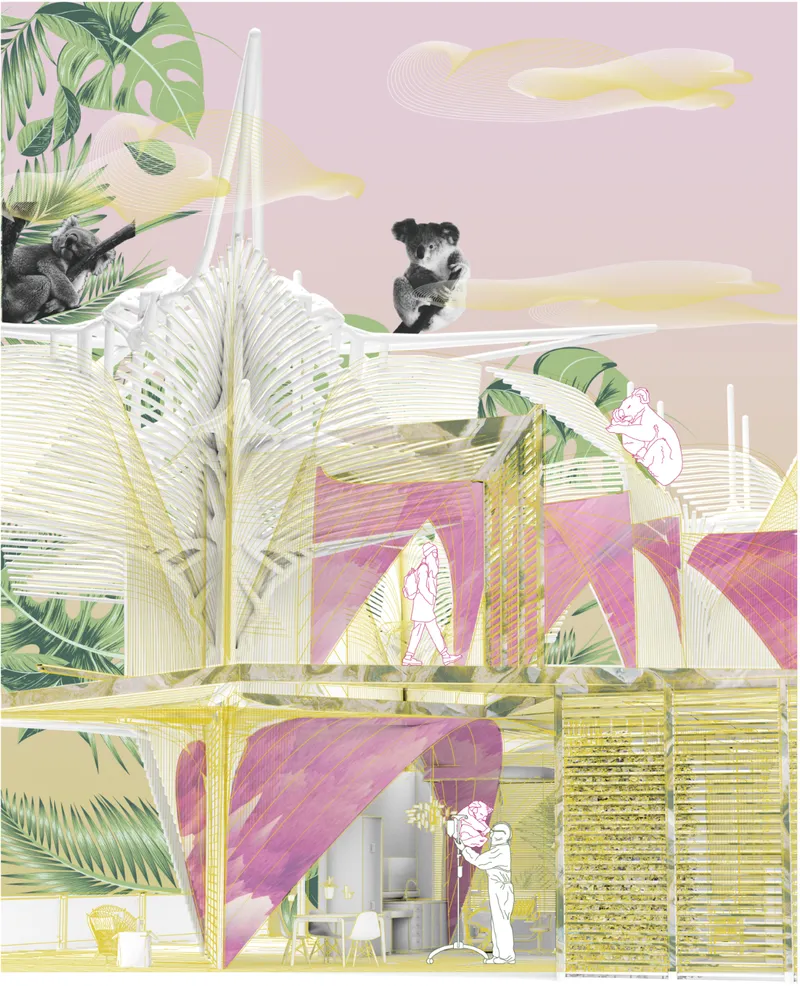
Spatial Experience and Environmental Immersion
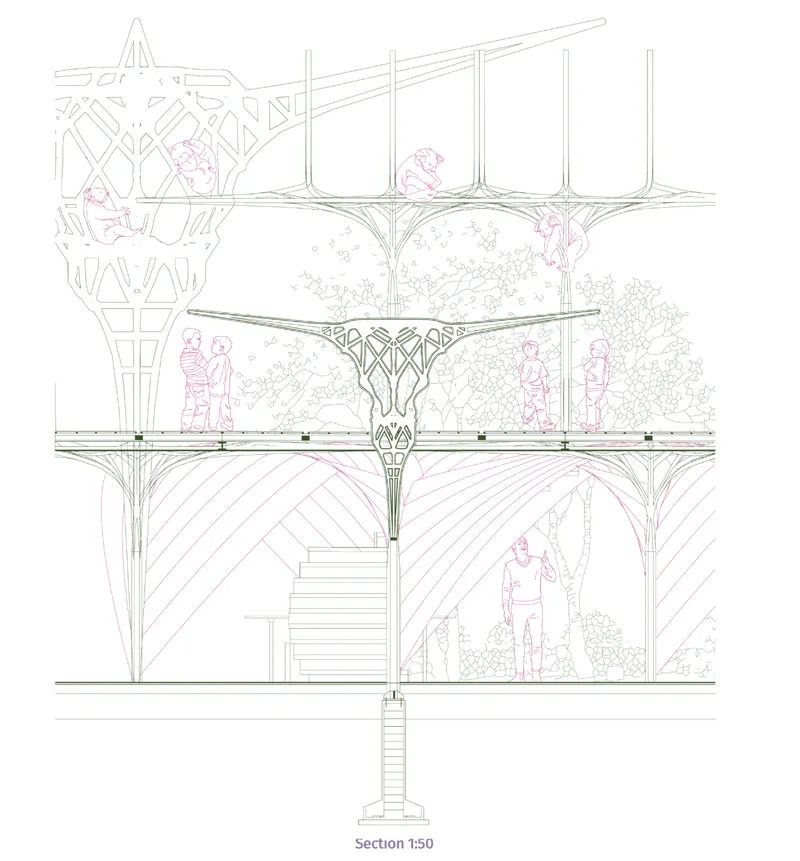
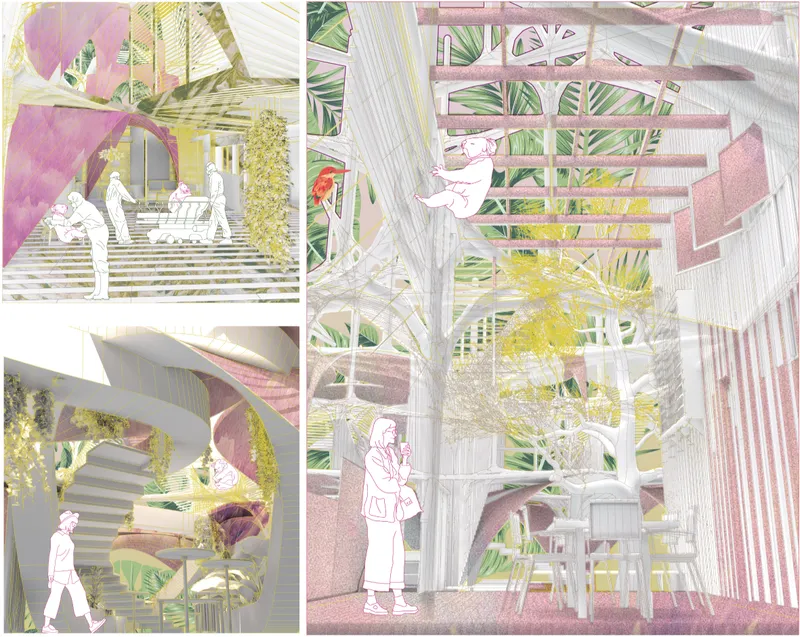
Boundary of Forest creates an experiential environment where architecture becomes inseparable from landscape. The rendered interior and sectional perspectives reveal layered spaces filled with filtered light, suspended circulation systems, organic structural supports, and integrated vegetation.
Rather than enclosed rooms, the project emphasizes open environmental continuity. Transitional zones allow visitors to experience changing relationships between enclosure, openness, vegetation, and wildlife.
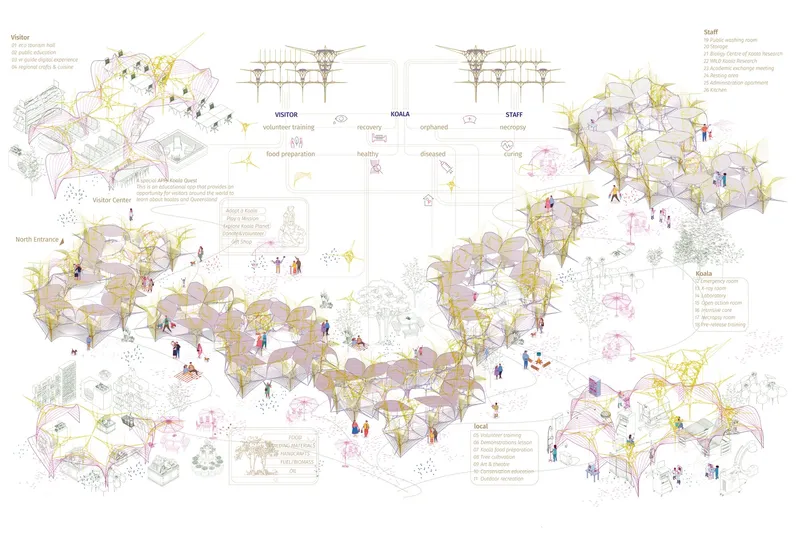
The vertical spatial arrangement mirrors the ecological hierarchy of forests. Upper levels accommodate koala resting spaces and elevated habitat systems, while lower levels host emergency care facilities, rehabilitation programs, public interaction areas, and visitor circulation.
The architecture intentionally avoids visual heaviness. Thin structural members, translucent surfaces, and branching frameworks generate a dematerialized atmosphere that reflects the visual softness of tree canopies and forest boundaries.
This immersive strategy supports the project’s larger goal of reconnecting humans with ecological systems through architecture. Visitors are not simply observing wildlife from outside barriers. Instead, they become participants within a carefully balanced environmental experience.
Sustainable Architecture Rooted in Ecology
Sustainability within Boundary of Forest extends far beyond energy efficiency or material selection. The proposal approaches sustainability as an ecological relationship between environment, species, structure, and human activity.
The project prioritizes environmental adaptation by responding directly to local eucalyptus ecosystems. Existing vegetation patterns inform spatial organization, circulation, and structural development. This minimizes intervention while preserving habitat continuity.
The computational growth system also supports material efficiency. By using digitally generated structural logic informed by branching patterns and force distribution, the architecture reduces unnecessary material usage while maintaining structural performance.
Furthermore, the proposal integrates digital fabrication methodologies that allow precise construction and adaptive assembly. Physical prototypes and simulation models help refine the system through observation, testing, and calibration.
The result is a research-driven architecture project that demonstrates how ecological analysis, computational systems, and material intelligence can converge into a sustainable architectural language.
Creating Educational and Economic Opportunities
Beyond habitat rehabilitation, Boundary of Forest also explores how environmental architecture can contribute to public education and local economies.
The proposal introduces visitor programs, interactive educational experiences, and tourism opportunities centered around koala conservation and Australian ecosystems. A digital learning platform known as “Koala Quest” allows visitors to engage with wildlife education through immersive technologies and environmental storytelling.
The project also proposes revenue-generating opportunities through events, merchandise, and rental spaces, helping support long-term operational sustainability while creating economic benefits for local communities.
By combining conservation, education, tourism, and architecture, the proposal establishes a multidimensional framework for future wildlife rehabilitation environments.
The Future of Wildlife Architecture
Boundary of Forest demonstrates how architecture can evolve into an active participant within ecological systems rather than an external intervention imposed upon them. Through its integration of biophilic architecture, computational design, wildlife conservation, and sustainable environmental planning, the project proposes a new direction for architecture in the age of climate crisis.
The project challenges conventional boundaries between nature and construction by treating forest systems as generators of architectural intelligence. Its branching structures, layered habitats, and adaptive spatial systems reveal how architecture can learn from biological growth processes to create more sensitive and responsive environments.
As global environmental challenges continue to intensify, projects like Boundary of Forest highlight the importance of ecological thinking within contemporary architecture. The future of design may no longer depend solely on creating buildings for humans, but on creating systems capable of supporting coexistence between species, environments, and communities.
Boundary of Forest ultimately presents a compelling vision of sustainable wildlife architecture where forests are not displaced by construction, but translated into architectural experience itself.




Popular Articles
Popular articles from the community


The Ocean Hive: Sustainable Architecture for a Self-Sufficient Civilization at Sea
The Ocean Hive imagines sustainable architecture at sea, where modular habitats, algae, wave power and ocean waste sustain a growing colony.
EW PARK: Sustainable Architecture Reimagines the Future of Urban Parking
EW PARK reimagines city parking as a modular wooden tower combining automation, solar energy, electric mobility, and adaptable urban design.

Riyadh For All: Intergenerational Urban Design for Active Aging in Rabat
Riyadh For All reimagines urban design in Rabat with intergenerational co-living, adaptive courtyards, and Moroccan cultural exchange today.

Co-Life: Senior Housing Design That Reconnects Older Adults With the City
Co-Life reimagines senior housing design through healing gardens, shared streets, workshops, and a sustainable community across generations.

Similar Reads
You might also enjoy these articles

Eco Chapel: A Green Architecture Pavilion Designed in Symbiosis with the Forest
Eco Chapel uses green architecture to weave prayer, learning and reuse into a forest pavilion shaped by modular hexagonal canopies for life.
Kaffeebühnen: Coffee Shop Architecture Designed as a Civic Stage Between Vienna’s City and Park
Kaffeebühnen turns coffee shop architecture into a civic stage, linking Vienna’s park edge, urban life, warm timber yards, and coffee craft.
Healing Façade: Sustainable Architecture for Reforestation, Community, and Sacred Ecology in Ethiopia
Healing Façade reimagines sustainable architecture as a living wall that restores soil, catches water and renews Ethiopia's forest churches.


Urban Forest: A Vertical Ecosystem for 5,000 Workers in Singapore's Changi Business Park
Radially stacked pods and layered green decks turn a 7-acre plot into 47 acres of ecological workspace projected for 2040.




Comments (0)
Please login or sign up to add comments
No comments yet. Be the first to comment!