
Erevna
Innovation hub

Construction system:
The main supportive structure is made by concrete. The two basements is also made by concrete. The main five floors building is made in a steel construction.
The facade all around the building is made by aluminium and glass. Some of the glass is windows which can be opened.
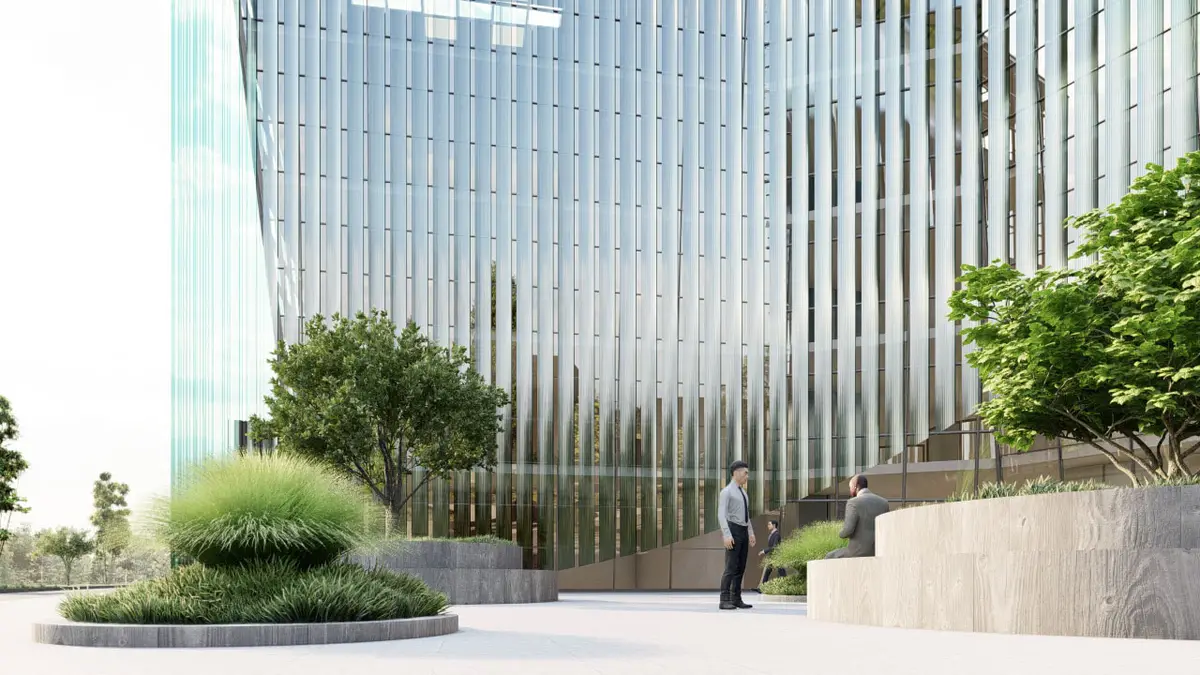
All around the building is vertical glass panels made by see-through glass with in-build sun energy. The distance from the main buildings are between 2 and 5 meters wide. The panels produces energy and isolates the building, both against the cold and the heat.
The roof is also a steel construction with in-build solar panels. Between these are holes for day light.
Material:
Concrete
Steel
Aluminium
Glass
Plastic
Wood
See-through glass with in-build vertical solar panels
Idea and vision of the building:
The idea is to build three towers, each got a conic shape on the three sides and is straight on the forth.
Each tower has five floors, which gives space to 30 different companies.
On the ground floor, between the towers, is a common lobby for all the different businesses to meet customers and each other, if they choose to do so, but also for reception and administration.
On the top floor is canteen and kitchen for all the companies.
Rooms and functions:
Each floor got six closed areas for separate companies, plus two areas for companies with open space.
The basement 1 and the basement 2 is an area for parking, food and kitchen preparation and store rooms for all the companies. The basement is also location for changing clothes.In the basements are also the engineering rooms for the vertical solar panels, as well as storage for the energy.
Because of the towers each floor got three closed areas for the big companies, with one big open space between them that gives room for smaller companies and small open offices.
Around the towers is a outer wall of vertical solar panels that moves according to the movements of the sun, thus optimizing the production of energy. The individual rooms on the inside are also able to move the panels, to get air.
The see-through glass makes it possible for everybody to see all of the surrounding nature.
Build into the walls are thin power elements like the ones in car rear windows, for providing warmth. At the same time the space between the towers and the outer structure is giving room for air circulation that both isolates and ventilate the building on the inside.
The panels and the materials are all of our own design.
This construction we feel is the best possible both for the environment and for saving energy.


Popular Articles
Popular articles from the community


Juan García Correa, John González and Claudia Rueda Sink a Circular Amphitheater into a Manizales Engineering Building
On the La Nubia campus in Manizales, Colombia, the S1 Building folds labs and offices into a hillside of ramped lawns that double as a campus route.

FCC Arquitectura Expands a Portuguese Granite House with a Board-Marked Concrete Wing
In Portugal, JV House pairs a cleaned-up whitewashed and granite dwelling with a timber-shuttered concrete extension, courtyards and a garden pool.


Singing Woman: An Opera House That Performs Before the Curtain Rises
Ovidiu Cristian Pavel's conceptual opera house translates Estonia's choral identity into a sculpted waterfront landmark facing the Baltic Sea.

Aquadapt: An Underwater Habitat That Rewrites Its Rooms by the Hour
Curved modules ring the seabed while one shell shifts from breakfast room to cinema, farm and football pitch as residents' needs change.

Similar Reads
You might also enjoy these articles

Vereda Arquitetos Renovates a 40-Square-Meter Apartment Inside Niemeyer's Copan Building
A compact unit in São Paulo's most iconic residential tower gets a material overhaul that pairs exposed concrete with bold blue Formica.

Shakur's House: Exposed Brick as an Interior Organiser in a 168 m² Mashhad Residence
Brick moves indoors in this Mashhad residence, where masonry walls, glass partitions and teal planes sequence a compact home without closing it off.

Day and Night Park: A Time-Based Urban Newsstand in Beijing
A temporary urban newsstand in Beijing blending travel, light, and reading through poetic colors, compact form, and community-focused design.

Modernist Patio Renovation in El Masnou, Barcelona by Oliver Segura Arquitectura + Cebrià Arquitectura
Modernist patio renovation blending tradition and innovation with a movable pool, leveled floors, and Catalan materials in El Masnou.

Comments (0)
Please login or sign up to add comments
No comments yet. Be the first to comment!