

FAST TRACK WORK
FUSING WORK SPACES WITH EXTREME SPORTS FACILITIES

As screen time is already becoming overwhelmingly the majority of our lives, either for work or leisure, it will in the future need an enforced balance of inescapable extreme physicality.
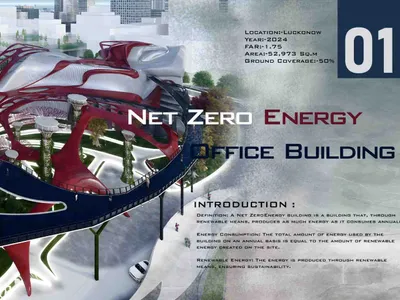
The project proposes that the future of work spaces will be a hybrid architecture of work and sports, interweaved within the same structure.
Workspaces are enclosed in multi-level predominancy solid towers providing all facilities supporting the effective collaboration of artificial intelligence, meta-metaverse and robotic systems, along with real, biological human workers.
Sports-spaces are arranged along a looping running track transferring the entire volume of the building and connecting all parts of the workspaces all along the running-track, an array of additional sports is “springled”: swimming linear, lap pools, banging-jumping, linear games sports, basketball, squash and bicycle racing tracks/velodromes.
The resulting hybrid of work-sports spaces responds to the current trend of diminishing need for physical work and the increasing need for intense exercising. The gradual reduction of weekly work hours (AI, robotics, metaverse), makes the fusing of work and sports not only feasible, but essential.
A note concerning the 50% allowable building footprint:
Even though the proposed plan is stretched to the outer limits of the plot, the actual projected footprint of the building is less than the allowable 50% as the arrangement frees outdoor space within the building volume issue, creating a multitude of “Inner-courtyards”.
FAST TRACK WORK is an outcome of reflections on how exactly office work as a slice of life would look in the future.
Considering tendencies of time management and work schedule changes nowadays, our group concluded that the form of daily work itself will change, not only in its appearance and time limits but also in the tools, in digital and analogous terms. Instead of boring screens and inferior ways of input, such as bulky keyboards, people would be using more refined ways, fused with additional and virtual realities as output, using their bodies as input. Our goal was to design an office space, which will be able to sustain the future, as we see it, however, at the same time it will be flexible enough to contain the present appearance of office work.
Another important assumption came with the concept of co-work itself. The space will be able to accommodate privacy and physical engagement, a place where 30 companies would be able to facilitate their projects, but also communicate and share their labor with neighbors, or search for specific experts within the offices, through the environment of the building creates. Another important objective was to adopt building design to a radically new approach to virtual reality use, like helping it to be used in different environments: water, big open areas, tracks, or paths, to create a new attitude for office work.
Considering all these factors, also our volition to have a constant, fluid, and free way to support more than just pedestrians, but also small transport like bicycles, through the building, the core idea of the project - the track was created.
WORK-FIT has a program arranged within the circulated track, where offices are separated into 6 (from A to H), where not only all required activities are supported, but also added new spaces and environments to support proposed ideas. Block does have straight connections with each other, to have an alternative path through the building, making a flexible network of rounds through the building, for faster access and new experiences. Giving an experience is an essential part of our design. While coming by our core track office workers would be able to see occurring projects and events in the building, to see, enjoy, or even participate. That is how we see our co-working environment.

Popular Articles
Popular articles from the community


Juan García Correa, John González and Claudia Rueda Sink a Circular Amphitheater into a Manizales Engineering Building
On the La Nubia campus in Manizales, Colombia, the S1 Building folds labs and offices into a hillside of ramped lawns that double as a campus route.

David Ortega Stacks a Two-Story Mexico City Penthouse Around a Steel Stair and a Pergola-Shaded Roof Terrace
In Colonia Roma, a 300 m² penthouse uses oak joinery, a planted steel stair and a slatted roof pergola to make a new-build apartment feel like a house.


Singing Woman: An Opera House That Performs Before the Curtain Rises
Ovidiu Cristian Pavel's conceptual opera house translates Estonia's choral identity into a sculpted waterfront landmark facing the Baltic Sea.

The Amber Palace Opera: A Geological Fiction Surfaces on Tallinn's Baltic Waterfront
Pierre Brillard reimagines a Baltic legend as a public landscape, opera house, and waterfront promenade rooted in Tallinn's coastal identity.

Similar Reads
You might also enjoy these articles
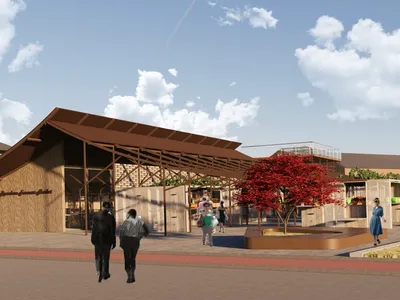
The Rhythm of Seasons
A Farmers' Market Connecting Nature and the City
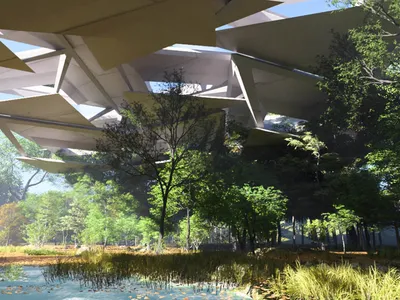

More Than a Building-Designing a Living System
More Than a Building-Designing a Living System
Base Beyond
DESERT COMPOUND ARID: TOURISM OF ABSENCE AND ABUNDANCE

Comments (0)
Please login or sign up to add comments
No comments yet. Be the first to comment!