
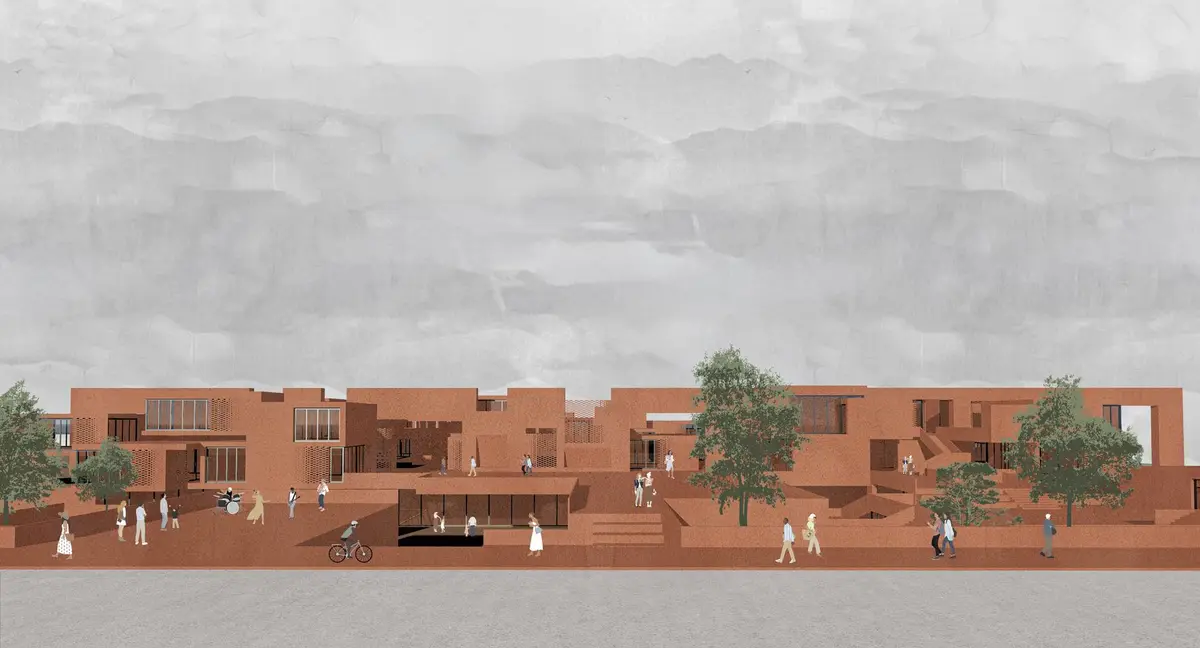
FOLD: Where Terracotta Surfaces Dissolve the Line Between Ground and Housing
A folded urban landscape of terracotta and shared courtyards rethinks the boundary between domestic life and public ground in sustainable housing.


What if the ground itself could become housing? FOLD takes that question literally, proposing a continuous folded surface that rises from the earth to form walls, roofs, courtyards, and public corridors in a single unbroken gesture. The result is a housing project that refuses to distinguish between landscape and architecture, between the civic realm and the domestic interior. Terracotta, used as both structure and skin, reinforces this continuity: modular blocks configured into ventilated walls, perforated screens, and shading systems that regulate climate while anchoring the project in the material logic of the ground it emerges from.
Designed by Doga D and Idil Dundar, FOLD is the winning entry of the Live Green competition. The designers observed that their site suffers from a fragmented relationship between residences, streets, and surrounding green areas, with rigid barriers like walls and fences limiting social encounters. Their response: erase the boundaries entirely. By extending a public corridor from a nearby park through the project site, they transform what would have been a collection of isolated housing blocks into a porous, walkable micro-community where shared terraces and courtyards sit between clusters of private living units.
Perforated Terracotta Screens as Climate and Community Regulators
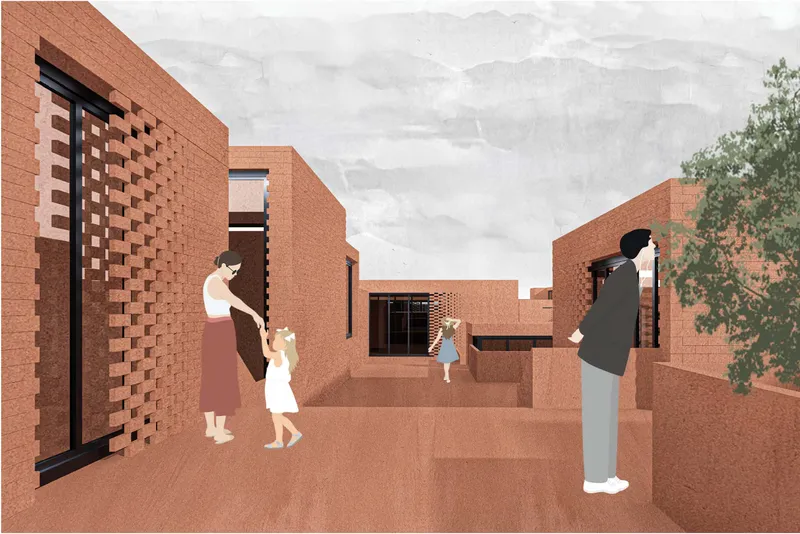
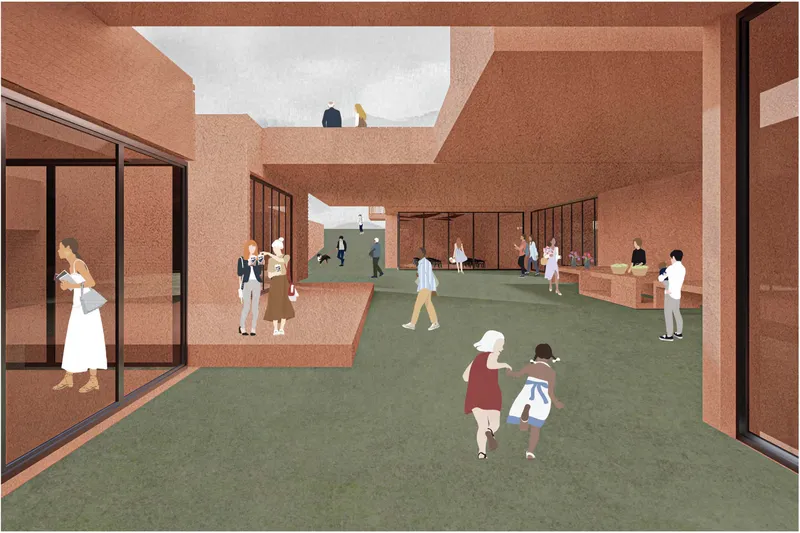
The perforated brick screen walls visible throughout the project are not decorative; they are the primary mechanism for passive climate control. Terracotta's thermal mass absorbs heat during the day and releases it slowly, while the perforations channel airflow through the courtyards and into living units. The designers describe terracotta as a "living skin," and it functions as one: the material breathes, shades, and mediates between interior comfort and exterior exposure. The earthy tone of the blocks harmonizes with the surrounding landscape, grounding the architecture in its ecological context rather than sitting on top of it.
The courtyard spaces framed by these screens serve double duty. They are private gardens for adjacent housing units, but their openness and visual permeability invite neighbors to gather, sit, and move through. The open-air rooftop terraces visible in the second image extend this logic vertically, creating shared outdoor rooms elevated above the ground plane where residents can occupy space together without the formality of a programmed public building.
A Terraced Ground Plane That Erases Front Doors
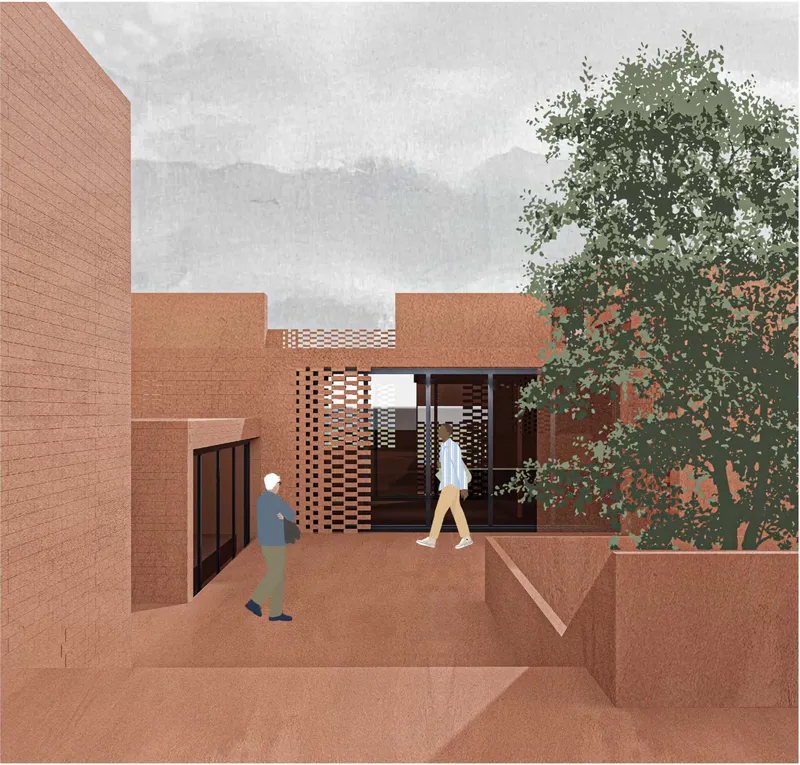
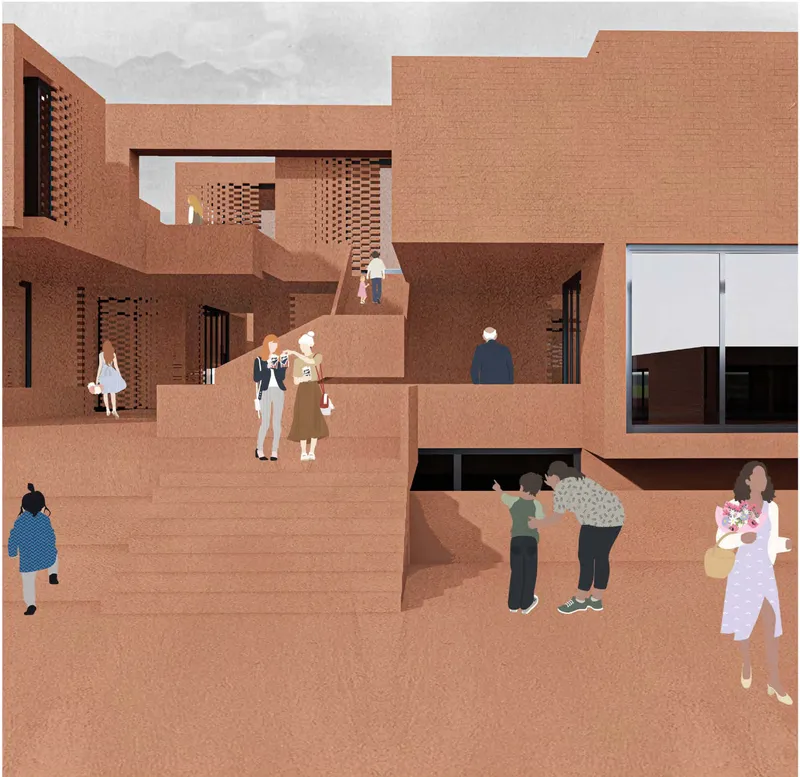
FOLD's most radical move is its treatment of the ground. Rather than placing housing units on a flat site with conventional entrances, the designers fold the terrain into a series of stepped terraces that merge circulation, planting, and dwelling into one continuous surface. Figures in the renderings navigate these multiple levels without encountering a single gate or threshold. The entrance view shows how a mature tree, a terraced courtyard, and the perforated brick screen coexist at the same scale, none dominant, all woven together.
The stepped courtyard images reveal how this topographic strategy generates varying degrees of privacy. Some spaces sit lower, embedded within the earth for acoustic and thermal protection. Others are lifted for airflow and light. Between the brick walls and glazed openings, intermediate zones host public functions: cafés, libraries, workshops, and play areas that bridge the domestic and civic spheres. These are not afterthought amenities bolted onto a housing scheme; they occupy the structural folds themselves, activating the social spine that connects the project to the adjacent park.
Section as Proof: Living Units Along Sloping Terrain
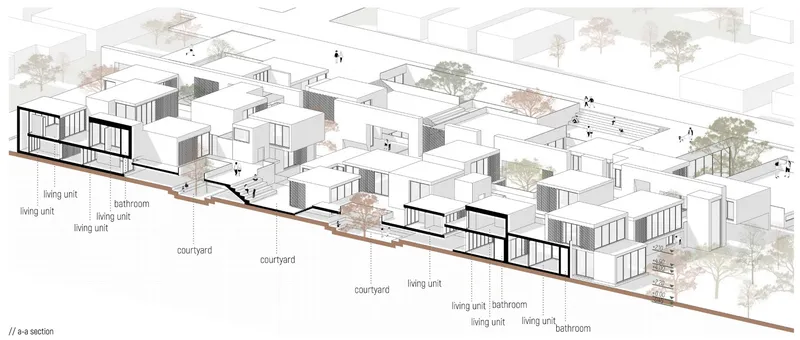
The sectional drawing cuts through the courtyard housing and confirms what the renderings suggest: the folded topography is both symbolic and functional. Living units step down the slope, each with direct access to outdoor space at different elevations. The section shows how rainwater is channeled through the folded surfaces, how natural shading is optimized by the overlapping terraces, and how ventilation is facilitated through the gaps between volumes. The terracotta façades act as passive climate regulators throughout, reducing reliance on mechanical cooling and heating systems.
The adjustable shading walls and bearing structures visible in the section allow residents to modify their living arrangements based on light conditions, privacy needs, and seasonal changes. This is not a static housing block with fixed floor plans. It is a framework for adaptation, where the architecture sets up conditions and the inhabitants complete them. The density achieved through this layered approach is notable: the project accommodates a significant number of units without the claustrophobic compression that typifies conventional apartment blocks.
Why This Project Matters
FOLD succeeds because it treats sustainability not as a checklist of technologies but as a spatial argument. Passive cooling, rainwater management, and reduced embodied carbon emerge from the project's geometry and material choices, not from systems layered on top of a conventional building. The decision to use terracotta as the dominant material is disciplined and coherent: it handles thermal regulation, visual identity, structural logic, and cultural resonance simultaneously. There is no gap between the project's ecological ambitions and its architectural language.
More importantly, Doga D and Idil Dundar demonstrate that the boundary between housing and city is a design choice, not an inevitability. By folding the ground plane into a continuous surface that hosts both private dwellings and public programs, they propose a model of urban density that feels generous rather than compressed. The project transforms its neighborhood from a collection of isolated blocks into an interconnected habitat where architecture, landscape, and community life are genuinely inseparable.
View the Full Project
About the Designers
Designers: Doga D, Idil Dundar
Enter a Design Competition on uni.xyz
uni.xyz runs architecture and design competitions year-round that reward proposals with spatial conviction and real site intelligence.
Project credits: FOLD by Doga D, Idil Dundar Live Green (uni.xyz).


Popular Articles
Popular articles from the community

ALGAL REALM: A Bio-Integrated Lunar Habitat Design for Life Beyond Earth
ALGAL REALM reimagines lunar habitat design with algae-powered life support, 3D-printed regolith, and vertical living for a lunar future.

The Ocean Hive: Sustainable Architecture for a Self-Sufficient Civilization at Sea
The Ocean Hive imagines sustainable architecture at sea, where modular habitats, algae, wave power and ocean waste sustain a growing colony.

Play: Fragments of Their World
Familiar architecture becomes modular playground design, creating safe spaces where displaced children can learn, connect, imagine and play.

The Musturak Paradise: Senior Living Architecture for a Connected Future in Temara, Morocco
The Musturak Paradise reimagines senior living architecture in Temara via private homes, social spaces, culture, community, and shared care.

Similar Reads
You might also enjoy these articles
Sustainable Architecture Design: Embracing Nature and Modernity at Villa Solsidan
The article explores Villa Solsidan by AndrénFogelström, showcasing its sustainable architecture design and integration with the natural surroundings in Saltsjöbaden, Sweden.
Scientific and Educational Monitoring Center of the Yenisei, Krasnoyarsk
Architecture as an instrument for ecological research, education, and environmental awareness along Russia’s largest river.
Development of Andretta Artist’s Village, Palampur, Himachal Pradesh, India
Reimagining Andretta as a living cultural landscape where art, architecture, and community converge to shape a global creative village.
Street Children Rehabilitation Center: A Model of Social Architecture for Community Rehabilitation
An inclusive social architecture project that transforms streets into nurturing environments, restoring dignity, identity, and opportunity for vulnerable children.

Comments (0)
Please login or sign up to add comments
No comments yet. Be the first to comment!