

MAKER architecten Rewire a 1972 Brutalist Dormitory on the VUB Campus as a Living Lab
A modular renovation strategy in Belgium breathes new life into Willy Van Der Meeren's modernist student housing without erasing its concrete bones.


More than 300 modular student dormitories designed by modernist architect Willy Van Der Meeren in 1972 sit on the VUB campus in Belgium, and for years they teetered on the edge of demolition. The concrete-frame buildings, products of a moment when industrialized construction promised affordable housing at speed, had aged into a preservation dilemma: structurally sound enough to save, but thermally and spatially obsolete. MAKER architecten took on a 400 square meter prototype, completed in 2025, to prove that renovation could outperform replacement.
What makes the WVDM Living Lab genuinely interesting is that it treats the dormitory not as a relic to be embalmed but as a chassis to be upgraded. The concrete skeleton stays. Everything else, from the facade panels to the interior partitions, is a bolt-on system designed for disassembly. It is a circular-economy argument made in plywood, OSB, and orange infill panels, and it reads as both a respectful nod to Van Der Meeren's prefab ambitions and a blunt correction of the things he got wrong.
Keeping the Skeleton, Replacing the Skin
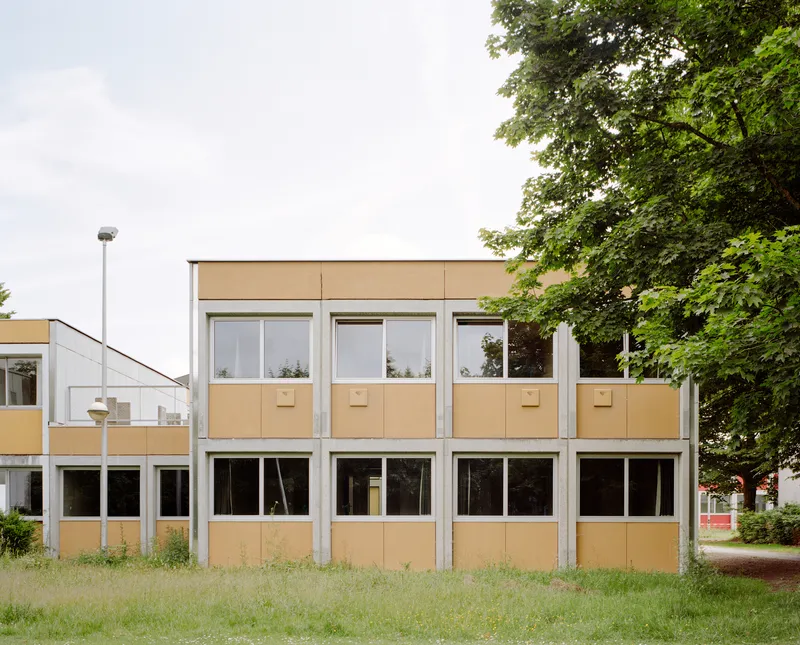
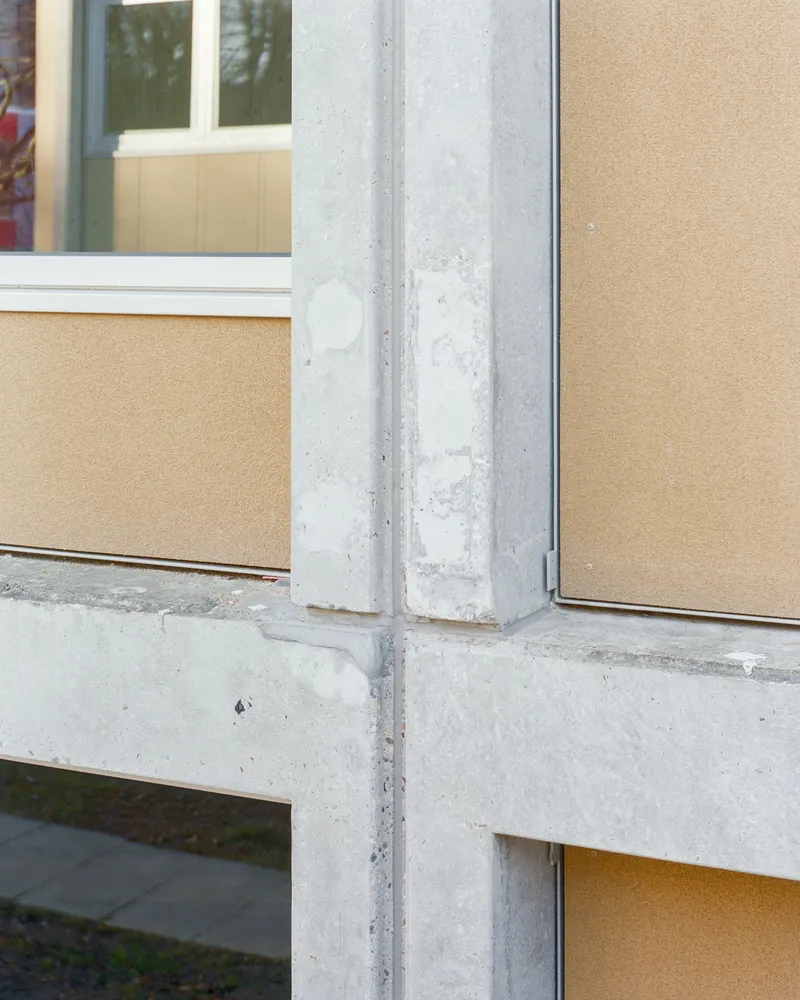

The street facade makes the strategy legible. Orange panels slot into white frames that wrap the original concrete structure like a prosthetic exoskeleton, filling the voids between columns with floor-to-ceiling glazing. Up close, the junction of pale board panels, metal fasteners, and white mullions reveals an approach closer to furniture assembly than masonry construction. Every component is mechanically fixed, never glued or plastered into permanence.
Walk through the courtyard and the campus context becomes clear: rows of concrete buildings flanked by tall deciduous trees, a legacy of postwar campus planning. The Living Lab doesn't fight that context. It simply sharpens it, swapping the dark, underperforming original panels for a lighter, thermally upgraded envelope that lets the brutalist frame remain the dominant visual register.
Honest Interiors Built for Disassembly

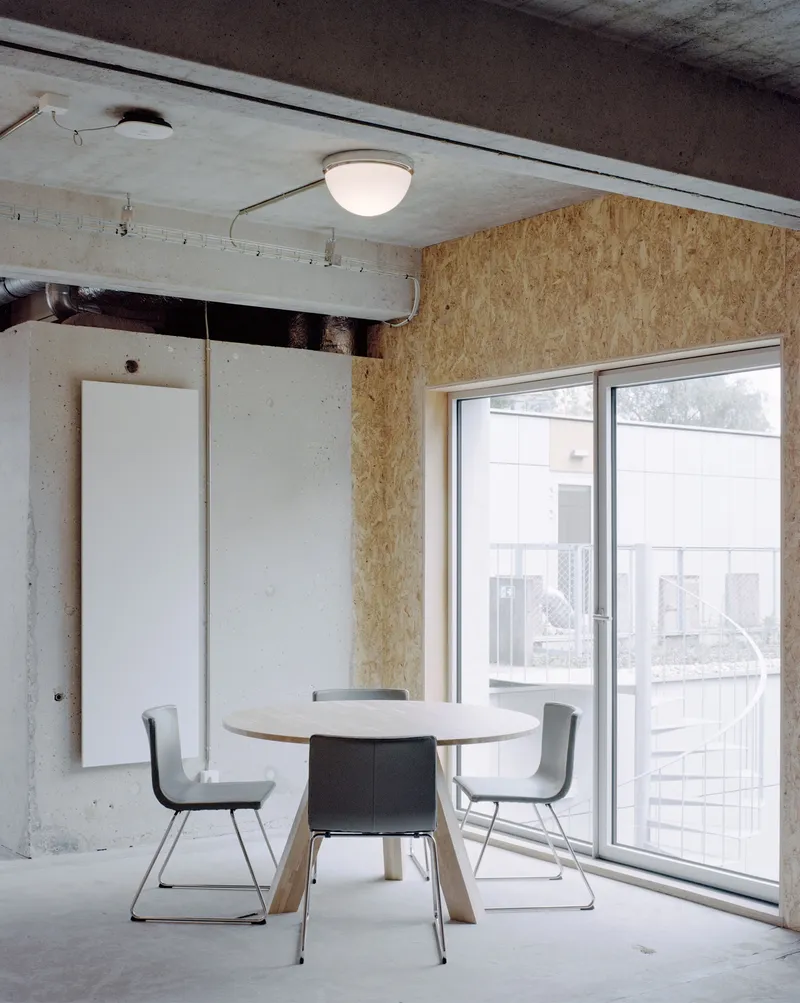

Inside, the exposed concrete ceiling runs continuously, a constant reminder of the host structure. Against it, MAKER architecten layer oriented strand board wall panels, light grey kitchen cabinetry, and white countertops in an open-plan arrangement that feels provisional in the best sense. Nothing is concealed. You can trace every joint, every fastener, every material transition.
The dining area, with its round table pushed against an OSB wall and a sliding door opening to a balcony, shows how the prototype operates at a domestic scale. These are not luxury student flats. They are demonstration units, calibrated to prove that comfort and circularity are not opposed goals. The kitchen's tall concrete panels framed by white metal mullions near a blue door distill the whole project into a single detail: old structure meeting new infill at a visible seam.
Plywood as Partition Logic
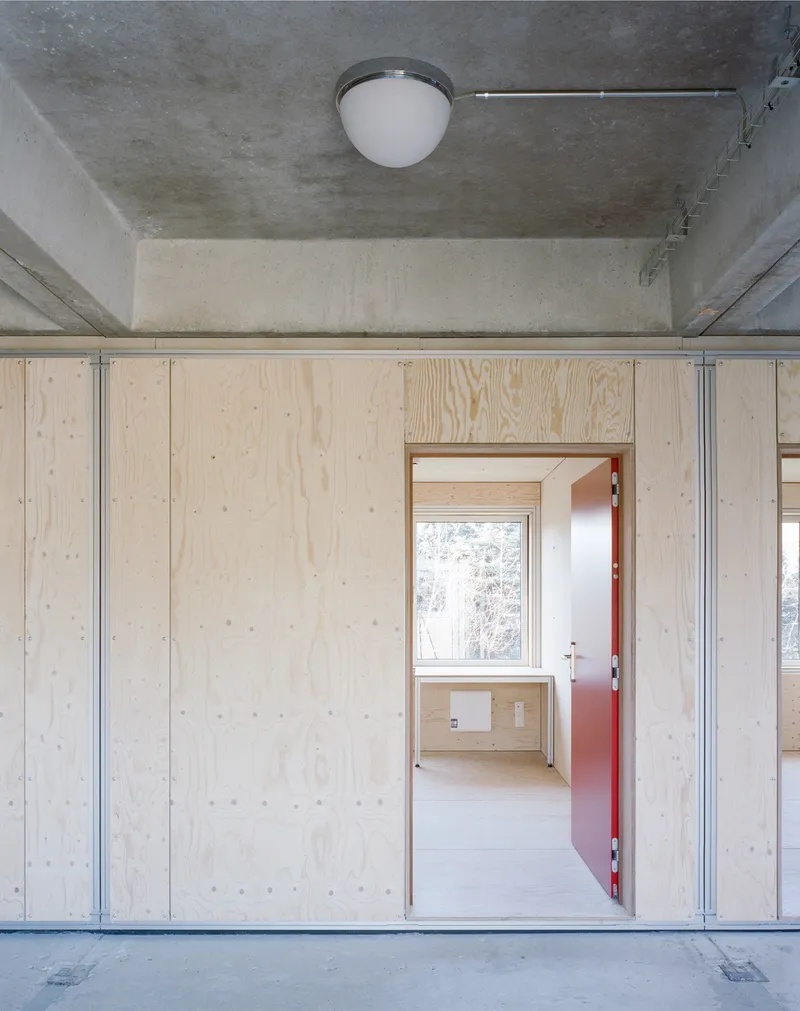

The interior partitions are the project's quiet innovation. Light plywood walls with salmon-colored doors and exposed steel channels define rooms without the permanence of drywall. Blue rubber flooring meets plywood frames at clean, reversible connections. You could pull out an entire wall system and reconfigure the plan without touching the concrete frame, which is precisely the point.
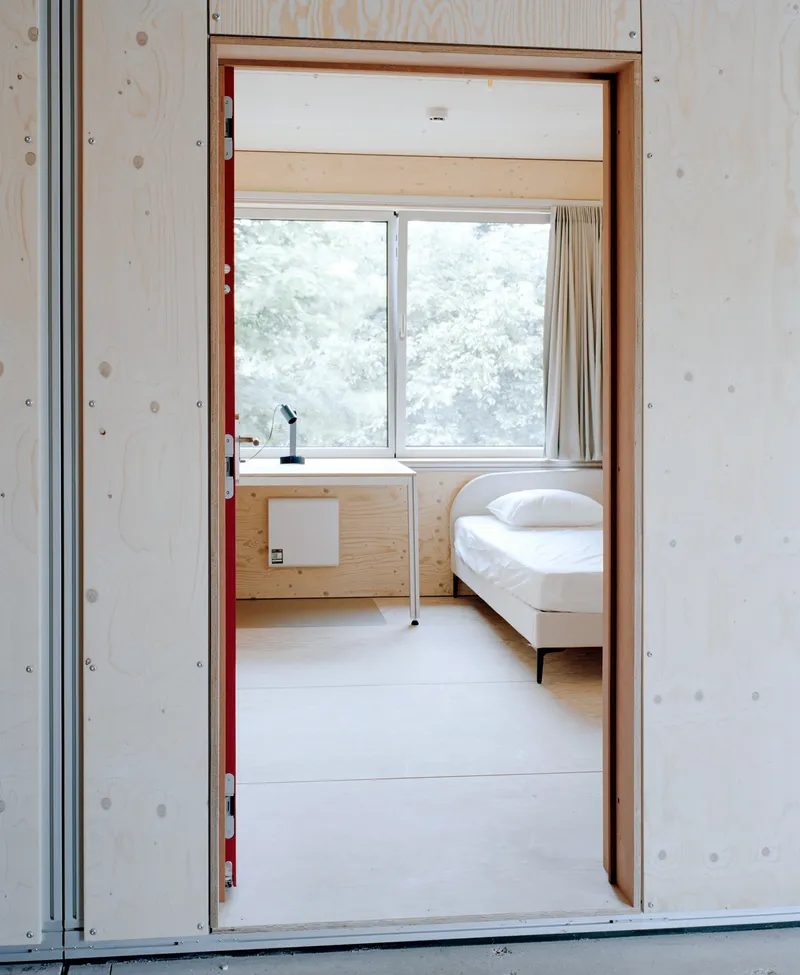
A view through a plywood-framed doorway into a bedroom with a single bed and a window overlooking trees captures the spatial result. The rooms are modest but well-lit, with a material warmth that raw concrete alone could never provide. The timber elements soften the industrial character just enough to make the units habitable without masking them.
Details That Tell the Whole Story
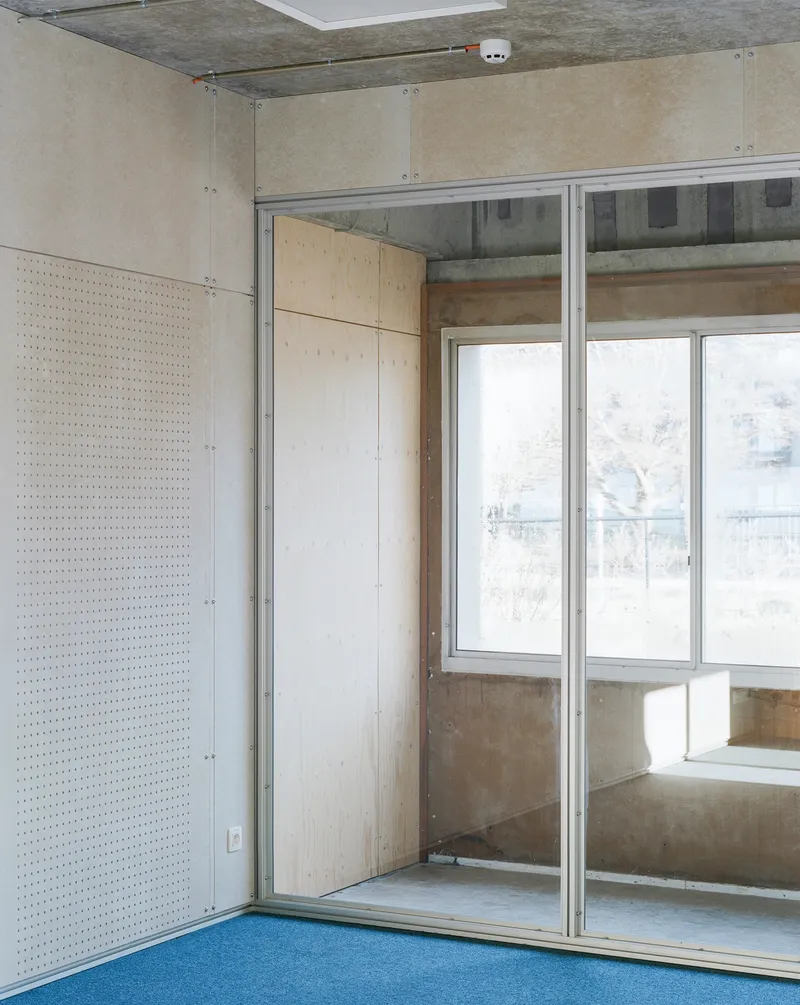
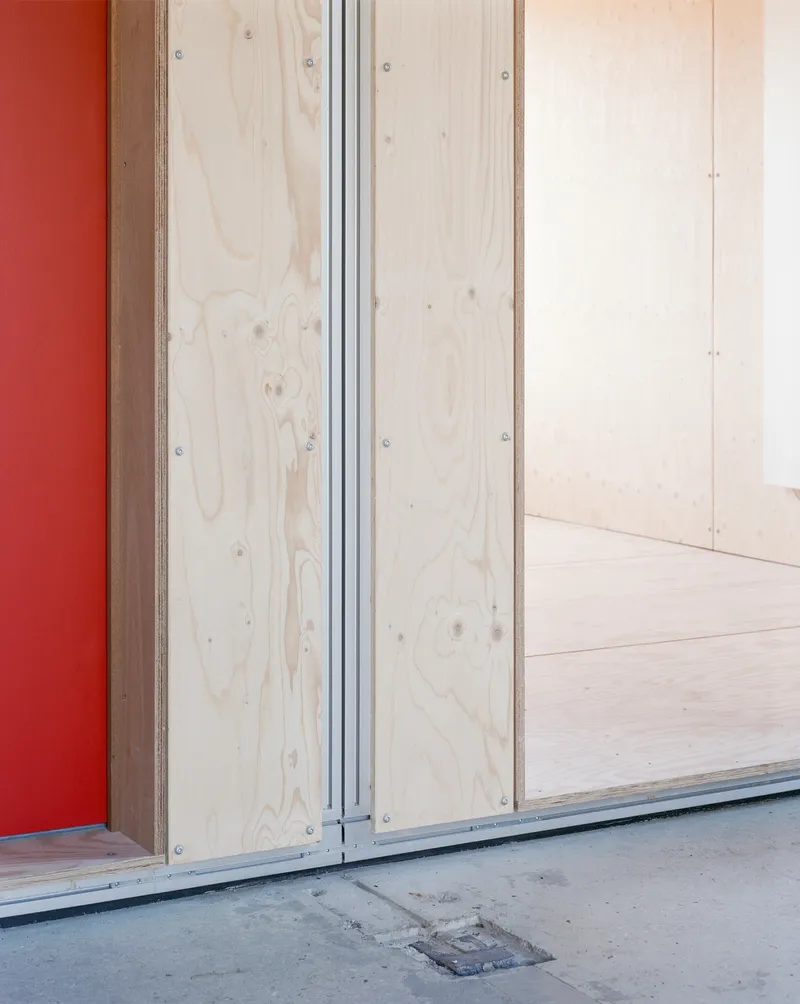

MAKER architecten clearly want you to look at the connections. A perforated plywood wall panel meets a sliding glass door track at a corner. A plywood door frame with exposed screws lands on a grey concrete floor. A blue carpet edge butts against a glass track. These are not details that hide behind trim profiles. They declare their logic openly, inviting inspection.
That legibility is strategic. As a Living Lab, the project must teach. If the joints were buried, the argument for disassembly and reuse would be abstract. Instead, every seam is evidence: proof that the building can be taken apart as intelligently as it was put together.
The Corridor as Proof of Concept
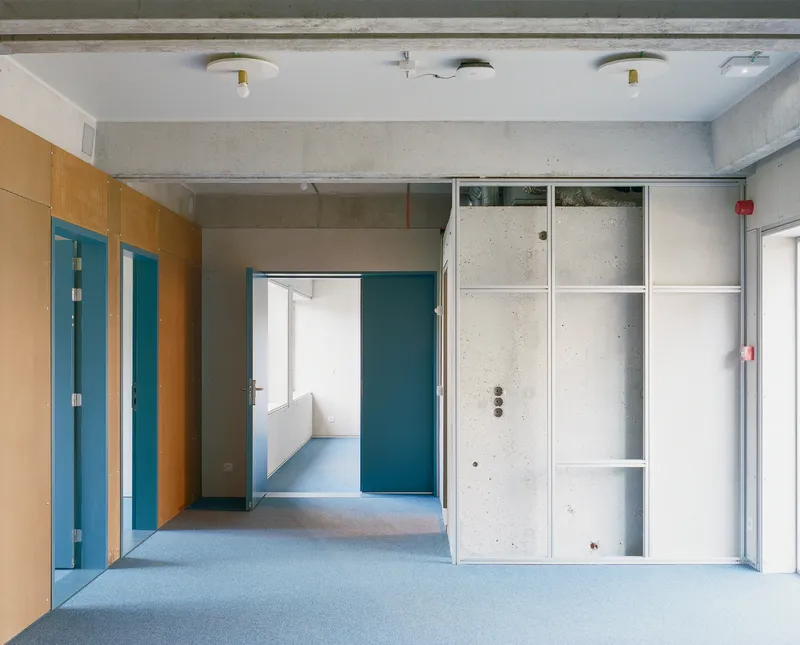
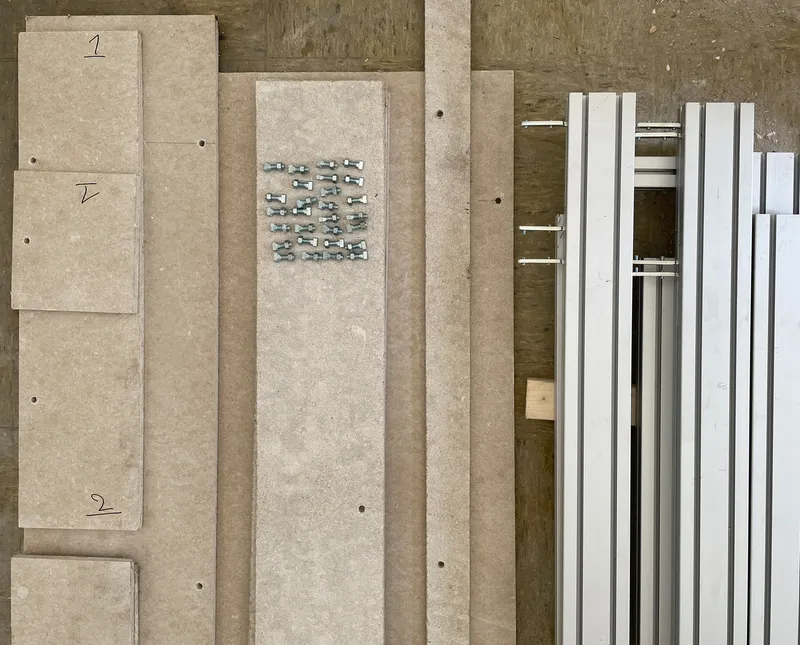
The corridor might be the most telling space. Exposed concrete ceilings run overhead while blue doors, orange plywood panels, and white metal storage partitions define the edges. It reads like a catalog of the project's material palette, compressed into a single circulation spine. The material samples laid out on a table, showing pale board panels, metal fasteners, and white window frames, function almost as a footnote: here are the ingredients.
Spiral Stair and Exterior Moves
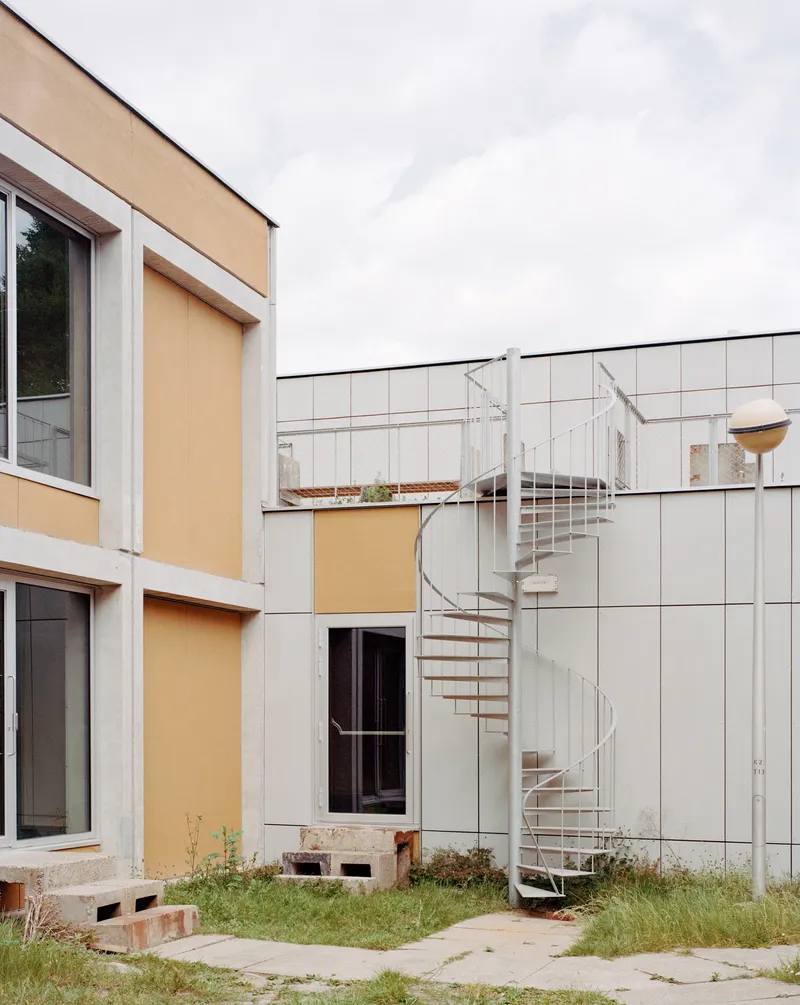
An exterior white spiral stair set against white tile cladding connects the floors and anchors the building to its grassy courtyard. It is a deliberately legible circulation element, separate from the main volume, reinforcing the idea that every system can be independently accessed and maintained. The courtyard pathway flanked by the original concrete buildings provides scale: the Living Lab is a single node in a much larger campus grid, a test case meant to inform hundreds of similar units.
Plans and Drawings

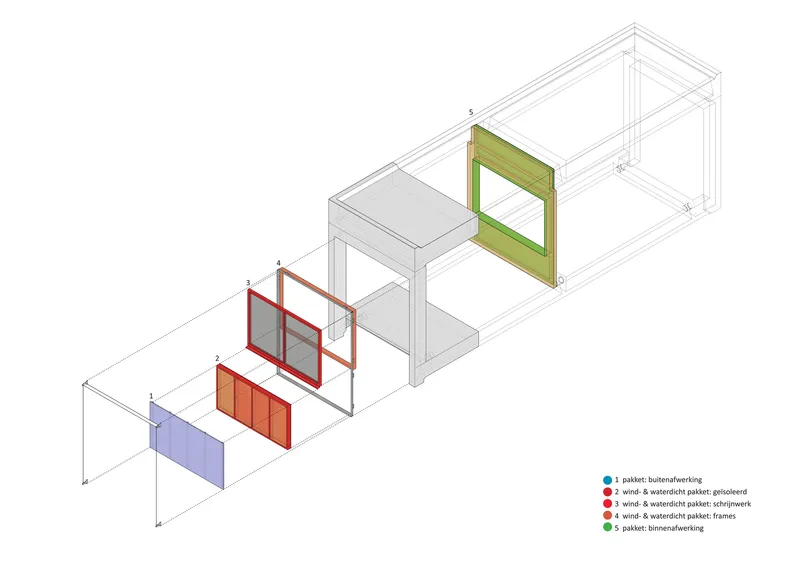
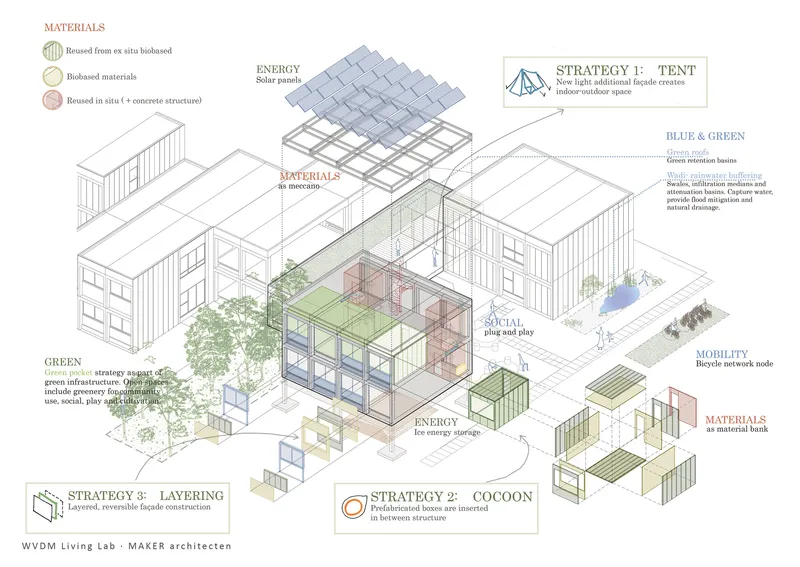

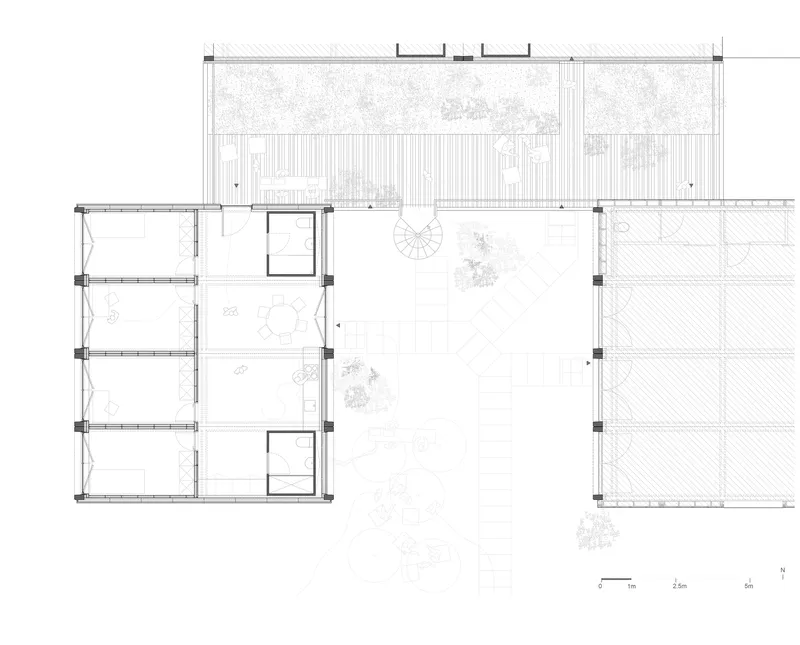
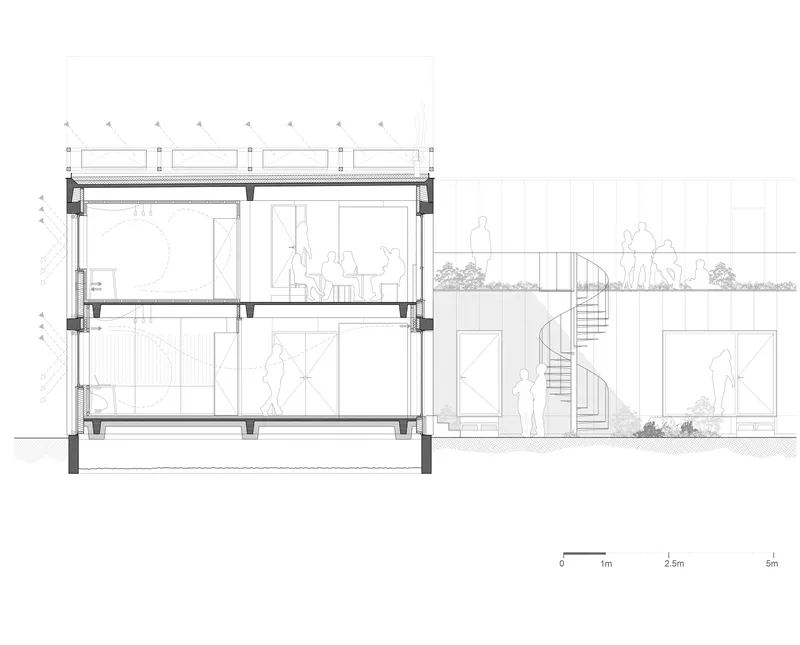
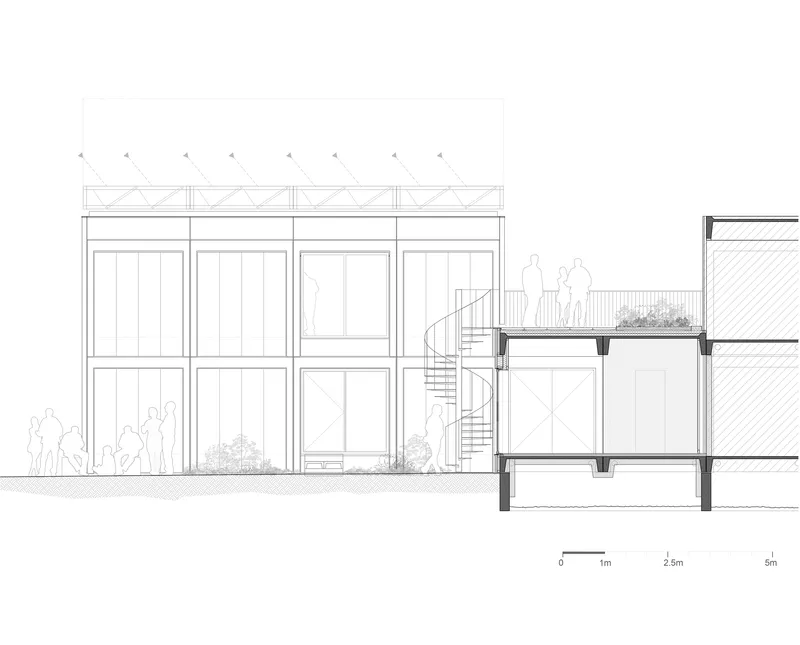
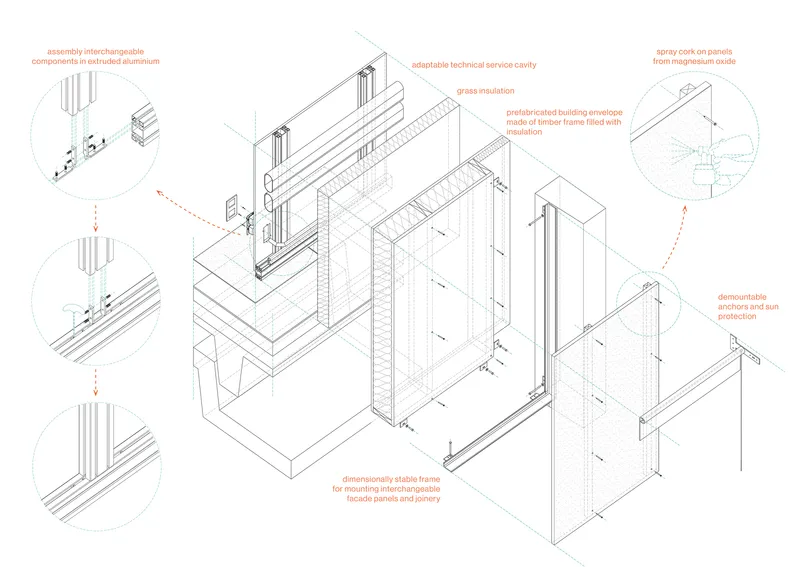
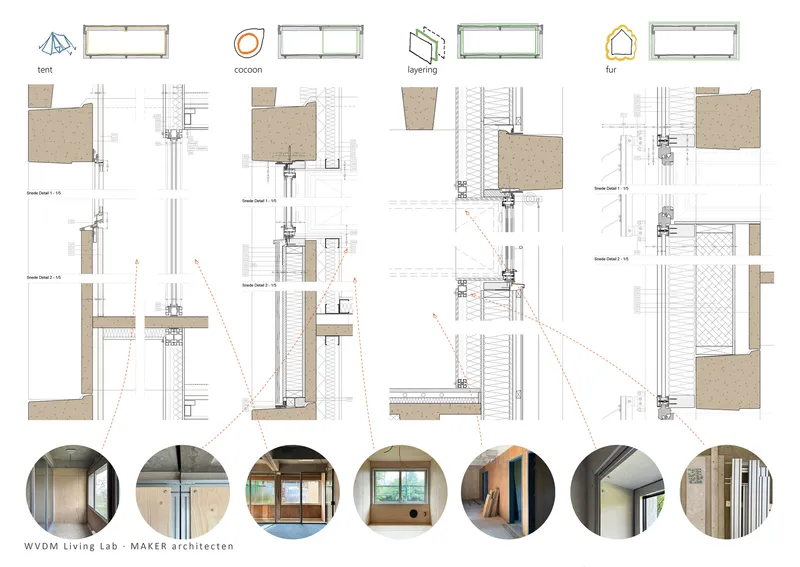
The drawing set reveals the full ambition. An axonometric campus layout shows the project's position among scattered buildings and tree clusters. An exploded axonometric of the facade assembly, with color-coded panel components and frames, makes the prefabrication strategy unmistakable: each layer is a discrete, replaceable system. An annotated sustainability diagram labels material and energy systems, turning the building into a legible argument for low-carbon renovation.
Floor plans show an L-shaped layout wrapped around a central spiral stair with courtyard plantings. The upper level peels back to fewer rooms and an enclosed terrace along the northern edge, giving the prototype a surprising variety of spatial conditions for its 400 square meters. Sections cut through the three-story volume expose the relationship between the glazed street facade, the spiral stair, and lower underground levels. The prefabricated timber frame assembly drawing and the detail sheet of four window configurations with section cuts close the loop, showing precisely how the theory becomes a built thing.
Why This Project Matters
The WVDM Living Lab matters because it confronts a question that hundreds of European universities will face in the coming decade: what do you do with thousands of square meters of postwar concrete housing that no longer meets contemporary standards? Demolition is the easy answer, and it is almost always the wrong one when the embodied carbon of the existing structure is accounted for. MAKER architecten's prototype offers a replicable alternative, one built on mechanical connections, circular material flows, and respect for the existing frame.
More importantly, it does this without nostalgia. There is no attempt to freeze Van Der Meeren's vision in amber. The orange panels, plywood partitions, and exposed fasteners are clearly contemporary interventions. They acknowledge the original architecture by working within its logic of modularity and prefabrication while upgrading its performance to a standard its designer could not have anticipated. That is a far more productive form of preservation than any heritage plaque.
WVDM Living Lab by MAKER architecten. Located in Belgium. 400 m². Completed in 2025. Photography by Séverin Malaud.
About the Studio
Share Your Own Work on uni.xyz
If projects like this are the kind of work you want to make, uni.xyz is a place to publish your own, find collaborators, and enter design competitions.


Popular Articles
Popular articles from the community


Manzana Morphosis: Stretching Barcelona's Grid into a Living Landscape for 2050
A radical reworking of the Eixample manzana turns density into a tool for generous public space, vertical ecology, and environmental performance.
Cloaked Colonization: A Mobile Underwater Habitat That Moves Like a Fish
Micah Abaya's shortlisted EHC Pacific entry reimagines ocean settlement as a dispersed network of self-sustaining architectural organisms.

Faces of the Soviet Avant-Garde: Turning Moscow's Street Names into an Open-Air Museum
A network of sculptural installations across a Moscow residential district transforms forgotten architect names into spatial encounters with cultural memor

The Amber Palace Opera: A Geological Fiction Surfaces on Tallinn's Baltic Waterfront
Pierre Brillard reimagines a Baltic legend as a public landscape, opera house, and waterfront promenade rooted in Tallinn's coastal identity.

Similar Reads
You might also enjoy these articles

Bao Huynh Watercolor Atelier: A Serene Art Retreat in Hội An
Bao Huynh Watercolor Atelier in Hội An blends multifunctional art spaces, sustainable design, local materials, and family-friendly living in a serene environment.

Atelier Macri Concept Store Interior Design by CASE-REAL
Atelier Macri store features a "ko" counter, walnut wood details, cork displays, blending retail, gallery, and seamless customer experiences.

Manuel Vargas Izquierdo Stadium and High-Performance Sports Center: Architectural Excellence in Jalpa de Méndez
The Manuel Vargas Izquierdo Stadium blends sustainable design, inclusive sports facilities, and cultural-inspired architecture, revitalizing Jalpa de Méndez’s public spaces.

KAKR Buluh Awar Hall: Revitalizing Community and Ecology Through Bamboo Architecture
Community built bamboo hall revitalizes Buluh Awar village, empowering youth, restoring ecology, celebrating vernacular craftsmanship through sustainable architecture and culture.


Comments (0)
Please login or sign up to add comments
No comments yet. Be the first to comment!