
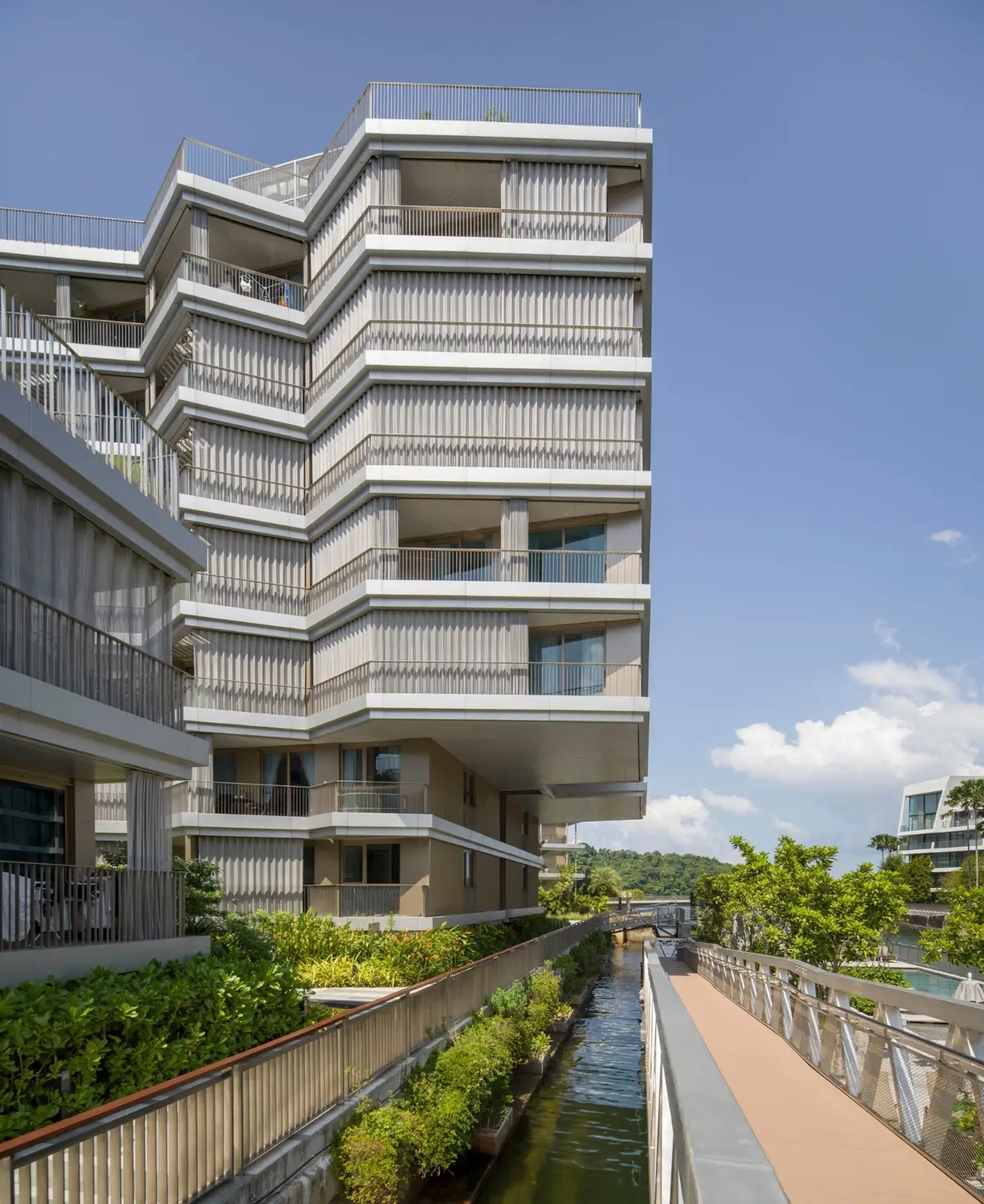
KCAP and DCA Architects Build a Stepped Urban Village on Singapore's King's Dock Waterfront
A 26,000 square meter residential development in Singapore trades tower isolation for terraced courtyards and a planted promenade along the harbor.


Waterfront residential projects in Southeast Asia tend to follow a reliable formula: maximize floor area, stack units high, and surround the base with a ring of retail. The Reef at King's Dock, designed by KCAP and DCA Architects, takes a different route. Rather than erecting isolated towers on a podium, the scheme breaks its 26,000 square meters into a composition of courtyard buildings, stepped blocks, and villa units that step down toward the waterfront. The result reads less like a condominium development and more like a compact neighborhood, one with its own internal streets, garden corridors, and public edges.
What makes the project genuinely interesting is its refusal to treat density and livability as opposites. The architects have organized the massing so that no single building dominates the skyline, and the spaces between buildings do as much work as the buildings themselves. Courtyards, planted walkways, and a continuous waterside promenade stitch the complex together, creating a ground plane that belongs to residents and the public alike. In a city where private residential developments often wall themselves off from the surrounding fabric, that porosity is worth paying attention to.
Terraced Massing Along the Harbor
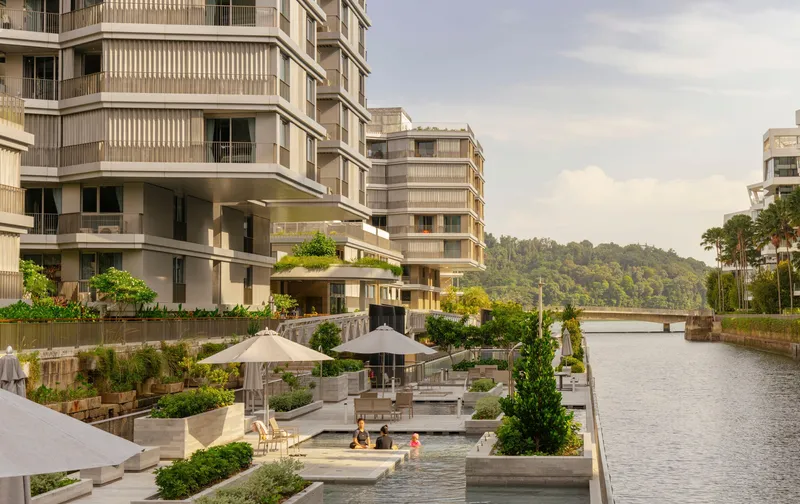
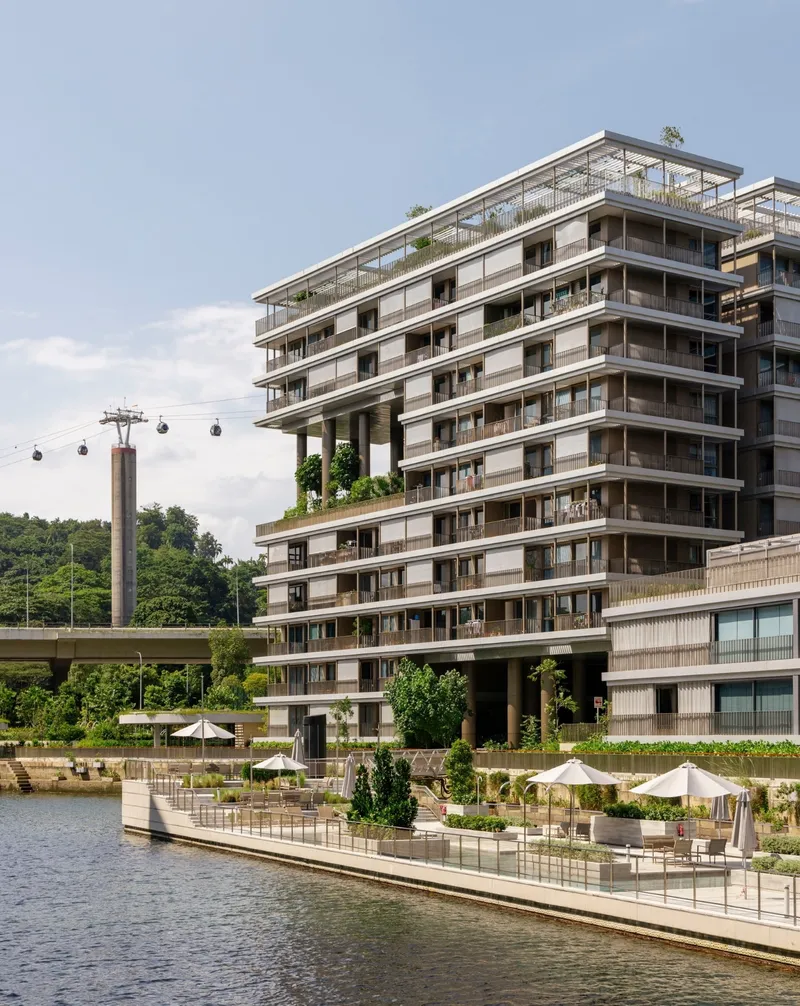
The development steps down from its tallest elements toward the water's edge, creating a terraced profile that opens up sightlines and maximizes the number of units with harbor views. From the waterside promenade, the buildings present a layered silhouette of deep balconies, rooftop gardens, and planted setbacks. The effect is almost geological: a series of horizontal strata rather than a vertical extrusion. The ground-level plaza, with its planters, umbrellas, and generous seating, functions as a genuine public threshold between the development and the dock.
KCAP's experience with European urban waterfronts, from Amsterdam to Hamburg, clearly informs the strategy here. The step-back approach avoids casting long shadows over the promenade, and the resulting rooftop terraces become usable garden spaces rather than mechanical plant zones. It is a simple idea, but one that requires disciplined massing studies to pull off without sacrificing unit count.
Facade Language: Louvers, Timber, and Depth


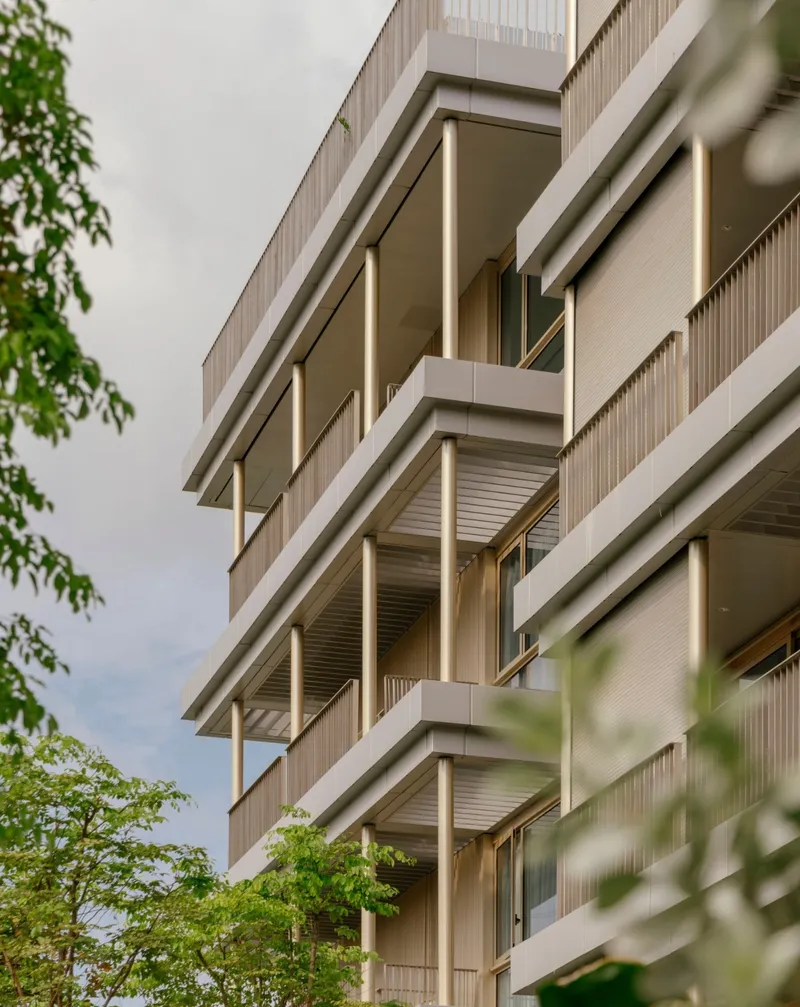
The facade treatment across The Reef deserves close reading. Vertical timber louvers, projecting concrete floor slabs, and recessed balconies work together to create a layered envelope that manages solar gain while giving each unit a distinct sense of enclosure. The zigzagging facade along the planted canal is the strongest move: its angled planes break the building's length into a rhythmic series of bays, each with its own orientation to light and breeze.
At dusk, the staggered balconies with integrated lighting reveal the building's volumetric depth in a way that daytime views do not. The timber cladding reads warm against the concrete frame, avoiding the all-glass monotony that plagues so many tropical residential towers. The decision to vary the screening density across elevations suggests that the architects tuned the facade to specific solar exposures rather than applying a single pattern uniformly.
Courtyards as Connective Tissue
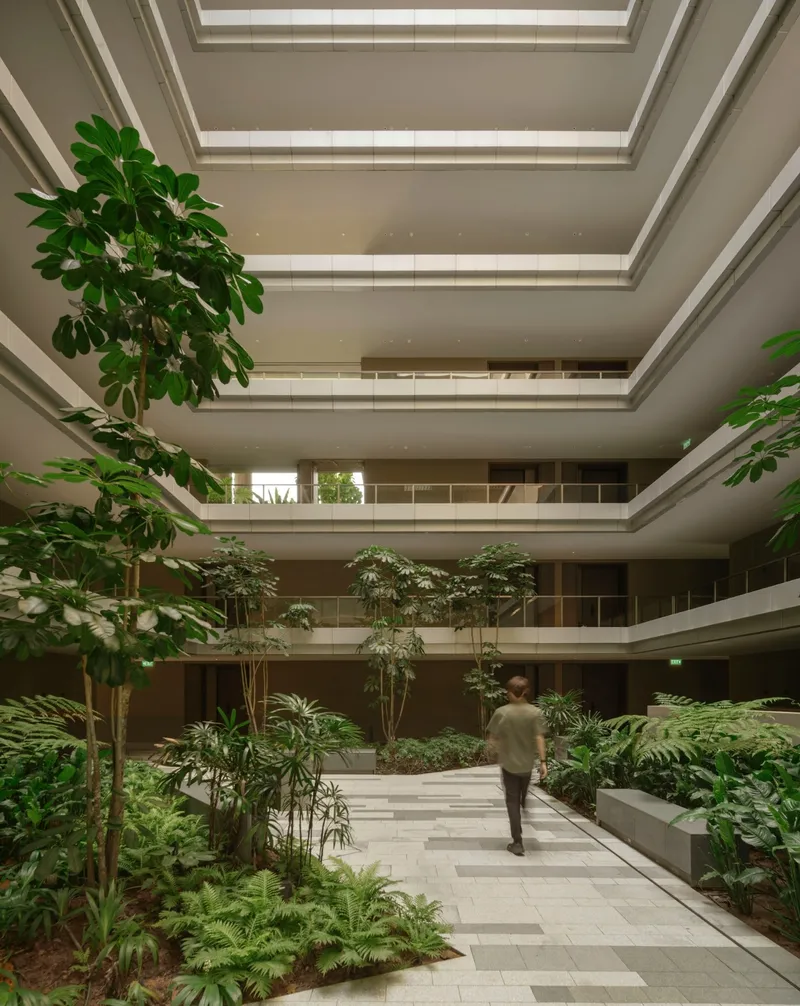
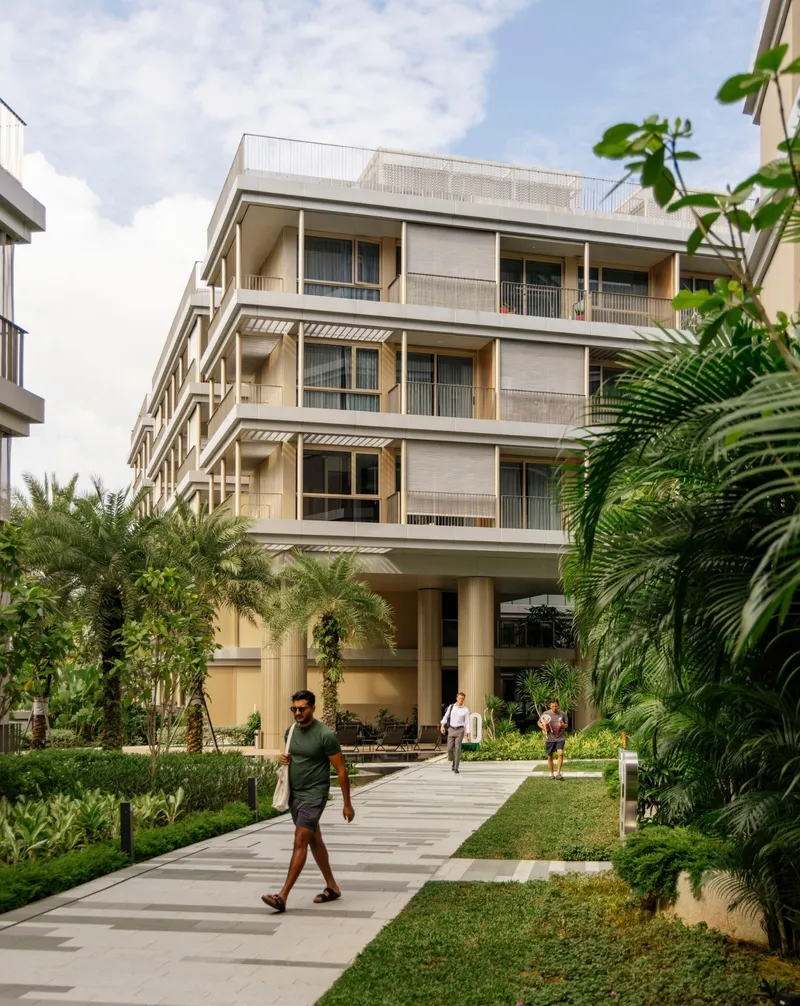
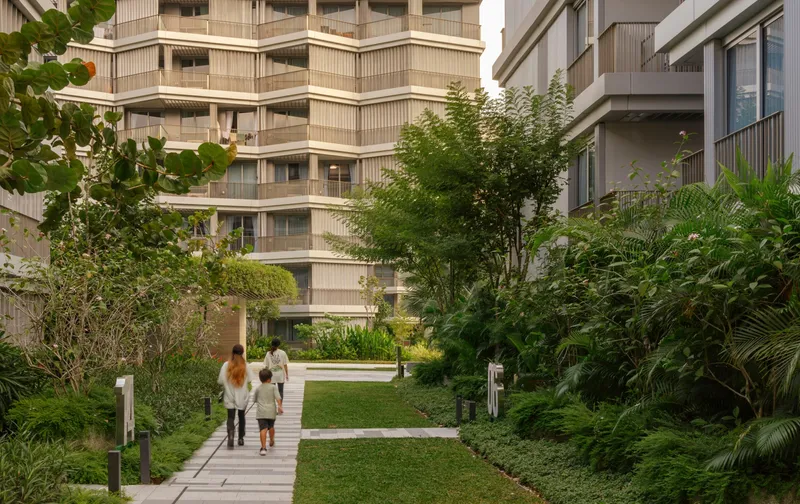
The interior courtyards are where the "urban village" concept moves from rhetoric to spatial reality. These are not token green voids surrounded by blank party walls. Instead, they are planted corridors with walking paths, mature palms, and ground-level transparency that lets you see through the block to the next courtyard beyond. The interior atrium with its skylights and planted beds is particularly convincing: it brings filtered daylight deep into the plan while offering a genuinely cool, shaded passage in Singapore's equatorial climate.
Residents appear to actually use these spaces, which is the ultimate test. The images show people walking, pausing, and crossing through at various times of day. That casual occupation suggests the courtyards are well-scaled and well-placed on desire lines, not ornamental leftovers between buildings.
Landscape as Infrastructure


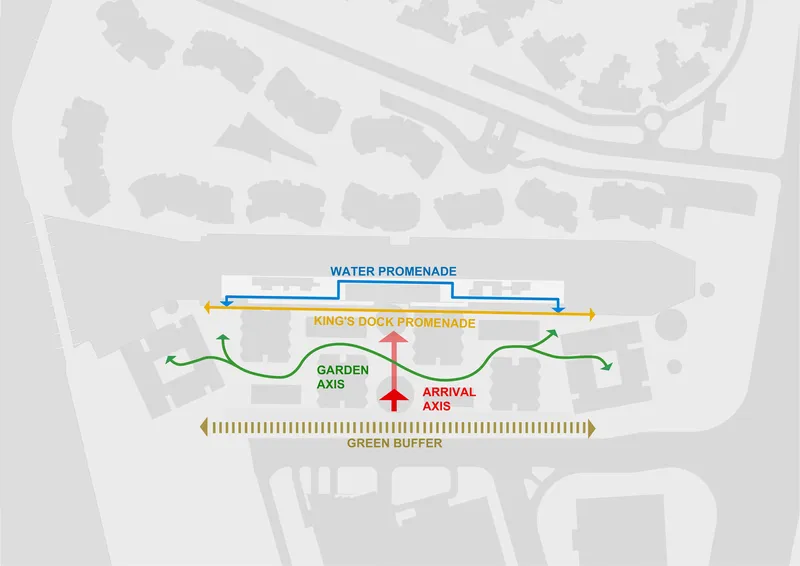
Beyond the courtyards, the landscape design operates at the scale of the entire site. A public plaza with young trees and native grasses anchors the arrival sequence at sunset. A covered walkway with timber slats runs alongside a reflecting pool, creating a microclimate corridor that channels breezes and provides shade. These are not isolated amenity moments; they form a continuous landscape system that links the waterfront promenade to the interior garden axis.
The timber-slatted covered walkways deserve particular credit. In a tropical climate, the five-foot way tradition of covered pedestrian corridors has deep historical roots. KCAP and DCA translate that principle into a contemporary vocabulary of timber, steel, and water, keeping the functional logic intact while giving it a residential rather than commercial character.
Rooftop Amenities at Dusk

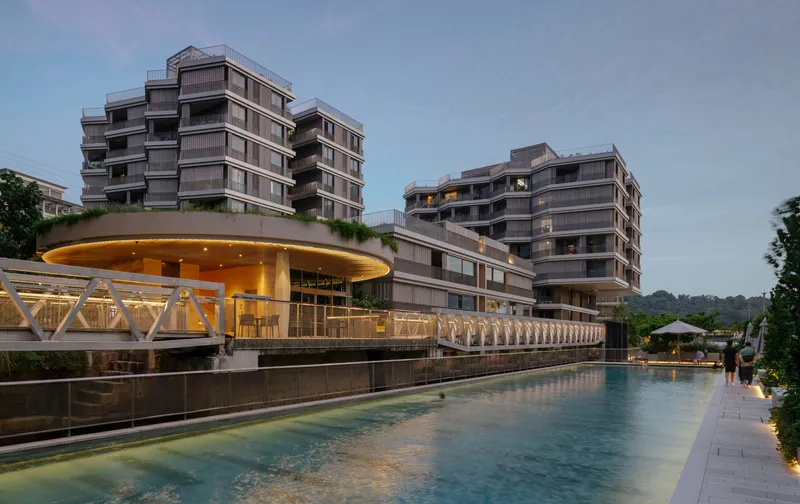
The rooftop pool deck and the long pool with its pavilion demonstrate how the stepped massing pays dividends for communal amenity space. By terracing the buildings, the architects unlock generous roof areas at intermediate levels, not just at the top of the tallest tower. The twilight views show how these spaces frame the harbor and the surrounding skyline, transforming what could be utilitarian recreation decks into genuine social destinations.
The illuminated pool pavilion at dusk, set against the residential blocks, gives the development a civic presence that most condominiums lack. It reads as a shared living room for the neighborhood rather than an exclusive club.
Plans and Drawings
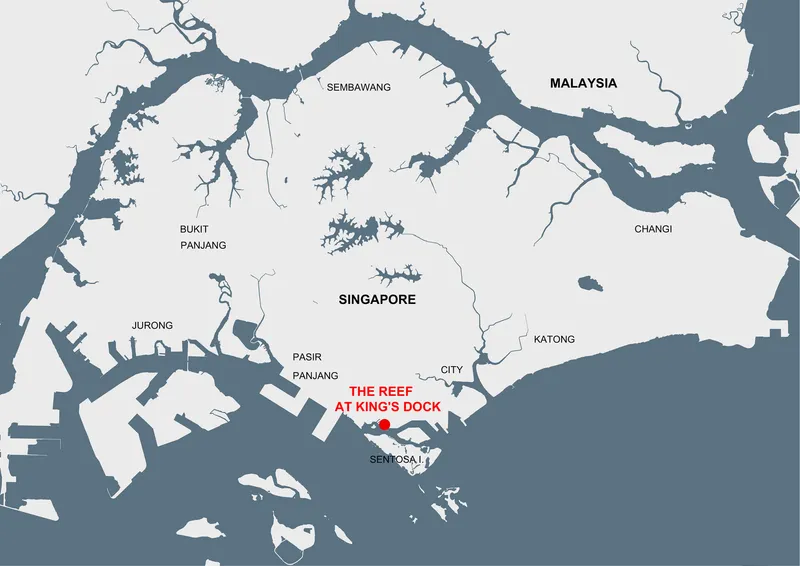
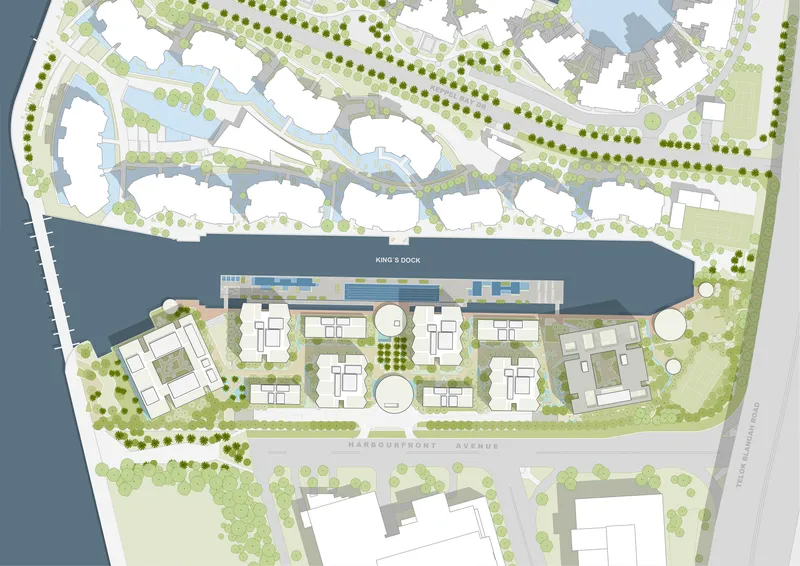
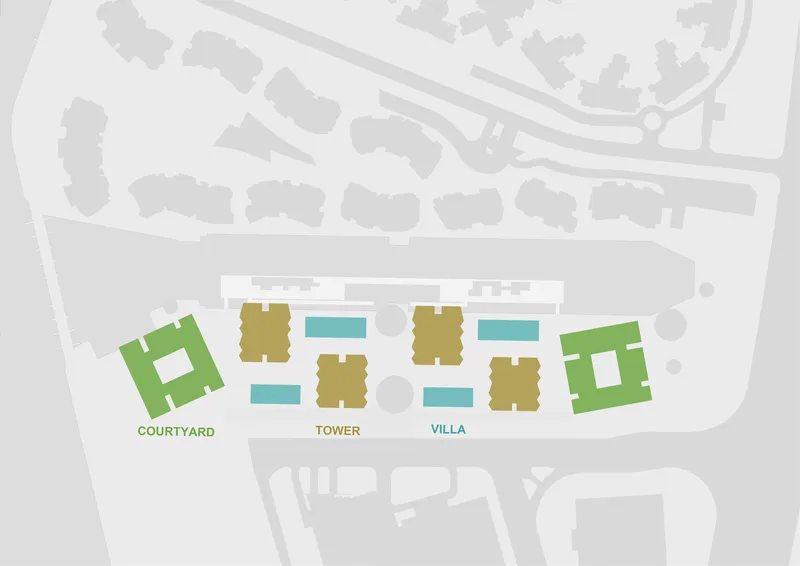

The site map and master plan reveal the development's relationship to the broader coastal geography of Singapore's southern waterfront. The residential blocks are arranged along the harbor edge with landscaped promenades and tree-lined streets creating a legible public realm between the buildings and the water. The plan distinguishes between courtyard buildings, tower blocks, and villa units, each assigned to different zones within the site to create variation in scale and density.
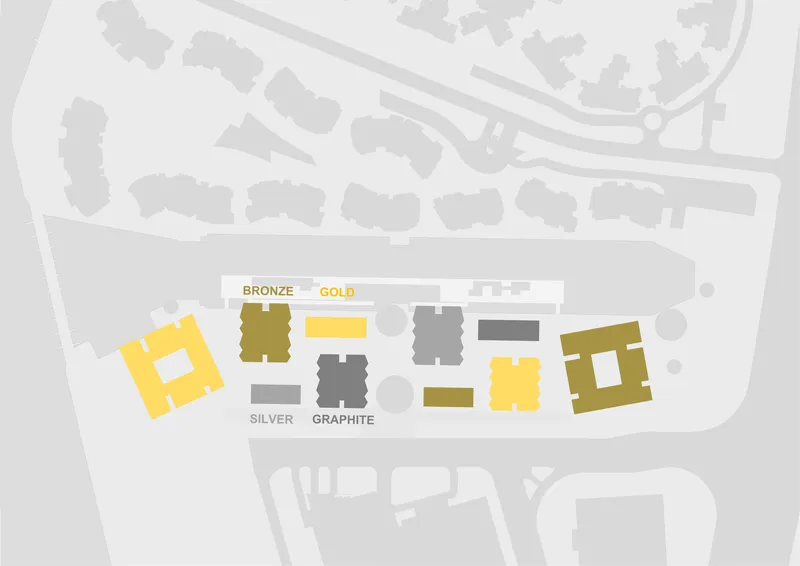
The color-coded building finish diagram is a useful piece of documentation, showing how bronze, gold, silver, and graphite tones are distributed across the site to differentiate building clusters without fragmenting the overall palette. The circulation diagram is equally revealing: it maps a water promenade, a garden axis, and arrival routes as three distinct pedestrian systems layered onto the same ground plane. The amenity plan distributes pool facilities, club spaces, a roof garden, and a tennis court across the site rather than concentrating them in a single location, reinforcing the village concept at the planning level.
Why This Project Matters
Singapore's housing landscape is defined by two extremes: the HDB public housing block and the luxury condominium tower. The Reef at King's Dock carves out a middle ground that neither type typically occupies. By breaking the program into a village-scaled composition of courtyard buildings and stepped blocks, KCAP and DCA Architects demonstrate that waterfront density can be achieved without resorting to tower-on-podium formulas. The project's real contribution is at ground level, where a network of courtyards, promenades, and planted corridors creates a pedestrian environment that connects to the city rather than walling itself off.
For architects and planners working on waterfront sites in tropical climates, The Reef offers a transferable set of ideas: facade depth calibrated to solar exposure, landscape corridors that function as microclimatic infrastructure, and a massing strategy that distributes amenities vertically across stepped terraces. None of these ideas are radical in isolation, but their integration into a coherent whole is convincing. The project proves that the most effective design moves in residential architecture are often organizational rather than formal.
The Reef at King's Dock, designed by KCAP and DCA Architects. Located in Singapore, Singapore. 26,000 m². Completed in 2024. Photography by Finbarr Fallon.
About the Studio
Share Your Own Work on uni.xyz
If projects like this are the kind of work you want to make, uni.xyz is a place to publish your own, find collaborators, and enter design competitions.


Popular Articles
Popular articles from the community


Singing Woman: An Opera House That Performs Before the Curtain Rises
Ovidiu Cristian Pavel's conceptual opera house translates Estonia's choral identity into a sculpted waterfront landmark facing the Baltic Sea.


graciastudio Turns a Viewless Tijuana Lot Inward Around a Courtyard of Concrete, Timber and Trees
In Tijuana, Jorge Gracia's GA2 House stacks a timber-clad private floor over exposed concrete and replaces a missing view with a planted interior patio.

The Amber Palace Opera: A Geological Fiction Surfaces on Tallinn's Baltic Waterfront
Pierre Brillard reimagines a Baltic legend as a public landscape, opera house, and waterfront promenade rooted in Tallinn's coastal identity.

FCC Arquitectura Expands a Portuguese Granite House with a Board-Marked Concrete Wing
In Portugal, JV House pairs a cleaned-up whitewashed and granite dwelling with a timber-shuttered concrete extension, courtyards and a garden pool.

Similar Reads
You might also enjoy these articles

LAVA Architecten Gives Vocational Education a Sawtooth-Roofed Face on a Mechelen School Campus
In Mechelen, Belgium, a 2,053 m² STEM school on a 6×6 m grid turns workshops and classrooms into rooms that can be rearranged as teaching changes.

KEMA Studio Turns a Derelict Marvila Attic into a 60 m² Lighthouse Apartment Above Lisbon
In Lisbon's Marvila district, a rebuilt roof, four skylights and two plywood volumes turn an unlivable attic into a bright home facing the Tagus.

Pixel Gardens: One Repeated Module Stacked Into a Terraced Social Housing Tower for Famagusta
Salem Bader's shortlisted housing tower builds a vertical neighbourhood from one repeated module, offsetting units to carve terraces, light and air.

Bao Huynh Watercolor Atelier: A Serene Art Retreat in Hội An
Bao Huynh Watercolor Atelier in Hội An blends multifunctional art spaces, sustainable design, local materials, and family-friendly living in a serene environment.

Comments (0)
Please login or sign up to add comments
No comments yet. Be the first to comment!