
Non Architecture's Horrible Houses Competition Asks AI to Design the Ugliest Home Possible
A free global competition invited participants to use AI image generators to produce the most hideous house they could imagine.


What happens when you strip architecture of every aspirational impulse and ask a machine to produce something genuinely repulsive? That is the premise behind Horrible Houses, a free competition organized by Non Architecture Competitions that challenged participants worldwide to submit a single AI-generated image of the worst house they could conjure. No plans, no sections, no materiality schedules. Just one image, produced by whichever generative engine the entrant preferred, depicting a dwelling so aesthetically offensive it could only exist in latent space.
The competition is worth discussing not because it produced buildings, but because it produced a revealing catalogue of what architects, designers, and hobbyists consider to be architectural failure. When you ask someone to make something horrible on purpose, you learn what their implicit standards of "good" actually are. Horrible Houses functions less as a design brief and more as a Rorschach test for the discipline's unspoken aesthetic hierarchies, filtered through the uncanny tendencies of diffusion models and GANs.
The Anti-Brief
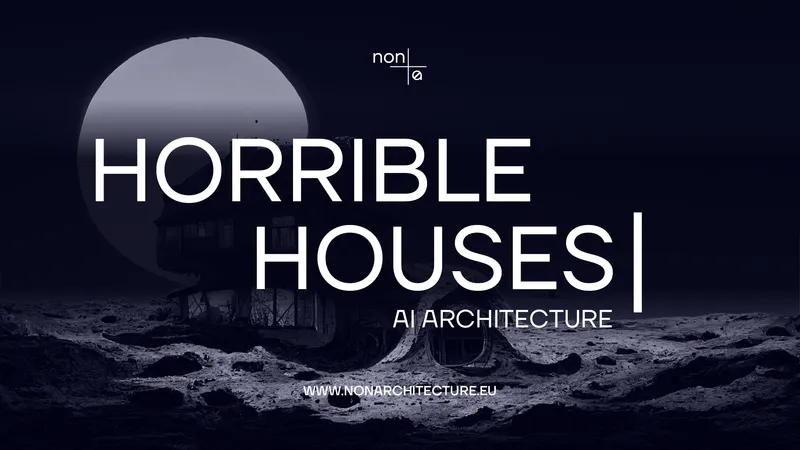
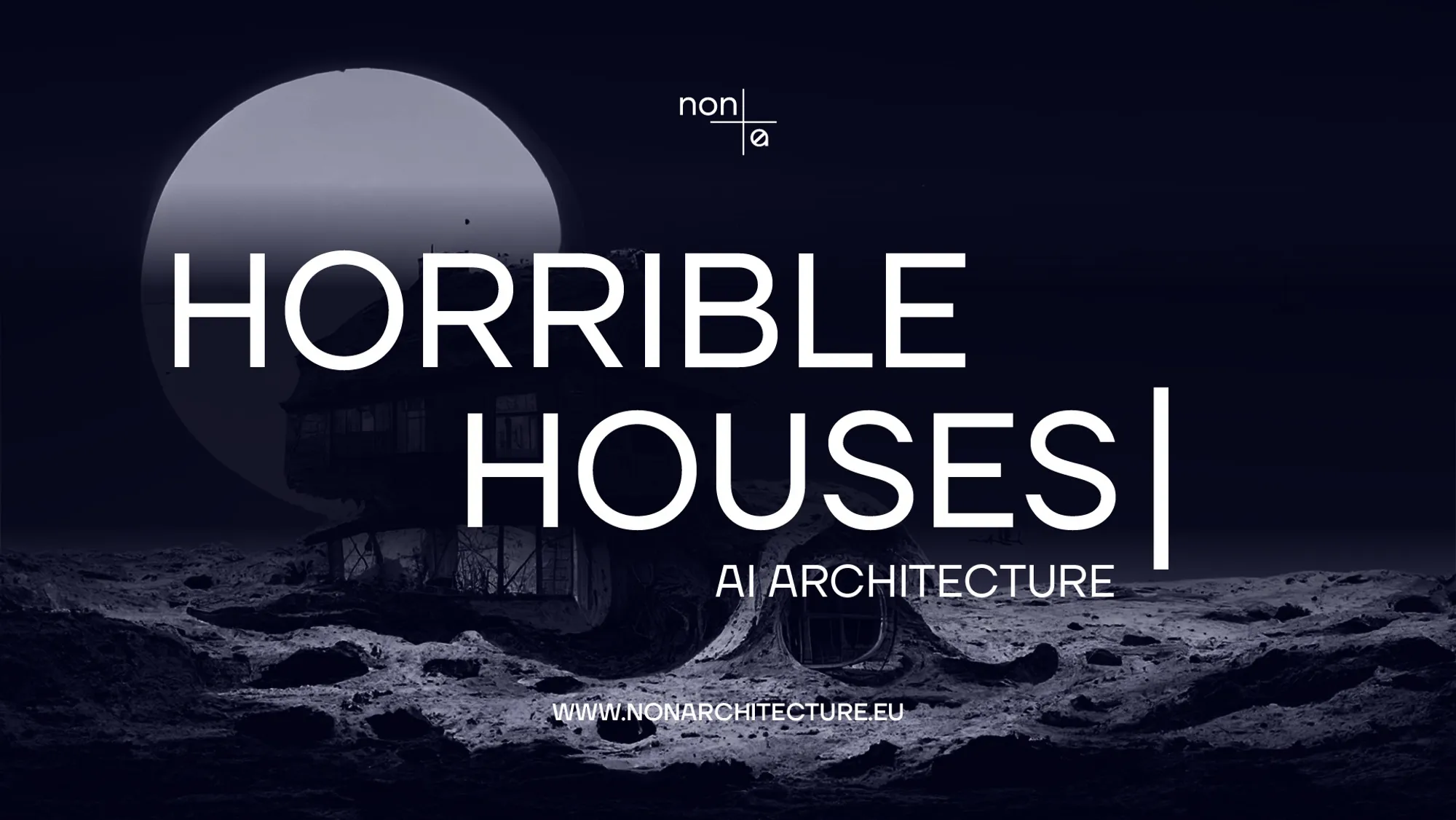
Most architectural competitions impose constraints: site, program, budget, sustainability targets. Horrible Houses had essentially one rule: use AI, and make it ugly. The competition's title graphic, set against a moody moonlit landscape of barren rock, already hints at the tongue-in-cheek gothic register the organizers were after. By removing every conventional criterion of quality, the brief forced participants to confront what "horrible" even means when there is no client, no occupant, and no gravity to obey.
The format, a single image rather than a set of drawings, is itself a provocation. It suggests that architecture, at least in the AI era, can be reduced to a surface. Whether that reduction is liberating or disturbing depends on your relationship to the discipline. For students drowning in Revit deliverables, it might feel like a holiday. For practitioners who spend years coordinating structure with envelope, it might feel like a category error dressed up as fun.
AI as Aesthetic Mirror
Generative image tools like Midjourney, DALL·E, and Stable Diffusion learn from the entire visible internet. Their outputs reflect the biases of millions of photographs, renders, and drawings scraped from architectural media. When these tools produce "horrible" architecture, they often do so by amplifying or distorting the visual tropes the discipline already circulates: bloated massing, clashing materials, ornament without logic, symmetry gone feral. The results tend to look less like pure invention and more like the built environment's existing failures, concentrated and exaggerated.
That feedback loop is the most interesting thing about the competition. AI generators are not neutral instruments. They are trained on datasets that encode taste, and when you prompt them to violate that taste, you get a photographic negative of the discipline's current consensus. Horrible Houses, intentionally or not, maps the boundary between architectural acceptability and disgust, and it does so with the computational thoroughness that only a machine trained on billions of images can provide.
Competitions Without Construction
Non Architecture Competitions has built a niche around speculative briefs that prioritize ideas over buildability. Horrible Houses sits at the extreme end of that spectrum. There is no site, no structural logic, no program beyond "house," and no expectation that any submission could survive contact with reality. The competition exists purely in the image domain, which raises a fair question: is this architecture at all, or is it graphic design with architectural subject matter?
The answer probably depends on how broadly you define the discipline. If architecture requires the possibility of inhabitation, then Horrible Houses is a meme contest. But if architecture also includes the discourse around what buildings should look like and why, then a competition that explicitly interrogates ugliness belongs in the conversation. The history of the discipline is full of polemical projects, from Superstudio's Continuous Monument to Archizoom's No-Stop City, that existed only as images and still shaped real buildings decades later.
Why This Project Matters
Horrible Houses matters because it makes legible a question that most AI-and-architecture discourse avoids: what are these tools actually good at, and what do their outputs reveal about the discipline's blind spots? By inverting the usual objective, the competition turns generative AI from a production tool into a diagnostic one. The horrible images it elicits are data points about collective taste, rendered in high resolution.
It also matters as a cultural marker. The fact that a free, image-only, AI-powered competition can attract global attention says something about where architectural engagement is migrating. The barriers to participation are collapsing. You no longer need Rhino, a laser cutter, or a degree to enter the discourse. Whether that democratization enriches or dilutes the field remains an open question, but competitions like Horrible Houses are forcing the conversation, one grotesque render at a time.
Horrible Houses, organized by Non Architecture Competitions. Open call for AI-generated images of intentionally ugly houses. No fixed location, no built project. Competition hosted by AI Architecture Competition.
About the Studio
Share Your Own Work on uni.xyz
If projects like this are the kind of work you want to make, uni.xyz is a place to publish your own, find collaborators, and enter design competitions.




Popular Articles
Popular articles from the community


Conexión: Biophilic Design Reimagines High-Rise Living in Hong Kong
Conexión reimagines high-rise living in Hong Kong through biophilic design, green facades, shared spaces, daylight, water and nature within.

The Earth Pod: 3D Printed Homes for Resilient Refugee Communities
The Earth Pod reimagines refugee housing through 3D printed homes made from clay, combining resilience, self-sufficiency, and rapid shelter.

Co-life: Sustainable Architecture for Age-Friendly Community Living
Co-life reimagines sustainable architecture for seniors through courtyards, rammed earth, shared gardens, and spaces designed for belonging.

The Ocean Hive: Sustainable Architecture for a Self-Sufficient Civilization at Sea
The Ocean Hive imagines sustainable architecture at sea, where modular habitats, algae, wave power and ocean waste sustain a growing colony.

Similar Reads
You might also enjoy these articles

Bao Huynh Watercolor Atelier: A Serene Art Retreat in Hội An
Bao Huynh Watercolor Atelier in Hội An blends multifunctional art spaces, sustainable design, local materials, and family-friendly living in a serene environment.

Atelier Macri Concept Store Interior Design by CASE-REAL
Atelier Macri store features a "ko" counter, walnut wood details, cork displays, blending retail, gallery, and seamless customer experiences.

Manuel Vargas Izquierdo Stadium and High-Performance Sports Center: Architectural Excellence in Jalpa de Méndez
The Manuel Vargas Izquierdo Stadium blends sustainable design, inclusive sports facilities, and cultural-inspired architecture, revitalizing Jalpa de Méndez’s public spaces.

KAKR Buluh Awar Hall: Revitalizing Community and Ecology Through Bamboo Architecture
Community built bamboo hall revitalizes Buluh Awar village, empowering youth, restoring ecology, celebrating vernacular craftsmanship through sustainable architecture and culture.


Explore Architecture Competitions
Discover active competitions in this discipline



Challenge to reimagine the Iron Throne


Photograph architecture without architects


Illustrate the lost glory of Angkor Wat - Render Challenge


Design challenge to reuse E-waste
Comments (0)
Please login or sign up to add comments
No comments yet. Be the first to comment!