

Formafatal Builds Costa Rica's First Rammed Earth Villas on a Jungle Hillside Above the Pacific
Two 90-square-meter villas in Playa Hermosa use excavated clay soil for their bearing walls, blurring the line between architecture and landscape.


Costa Rica has no shortage of luxury jungle retreats, but almost none of them have tried rammed earth. Formafatal, the Prague-based studio led by Dagmar Štěpánová, changed that in 2022 with Achioté Villas, a pair of compact pavilions perched 300 meters above the Pacific on a steep, jungle-covered slope near Uvita. Every perimeter bearing wall is built from clay excavated on site, making this the first rammed earth construction in the country. The technique was realized with help from Daniel Mantovani of the Brazilian firm Terra Compacta, who trained local craftsmen for the build.
What makes Achioté genuinely interesting is the discipline of its restraint. Each villa measures just 90 square meters of gross floor area, yet the experience of the space is radically larger because the main living zone is an outdoor terrace that connects bedroom, bathroom, and kitchen to an infinity plunge pool cantilevering over the valley. The two villas are architecturally identical in plan, materials, and orientation toward the cardinal points, but each receives a distinct color concept rooted in the energies Formafatal perceived on site before construction: Jaspis Villa reads in a sandy yin palette, while Nefrit Villa pulses with a red-terracotta yang energy transmitted through its concrete floor, which takes its hue from the local soil.
Entering from Above
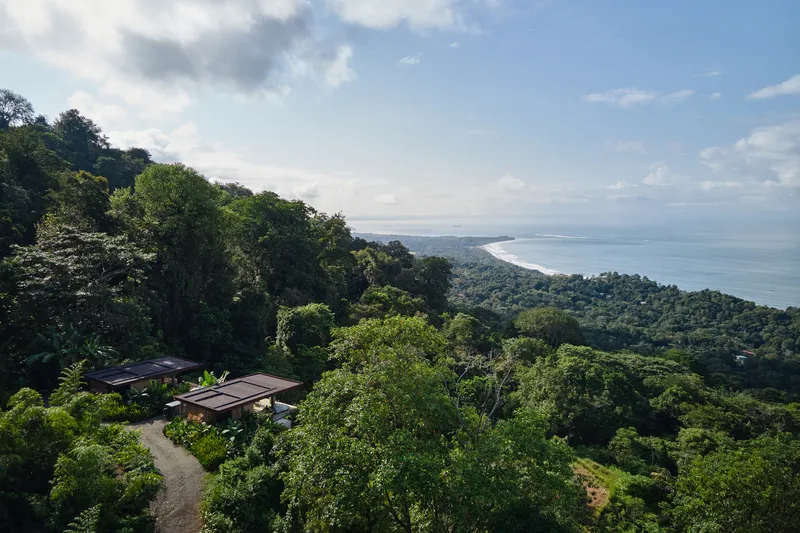
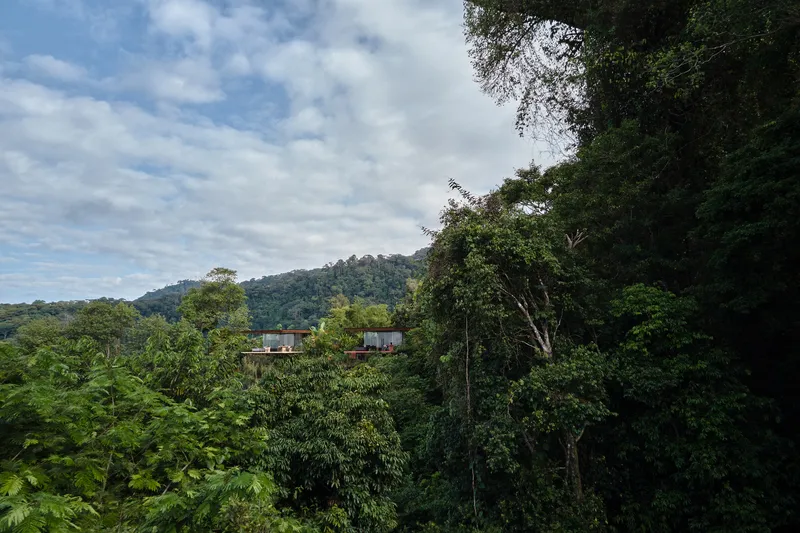
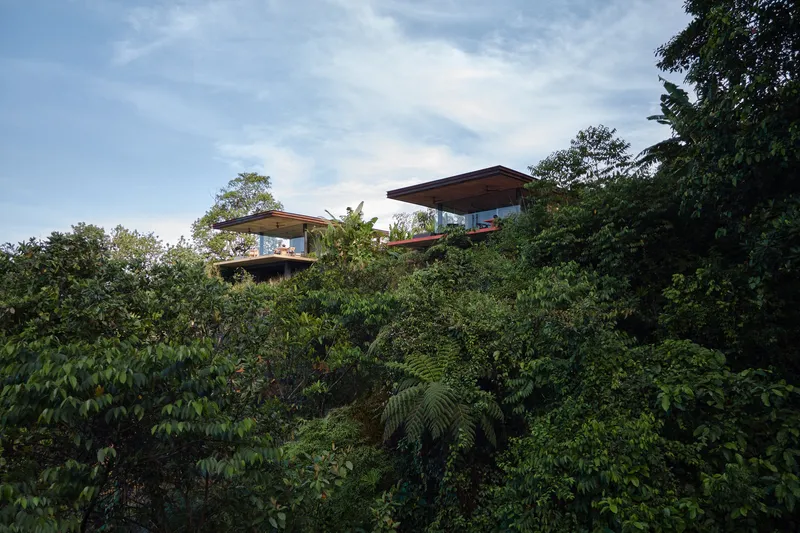
Formafatal designed the approach so that each villa looks almost humble from its entry point. You arrive at the top of a slope and see only a flat, low-slung roof sinking into the canopy. The drama unfolds as you move through the plan toward the south, where cantilevered terraces launch out over the hillside and the Pacific coastline opens up in front of you. The two volumes sit 12 meters apart, each nestled into the topography rather than imposed on it, visible from a distance only as thin horizontal lines floating within a sea of green.
Rammed Earth Walls and Local Clay
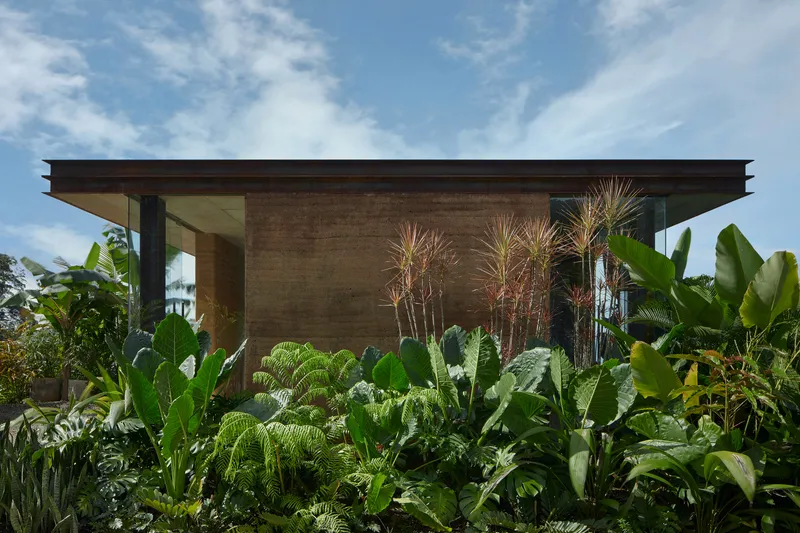
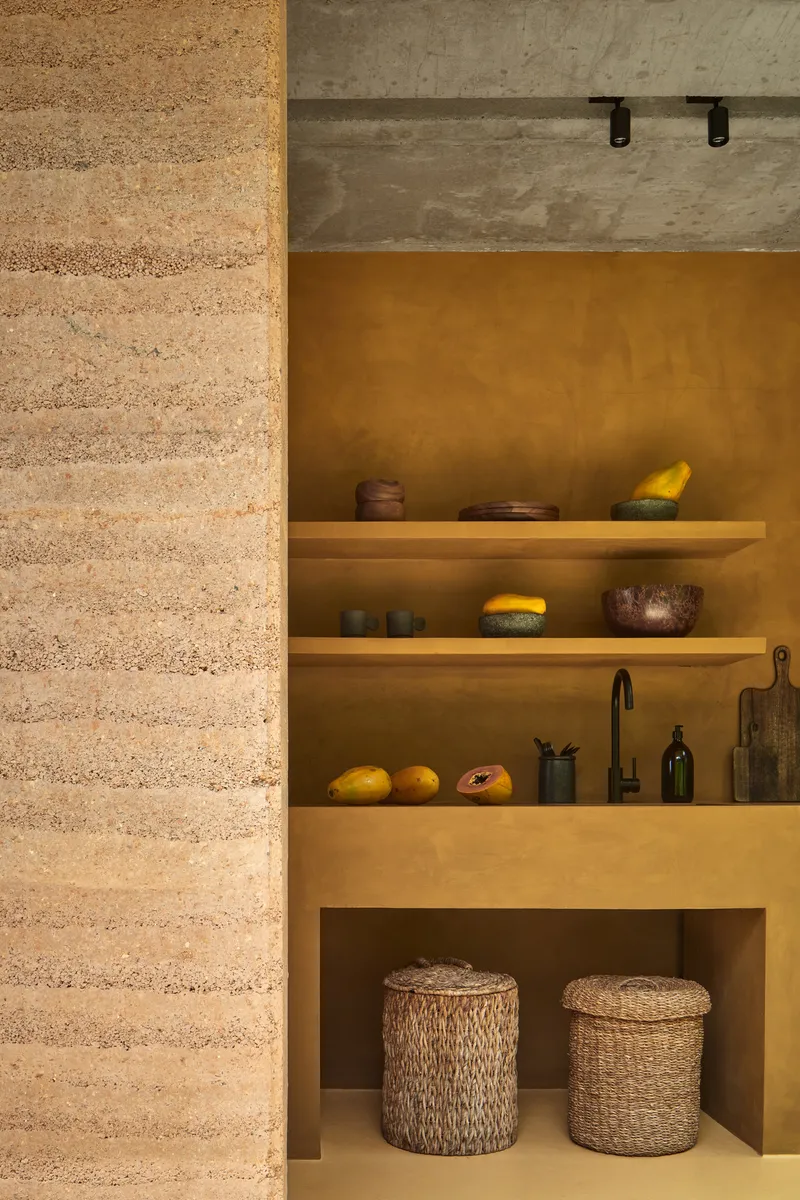
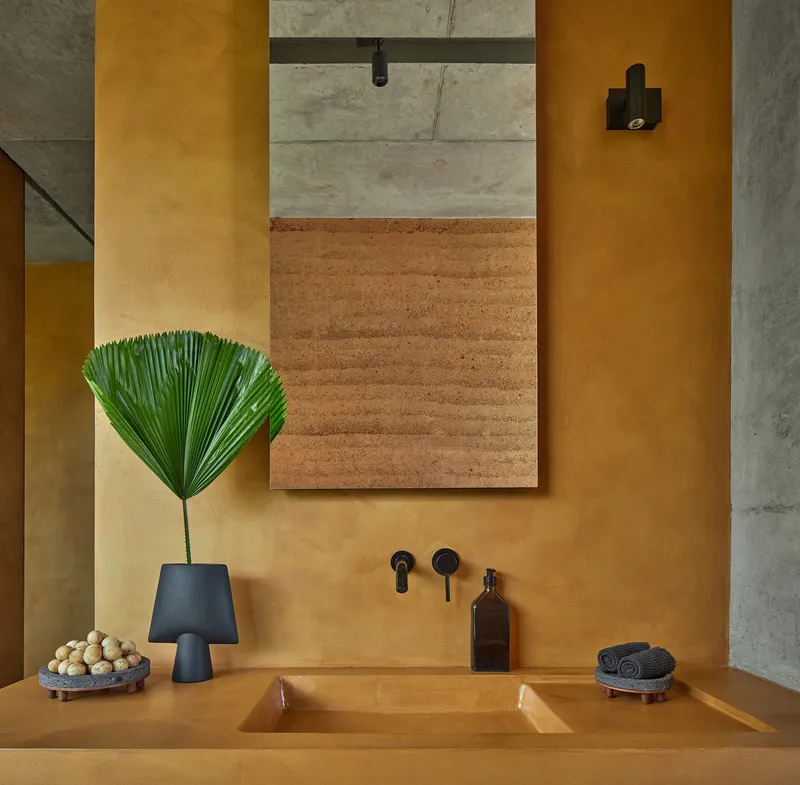
The rammed earth walls are the structural and conceptual heart of the project. All perimeter bearing walls use clay soil pulled directly from the site excavations, which means the building literally is the ground it sits on, rearranged into vertical planes. In Costa Rica's tropical climate, with its relentless humidity and seasonal downpours, rammed earth is an unusual bet. The material's thermal mass helps regulate interior temperatures, and Formafatal paired it with concrete foundations and steel H-columns to carry the monolithic concrete ceiling slab, letting the earth walls do what they do best: breathe.
Up close, the walls show the horizontal striations that are the hallmark of the technique, shifting subtly in tone as different soil layers were compacted. Against the ochre plaster of the kitchen alcoves and bathroom surfaces, the rammed earth panels read as something between geology and craft.
The Red Villa: Nefrit's Terracotta Energy
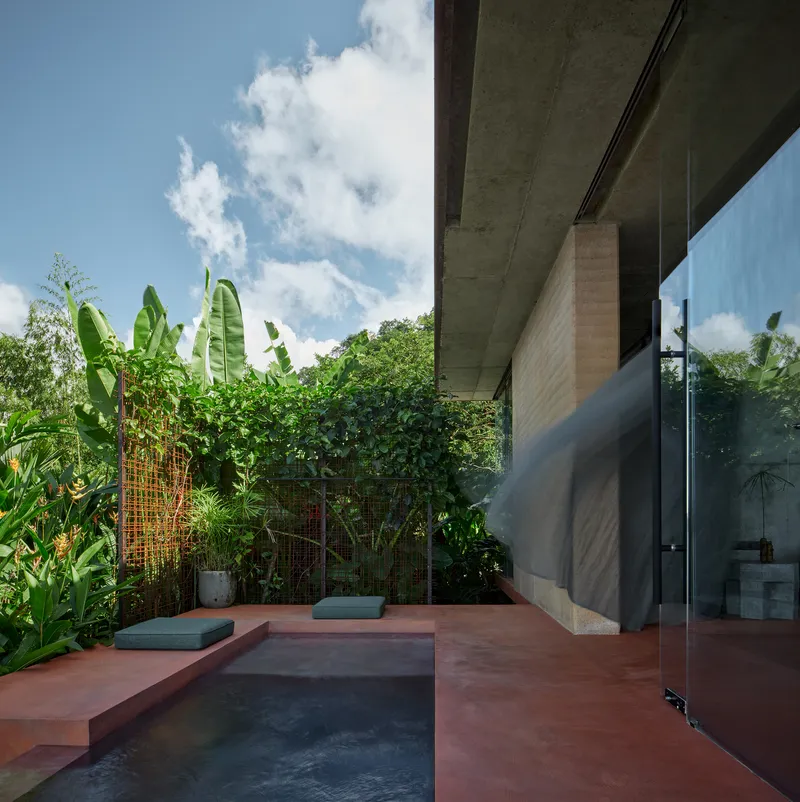
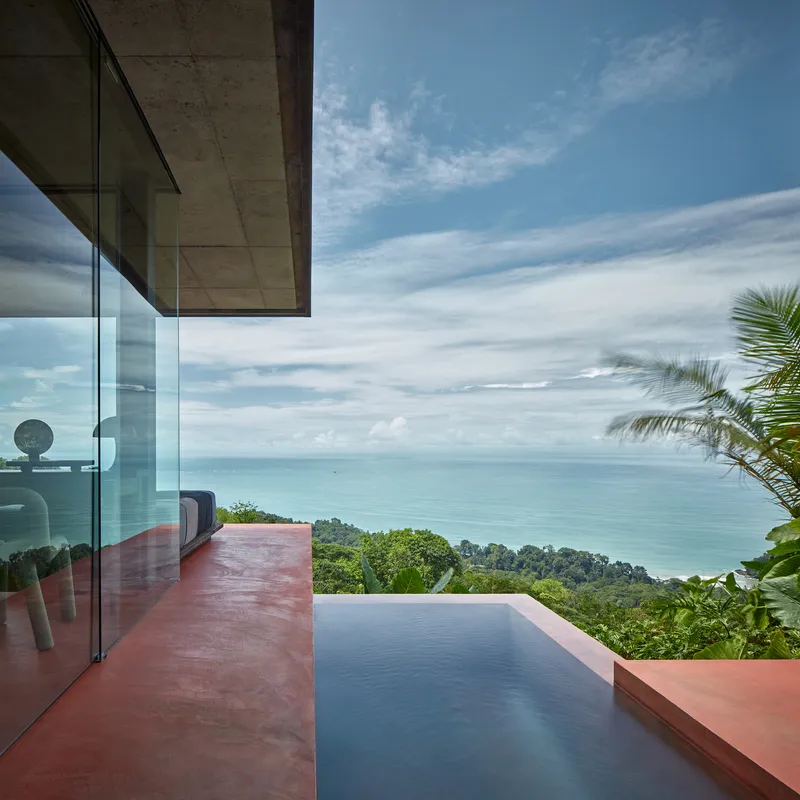

Nefrit Villa is the louder of the two, and its red-terracotta concrete floor is the reason. The pigment transmits the shade of local soil into every interior surface, staining the plunge pool surround, the terrace, and the floor slab with a warm oxide hue that feels volcanic against the surrounding green. When wet, the color deepens; in direct sun, it glows. The effect is that the ground plane itself becomes the primary design element, pulling your eye through the space and out to the infinity edge.
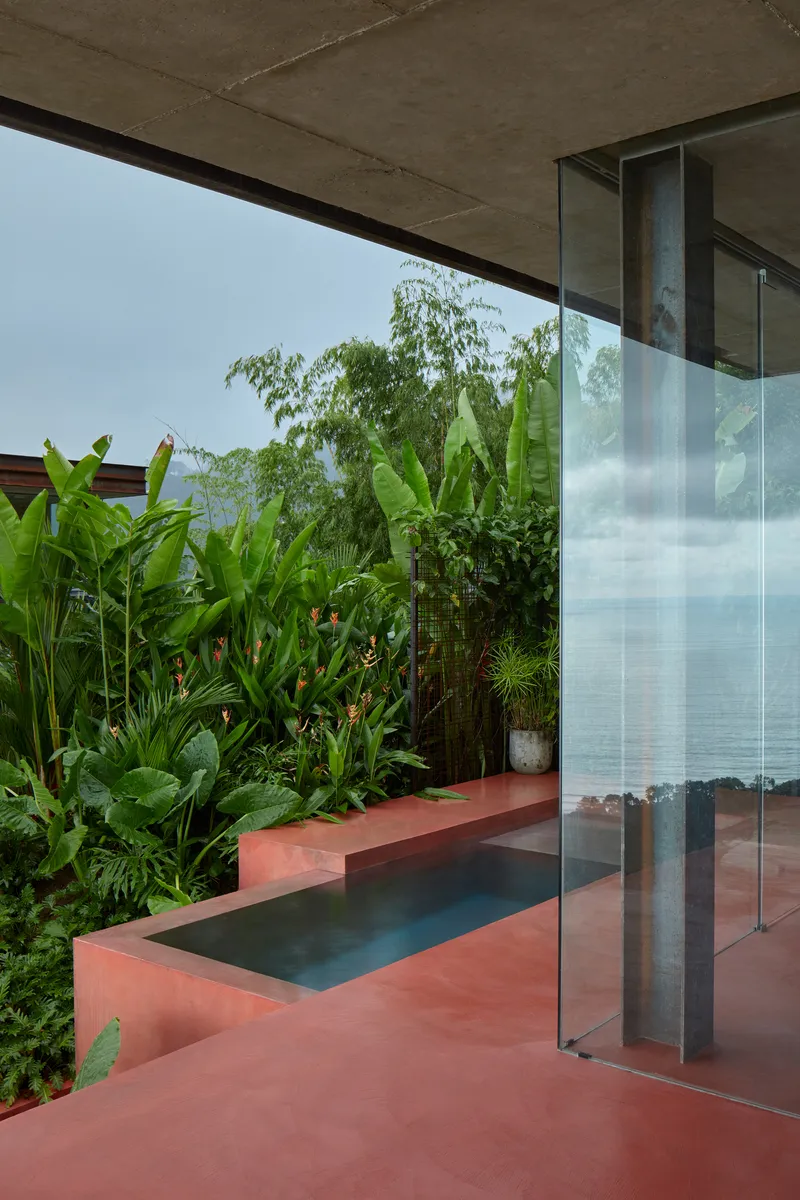
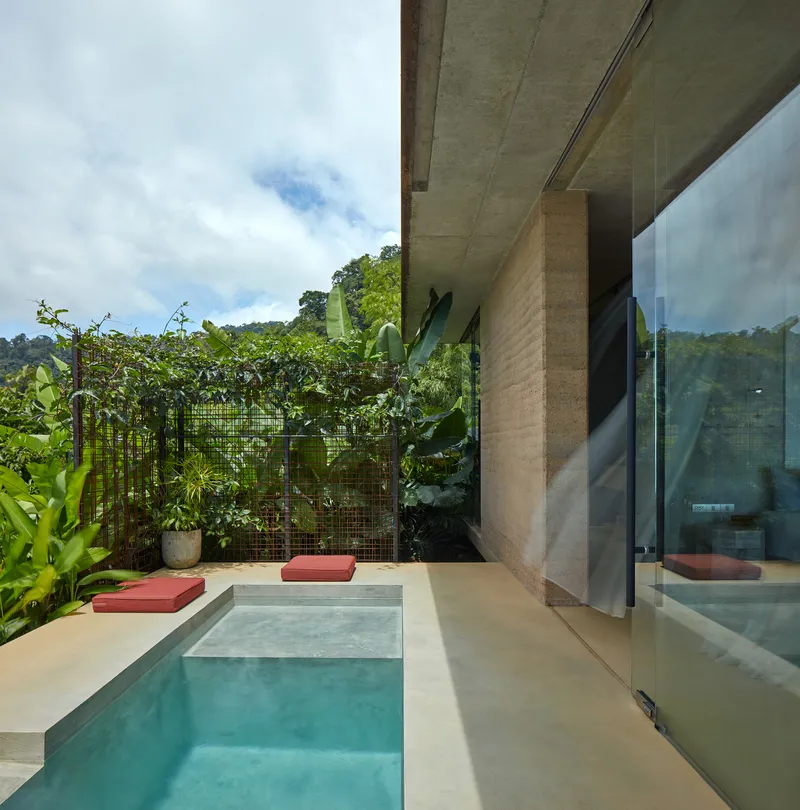
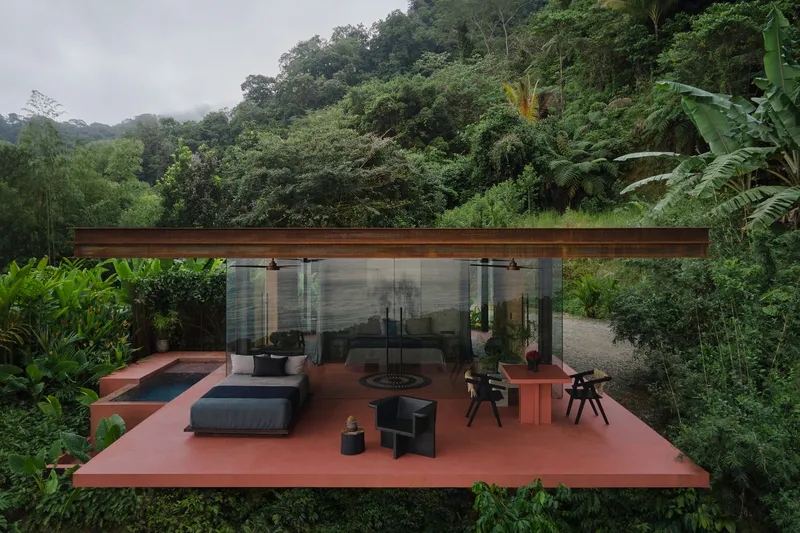
The courtyard pool with its red cushioned seating ledges and wire-mesh green wall is a particularly sharp detail. It acts as a hinge between the enclosed bedroom zone and the open terrace, creating a microclimate pocket shielded from wind but open to sky. Tropical plants climb the mesh, and within a few years the wall will be entirely living, softening the boundary between built form and jungle even further.
The Sand Villa: Jaspis and Quiet Warmth
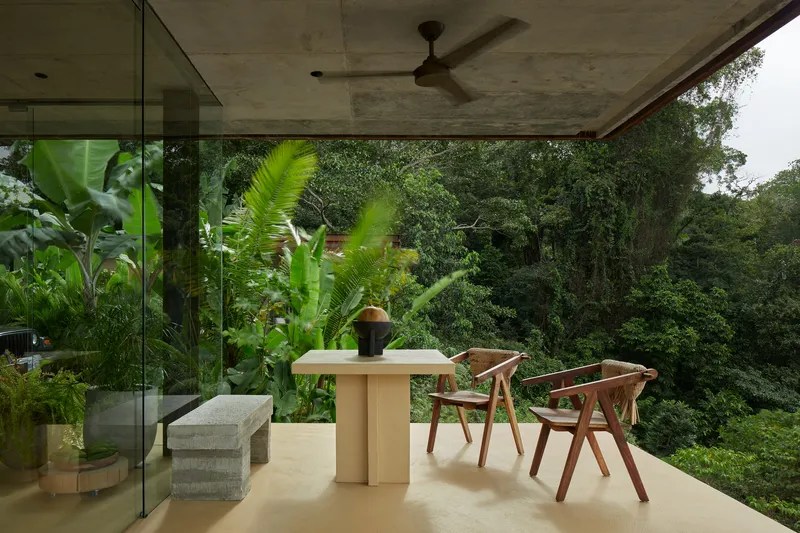
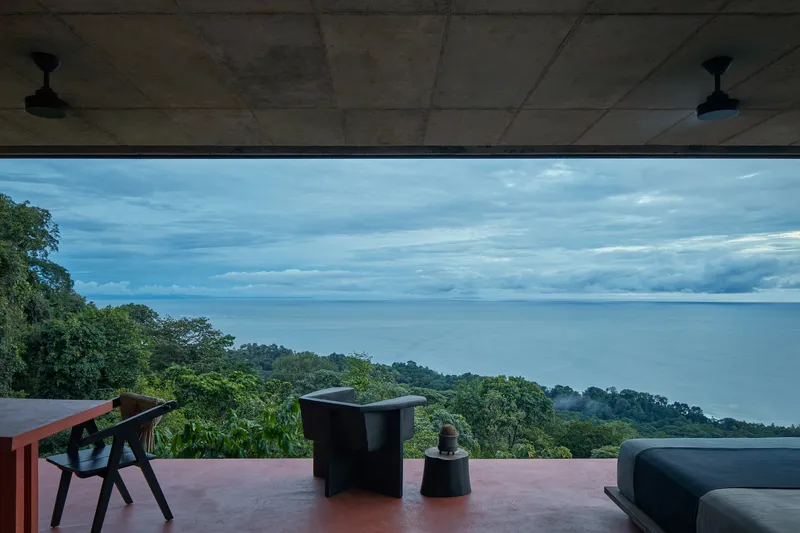
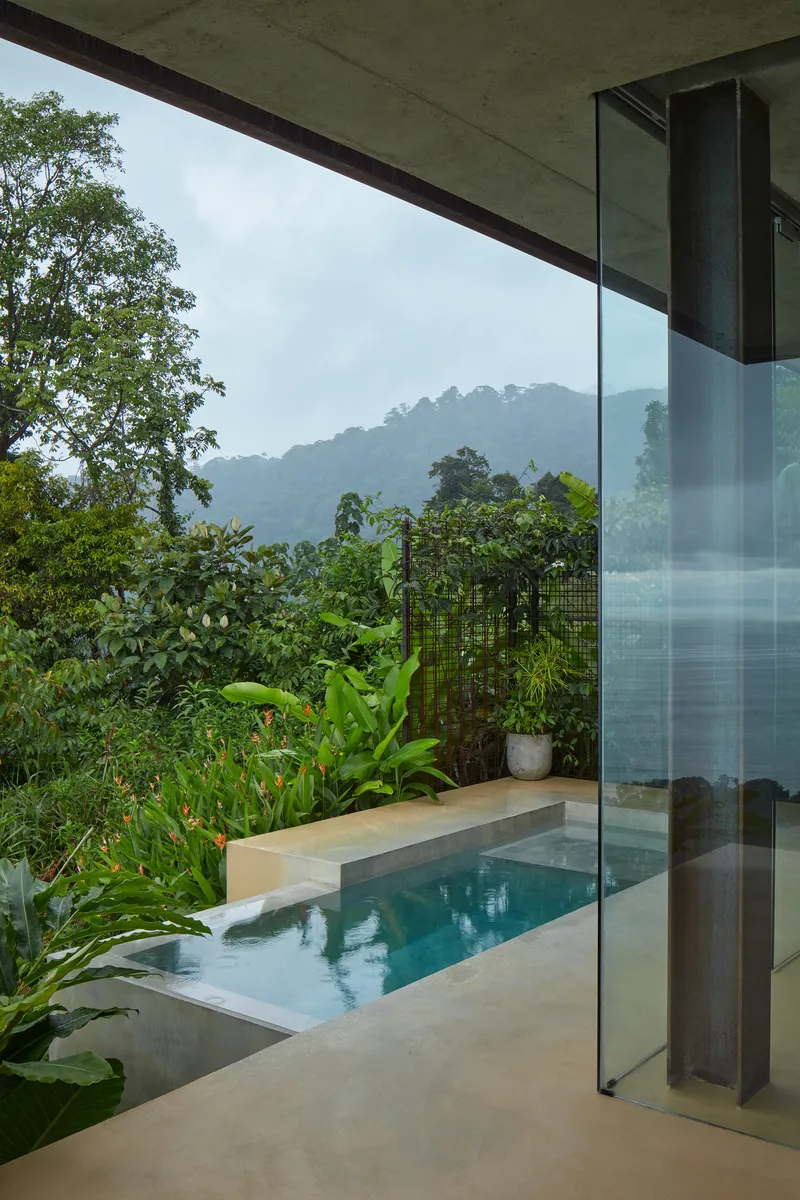
Jaspis Villa deploys the same plan rotated through the same compass orientation but washed in a sandy, neutral palette. The concrete floor is lighter, the plaster tones are softer, and the overall mood is cooler, more contemplative. Where Nefrit pushes outward with its chromatic intensity, Jaspis invites you to settle in. The covered dining terrace, framed by banana plants and looking out over the forested slope, is one of the most composed outdoor rooms Formafatal has produced: exposed concrete soffit, ceiling fans turning slowly, and the Pacific somewhere beyond the mist.
Glass Walls and the Dissolving Envelope
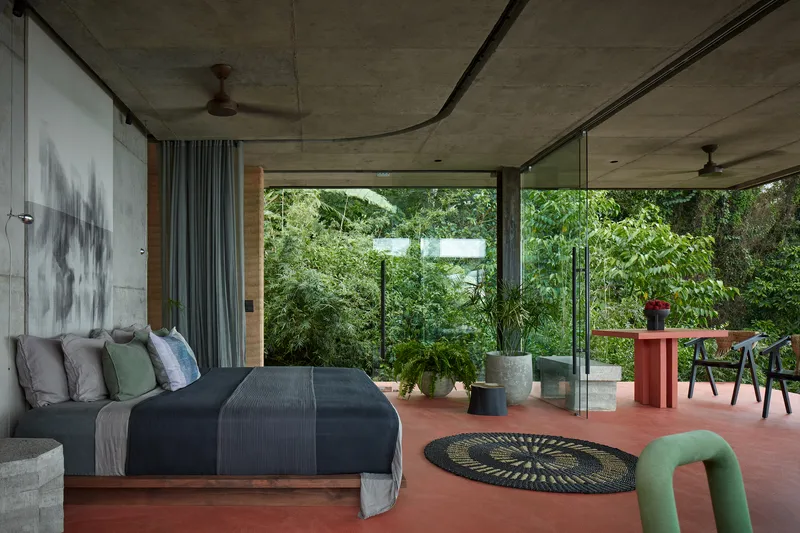
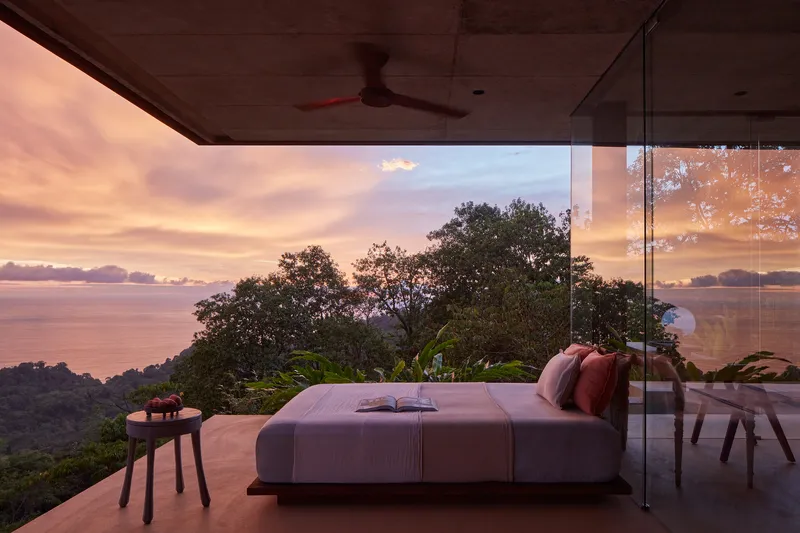
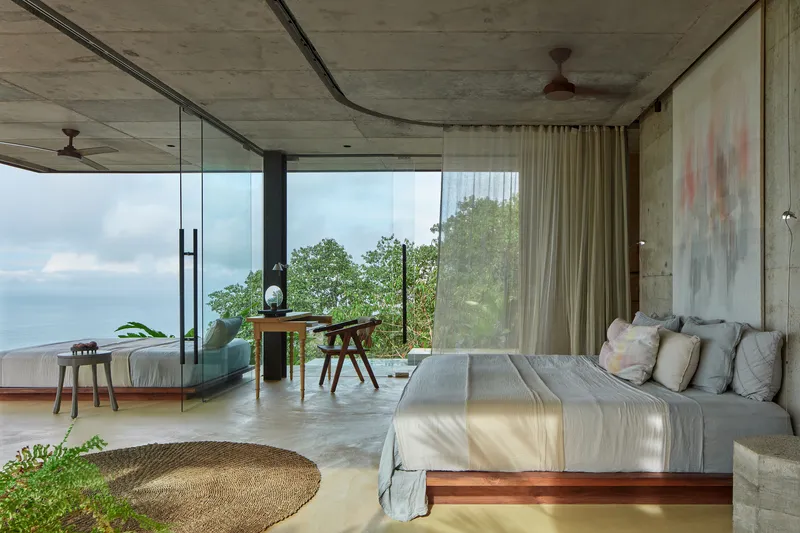
There are no doors in these villas, with the sole exception of a large sliding panel in the shower area. The rest of the envelope is frameless glass, recessed into grooves milled into the concrete ceiling and floor slabs. When the panels slide open, the bedroom is simply outside. The absence of frames is critical: it removes the visual threshold between interior and terrace, so the concrete soffit reads as a continuous canopy sheltering both zones equally.
The bedrooms are the clearest expression of this strategy. Curved curtain tracks embedded in the ceiling slab allow sheer linen mosquito nets and curtains to sweep around the sleeping area, creating a soft enclosure within the hard concrete shell. It is a layered system: rammed earth for mass, glass for view, linen for intimacy.
Concrete as Furniture
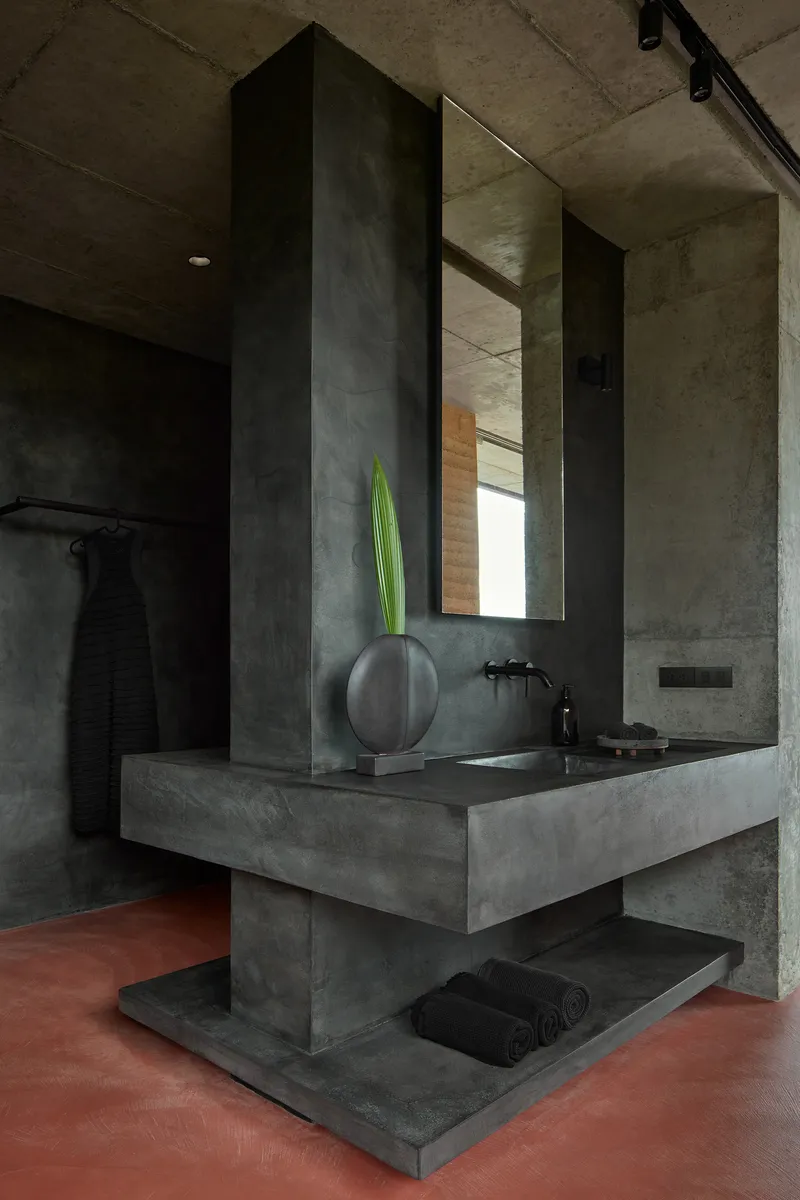
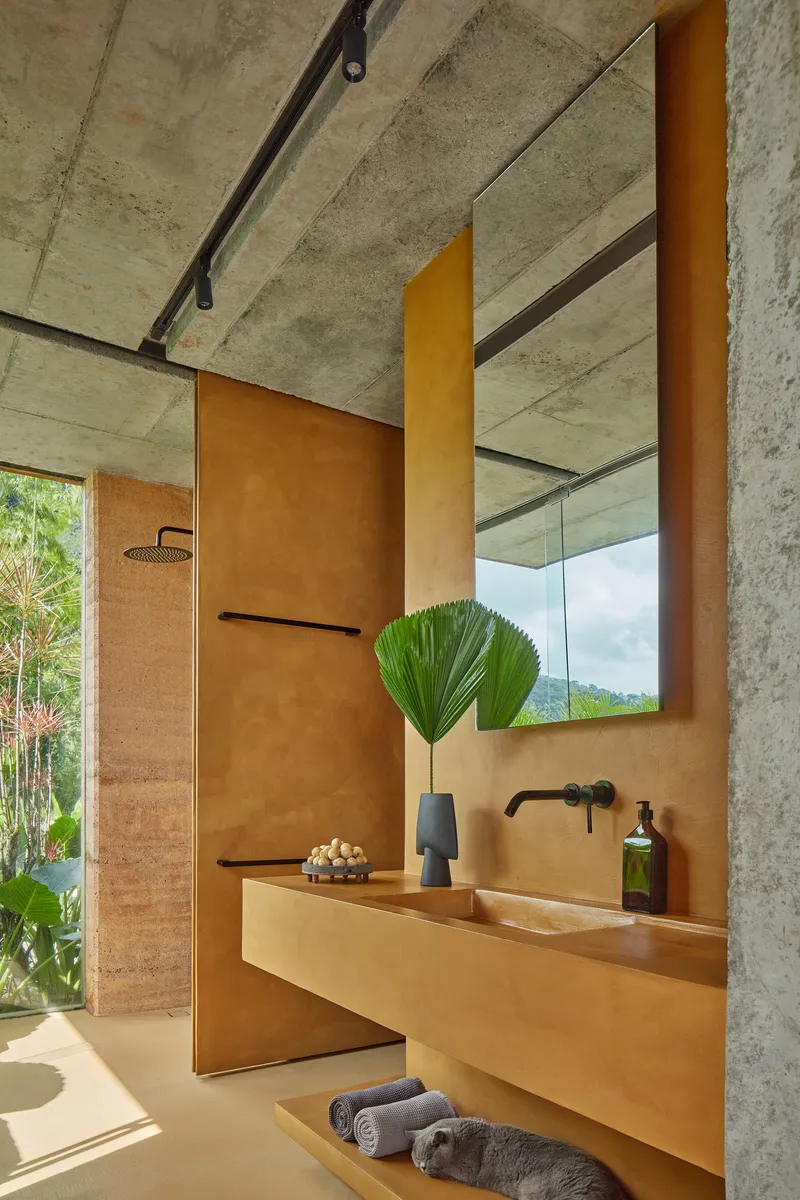
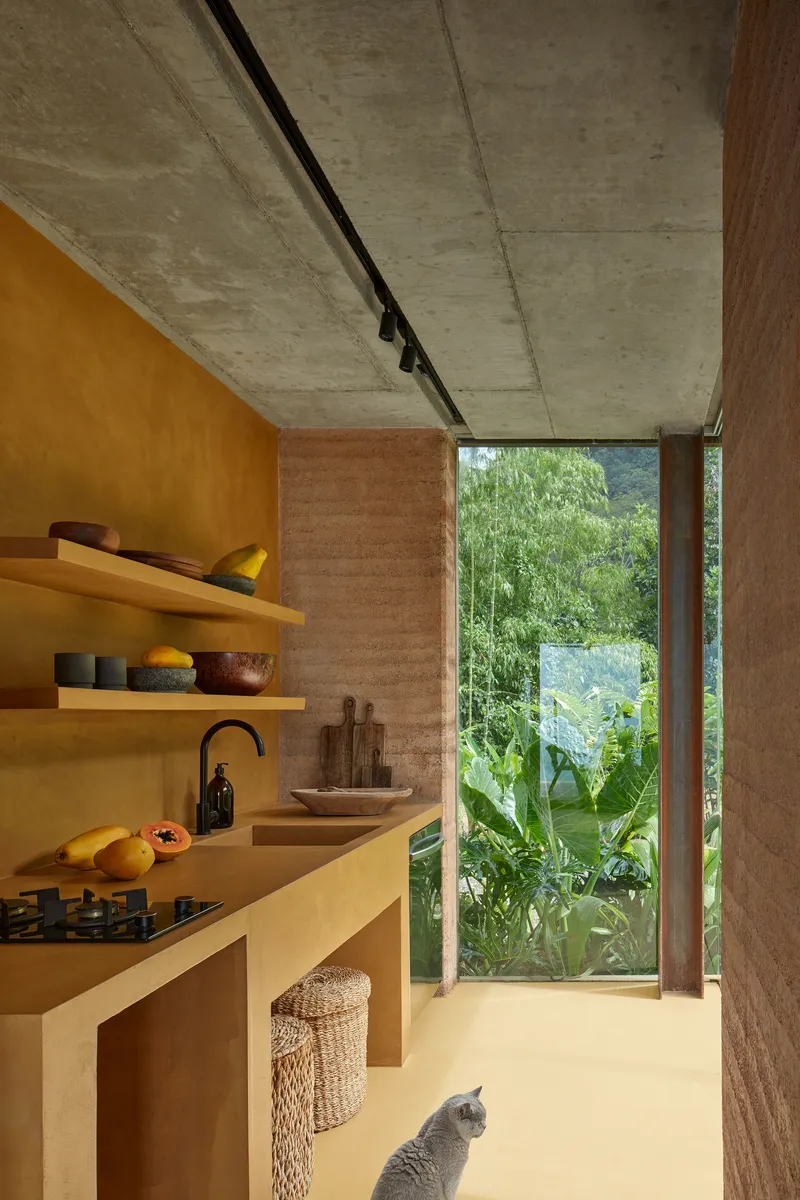
Formafatal poured nearly every piece of furniture from the same concrete used for the structural slabs. Kitchen counters, sinks, shelves, bedside tables, and bathroom vanities are monolithic, cantilevered from walls or cast in place. The effect is one of geological continuity: the building does not contain furniture so much as it grows it. A few elements break the concrete rule. Teak beds bring warmth to the sleeping zone, PlyRock fibre cement panels serve as the sliding shower partition and dining table surface, and all fabric in the villas is 100% linen, chosen for its ability to breathe in the humidity.
Cantilevered Terraces and the Plunge Pool Edge
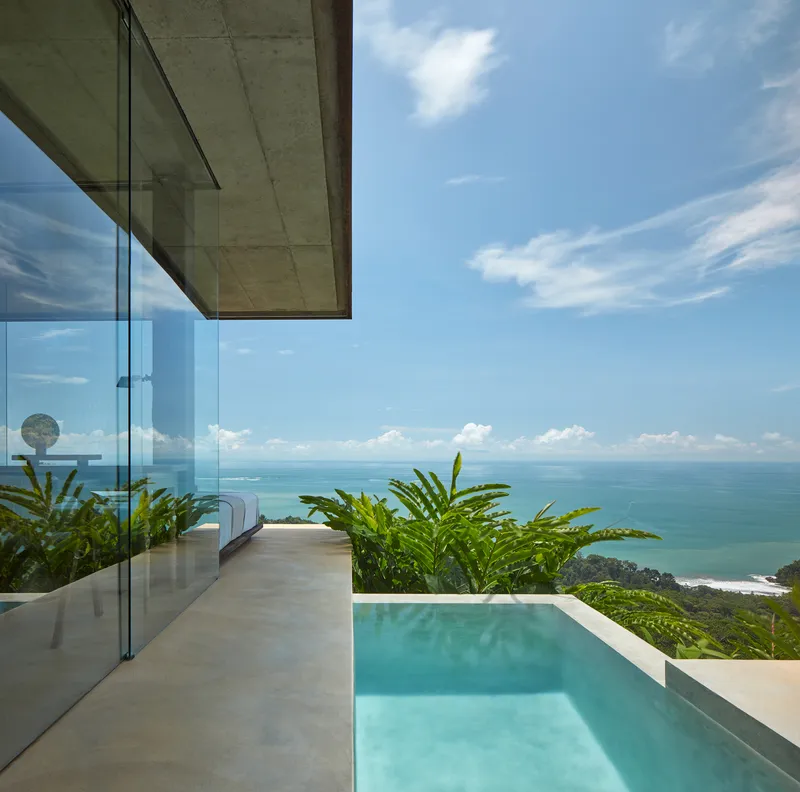
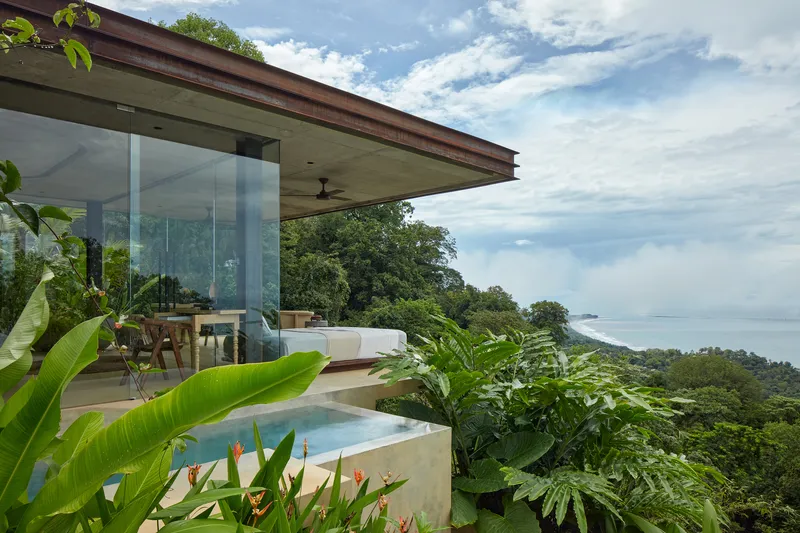
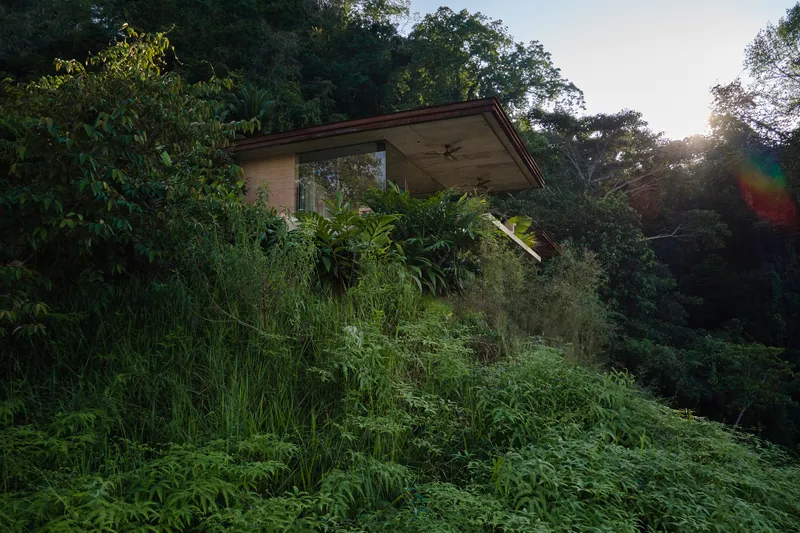
The most photographed moment in each villa is the cantilevered terrace with its infinity plunge pool extending over the steep southern slope. The structural trick is straightforward: steel H-beams carry the concrete slab beyond the hillside, and the steel U-profiles lining the upper face of the roof double as a roof attic while shading the platform below. But the experiential payoff is immense. You are floating in warm water, looking down into treetops, with the Pacific stretching out to the horizon. It is a controlled vertigo, made possible by the site's 300-meter elevation and Formafatal's decision to cantilever rather than terrace.
Plans and Drawings
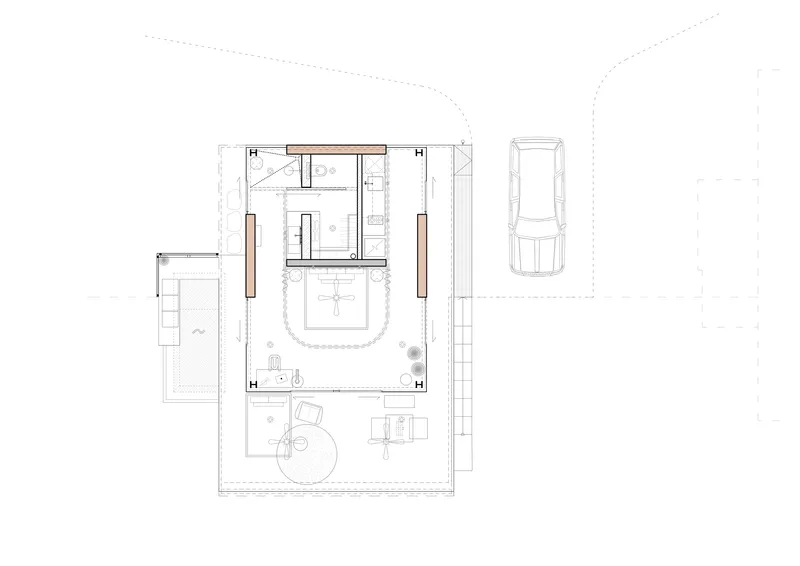
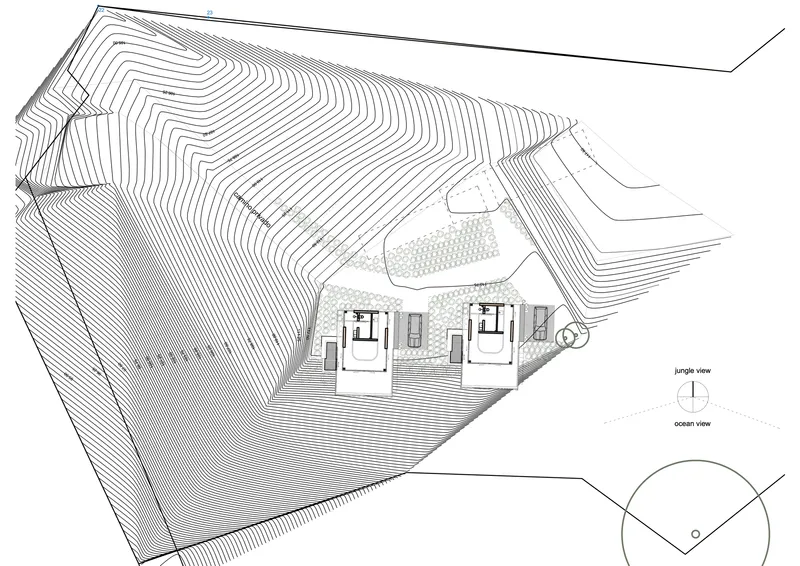

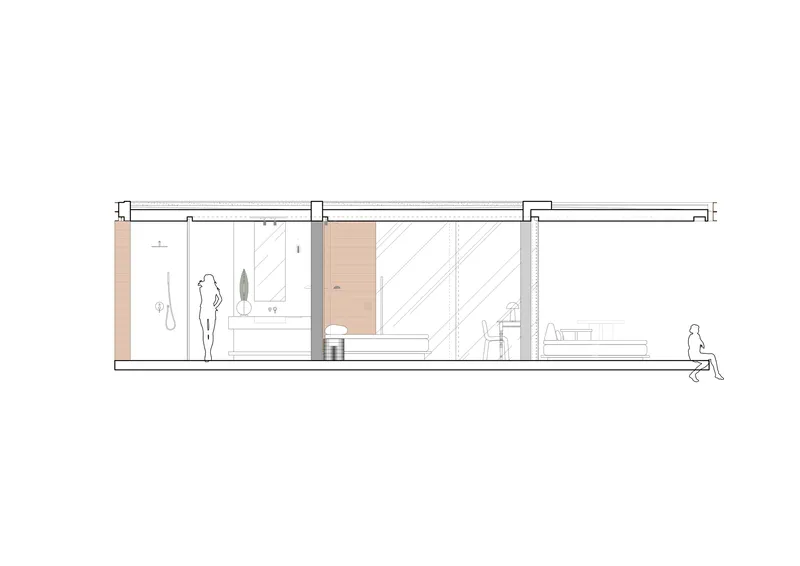
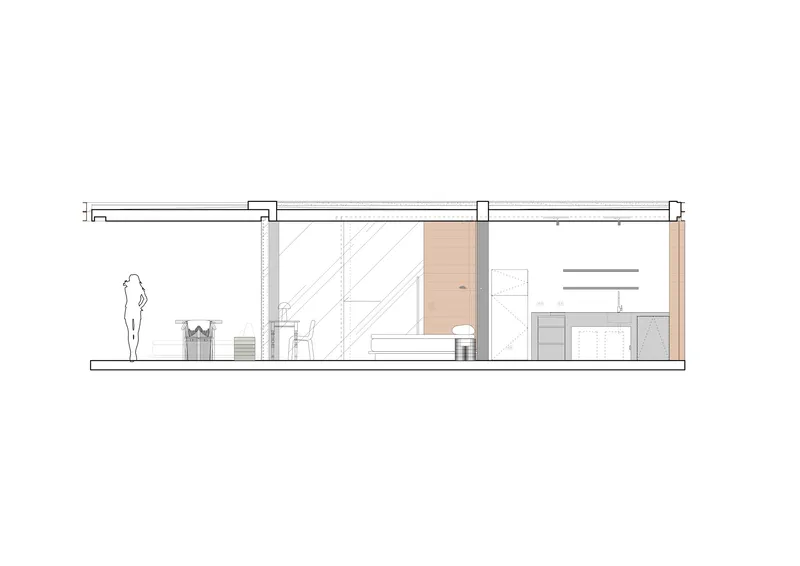
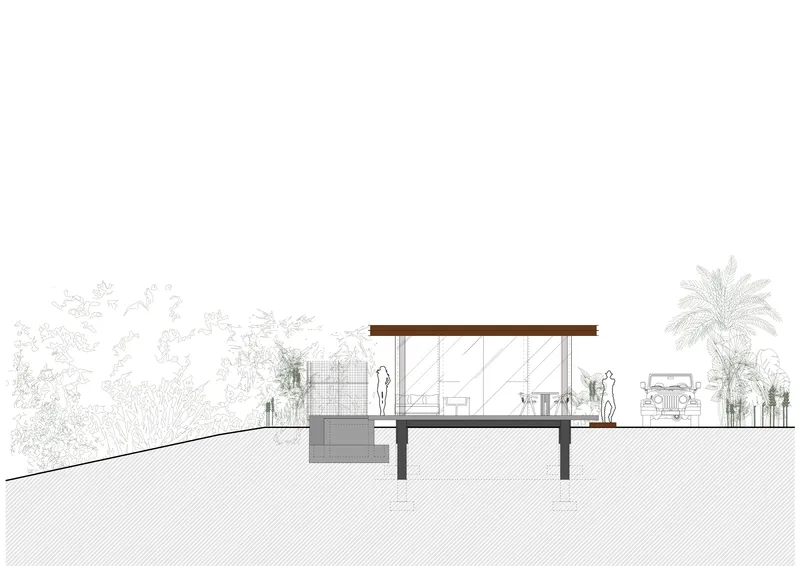
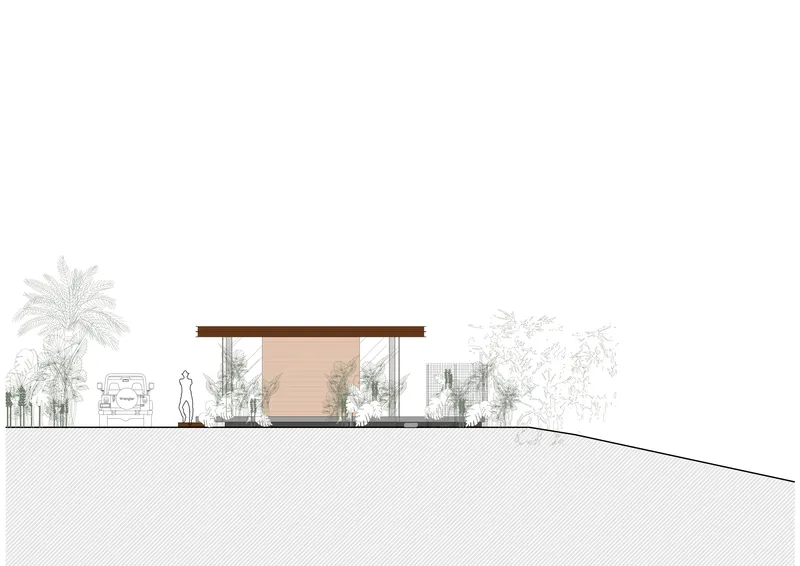
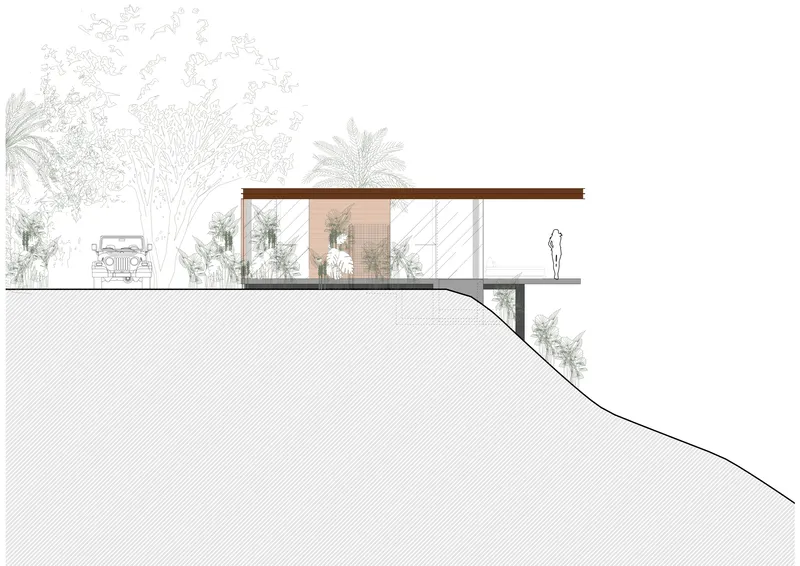
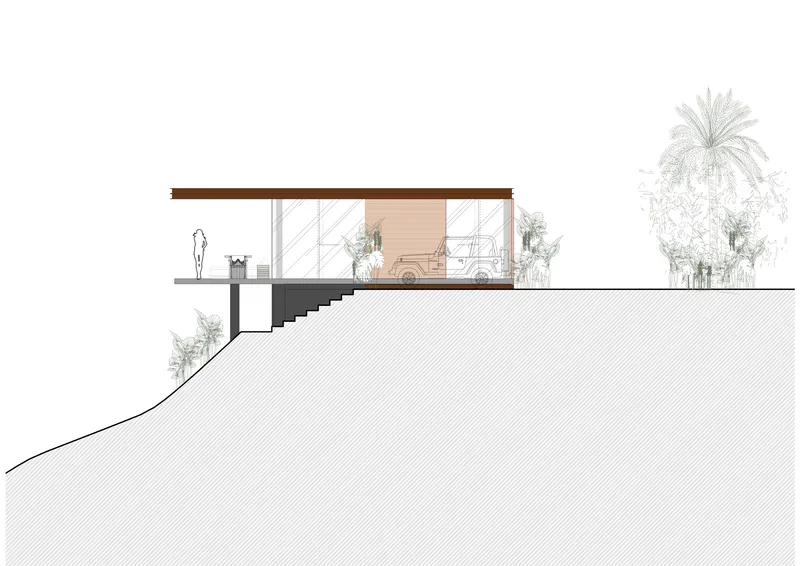
The floor plan reveals how compact the program actually is. Each villa is organized around a central courtyard that pulls light and ventilation into the core, with the bedroom, bathroom, and kitchen arranged in a tight linear sequence. The sections are the more revealing drawings: they show how the villas step down the slope, how the cantilevered terrace launches from the hillside, and how the concrete ceiling slab acts as a unifying datum across the entire composition. The relationship between the flat roof plane and the steep terrain is what gives the project its spatial drama.
Why This Project Matters
Achioté Villas matter because they prove that rammed earth can work in a Central American tropical context, not just in the dry climates of Australia or southern Europe where the technique has become familiar. Formafatal took a genuine material risk, importing expertise from Brazil and training local workers to execute a construction method that had never been attempted in Costa Rica. The result is a building whose walls are made from its own excavated soil, whose floors take their color from the earth beneath, and whose structural system is legible and honest. There is no greenwashing here, just clay, concrete, steel, and glass doing exactly what each material does best.
The broader lesson is about scale. At 90 square meters per villa, Achioté is proof that luxury does not require bloated floor plans. The architecture is tight, the material palette is restrained, and the experience of space comes from the relationship between inside and outside rather than from sheer size. For a studio working 9,000 kilometers from its home base in Prague, Formafatal has produced something that feels deeply rooted in its site, built from its soil, oriented to its climate, and shaped by the specific slope of a Costa Rican hillside above the Pacific.
Achioté Villas by Formafatal. Located in Playa Hermosa, Costa Rica. 190 m² total (95 m² per villa). Completed in 2022. Photography by BoysPlayNice.
About the Studio
Share Your Own Work on uni.xyz
If projects like this are the kind of work you want to make, uni.xyz is a place to publish your own, find collaborators, and enter design competitions.


Popular Articles
Popular articles from the community


Manzana Morphosis: Stretching Barcelona's Grid into a Living Landscape for 2050
A radical reworking of the Eixample manzana turns density into a tool for generous public space, vertical ecology, and environmental performance.

Cloaked Colonization: A Mobile Underwater Habitat That Moves Like a Fish
Micah Abaya's shortlisted EHC Pacific entry reimagines ocean settlement as a dispersed network of self-sustaining architectural organisms.

The Amber Palace Opera: A Geological Fiction Surfaces on Tallinn's Baltic Waterfront
Pierre Brillard reimagines a Baltic legend as a public landscape, opera house, and waterfront promenade rooted in Tallinn's coastal identity.

Tsunami Convergenics: Turning Catastrophic Ocean Forces into Underwater Housing Infrastructure
A speculative underwater settlement off the coast of Onagawa, Japan, treats tsunamis and typhoons as energy sources rather than threats.

Similar Reads
You might also enjoy these articles

Bao Huynh Watercolor Atelier: A Serene Art Retreat in Hội An
Bao Huynh Watercolor Atelier in Hội An blends multifunctional art spaces, sustainable design, local materials, and family-friendly living in a serene environment.

Atelier Macri Concept Store Interior Design by CASE-REAL
Atelier Macri store features a "ko" counter, walnut wood details, cork displays, blending retail, gallery, and seamless customer experiences.

Manuel Vargas Izquierdo Stadium and High-Performance Sports Center: Architectural Excellence in Jalpa de Méndez
The Manuel Vargas Izquierdo Stadium blends sustainable design, inclusive sports facilities, and cultural-inspired architecture, revitalizing Jalpa de Méndez’s public spaces.

KAKR Buluh Awar Hall: Revitalizing Community and Ecology Through Bamboo Architecture
Community built bamboo hall revitalizes Buluh Awar village, empowering youth, restoring ecology, celebrating vernacular craftsmanship through sustainable architecture and culture.

Explore Villa Competitions
Discover active competitions in this discipline

Challenge to design mud housing for contemporary communities

Challenge to reimagine the Iron Throne

Photograph architecture without architects

Illustrate the lost glory of Angkor Wat - Render Challenge
Comments (0)
Please login or sign up to add comments
No comments yet. Be the first to comment!