
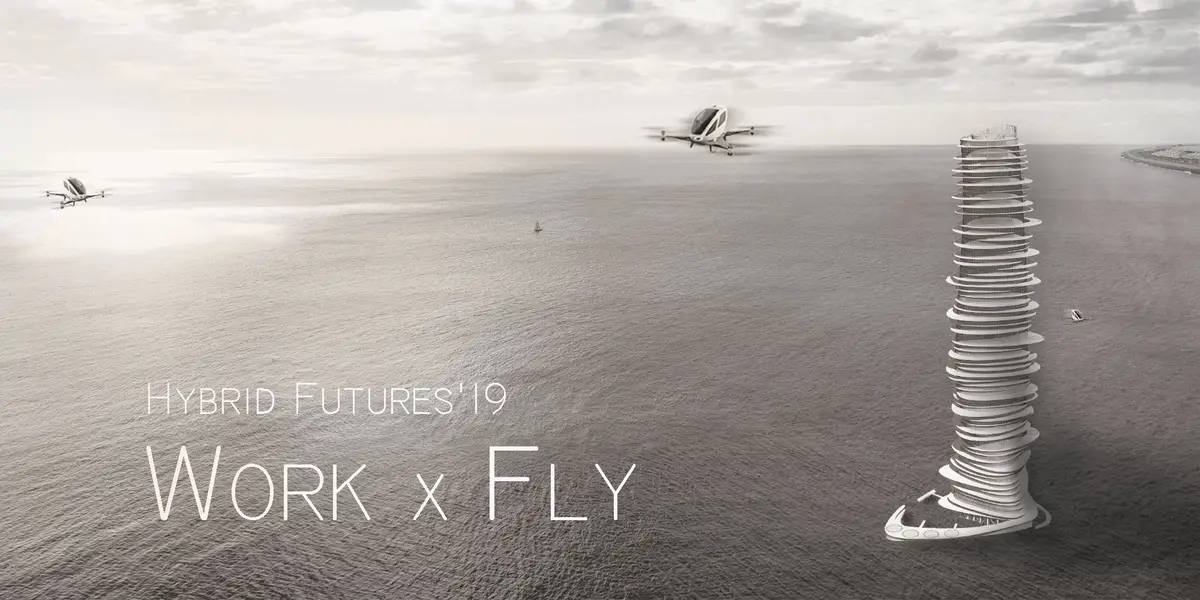
Work x Fly: A Skyscraper Designed Around Aerial Commutes and VTOL Drone Landings
Rotating floor plates, ocean-based foundations, and integrated drone parking reimagine the daily commute as a sky-to-desk experience.


What if the morning commute meant stepping onto a drone pad at the edge of a spiraling tower rising from the ocean? Work x Fly takes that premise literally, proposing a skyscraper whose rotating, stacked floor plates are engineered not just for office space but as landing bays for vertical take-off and landing (VTOL) vehicles. The building's form is its function: each articulated platform shifts and reconfigures to create drop-off points at multiple levels, turning the entire tower into a three-dimensional transit hub where aerial access replaces the lobby elevator ride.
Designed by Eliska Ilavska and UNI, Work x Fly was a shortlisted entry in the Hybrid Futures '19 - Work x Fly competition. The brief asked entrants to merge workplace architecture with emerging flight technologies. Ilavska and UNI responded with a tower sited in open water, raised on piles above the seabed, that treats the sky as its primary transportation corridor and the ocean as its foundation.
A Spiral of Floor Plates Above the Waterline
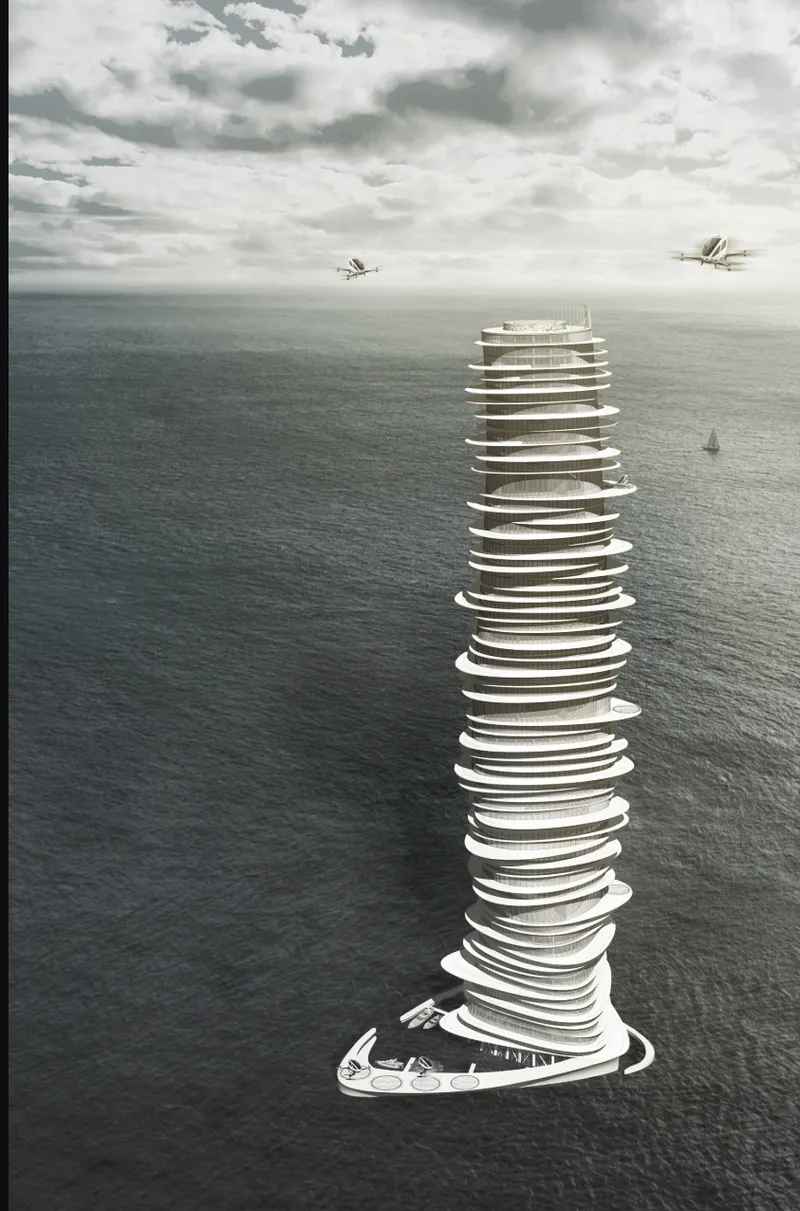
The aerial view reveals the tower's most striking gesture: a stack of extended floor plates that rotate as they climb, producing a spiraling silhouette against the open ocean. These are not decorative twists. Each rotation creates a cantilevered overhang that doubles as a landing zone for VTOL drones and personal air vehicles. The gaps between plates allow for clear approach vectors, so aircraft can dock at various elevations without circling the building or competing for a single rooftop pad. Planes overhead reinforce the project's central argument that future urban airspace will be as layered and active as a freeway interchange.
Vertical Circulation and Stacked Drone Parking
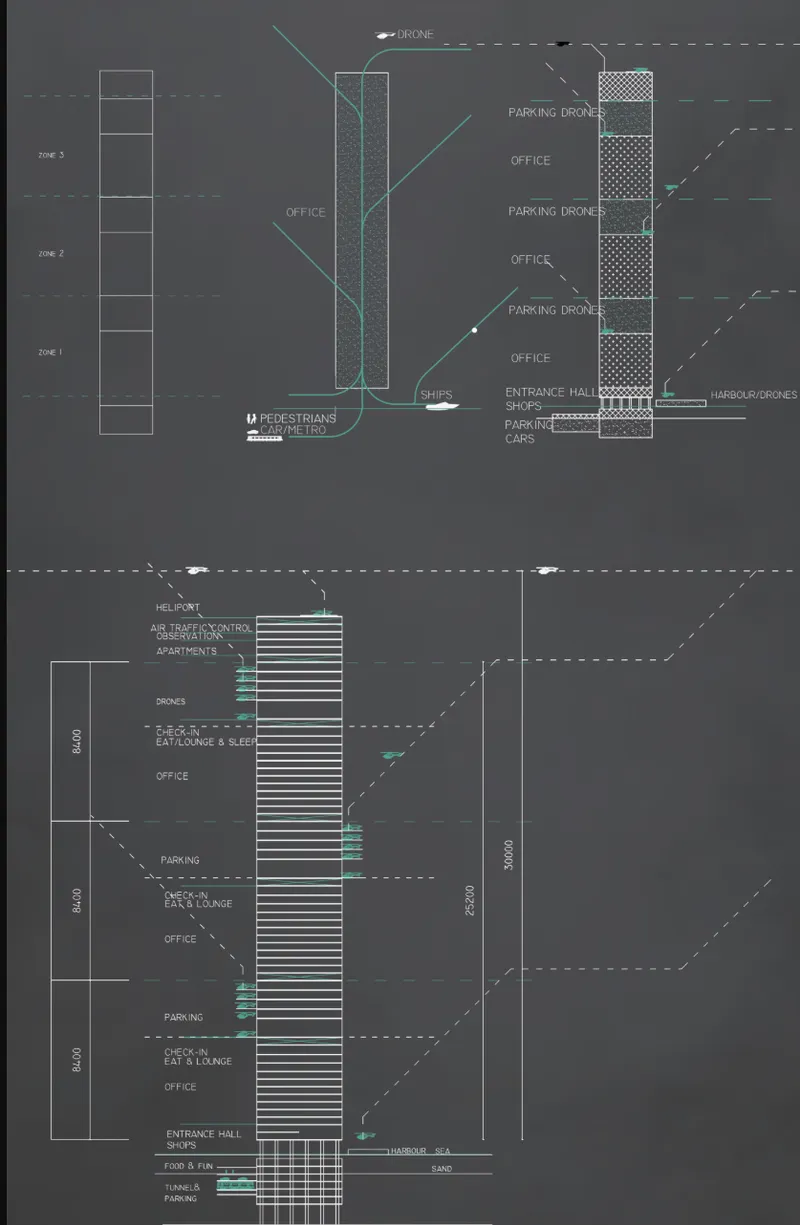
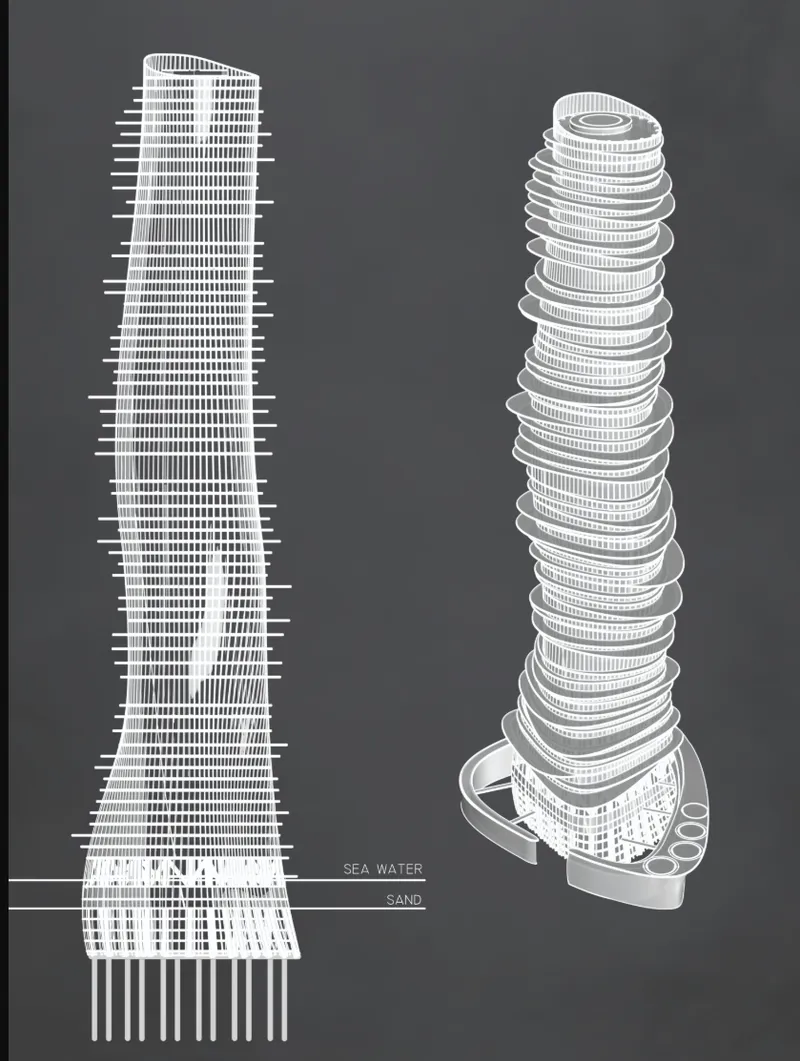
The section drawings cut through the tower to expose its organizational logic. A central vertical circulation core runs the full height, anchoring the rotating plates and distributing structural loads down to the pile foundations below. Flanking the core are stacked parking decks dedicated to drone storage, visible in the section as layered horizontal bands. These decks function like a conventional parking garage turned vertical, letting vehicles land on an exterior platform, taxi inward, and park within the building envelope. The result is a tower where transit infrastructure is embedded in the architecture rather than appended to it.
The axonometric drawing makes the ocean-based foundation explicit. The tower stands on piles driven into the seabed, elevating the lowest occupied floors above the waterline. Siting the project offshore is a deliberate provocation: it sidesteps ground-level congestion entirely and positions the building as a node in a network of aerial routes that connect city zones and suburbs directly to the workplace. The structural diagram also clarifies how lateral forces from wind and aircraft approach are transferred through the core and into the piled base.
Triangular Geometry and the Central Core in Plan
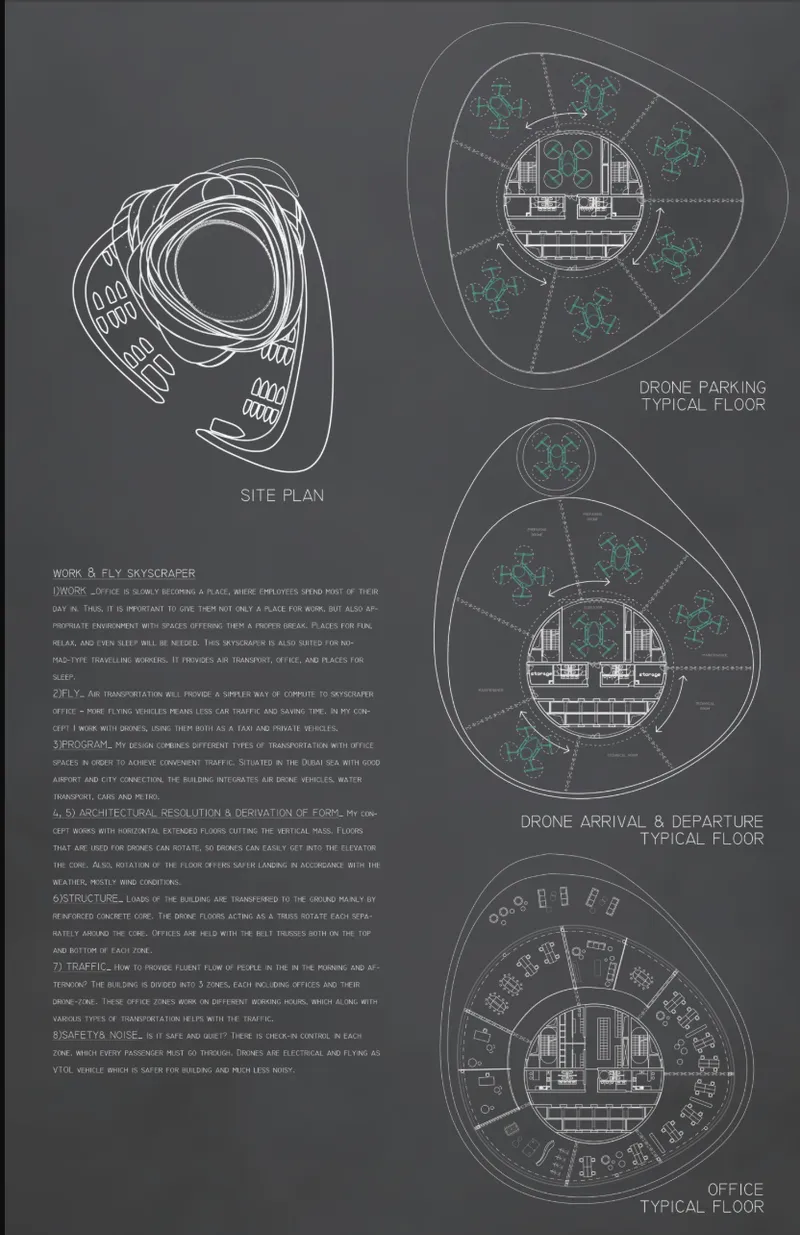
The plan drawings show that each floor plate follows a triangular perimeter, an efficient geometry for distributing loads from three directions and maximizing usable floor area around a compact central core. The core contains vertical circulation, services, and structural bracing, while the triangular wings extend outward to accommodate open-plan offices and, at their edges, drone parking arrangements. The plans indicate designated parking slots arrayed along the plate edges, confirming that every floor is simultaneously workspace and transit infrastructure. It is a compact diagram, but it encodes a radical proposition: every desk in the building is within walking distance of an air vehicle.
Why This Project Matters
Work x Fly does not treat VTOL integration as an afterthought bolted onto a conventional office tower. The entire building, from its pile foundations in the ocean to the rotating floor plates that serve as landing bays, is organized around the premise that aerial commuting will reshape how workplaces are sited, structured, and accessed. That commitment to letting the transportation concept drive the architectural form is what elevates the proposal beyond a speculative rendering.
For a competition entry by young designers, the project demonstrates a rigorous willingness to follow an idea to its spatial and structural conclusions. The triangular plan, the stacked drone decks, the offshore foundation: each decision traces back to the question of how a building should perform when its primary entrance is the sky. As urban air mobility moves from prototype to regulation, projects like Work x Fly offer a useful test case for what happens when architecture takes that future seriously at every scale, from the floor plan to the city.
View the Full Project
About the Designers
Designers: Eliska Ilavska, UNI
Enter a Design Competition on uni.xyz
uni.xyz runs architecture and design competitions year-round that reward proposals with spatial conviction and real site intelligence.
Project credits: Work x Fly by Eliska Ilavska, UNI Hybrid Futures '19 - Work x Fly (uni.xyz).


Popular Articles
Popular articles from the community


Singing Woman: An Opera House That Performs Before the Curtain Rises
Ovidiu Cristian Pavel's conceptual opera house translates Estonia's choral identity into a sculpted waterfront landmark facing the Baltic Sea.

Opera on the Sea: Driftwood Logic Shapes a Timber Opera House on Estonia's Coast
Trevor Orgill's opera house translates the entangled drift of floating timber into a civic building where wood, water, and music converge.


ETEH Reworks the Shared Spaces of São Domingos School in Brazil Around Timber, Color and Hanging Plants
At São Domingos School in Brazil, 436 m² of hall, refectory and library are recast with timber joinery, a yellow and blue code and trailing greenery.

FCC Arquitectura Expands a Portuguese Granite House with a Board-Marked Concrete Wing
In Portugal, JV House pairs a cleaned-up whitewashed and granite dwelling with a timber-shuttered concrete extension, courtyards and a garden pool.

Similar Reads
You might also enjoy these articles

Cube Design Draws an Ecological Corridor Between Two Shenzhen Hills with the Nankai Building
Beside Shenzhen's container docks, the Nankai Building pairs stacked balconies with a climbing green screen to connect two hillsides across its height.

Praksis A and Studio Sted Bend a Red Timber Cabin Across the Granite of Norway's Southern Coast
On the southern Norwegian coast, a 105 m² cabin follows the rock on slender posts, pairing red cladding outside with pine, brick and plywood within.

David Ortega Stacks a Two-Story Mexico City Penthouse Around a Steel Stair and a Pergola-Shaded Roof Terrace
In Colonia Roma, a 300 m² penthouse uses oak joinery, a planted steel stair and a slatted roof pergola to make a new-build apartment feel like a house.

PARALELA and LB2 Thread a Public Walkway Through the Base of a Las Condes Residential Tower
In Las Condes, Santiago, the Hamlet Building gives its fenceless ground floor to a 70-metre wooded passage linking two streets and the metro.

Explore Futuristic Workspaces Competitions
Discover active competitions in this discipline

Challenge to reimagine the Iron Throne

Photograph architecture without architects

Illustrate the lost glory of Angkor Wat - Render Challenge

Design challenge to reuse E-waste
Comments (0)
Please login or sign up to add comments
No comments yet. Be the first to comment!