
Guaju Pavilion: A Glass Bath in a Brazilian Forest
YVA Arquitetura placed a glass-and-steel bathing pavilion among the trees of a Buddhist retreat in southern Brazil, removing nothing and adding one room.


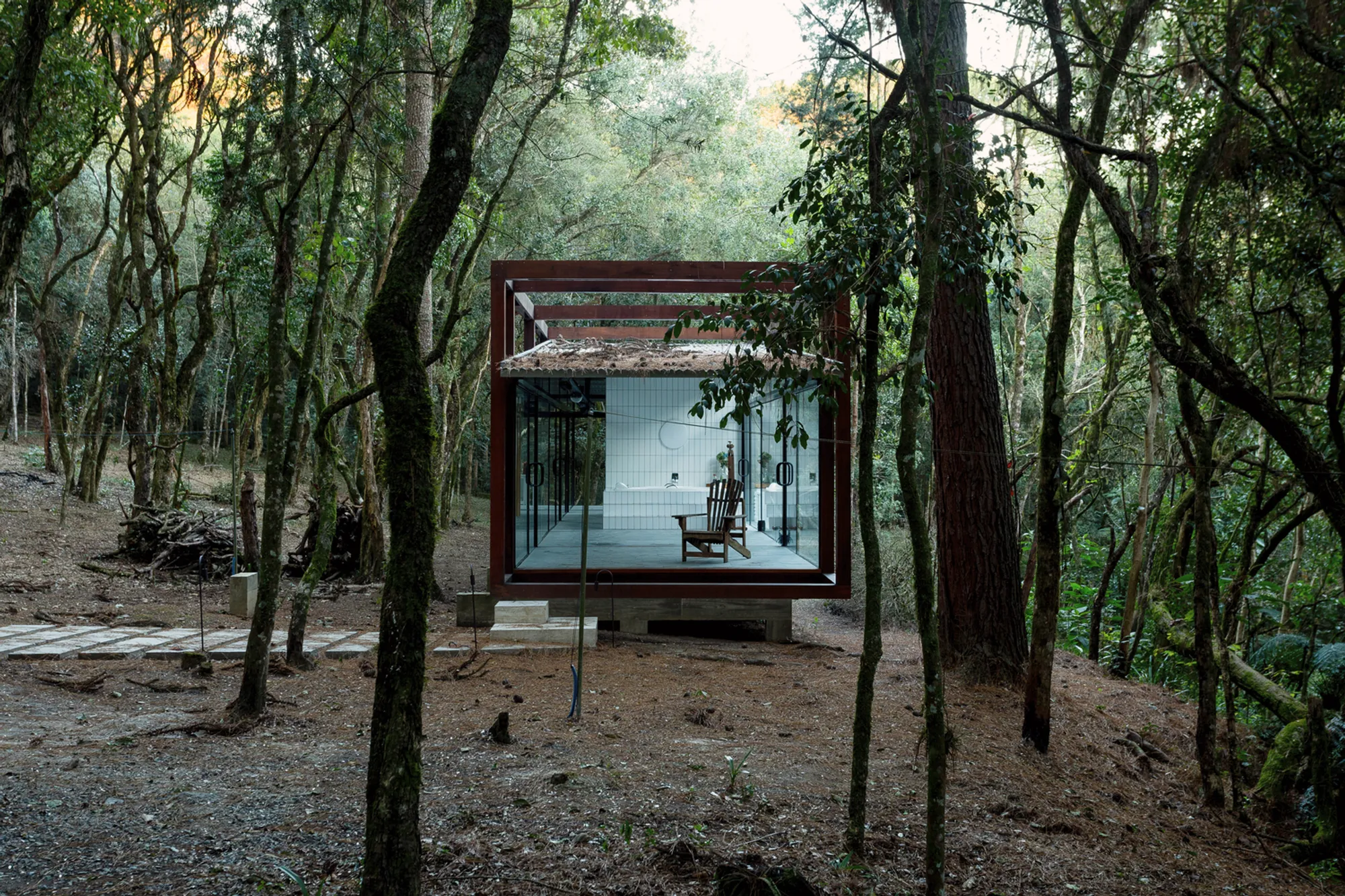
Guajuvira is a forested area in southern Brazil, dense with twisted native trees, moss-covered branches, and a canopy that filters the light into green. Guaju Pavilion, designed by YVA Arquitetura, is a glass box placed in a clearing among these trees. It is a meditation and bathing pavilion: one room with a soaking tub, a chair, and glass on all sides. The structure is a corten steel frame with a corrugated metal roof, lifted on concrete piers above the forest floor. No trees were removed. The building is smaller than the canopy gap it occupies.
The project is connected to a Buddhist retreat. The coloured prayer flags strung between the trees appear in several photographs. The programme is minimal: arrive, bathe, sit, look at the forest. The architecture serves that programme by being as transparent as possible. The walls are glass. The roof is metal. The frame is steel. The floor is stone. Everything else is the forest.
The Pavilion in the Forest
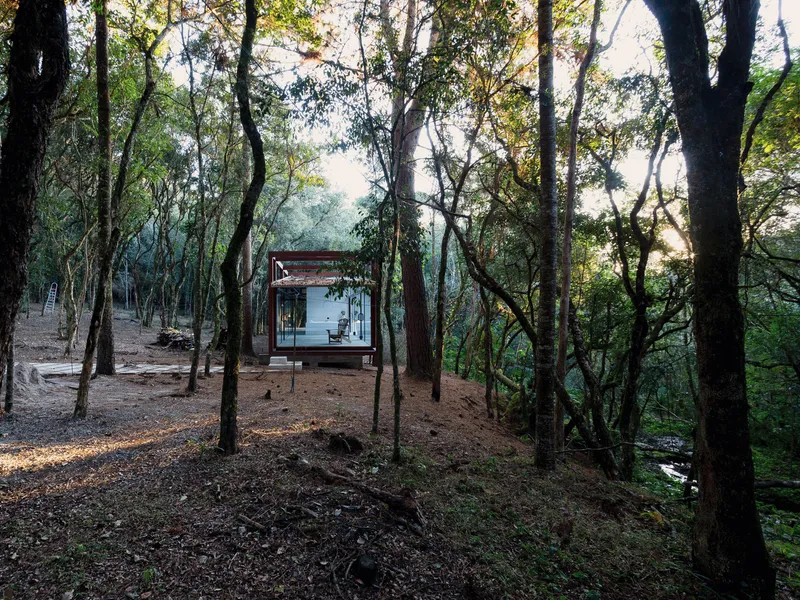
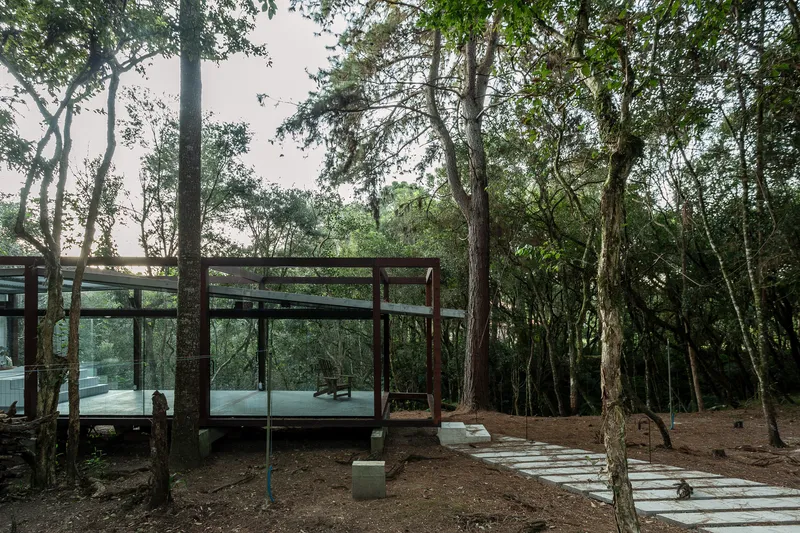
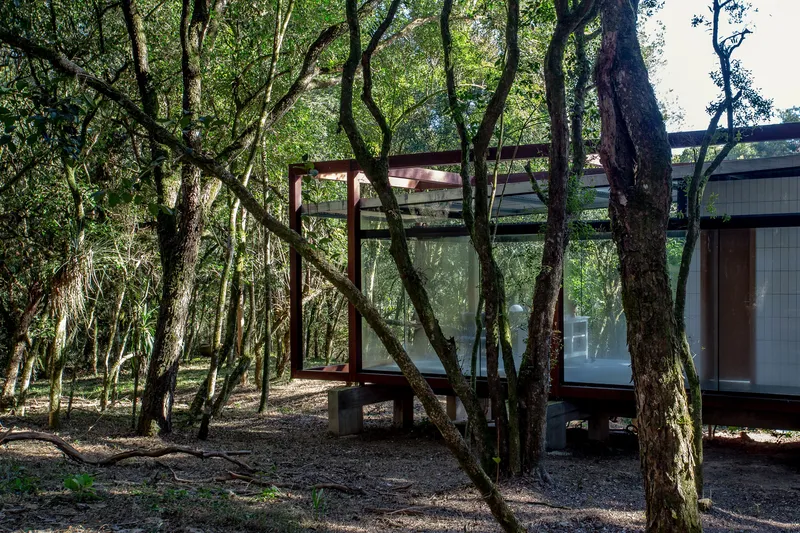
From a distance, the pavilion reads as a corten steel frame and a corrugated metal roof floating among the tree trunks. The glass walls are nearly invisible. The building does not compete with the forest; it defers to it. The twisted branches of the native trees press close to the glass on all sides. The stepping-stone path approaches through the leaf litter without a formal entry sequence. You walk through the forest and arrive at a glass room.
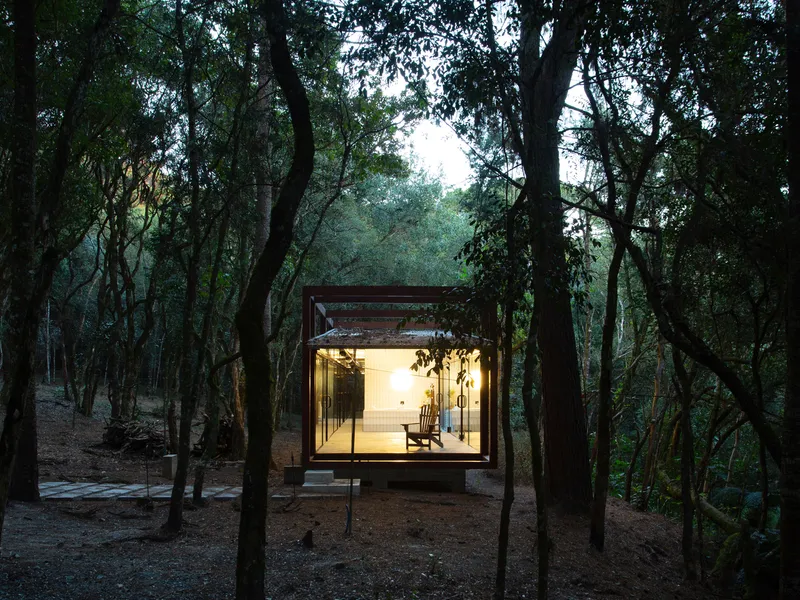
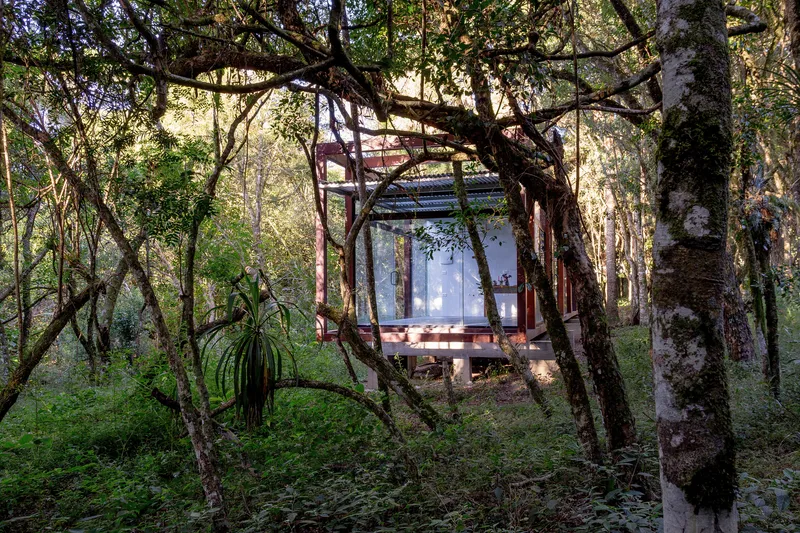
At dusk, the pavilion reverses. The glass walls become transparent from outside, and the warm interior light turns the building into a lantern in the dark forest. The timber chair, the tub, and the corrugated ceiling are all visible. The forest becomes the darkness around a single lit room.
The Steel Frame and the Roof
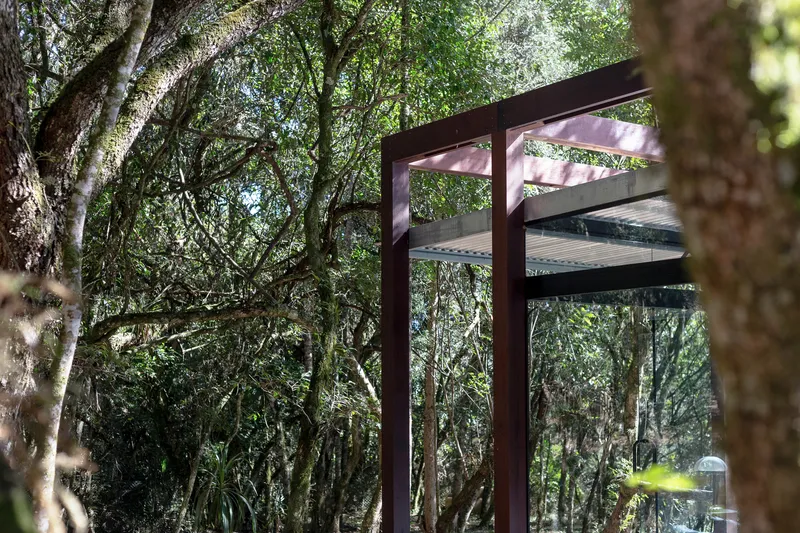
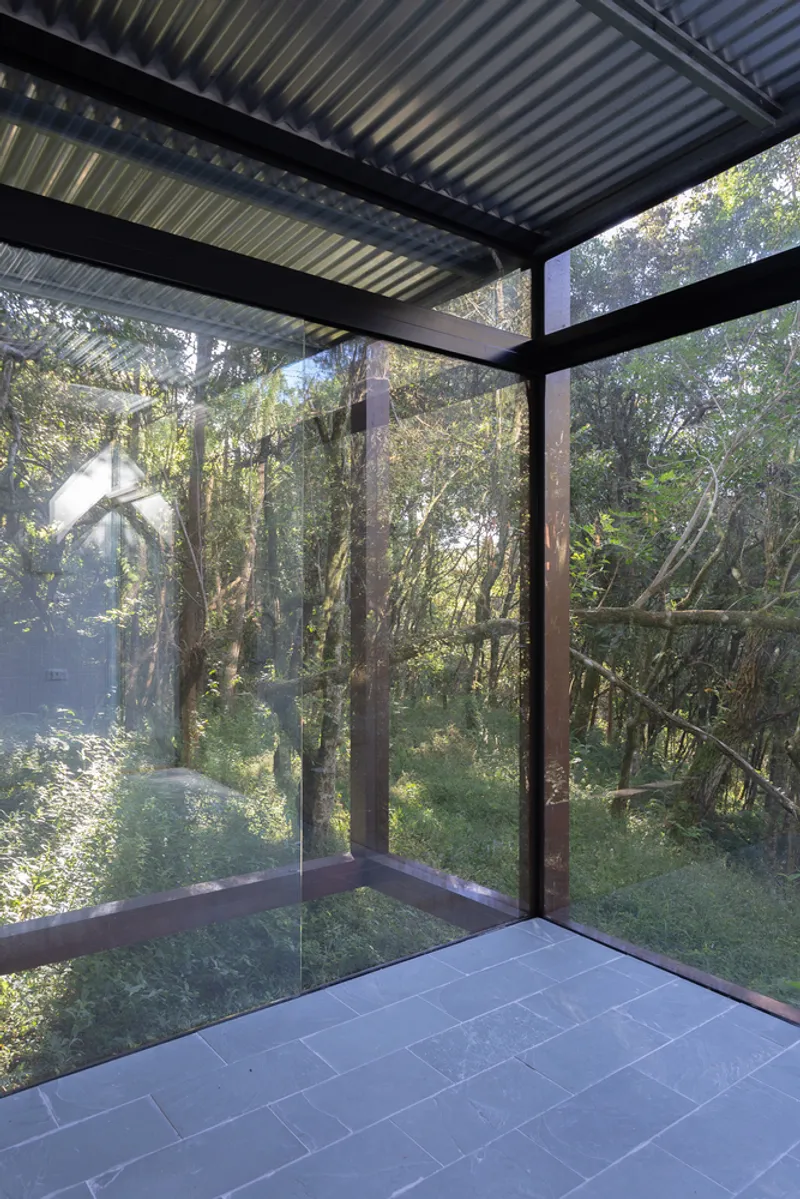
The structure is a simple portal frame in corten steel with a corrugated metal roof. The corten has weathered to a dark brown that matches the tree trunks. The corrugated metal is functional and cheap. The glass panels are floor-to-ceiling, frameless where possible, meeting at the corners without mullions. The detail is deliberately rough: this is not a polished glass pavilion. It is a shed in the forest, refined just enough to hold glass and water.
The Soaking Tub
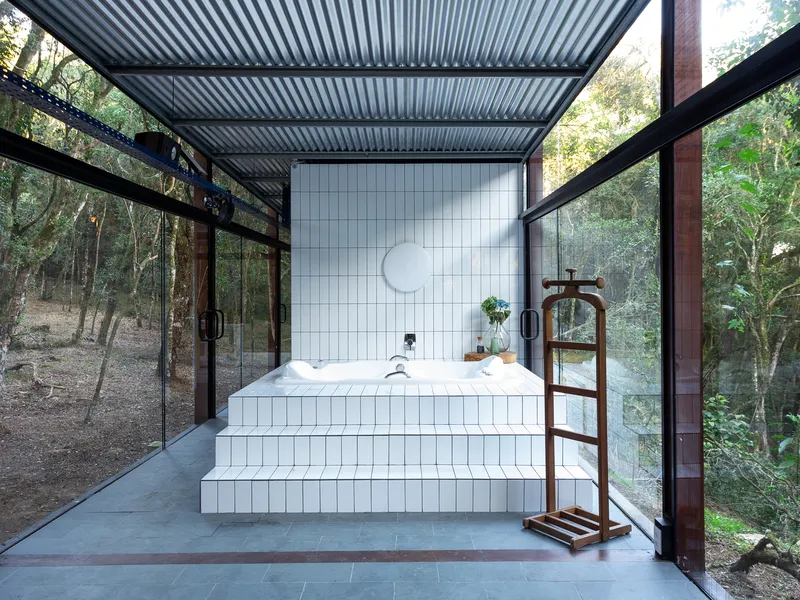
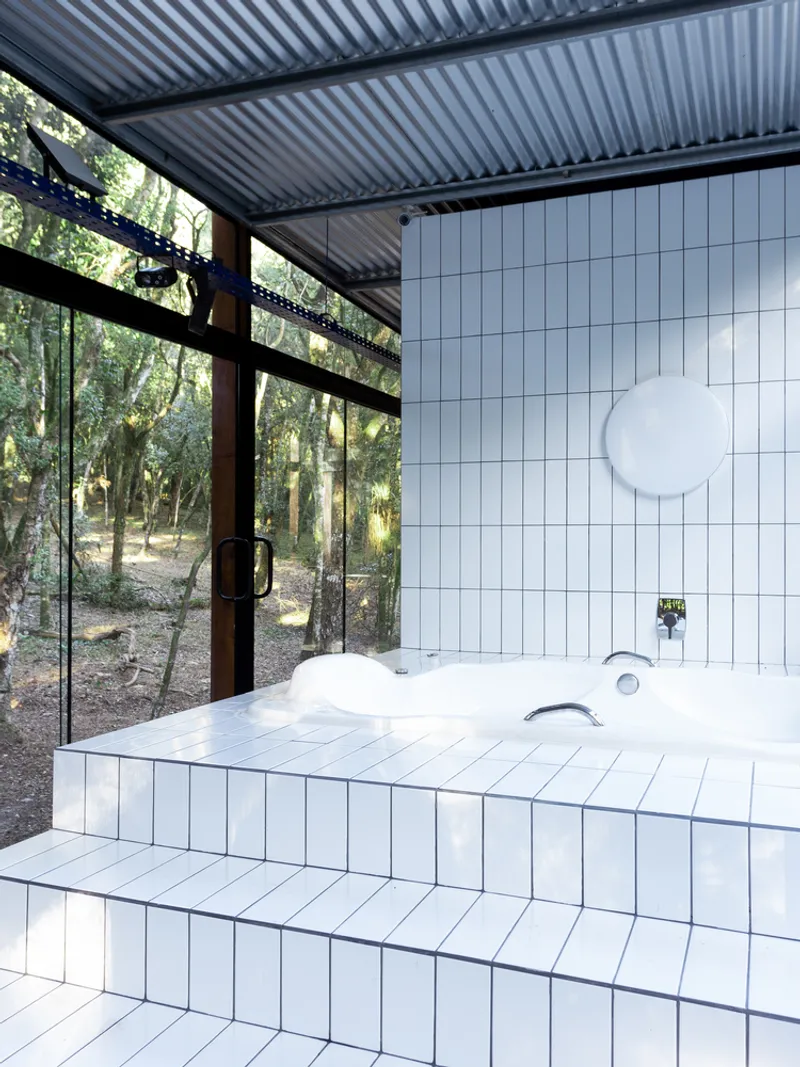
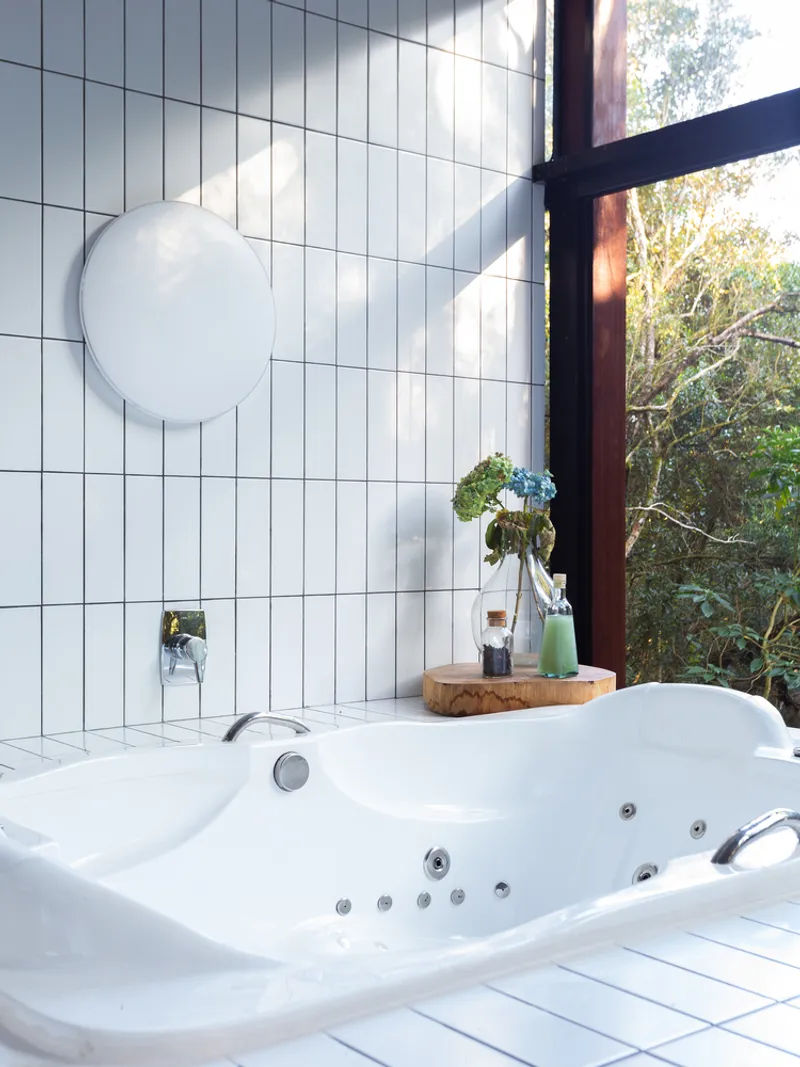
The soaking tub is the centrepiece: a white tile bath set under the corrugated ceiling with glass walls on two sides. You lie in the water and look at the forest. A round mirror on the tile wall, a timber bath tray, chrome fixtures: the details are simple and domestic. The contrast between the white tile interior and the dark green forest outside is the entire spatial experience. The tub is not luxury; it is a place to be still.
The Interior and the Entrance
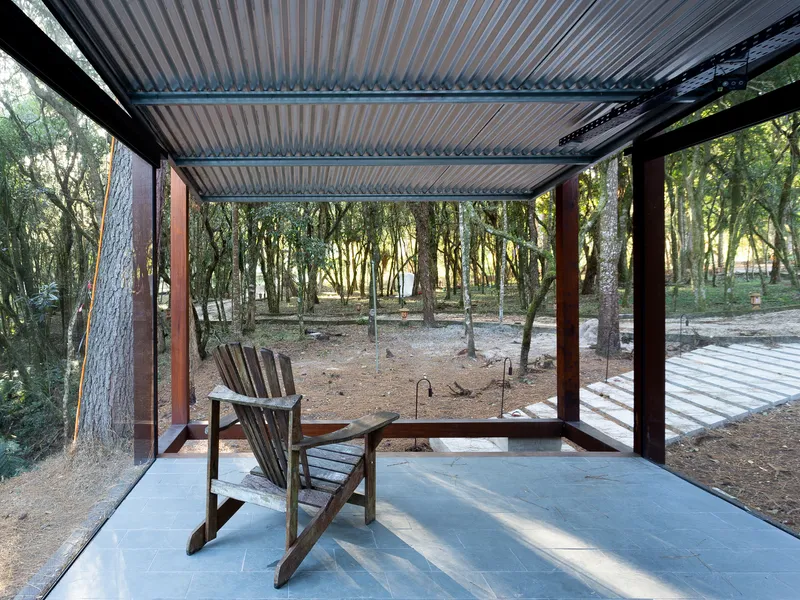
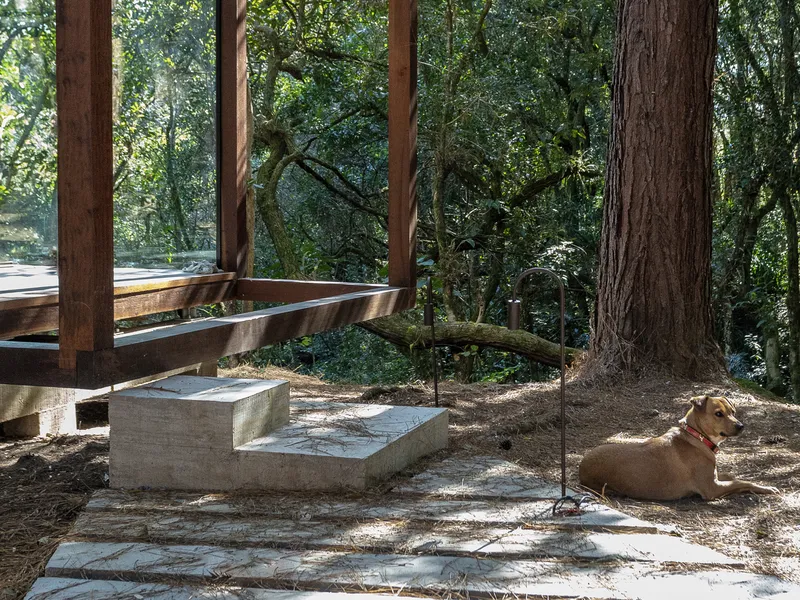
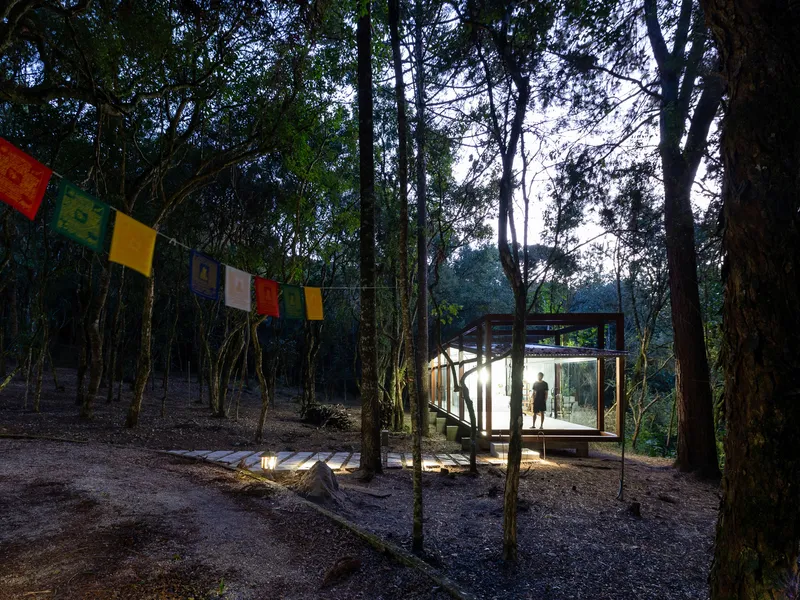
Inside, the pavilion has a stone floor, a timber Adirondack chair, and the tub. The corrugated metal ceiling is left exposed. The corten steel columns are visible at the corners. Concrete block steps lead up from the forest floor to the timber deck. Outside, coloured Buddhist prayer flags are strung between the trees, marking the clearing as a place of contemplation. A dog rests on the paving beside a large tree trunk. The atmosphere is quiet, informal, and grounded.
Site Plan
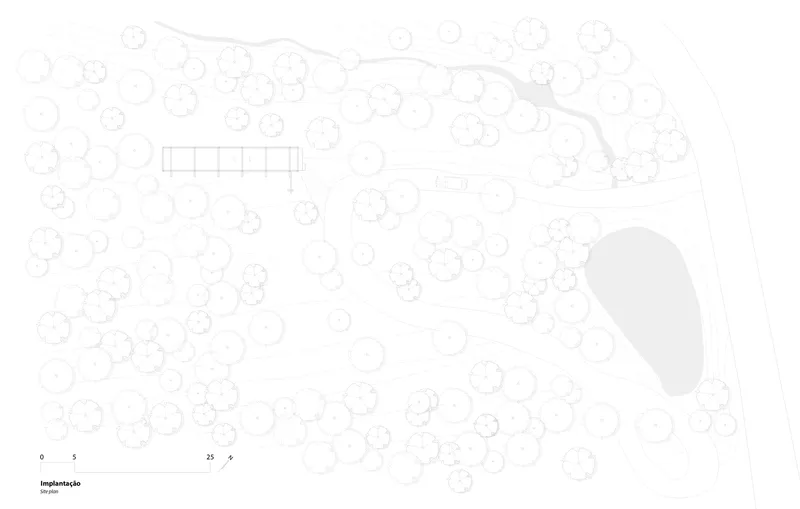
The site plan shows the pavilion as a tiny rectangular footprint among dozens of circles representing the existing trees. A stepping-stone path leads from the road. A pond sits at the lower corner of the site. The drawing makes the point clearly: the forest was preserved in its entirety, and the building was inserted into the smallest possible gap.
Why This Project Matters
Glass pavilions in the forest are a well-established typology, from Farnsworth to Lina Bo Bardi's Glass House. Guaju Pavilion belongs to this lineage but with a different programme: it is not a house but a bathing and meditation room. The scale is tiny. The budget is minimal. The materials are rough. And yet the spatial experience, lying in a white tile tub surrounded by glass and forest, is as powerful as anything a larger building could produce.
If you are designing a small retreat, a meditation pavilion, or any minimal structure in a natural setting, this project is worth studying for how it uses glass, steel, and a bathtub to produce an architecture of contemplation.
About the Studio
Share Your Own Work on uni.xyz
If you are working on retreat architecture, forest pavilions, or minimal structures, uni.xyz is a place to publish your work and connect with a global design community.
Project credits: Guaju Pavilion by YVA Arquitetura. Guajuvira, Brazil.




Popular Articles
Popular articles from the community


Conexión: Biophilic Design Reimagines High-Rise Living in Hong Kong
Conexión reimagines high-rise living in Hong Kong through biophilic design, green facades, shared spaces, daylight, water and nature within.

Lunar Spiral: Space Architecture Shaped by the Mathematics of the Universe
Lunar Spiral reimagines space architecture through Fibonacci geometry, lunar regolith, levitating habitats, and self-sustaining Moon living.

Co-Life: Senior Housing Design That Reconnects Older Adults With the City
Co-Life reimagines senior housing design through healing gardens, shared streets, workshops, and a sustainable community across generations.

The Earth Pod: 3D Printed Homes for Resilient Refugee Communities
The Earth Pod reimagines refugee housing through 3D printed homes made from clay, combining resilience, self-sufficiency, and rapid shelter.

Similar Reads
You might also enjoy these articles


Hodi-Mandai Geram
Project Function: Preservation and revitalization of the Intangible heritage and socio-spatial identity of the Hodi by Housing, Cultural Memory Center, Sacred Grove, landscape, local tourism economy


Olio Towers: A Mid-Rise for Performers That Fuses Housing, Rehearsal, and Stage
Located blocks from Houston's Theater District, this modular tower stacks living units around a central performance atrium.

Oasis: Modular Green Housing Carved into Dhaka's Urban Fabric
A shortlisted Plugin Housing entry reclaims unauthorized settlements in Dhaka with stepped concrete volumes, green roofs, and ventilation-driven design.

Black Hole: A Floating Megastructure for the Post-Physical Era
Emiliano Mazzarotto envisions a spherical, self-scaling arena where e-sports, digital hotels, and holographic stadiums replace traditional public space.

Explore Architecture Competitions
Discover active competitions in this discipline



Challenge to reimagine the Iron Throne


Photograph architecture without architects


Illustrate the lost glory of Angkor Wat - Render Challenge


Design challenge to reuse E-waste
Comments (0)
Please login or sign up to add comments
No comments yet. Be the first to comment!